From Real Exams Quiz
A Level H2 Biology Human Physiology Quiz
Free A Level H2 Biology Human Physiology quiz, HY3 Exam version, with questions, answers, and A Level-style practice for Singapore students.
These static practice materials are generated from the site's syllabus and paper-generation workflow, with source and model context shown so students and parents can evaluate the material before use.
Questions
Free quiz and exam paper access
Enter your details to view this paper
Your access is remembered on this device.
Answers
A-Level Biology H2 Quiz - Human Physiology (Answer Key)
Topic: Human Physiology
Total Marks: 40
Section A: Short Structured Questions
1. [1 mark]
Answer: Capillaries have a single-cell-thick endothelium (or are very thin-walled / have pores/fenestrations).
Teaching note: The thin wall (one cell thick) provides a short diffusion distance for substances to exchange with tissues.
Common mistake: Stating “large surface area” alone without the structural feature.
2. [1 mark]
Answer: Left atrium.
Teaching note: Oxygenated blood from lungs returns via pulmonary veins into the left atrium.
3. [2 marks]
Answer: Insulin; promotes uptake of glucose by liver (and muscle/adipose) and conversion to glycogen (or inhibits glycogenolysis). [1 for hormone, 1 for effect]
Alternative: Glucagon; stimulates glycogenolysis and gluconeogenesis in liver.
Teaching note: Blood glucose is regulated by pancreatic hormones; insulin lowers, glucagon raises.
4. [2 marks]
Answer: The SA node is the natural pacemaker; it generates electrical impulses (action potentials) that spread across the atria causing atrial contraction. [2]
Marking: 1 for “pacemaker/ generates impulses”, 1 for “causes atrial contraction / sets rhythm”.
5. [1 mark]
Answer: 13.0 – 5.3 = 7.7 kPa.
Teaching note: Diffusion is driven by partial pressure gradient; subtract venous from alveolar value.
6. [1 mark]
Answer: Efferent arteriole.
Teaching note: Blood leaves glomerulus via efferent arteriole (note: not vein).
7. [1 mark]
Answer: Osmosis.
Teaching note: ADH increases aquaporins; water moves by osmosis from filtrate to hypertonic medulla.
8. [2 marks]
Answer: Left ventricle pumps blood to the whole body (systemic circulation) at higher pressure; right ventricle pumps only to lungs (pulmonary, lower resistance). [2]
Marking: 1 for systemic vs pulmonary, 1 for pressure/resistance difference.
Section B: Data and Diagram Interpretation
9. [2 marks]
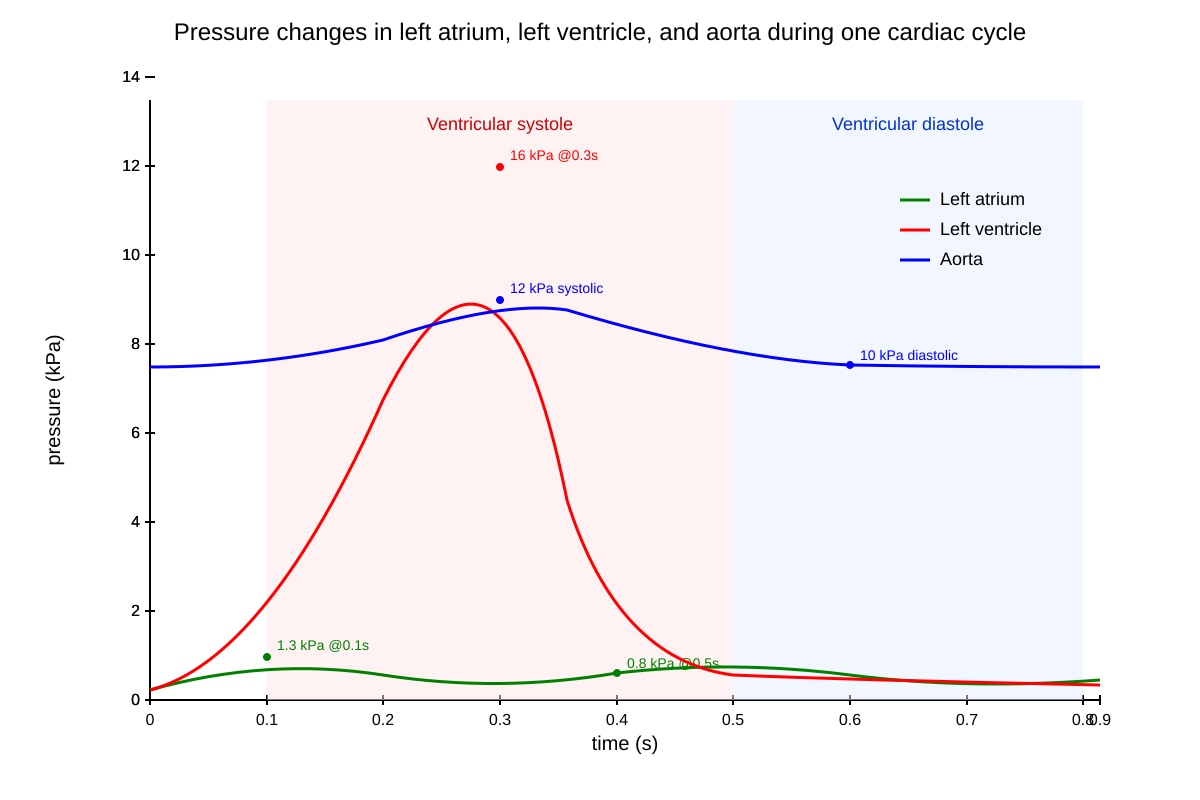
Answer: Aortic valve open during ventricular systole (~0.2–0.4 s) when left ventricular pressure exceeds aortic pressure. [1 for phase, 1 for explanation]
Teaching note: From graph, ventricle pressure rises above aorta (~16 > 12 kPa), pushing valve open.
10. [2 marks]
Working: Increase = (132 – 68) / 68 × 100 = 64 / 68 × 100 = 94.1%
Answer: 94% (or 94.1%).
Marking: 1 for correct subtraction, 1 for percentage calculation.
11. [3 marks]
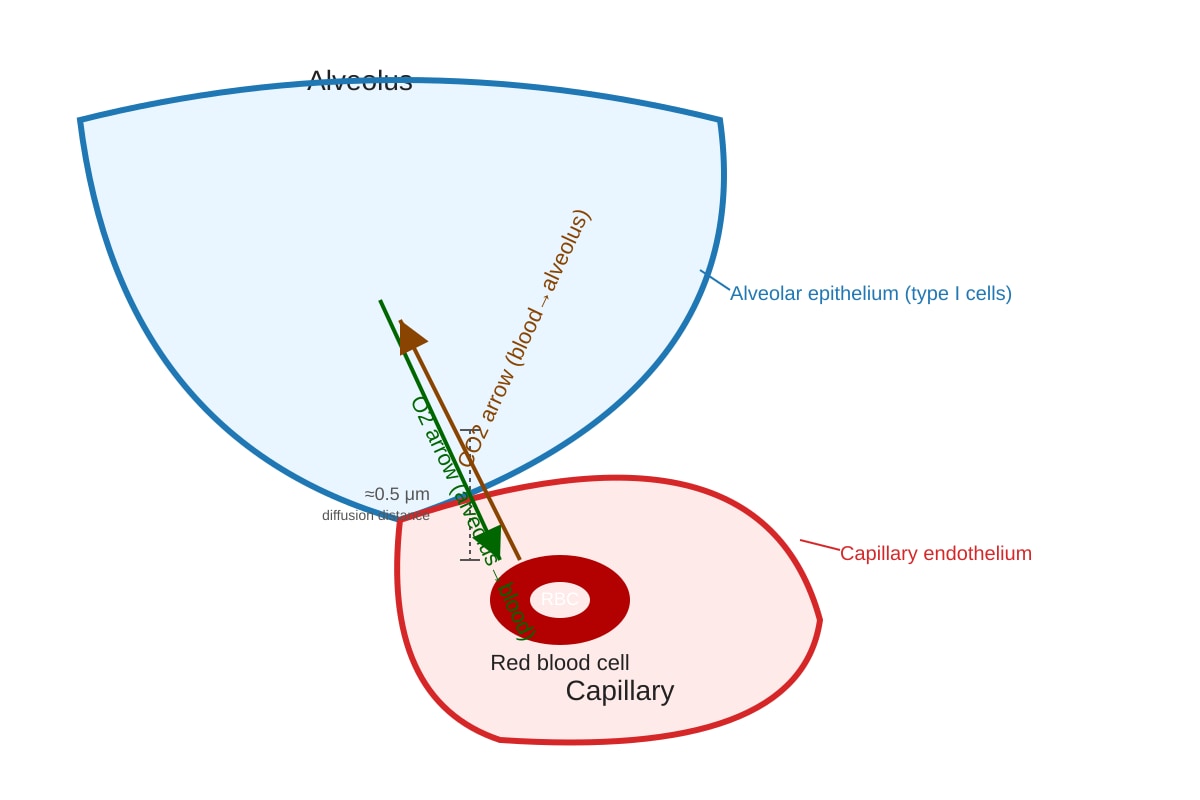
Answer: Wall is one cell thick (type I pneumocyte + endothelium) → short diffusion distance [1]; dense capillary network maintains gradient [1]; large surface area of alveolus [1].
Teaching note: Structure minimises distance and maximises area for Fick’s law.
12. [2 marks]
Answer: Proteins are too large to pass through filtration slits / basement membrane of glomerulus [1]; only small molecules filtered [1].
Marking: 1 size, 1 membrane barrier.
13. [2 marks]
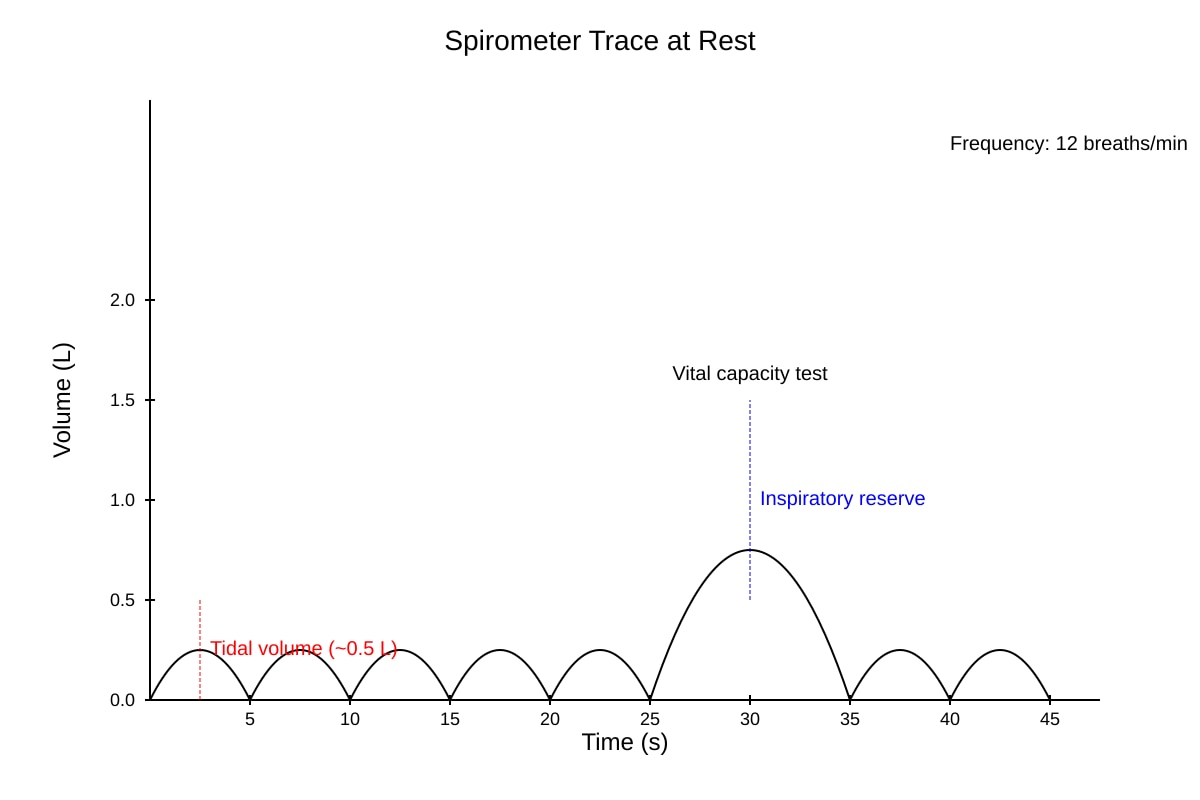
Answer: Tidal volume = 0.5 L [1]; Assumption: no gas exchange occurs in spirometer / person breathes normally without leak [1].
Teaching note: Tidal volume is volume per normal breath from trace amplitude.
14. [2 marks]
Working: Cardiac output = stroke volume × heart rate
20.0 L min⁻¹ = 0.100 L × HR → HR = 20.0 / 0.100 = 200 beats min⁻¹
Answer: 200 beats per min.
Marking: 1 for conversion (100 mL = 0.1 L) and formula, 1 for answer.
Section C: Applied and Extended Response
15. [4 marks]
Answer:
- SA node in right atrium spontaneously depolarises due to leaky Na⁺ channels / funny current. [1]
- Impulse spreads via gap junctions across atrial walls → atrial systole. [1]
- Reaches AV node, delayed, then via Bundle of His and Purkinje fibres. [1]
- Ventricular myocardium depolarises from apex up → ventricular contraction. [1]
Teaching note: Electrical sequence ensures atrial then ventricular contraction.
16. [4 marks]
Answer:
- Ascending limb actively transports Na⁺, Cl⁻ out (impermeable to water) → medullary interstitium hypertonic. [1]
- Descending limb permeable to water, not solutes → water leaves by osmosis. [1]
- Flow opposite directions (countercurrent) multiplies gradient. [1]
- Collecting duct under ADH reabsorbs water into hypertonic medulla → concentrated urine. [1]
17. [4 marks]
Answer:
- Likely respiratory acidosis due to hypoventilation / COPD retaining CO₂. [1]
- CO₂ + H₂O ⇌ H₂CO₃ ⇌ H⁺ + HCO₃⁻; high pCO₂ shifts right → more H⁺ → lower pH. [1]
- Normal regulation: chemoreceptors detect pH/CO₂, increase ventilation to blow off CO₂. [1]
- Kidney can also excrete H⁺ and reabsorb HCO₃⁻ (slower). [1]
18. [4 marks]
Answer:
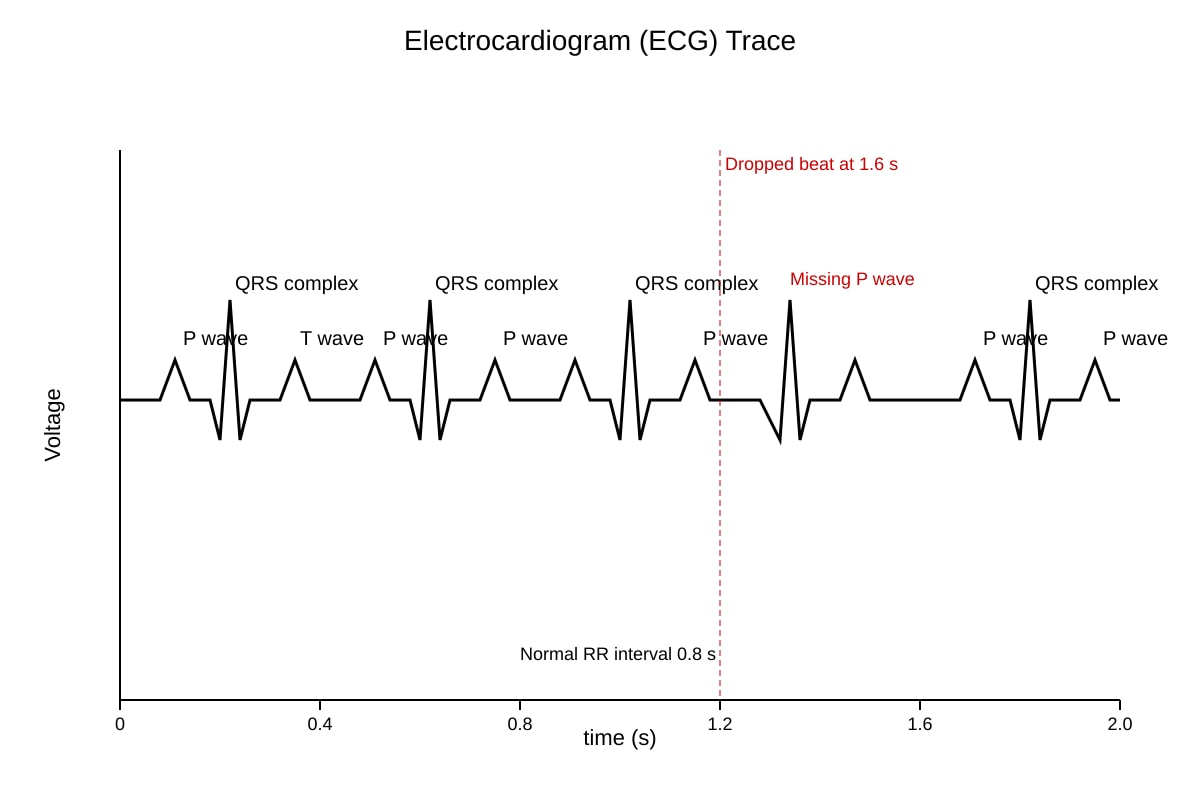
- Abnormality: dropped P wave / irregular beat at 1.6 s suggesting AV block or ectopic focus. [1]
- ECG P = atrial depolarisation, QRS = ventricular depolarisation, T = repolarisation. [2]
- Missing P indicates impulse did not originate in SA node or blocked at AV. [1]
19. [4 marks]
Answer:
- O₂: bound to haemoglobin in RBC (98%), small dissolved; loaded in lungs high pO₂. [2]
- CO₂: mostly as HCO₃⁻ in plasma, some carbamino-haemoglobin, dissolved; unloaded in lungs. [2]
- Contrast: O₂ mainly protein-bound, CO₂ chemically converted / buffered.
20. [4 marks]
Answer:
- Na⁺/K⁺ ATPase maintains low intracellular Na⁺. [1]
- Glucose reabsorption uses SGLT (Na⁺-glucose cotransport) driven by Na⁺ gradient. [1]
- Inhibiting pump collapses gradient → less glucose reabsorption (glycosuria). [1]
- Water follows solutes osmotically → less water reabsorption. [1]