From Real Exams Quiz
A Level H2 Biology Genetics Inheritance Quiz
Free A Level H2 Biology Genetics Inheritance quiz, HY3 Exam version, with questions, answers, and A Level-style practice for Singapore students.
These static practice materials are generated from the site's syllabus and paper-generation workflow, with source and model context shown so students and parents can evaluate the material before use.
Questions
Free quiz and exam paper access
Enter your details to view this paper
Your access is remembered on this device.
Answers
A-Level Biology H2 Quiz - Genetics Inheritance: Answer Key
Total Marks: 40
Topic: Genetics & Inheritance (Syllabus 9477 Core Idea 2)
Section A Answers (1–8)
1. [2 marks]
- Semi-conservative replication: each new DNA molecule contains one original (parent) strand and one newly synthesised strand. [1]
- Enzyme: DNA polymerase (specifically DNA pol III in prokaryotes; DNA pol δ/ε in eukaryotes). [1]
Teaching note: Meselson–Stahl proved this model. The original strand serves as template.
2. [2 marks]
- Gene mutation: change in nucleotide sequence of a single gene (e.g., substitution causing sickle cell anaemia: A→T in β-globin). [1]
- Chromosomal aberration: change in structure or number of whole chromosomes (e.g., trisomy 21 / Down syndrome). [1]
Common mistake: calling aneuploidy a gene mutation.
3. [2 marks]
- Crossing-over exchanges segments between non-sister chromatids of homologous chromosomes. [1]
- Produces new allele combinations (recombinants) not present in parents, increasing genetic diversity. [1]
4. [2 marks]
- Codominance: both alleles expressed simultaneously in heterozygote. [1]
- Example: ABO blood group IᴬIᴮ gives AB phenotype. [1]
5. [2 marks]
- Reverse transcriptase converts viral RNA genome into DNA. [1]
- This DNA integrates into host genome (provirus). [1]
6. [2 marks]
- Introns are non-coding sequences within genes. [1]
- Removed by splicing during pre-mRNA processing. [1]
7. [2 marks] Any two:
- Bacterial DNA is circular, eukaryotic is linear. [1]
- Bacteria lack introns; eukaryotes have introns. [1]
(Also: bacteria have no histone-bound chromatin; eukaryotes do.)
8. [2 marks]
- Reveals unknown genotype by phenotype of offspring. [1]
- If any recessive phenotype appears, unknown is heterozygous; if all dominant, unknown is homozygous dominant. [1]
Section B Answers (9–14)
9. [4 marks]
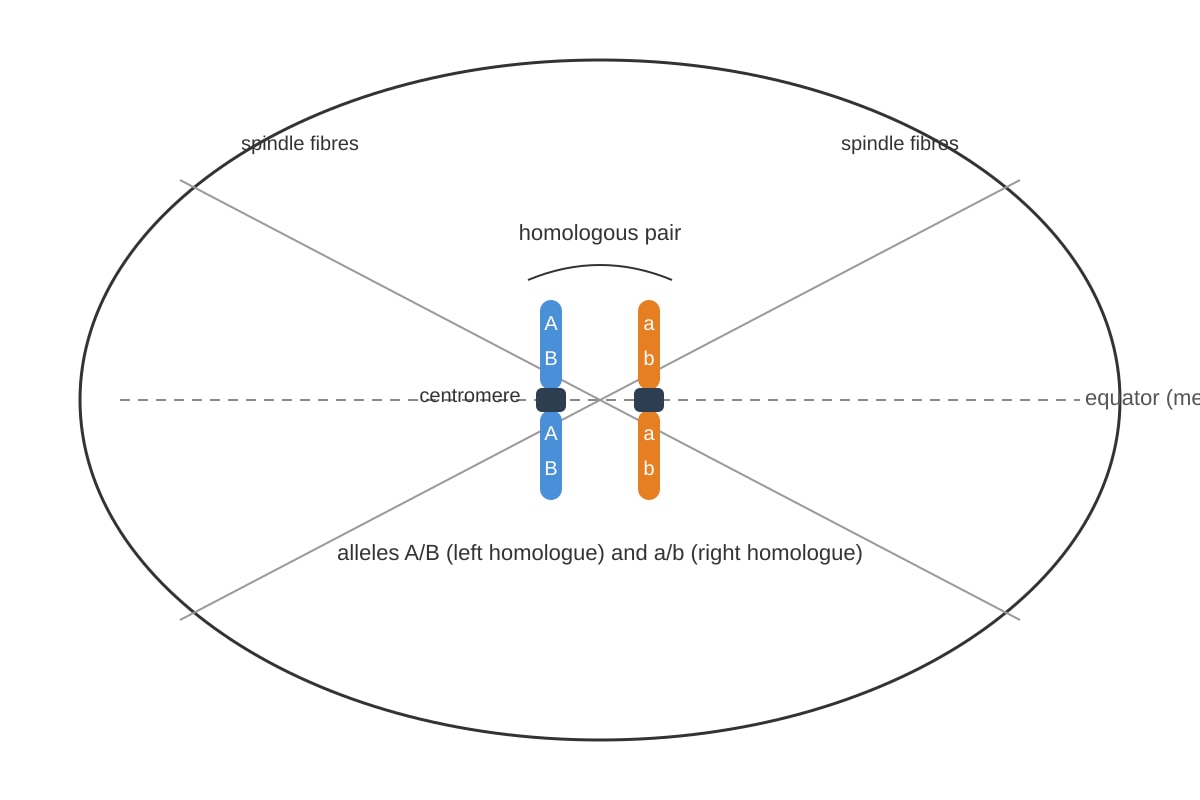
- Arrangement: homologous pair aligned at metaphase plate, each with two sister chromatids. [1]
- Independent assortment: orientation of each homologous pair is random relative to others. [1]
- This produces 2ⁿ possible gamete combinations (n = haploid number). [1]
- With crossing-over, further variation. [1]
From figure: alleles A/B on one homologue, a/b on other; random poleward movement yields AB, ab, Ab, aB gametes.
10. [3 marks]
- I: HbA HbA (homozygous normal) [1]
- II: HbA HbS (heterozygous carrier) [1]
- III: HbS HbS (homozygous sickle) [1]
- IV: HbA HbS (heterozygous) [0 if all four correct; mark split 1 each]
11. [3 marks]
- Total = 547 + 193 = 740. [1]
- Expected round = 740 × 3/4 = 555. [1]
- Expected wrinkled = 740 × 1/4 = 185. [1]
- Observed (547, 193) close to expected → chi-squared unlikely significant. (No test calc required.)
12. [4 marks] (allocated as 2 + 2 in quiz; total 4)
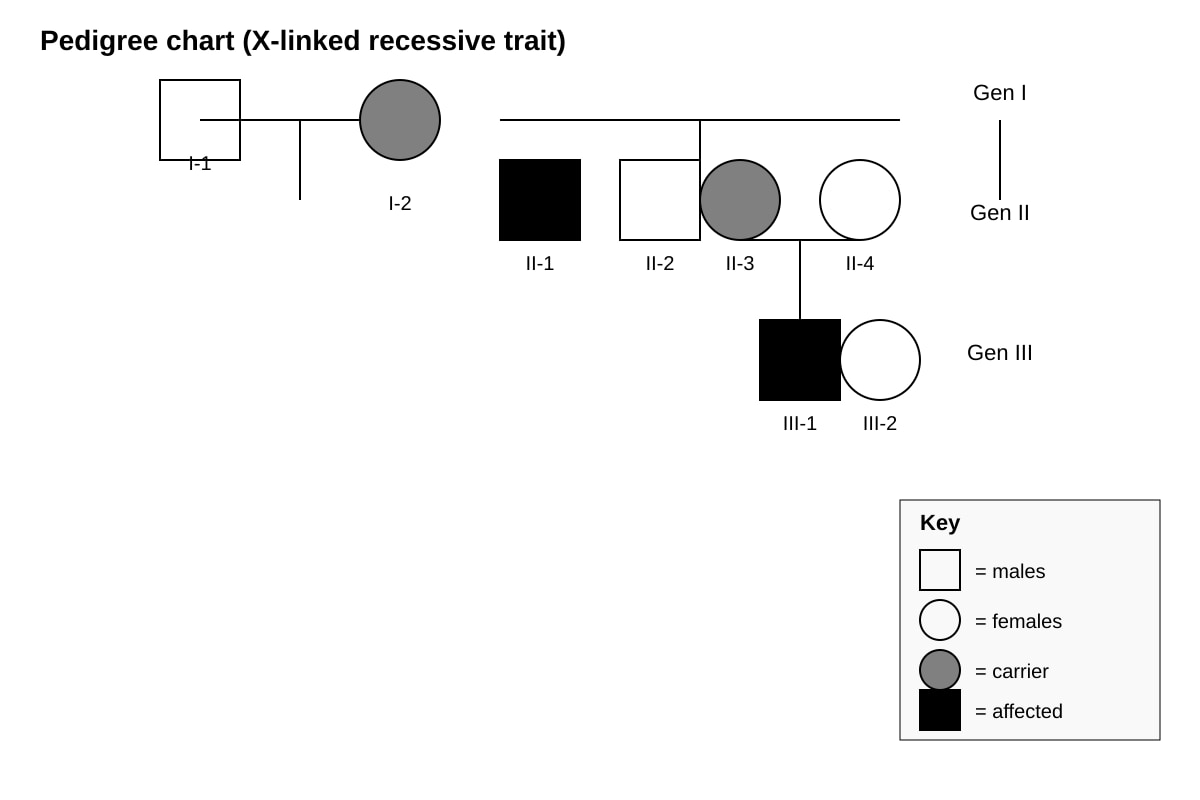
- Gen I female: XᴴXʰ (carrier). [2]
- Gen III female: mother is carrier (XᴴXʰ) × father unaffected (XᴴY). Daughter gets Xᴴ from father; from mother Xᴴ or Xʰ with equal chance → probability carrier = 1/2. [2]
13. [3 marks]
- Conjugation: pilus forms between donor (F⁺) and recipient (F⁻); plasmid DNA transferred single-stranded, replicated. [2]
- Not asexual because it is horizontal gene transfer between cells, not cell division. [1]
14. [3 marks]
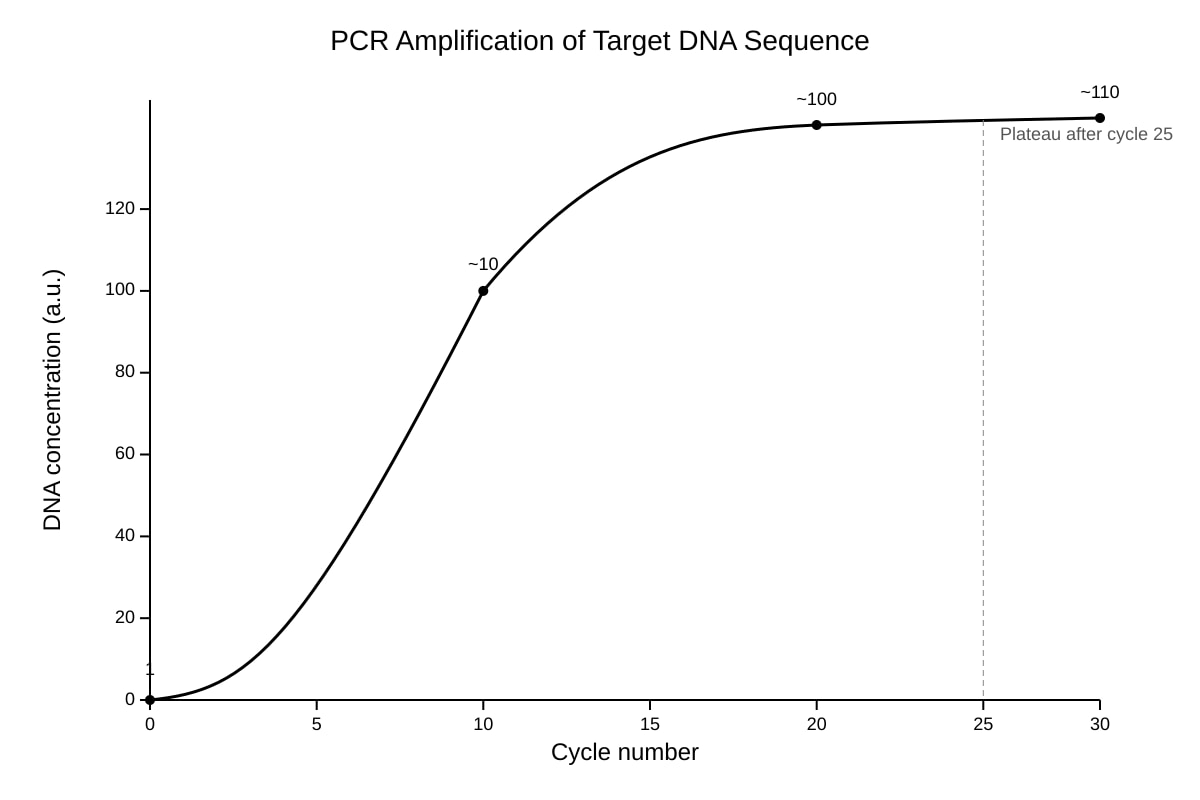
- Trend: exponential increase to ~cycle 20, then plateau. [1]
- Plateau: reagents (dNTPs, primers) depleted or enzyme inactive. [1]
- Also product reannealing competes with template. [1]
Section C Answers (15–20)
15. [3 marks]
- Expected ratio: 1:1:1:1. [1]
- Phenotypes: normal wing grey, normal wing black, vestigial grey, vestigial black. [2 total, 0.5 each]
16. [4 marks]
(a) Rr × Rr → gametes R, r. Offspring: RR, Rr, Rr, rr. [2]
(b) Phenotypic ratio: 1 red : 2 pink : 1 white. [1]
(c) Incomplete dominance shows heterozygote intermediate, not masked; violates Mendel's dominant/recessive. [1]
17. [4 marks]
(a) Man: Aa (father aa → must carry a). Woman: Aa (mother aa). [1]
(b) Cross Aa × Aa: AA, Aa, Aa, aa. Probability albino (aa) = 1/4. [3: 1 for diagram, 2 for ratio]
18. [3 marks]
- q = 0.04, p = 1 – 0.04 = 0.96. [1]
- 2pq = 2 × 0.96 × 0.04 = 0.0768. [1]
- Carrier frequency = 0.0768 (7.68%). [1]
19. [3 marks]
- Epistasis: one gene masks another (e.g., coat colour in Labrador: B/b pigment, E/e extension; ee masks B). [2]
- Linkage: genes on same chromosome inherited together, not independent. [1]
20. [4 marks]
- DNA cut by restriction enzymes, loaded into gel, electric field separates by size (smaller faster). [2]
- Bands visualised by stain/probe. [1]
- Limitation: close relatives share many fragments → low discrimination. [1]