From Real Exams Quiz
A Level H2 Biology Evolution Diversity Quiz
Free A Level H2 Biology Evolution Diversity quiz, LongCat Exam version, with questions, answers, and A Level-style practice for Singapore students.
These static practice materials are generated from the site's syllabus and paper-generation workflow, with source and model context shown so students and parents can evaluate the material before use.
Questions
Free quiz and exam paper access
Enter your details to view this paper
Your access is remembered on this device.
Answers
A-Level Biology H2 Quiz - Evolution Diversity
Answer Key
Question 1 [2 marks]
Answer:
A gene pool is the total sum of all the alleles (or all the genes) present in all individuals of a population at a given time.
Marking notes:
- 1 mark for "total alleles/genes in a population"
- 1 mark for specifying "all individuals" or "at a given time" (i.e., the collective nature of the pool)
- Accept equivalent phrasing such as "the complete set of genetic information in a breeding population."
Common mistakes:
- Confusing gene pool with genome (genome refers to all the genes in one individual).
- Omitting the population-level context.
Question 2 [2 marks]
Answer:
Allopatric speciation occurs when populations are separated by a geographical barrier, preventing gene flow between them. Sympatric speciation occurs within the same geographical area, without physical separation, often driven by ecological, behavioural, or genetic mechanisms (e.g., polyploidy or habitat differentiation).
Key difference: Allopatric speciation requires geographical isolation; sympatric speciation does not.
Marking notes:
- 1 mark for correctly describing allopatric speciation (must mention geographical barrier/isolation).
- 1 mark for correctly describing sympatric speciation (must state no geographical barrier, or occur in same area).
- Award full marks if the distinction is clearly made even without full definitions.
Question 3 [2 marks]
Answer (any two of the following):
(a) No mutations
(b) Random mating (no sexual selection)
(c) No natural selection
(d) Very large population size (no genetic drift)
(e) No gene flow (no migration into or out of the population)
Marking notes:
- 1 mark per correct condition, up to 2 marks.
- These are the five standard Hardy-Weinberg conditions. Any two are acceptable.
Common mistakes:
- Stating "no evolution" — this is a consequence, not a condition.
- Stating "equal allele frequencies" — this is not a requirement for equilibrium.
Question 4 [2 marks]
Answer:
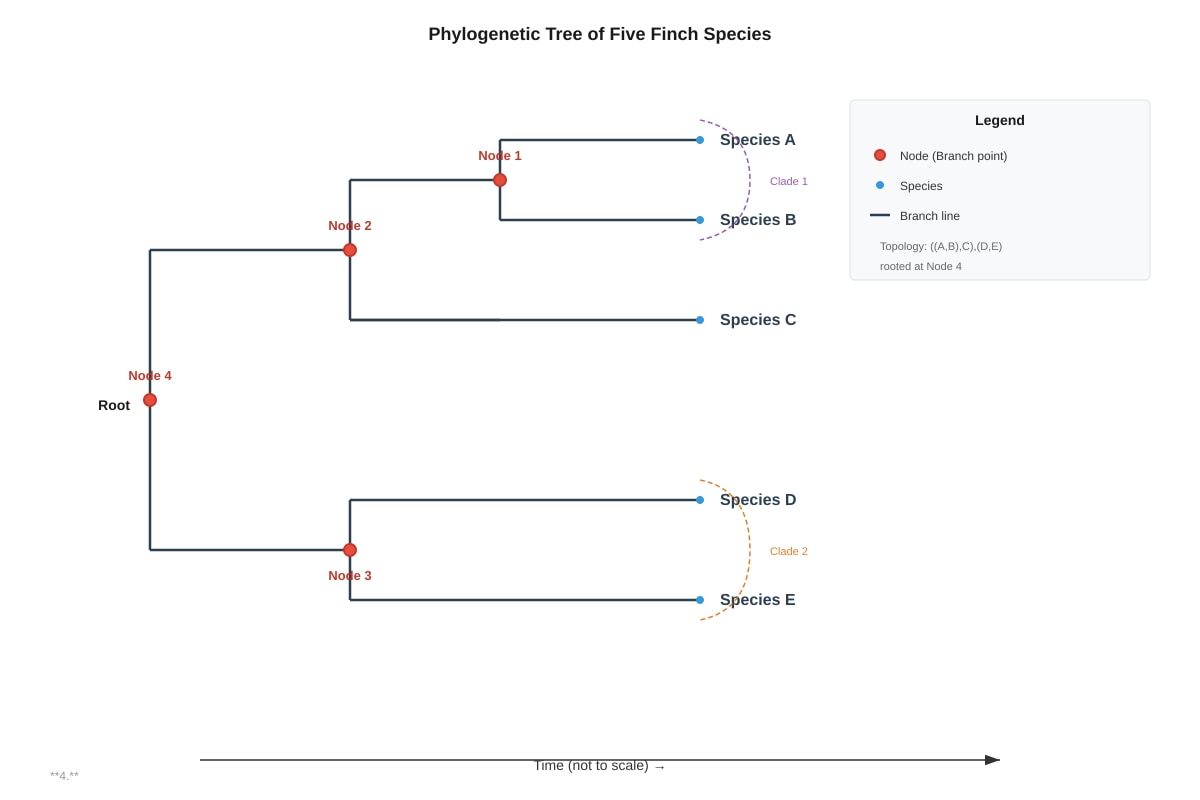
Species A and species B are most closely related. They share the most recent common ancestor at Node 1, which is the most terminal (most recent) node on the tree. No other pair of species shares a more recent node.
Marking notes:
- 1 mark for correctly identifying species A and B.
- 1 mark for explaining that they share the most recent common ancestor (Node 1).
- Accept "they diverged most recently" or "they are on the most closely adjacent branches."
Common mistakes:
- Choosing D and E — while they are also a pair, the question asks for the two most closely related, and both (A,B) and (D,E) are pairs. However, based on the tree topology described, both pairs share equally recent nodes. Clarification for marking: If the tree shows Node 1 and Node 3 at the same horizontal level (same time), accept either (A and B) or (D and E) with valid reasoning. If the tree shows Node 1 as more recent, only (A and B) is correct. The answer key accepts (A and B) as the intended answer based on the described topology where Node 1 is the most recent.
Question 5 [2 marks]
Answer:
Reproductive isolation refers to the existence of biological barriers that prevent members of two different species from interbreeding and producing viable, fertile offspring.
One prezygotic barrier (any one of the following):
- Temporal isolation (species breed at different times)
- Habitat isolation (species occupy different habitats)
- Behavioural isolation (different courtship rituals)
- Mechanical isolation (incompatible reproductive structures)
- Gametic isolation (sperm cannot fertilise egg of other species)
Marking notes:
- 1 mark for a correct definition of reproductive isolation (must mention prevention of interbreeding or production of viable/fertile offspring).
- 1 mark for naming a correct prezygotic barrier.
- The barrier must be prezygotic (i.e., acting before fertilisation). Postzygotic barriers (e.g., hybrid inviability) do not earn the mark for this question.
Question 6 [5 marks]
(a) [3 marks]
Working:
- White butterflies are homozygous recessive (bb).
- Frequency of homozygous recessive genotype:
- Frequency of recessive allele:
Answer: The frequency of allele b is 0.6.
Marking notes:
- 1 mark for correctly calculating .
- 1 mark for taking the square root: .
- 1 mark for the correct final answer: .
- Award 1 mark for correct method even if arithmetic is wrong (error carried forward).
Common mistakes:
- Forgetting to take the square root of .
- Using 320/500 instead of 180/500 (confusing dominant phenotype frequency with recessive).
(b) [2 marks]
Working:
- Frequency of heterozygotes:
- Expected number of heterozygous butterflies:
Answer: The expected number of heterozygous butterflies is 240.
Marking notes:
- 1 mark for calculating (or correct method).
- 1 mark for the correct final answer: 240.
- Accept error carried forward from part (a) if a wrong value was used consistently.
Question 7 [4 marks]
Answer:
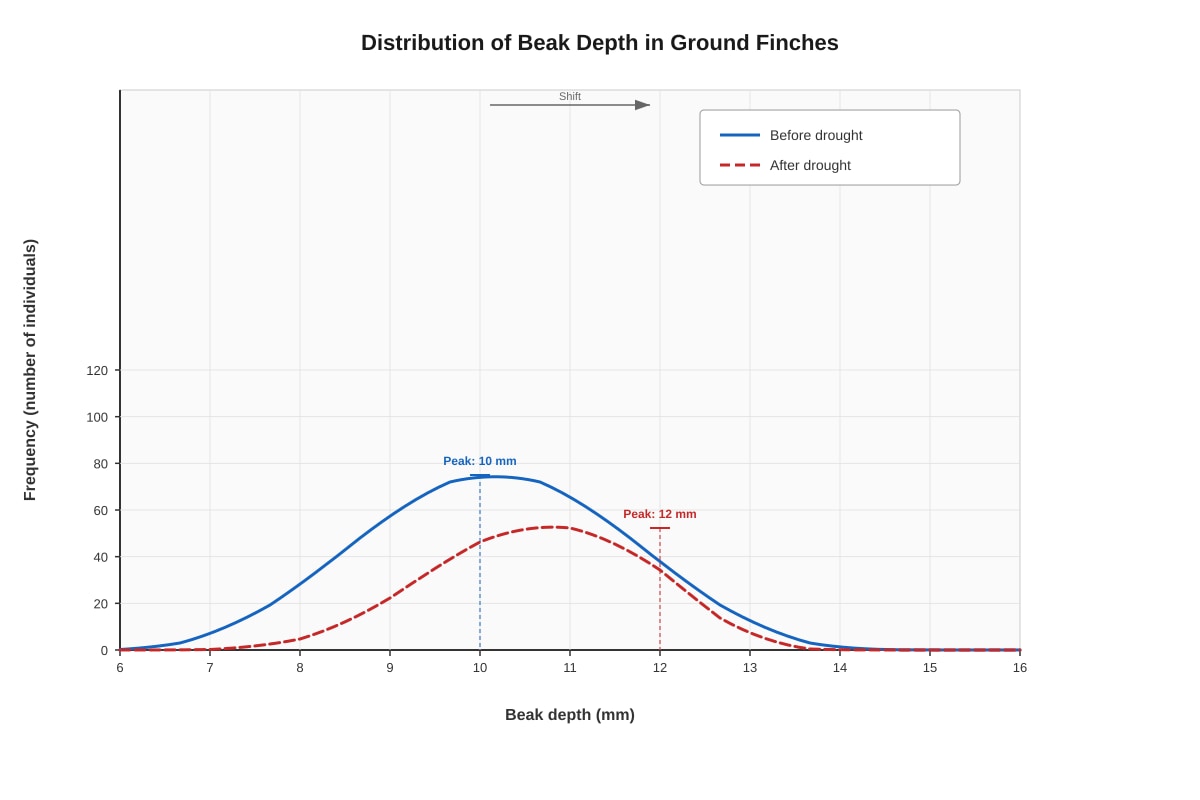
Description of change: After the drought, the mean beak depth increased from approximately 10 mm to approximately 12 mm. The distribution shifted to the right, indicating that the population now has a higher proportion of individuals with deeper beaks. The range may also have narrowed slightly.
Explanation in terms of natural selection:
The drought reduced the availability of small, soft seeds, leaving mostly large, hard seeds. Finches with deeper (larger) beaks were better able to crack and consume these hard seeds, giving them a selective advantage. These individuals had higher survival and reproductive success. They passed the alleles for deeper beaks to the next generation, causing the mean beak depth to increase in the population. This is an example of directional selection.
Marking notes:
- 1 mark for describing the shift/increase in mean beak depth (from ~10 mm to ~12 mm).
- 1 mark for describing the rightward shift in the distribution.
- 1 mark for explaining the selective advantage of larger beaks (ability to crack hard seeds during drought).
- 1 mark for linking differential survival/reproduction to the change in allele frequencies in the next generation (i.e., natural selection causing evolution).
- Award a maximum of 3 marks if the answer describes the change but does not use the term "directional selection" or equivalent reasoning.
Common mistakes:
- Describing the change without explaining the mechanism.
- Saying "finches grew bigger beaks" (Lamarckian reasoning) rather than explaining differential survival of individuals that already had larger beaks.
Question 8 [4 marks]
Answer:
Natural selection is the process by which individuals with characteristics that are better suited to their environment tend to survive and reproduce more successfully than those without such characteristics.
The process leading to evolution involves the following steps:
- Variation exists within a population (due to mutations, sexual reproduction).
- The environment exerts a selective pressure — resources are limited, and individuals must compete for survival.
- Individuals with advantageous traits (better adapted to the environment) are more likely to survive and reproduce (differential survival and reproduction).
- These individuals pass the advantageous alleles to their offspring.
- Over generations, the frequency of advantageous alleles increases in the population, while the frequency of less advantageous alleles decreases.
- This change in allele frequencies over time constitutes evolution.
Marking notes:
- 1 mark for defining natural selection (differential survival/reproduction based on fitness).
- 1 mark for mentioning variation within the population.
- 1 mark for explaining differential survival/reproduction linked to advantageous traits.
- 1 mark for stating that this leads to a change in allele frequencies over generations (evolution).
- Award marks for any four valid points from the sequence above.
Common mistakes:
- Omitting the role of variation.
- Confusing individual adaptation with population-level evolution.
- Using Lamarckian language ("organisms adapt" rather than "populations evolve").
Question 9 [4 marks]
(a) [2 marks]
Answer:
Chicken and horse are the most closely related, with only 11 amino acid differences in their cytochrome c proteins. This is the smallest number of differences between any pair of species in the table.
Marking notes:
- 1 mark for identifying chicken and horse.
- 1 mark for referencing the data (11 differences, the lowest value).
- Accept "horse and chicken" in either order.
(b) [2 marks]
Answer:
Cytochrome c is a conserved protein found in many organisms and is essential for cellular respiration. Because it evolves slowly, the number of amino acid differences between species reflects the time since they diverged from a common ancestor. Species that diverged more recently have fewer differences. Molecular evidence is useful because it provides quantitative, objective data that can be compared across organisms, including those that lack clear morphological similarities. It can also reveal evolutionary relationships that are not apparent from physical characteristics alone.
Marking notes:
- 1 mark for explaining that fewer differences = more recent common ancestor (molecular clock concept).
- 1 mark for stating an advantage of molecular evidence (e.g., quantitative/objective, applicable to organisms without clear morphology, reveals hidden relationships).
- Accept any two valid points.
Question 10 [3 marks]
Answer:
Genetic drift is the random change in allele frequencies due to chance events, particularly the random sampling of alleles during reproduction. It is non-directional and does not depend on the fitness of alleles.
Natural selection is the non-random process by which alleles that confer a survival or reproductive advantage increase in frequency over generations. It is directional and depends on the fitness of alleles.
Why drift has a greater effect in small populations: In small populations, chance events (e.g., random death of individuals before reproduction) can significantly alter allele frequencies because each individual represents a larger proportion of the gene pool. In large populations, such random fluctuations tend to average out. In very small populations, genetic drift can lead to the fixation or loss of alleles regardless of their selective value.
Marking notes:
- 1 mark for defining genetic drift (random change in allele frequencies).
- 1 mark for defining natural selection (non-random, based on fitness).
- 1 mark for explaining why drift is stronger in small populations (chance has greater proportional effect).
- Award 2 marks if definitions are given but the small population explanation is missing.
Common mistakes:
- Confusing genetic drift with natural selection.
- Stating that drift is "directed" or "adaptive."
Question 11 [4 marks]
(a) [1 mark]
Answer:
Allopatric speciation.
(b) [3 marks]
Answer:
- The formation of the new river channel acts as a geographical barrier, physically separating the fish population into two groups and preventing gene flow between them.
- The two sub-populations experience different environmental conditions (e.g., different food sources, predators, water chemistry) and accumulate different mutations independently.
- Different selective pressures in each lake cause natural selection to favour different traits in each population.
- Over many generations, the genetic differences accumulate, leading to divergence.
- Eventually, the two populations become so genetically different that they can no longer interbreed to produce viable, fertile offspring even if they come into contact again — they are now reproductively isolated and constitute two separate species.
Marking notes:
- 1 mark for geographical barrier preventing gene flow.
- 1 mark for different mutations/selective pressures causing divergence.
- 1 mark for accumulation of differences leading to reproductive isolation.
- Award marks for any three valid sequential points.
Question 12 [3 marks]
Answer:
Mutations are random changes in the DNA sequence of an organism. They are the ultimate source of all genetic variation in a population, providing the raw material upon which natural selection and other evolutionary forces can act. Without mutations, there would be no new alleles, and evolution could not occur.
Somatic vs. germ-line mutations:
- Somatic mutations occur in body cells and are not passed on to offspring. They may affect the individual (e.g., causing cancer) but do not contribute to evolution because they are not inherited.
- Germ-line mutations occur in reproductive cells (gametes) and can be passed on to offspring. These mutations introduce new alleles into the gene pool and can change allele frequencies over generations, thus contributing to evolution.
Marking notes:
- 1 mark for defining mutations and stating they are the source of genetic variation.
- 1 mark for explaining that somatic mutations are not inherited / do not affect evolution.
- 1 mark for explaining that germ-line mutations are inherited / contribute to evolution.
Common mistakes:
- Stating that all mutations are harmful.
- Failing to distinguish between somatic and germ-line cells.
Question 13 [3 marks]
(a) [1 mark]
Answer:
Individuals 1 and 4 (Lanes 1 and 4) have identical DNA fragment patterns.
(b) [2 marks]
Answer (any one of the following):
- Genetic variation due to mutations: Differences in DNA sequences between individuals (e.g., point mutations, insertions, deletions) can create or remove restriction enzyme recognition sites, leading to different fragment lengths (RFLPs).
- Sexual reproduction / recombination: Crossing over during meiosis and random assortment of chromosomes generates new combinations of DNA sequences, resulting in different banding patterns among individuals.
- Allelic variation: Different alleles at a locus may differ in the number of tandem repeats (VNTRs), producing fragments of different sizes.
Marking notes:
- 1 mark for a valid biological explanation.
- 1 mark for linking the explanation to the observed differences in banding patterns (e.g., different fragment sizes due to different restriction sites).
Question 14 [3 marks]
Answer:
Artificial selection is the process by which humans deliberately choose which individuals are allowed to breed, selecting for desirable traits. Natural selection is the process by which the environment determines which individuals are more likely to survive and reproduce, without human intervention.
Key difference: In artificial selection, the selective agent is human choice; in natural selection, the selective agent is the natural environment.
Example: The domestication of dogs from wolves. Humans selectively bred wolves that exhibited tameness, specific coat colours, or particular sizes. Over many generations, this led to the enormous diversity of dog breeds seen today.
Underlying principle: Both processes rely on the same principle — differential reproduction. Individuals with certain traits (whether chosen by humans or favoured by the environment) are more likely to pass on their alleles. Over time, this changes the allele frequencies in the population, leading to evolution.
Marking notes:
- 1 mark for distinguishing artificial from natural selection (human choice vs. environment).
- 1 mark for a valid example (dogs, crop plants, cattle, etc.).
- 1 mark for explaining the shared principle (differential reproduction / change in allele frequencies).
- Accept any valid example of artificial selection.
Question 15 [3 marks]
Answer:
The Biological Species Concept defines a species as a group of organisms that can interbreed to produce viable, fertile offspring in nature. This concept relies on reproductive isolation as the criterion for species boundaries.
Organisms that reproduce asexually (e.g., by binary fission, budding, or vegetative propagation) do not interbreed with other individuals. Therefore, the criterion of reproductive isolation cannot be applied — there is no gene flow between individuals to begin with, so the concept of "interbreeding" is meaningless.
Alternative criterion (any one of the following):
- Morphological species concept: Classifying organisms based on shared physical characteristics and structural features.
- Phylogenetic / cladistic species concept: Defining species based on shared evolutionary history and monophyly (all members share a common ancestor not shared with other groups).
- Ecological species concept: Defining species based on their ecological niche — the unique set of environmental resources and conditions they exploit.
- Genetic / molecular criterion: Using a threshold of genetic similarity (e.g., DNA sequence similarity) to delineate species.
Marking notes:
- 1 mark for explaining why the Biological Species Concept fails for asexual organisms (no interbreeding).
- 1 mark for suggesting a valid alternative criterion.
- 1 mark for briefly explaining how the alternative criterion could be applied.
Question 16 [3 marks]
Answer:
The drought of 1977 caused a severe reduction in the availability of small, soft seeds, which were the primary food source for many finches. Only large, hard seeds remained abundant. This created a selective pressure favouring finches with larger, deeper beaks that were capable of cracking these hard seeds. Finches with smaller beaks were less able to feed effectively and had lower survival rates. As a result, finches with the trait of deeper beaks had a selective advantage — they were more likely to survive the drought and reproduce, passing on the alleles for deeper beaks to the next generation.
Marking notes:
- 1 mark for identifying the drought as a selective pressure (reduction in small seeds).
- 1 mark for explaining the advantage of larger/deeper beaks (ability to crack hard seeds).
- 1 mark for linking this to differential survival/reproduction.
- Award a maximum of 2 marks if the answer does not reference the passage.
Question 17 [3 marks]
Answer:
The increase in average beak depth in the generation after the drought provides evidence for evolution by natural selection because:
- Variation existed in the population — finches had a range of beak depths.
- The drought acted as a selective pressure, causing differential survival — finches with deeper beaks survived at higher rates because they could crack the remaining hard seeds.
- Beak depth is a heritable trait (influenced by alleles passed from parents to offspring).
- The surviving finches reproduced and passed the alleles for deeper beaks to their offspring.
- The result was a change in allele frequencies in the population — the mean beak depth increased. This change in allele frequencies over generations is the definition of evolution.
Marking notes:
- 1 mark for mentioning variation in beak depth.
- 1 mark for explaining differential survival linked to the selective pressure.
- 1 mark for stating that the change in mean beak depth represents a change in allele frequencies (evolution).
- Award marks for any three valid points that connect the observation to the mechanism of natural selection.
Common mistakes:
- Saying individual finches changed their beak size (Lamarckian).
- Failing to mention heritability.
Question 18 [2 marks]
Answer:
Genetic variation is essential for evolution because it provides the raw material upon which evolutionary forces (natural selection, genetic drift, sexual selection) can act. Without variation, all individuals would be genetically identical, and there would be no differences in fitness for natural selection to act upon. Hybridisation between finch species introduces new combinations of alleles into a population, increasing genetic variation. This increased variation allows the population to adapt to changing environmental conditions — some individuals may possess trait combinations that are advantageous under new selective pressures, enabling the population to survive and evolve.
Marking notes:
- 1 mark for stating that genetic variation is the raw material for evolution.
- 1 mark for explaining that hybridisation increases variation / enables adaptation to changing environments.
Question 19 [3 marks]
(a) [2 marks]
Answer:
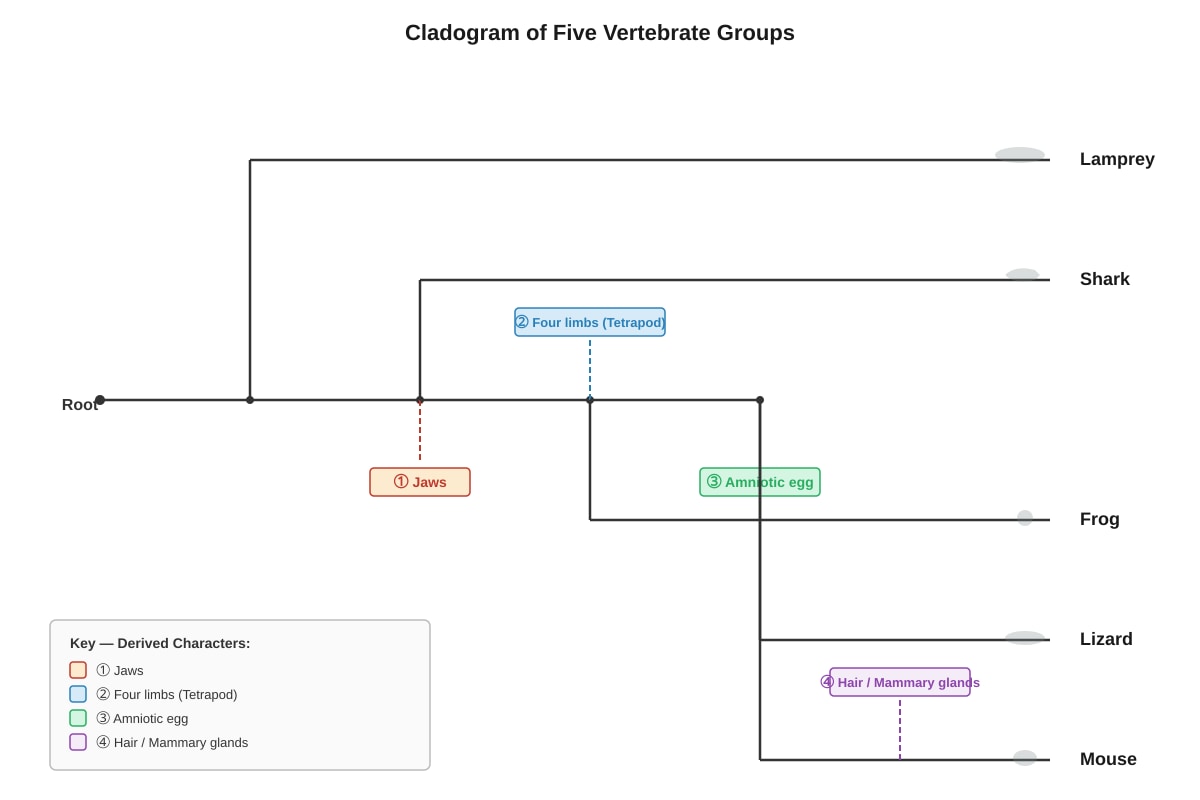
The lamprey is the outgroup. It is the first organism to branch off from the root of the cladogram, meaning it diverged earliest from the common ancestor of all five groups. It does not possess any of the derived characters (jaws, four limbs, amniotic egg, hair) that are shared by the other four groups.
Marking notes:
- 1 mark for identifying the lamprey.
- 1 mark for explaining that it branches off first / lacks the derived characters / is the most distantly related.
(b) [1 mark]
Answer:
The amniotic egg is a derived character shared by the lizard and the mouse but not by the frog.
Marking notes:
- 1 mark for "amniotic egg."
- Accept "amniotic egg" only — "four limbs" is shared by frog, lizard, and mouse, so it is incorrect.
Question 20 [4 marks]
Answer:
Natural selection changes allele frequencies by favouring alleles that increase an organism's fitness in a given environment. Advantageous alleles increase in frequency, while deleterious alleles decrease.
Genetic drift causes random changes in allele frequencies due to chance events, especially in small populations. It can cause alleles to be lost or fixed regardless of their fitness effects.
Gene flow is the movement of alleles between populations through migration. It tends to reduce genetic differences between populations by introducing new alleles or changing allele frequencies.
Scenario: Consider a small population of birds on an island.
- Natural selection favours alleles for longer beaks because the primary food source is nectar from deep flowers.
- Genetic drift occurs because the population is small — a storm randomly kills several birds, some of which carried alleles for shorter beaks. By chance, the frequency of short-beak alleles decreases more than expected by selection alone.
- Gene flow occurs when birds from a nearby island (where short beaks are advantageous because the food source is seeds) migrate to the island, introducing short-beak alleles into the population.
Opposing effects: Natural selection is increasing the frequency of long-beak alleles, while gene flow is introducing short-beak alleles from the migrant population. Genetic drift is randomly altering allele frequencies in an unpredictable direction. The net change in allele frequencies depends on the relative strengths of these three processes. If gene flow is strong, it may counteract the effects of natural selection, preventing the population from fully adapting to the local environment. If drift is strong (very small population), it may override selection and cause the loss of beneficial alleles.
Marking notes:
- 1 mark for correctly describing natural selection and its effect on allele frequencies.
- 1 mark for correctly describing genetic drift and its effect.
- 1 mark for correctly describing gene flow and its effect.
- 1 mark for providing a coherent scenario where the three processes have opposing effects on allele frequencies.
- Award a maximum of 3 marks if no scenario is given or if the scenario does not show opposing effects.
Common mistakes:
- Describing only one or two of the three processes.
- Failing to explain how the processes can oppose each other.
- Confusing gene flow with genetic drift.
END OF ANSWER KEY