From Real Exams Quiz
A Level H2 Biology Ecology Quiz
Free A Level H2 Biology Ecology quiz, HY3 Exam version, with questions, answers, and A Level-style practice for Singapore students.
These static practice materials are generated from the site's syllabus and paper-generation workflow, with source and model context shown so students and parents can evaluate the material before use.
Questions
Free quiz and exam paper access
Enter your details to view this paper
Your access is remembered on this device.
Answers
A-Level Biology H2 Quiz - Ecology: Answer Key
Total Marks: 40
Topic: Ecology
Section A Answers (1–8)
1. [2 marks]
Definition: An ecosystem is a community of living organisms (biotic components) interacting with each other and with their non-living (abiotic) environment in a particular area.
Marking: 1 mark for biotic community, 1 mark for abiotic interaction.
Teaching note: Ecosystem includes both parts and their exchanges of energy/matter.
2. [2 marks]
Any two: temperature, light intensity, dissolved oxygen, pH, salinity, water flow. [1+1]
Common mistake: Listing biotic items like fish.
3. [2 marks]
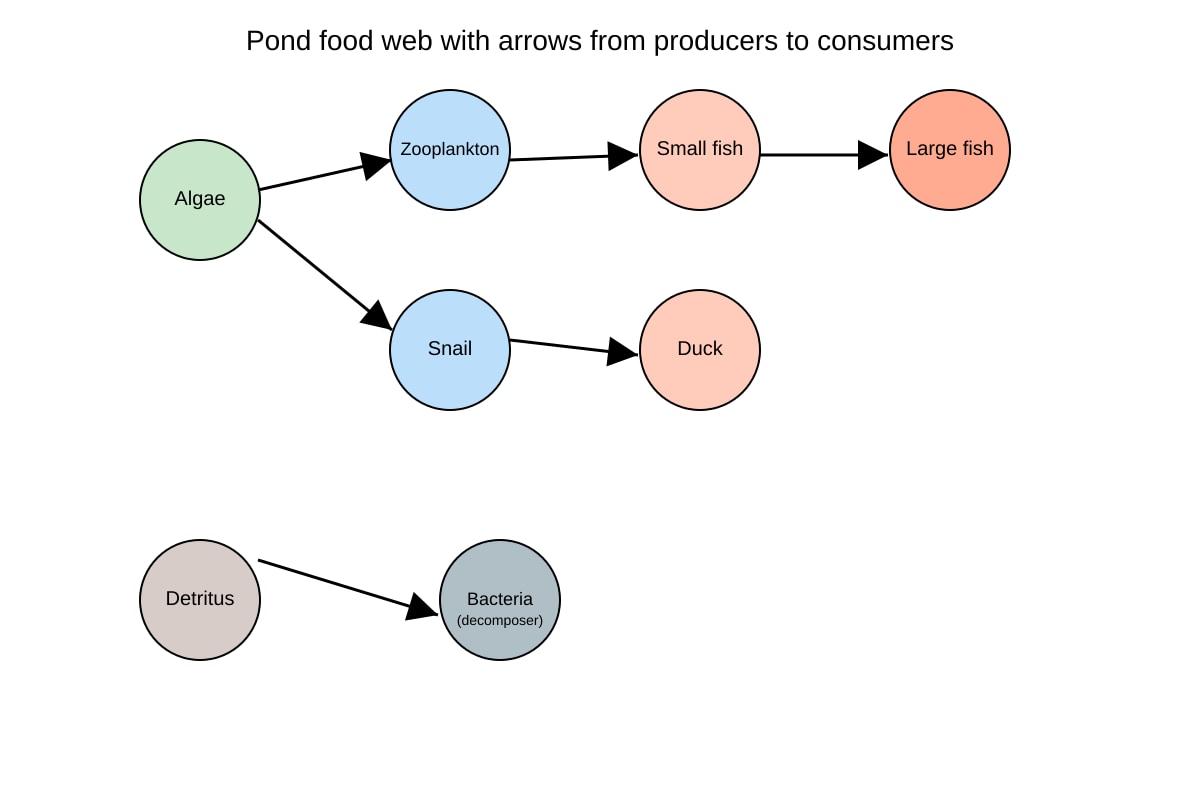
A food chain is a linear sequence of organisms showing who eats whom (1 mark). A food web is a network of interconnected food chains showing multiple feeding relationships (1 mark).
Teaching note: Webs are more realistic and show resilience.
4. [1 mark]
The position an organism occupies in a food chain, e.g. producer, primary consumer.
5. [2 marks]
Carrying capacity is the maximum population size that the environment can sustain indefinitely (1 mark) given available resources such as food, space, and water (1 mark).
6. [1 mark]
Nitrogen fixation.
7. [1 mark]
Burning fossil fuels / deforestation / cement production (any one).
8. [3 marks]
Species richness = number of different species in a community (1 mark). A higher value indicates greater variety of species (1 mark) and usually a more complex community (1 mark).
Teaching note: Do not confuse with abundance (individual count).
Section B Answers (9–14)
9. [3 marks]
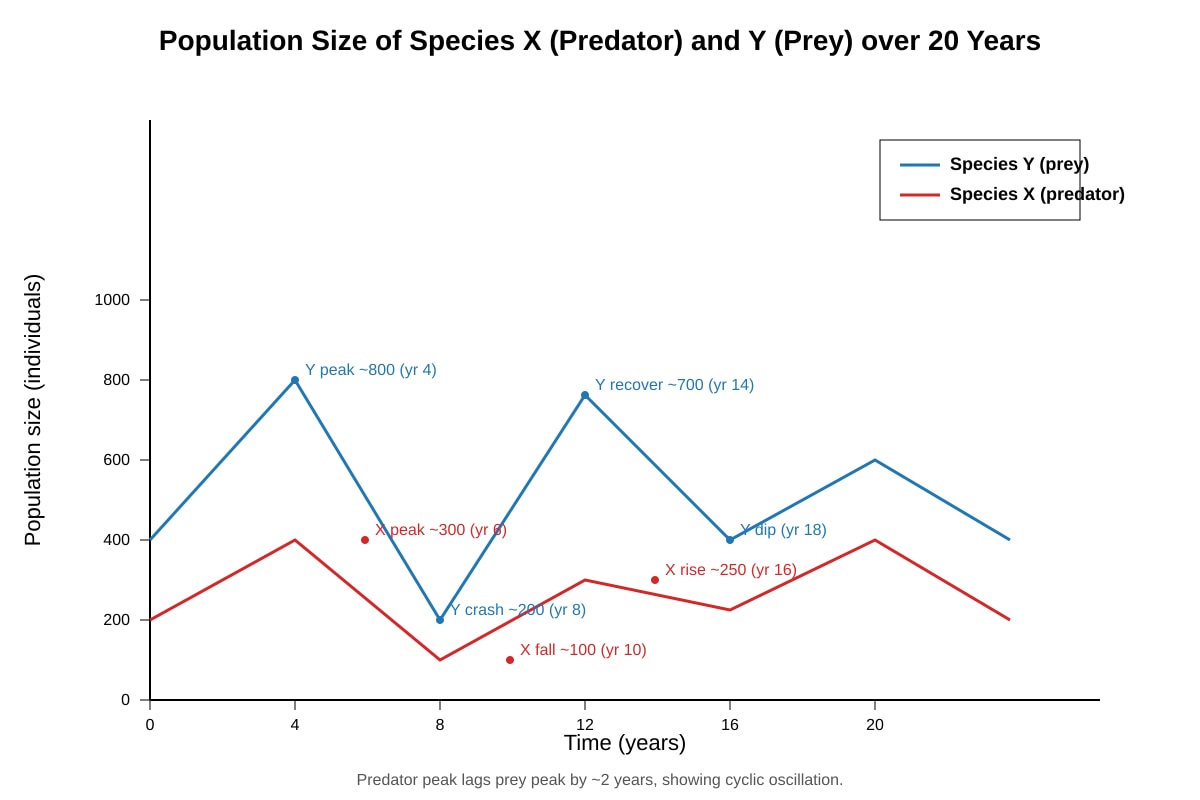
- Species Y (prey) fluctuates cyclically (1 mark).
- Species X (predator) peaks ~2 years after Y (1 mark).
- Predator population follows prey due to dependent consumption (1 mark).
From graph: lag visible at year 4 (Y peak) → year 6 (X peak).
10. [2 marks]
Efficiency = (5000 / 50000) × 100 = 10%
Working: 5000 ÷ 50000 = 0.1 → ×100 = 10%
Answer: 10% [2 marks for correct calc]
11. [3 marks]
- Not all ingested food is absorbed; some lost as faeces (1).
- Much energy lost as heat via respiration (1).
- Some parts not consumed (e.g. bones) (1).
12. [2 marks]
Decomposer: Bacteria (1). Role: Break down dead organic matter/detritus, releasing nutrients to ecosystem (1).
13. [2 marks]
Density = 40 per m². Total = 40 × 800 = 32 000.
Working: 40 × 800 = 32 000
Answer: 32 000 daisies.
14. [2 marks]
Convert ammonia to nitrite then nitrate (1 mark) which plants absorb (1 mark).
Teaching note: Nitrosomonas and Nitrobacter are examples.
Section C Answers (15–20)
15. [4 marks]
- Pioneer species (lichens/mosses) colonise bare rock, weather it (1).
- Soil accumulates, grasses/herbs establish (1).
- Shrubs then trees outcompete, increasing biomass (1).
- Climax community stable with high diversity (1).
16. [3 marks]
- CO₂ from atmosphere taken by photosynthesis into glucose (1).
- Passed via food chains (1).
- Returned by respiration, decay, combustion (1).
17. [3 marks]
- Fertiliser causes algal bloom (1).
- Algae die, decomposers respire using O₂ (1).
- Dissolved O₂ falls, may kill fish (1).
18. [3 marks]
Biodiversity = variety of species/genes/ecosystems (1). Reasons: more niches → redundant functions (1); pests/disease less likely to wipe all (1).
19. [2 marks]
χ² = 10.0 > 3.84, reject null hypothesis (1). Significant difference in distribution between habitats (1).
20. [3 marks]
- Rising temps shift species upslope/away (1).
- Altered rainfall changes composition (1).
- Some species local extinction if unable to migrate (1).