From Real Exams Quiz
A Level H2 Biology Ecology Quiz
Free Exam-Derived DeepSeek V4 Pro A Level H2 Biology Ecology quiz with questions and answers for Singapore students. This page is rendered as a direct URL so the questions and answers can be discovered without pressing in-page buttons.
These static practice materials are generated from the site's syllabus and paper-generation workflow, with source and model context shown so students and parents can evaluate the material before use.
Questions
A-Level Biology H2 Quiz - Ecology
Name: __________________________ Class: __________________________ Date: __________________________ Score: ________ / 52
Duration: 1 hour Total Marks: 52
Instructions:
- Answer all questions in the spaces provided.
- The number of marks is given in brackets [ ] at the end of each question or part question.
- Where appropriate, show your working.
- Use black or dark blue pen. Pencil may be used for diagrams.
Section A: Short Answer and Data Interpretation (Questions 1–5)
1. A student investigated the distribution of two plant species, Digitaria and Cynodon, along a sand dune transect from the shoreline inland. The percentage cover at each 10 m interval is shown in Fig. 1.1.
| Distance from shoreline (m) | Digitaria cover (%) | Cynodon cover (%) |
|---|---|---|
| 0 | 5 | 0 |
| 10 | 20 | 2 |
| 20 | 45 | 8 |
| 30 | 60 | 25 |
| 40 | 30 | 55 |
| 50 | 10 | 75 |
| 60 | 2 | 65 |
| 70 | 0 | 50 |
| 80 | 0 | 30 |
Fig. 1.1
(a) Describe the change in percentage cover of Digitaria along the transect. [1]
(b) With reference to ecological succession, explain the change in the relative abundance of the two species shown in Fig. 1.1. [2]
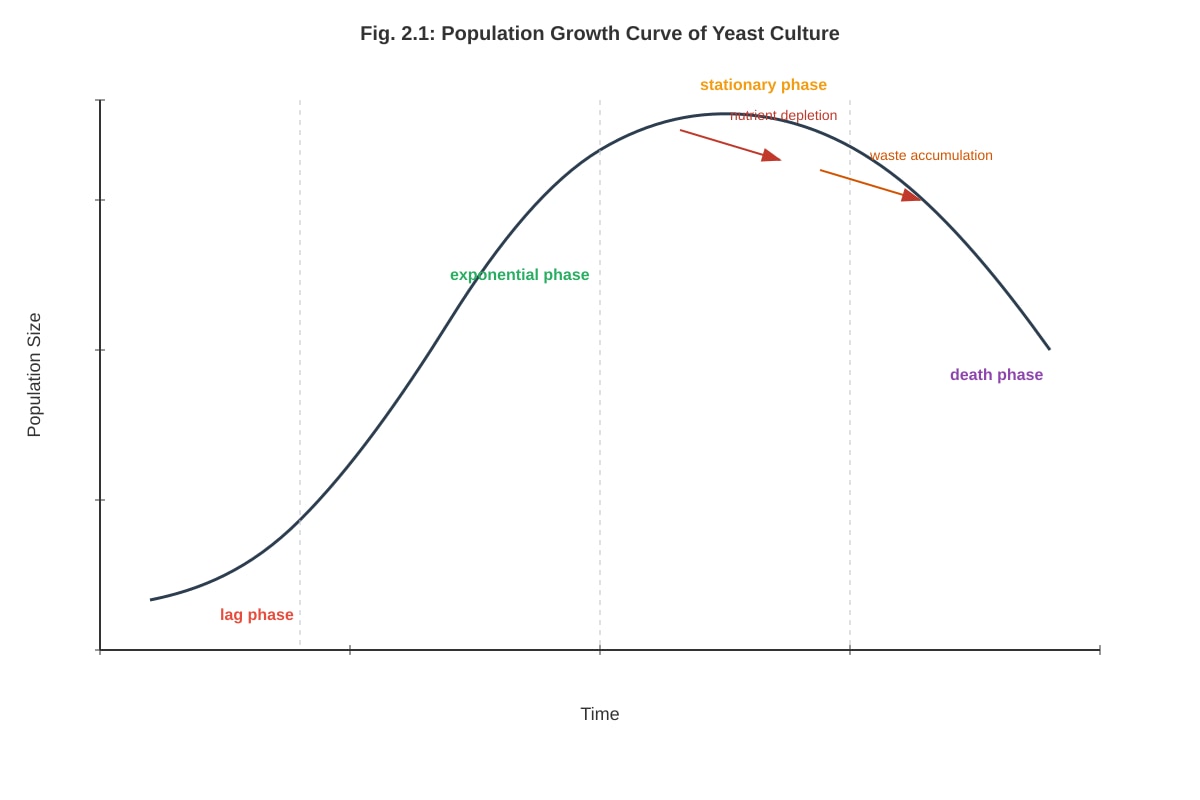
2. Fig. 2.1 shows the population growth curve of a yeast culture in a closed flask containing a limited nutrient supply.
[Diagram not shown – a sigmoid curve with labels: lag, exponential, stationary, death phases, and arrows indicating nutrient depletion and waste accumulation.]
(a) State two factors that cause the growth rate to slow during the stationary phase. [1]
(b) Suggest why the death phase is delayed in a population with a high proportion of dormant cells. [1]
3. The table below gives the mean dry mass (biomass) of organisms in a freshwater pond ecosystem.
| Trophic level | Organism group | Biomass (g m⁻²) |
|---|---|---|
| Producer | Phytoplankton | 4.2 |
| Primary consumer | Zooplankton | 2.1 |
| Secondary consumer | Small fish | 0.8 |
| Tertiary consumer | Large fish | 0.3 |
(a) Draw a pyramid of biomass for this ecosystem. Label each trophic level. [2]
(b) Explain why the pyramid of biomass for a marine ecosystem dominated by very small, fast-growing phytoplankton is often inverted. [1]
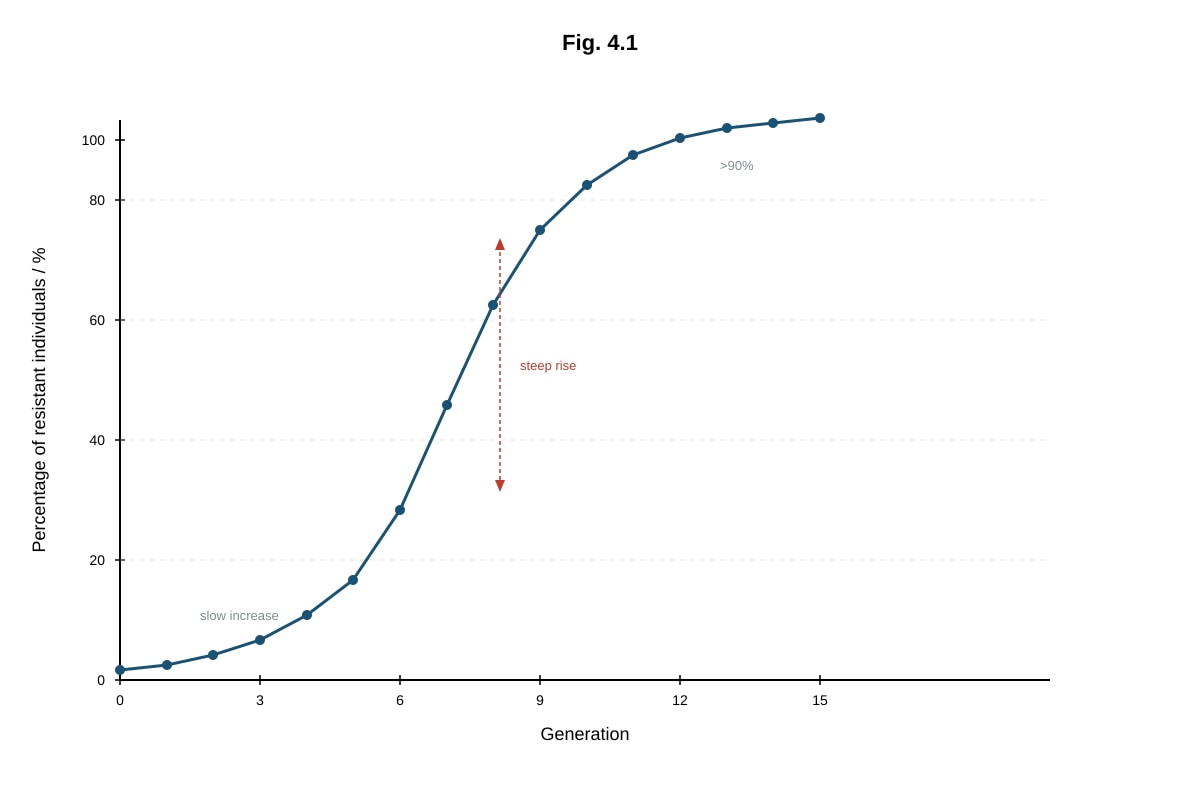
4. A farmer sprays an insecticide to control a pest on a crop. The graph in Fig. 4.1 shows the percentage of resistant individuals in the pest population over several generations.
[Graph shows a slow increase at first, then a steep rise after about 5 generations, reaching >90% by generation 15.]
(a) With reference to natural selection, explain the trend shown in Fig. 4.1. [1]
(b) Suggest one component of an integrated pest management (IPM) strategy that could reduce the selection pressure for insecticide resistance. [1]
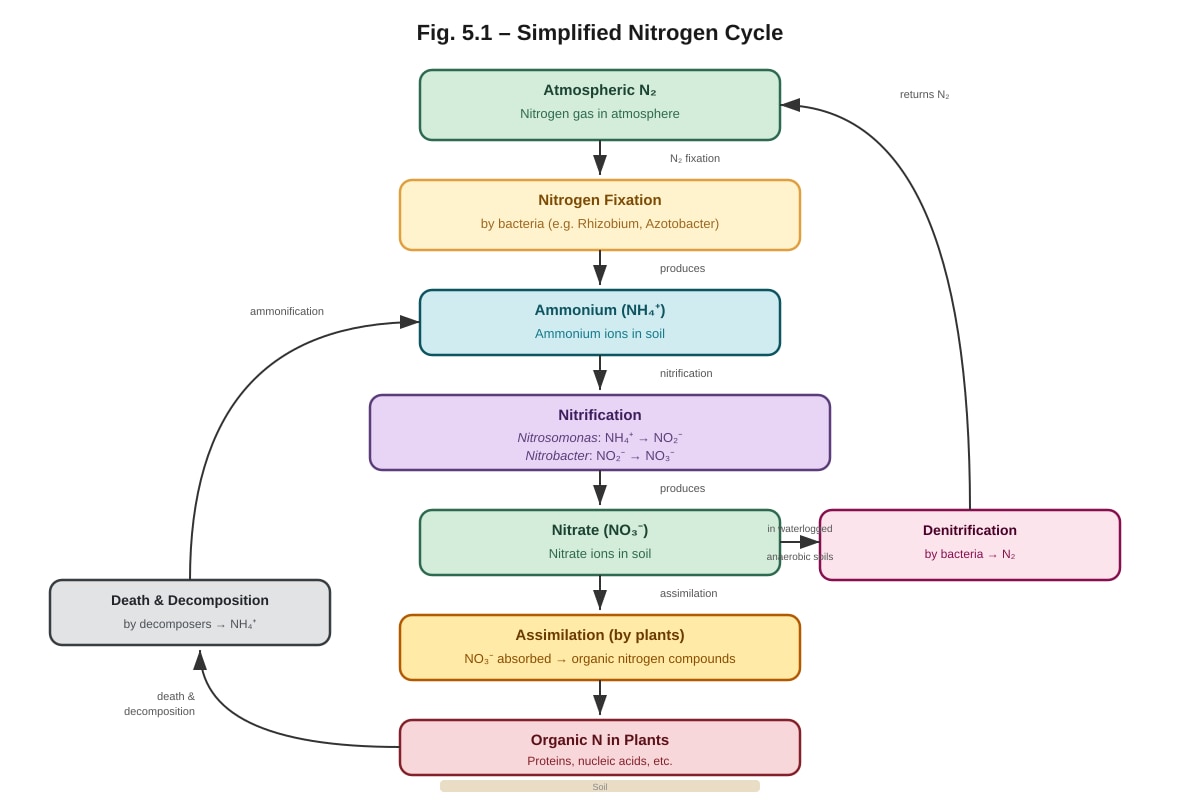
5. Fig. 5.1 is a simplified diagram of the nitrogen cycle.
[Diagram shows boxes: Atmospheric N₂, Nitrogen fixation (by bacteria), Ammonium (NH₄⁺), Nitrification (by Nitrosomonas and Nitrobacter), Nitrate (NO₃⁻), Assimilation (by plants), Organic N in plants, Death and decomposition, Denitrification (by bacteria) returning N₂.]
(a) Name the process carried out by Nitrosomonas and state the substrate it uses. [1]
(b) Explain why waterlogged soils often become deficient in nitrate ions. [2]
Section B: Structured Questions (Questions 6–10)
6. A group of ecologists estimated the population size of woodlice (Porcellio scaber) in a 50 m² area of deciduous woodland using the capture-mark-recapture method.
They collected 84 woodlice on the first occasion, marked them with a small dot of non-toxic paint, and released them. On the second occasion, 72 woodlice were collected, of which 18 were marked.
(a) State one assumption that must be made when using this method. [1]
(b) Calculate the estimated total population of woodlice in the study area. Show your working. [2]
7. Fig. 7.1 shows the energy flow through an Arctic food chain: phytoplankton → zooplankton → Arctic cod → ringed seal → polar bear. The numbers represent energy in kJ m⁻² yr⁻¹.
| Trophic level | Gross production (GPP or GSP) | Respiratory loss (R) | Net production (NPP or NSP) |
|---|---|---|---|
| Phytoplankton | 38 000 | 22 000 | 16 000 |
| Zooplankton | 4 800 | 3 200 | 1 600 |
| Arctic cod | 720 | 480 | 240 |
| Ringed seal | 90 | 72 | 18 |
| Polar bear | 9 | 8 | 1 |
(a) Calculate the percentage of the phytoplankton gross production that is transferred to net production at the zooplankton level. [1]
(b) Explain why the percentage energy transfer between trophic levels is usually less than 20%. [2]
8. Peat bogs are important carbon sinks. When drained, they become a source of carbon dioxide.
(a) Describe how peat bogs store carbon and why they are considered carbon sinks. [1]
(b) Explain the effect of draining a peat bog on the carbon cycle and on global warming. [2]
9. In a study of a rocky shore community, the distribution of two barnacle species was recorded at different heights above the mean low-tide level (Fig. 9.1).
| Height above mean low-tide (m) | Chthamalus density (individuals m⁻²) | Semibalanus density (individuals m⁻²) |
|---|---|---|
| 0.5 | 8 | 120 |
| 1.0 | 25 | 110 |
| 1.5 | 72 | 75 |
| 2.0 | 95 | 22 |
| 2.5 | 60 | 0 |
| 3.0 | 18 | 0 |
(a) Describe the distribution of Semibalanus along the height gradient. [1]
(b) Suggest one abiotic factor that may determine the upper limit of Semibalanus on the shore. [1]
10. Fig. 10.1 shows a simplified detritus food chain in a mangrove ecosystem.
Mangrove leaves → detritus → bacteria and fungi → detritivore worms → small fish → heron.
(a) Name the trophic level of the detritivore worms. [1]
(b) Explain the role of bacteria and fungi in this food chain. [1]
Section C: Data-Based Questions (Questions 11–15)
11. Fig. 11.1 shows the population cycles of the snowshoe hare and the Canada lynx over several decades.
| Year | Hare population (thousands) | Lynx population (thousands) |
|---|---|---|
| 1900 | 80 | 4 |
| 1905 | 30 | 8 |
| 1910 | 10 | 2 |
| 1915 | 100 | 1 |
| 1920 | 120 | 6 |
| 1925 | 40 | 10 |
| 1930 | 8 | 3 |
(a) Describe the relationship between the two populations. [1]
(b) Explain the observed pattern in terms of predator–prey dynamics. [2]
12. In a tropical rainforest, a student surveyed tree species in a 20 m × 20 m quadrat. The results are shown below.
| Tree species | Number of individuals (n) | (n/N)² |
|---|---|---|
| Shorea | 30 | 0.09 |
| Dipterocarpus | 25 | 0.0625 |
| Koompassia | 15 | 0.0225 |
| Eugenia | 20 | 0.04 |
| Others | 10 | 0.01 |
Total individuals, N = 100.
(a) Using the data, calculate Simpson’s Index of Diversity (D = 1 – Σ(n/N)²). Show your working. [2]
(b) Based on the calculated index, comment on the stability of this forest ecosystem. [1]
13. Fig. 13.1 is a simplified diagram of the global carbon cycle, showing major reservoirs and fluxes.
[Diagram shows arrows: Photosynthesis (atmosphere to land biomass), Respiration (land biomass to atmosphere), Deforestation (land biomass to atmosphere), Ocean uptake (atmosphere to ocean), Fossil fuel burning (geological reservoir to atmosphere).]
(a) Identify the process labelled X that transfers carbon from the atmosphere to land biomass. [1]
(b) Explain how deforestation affects the global carbon cycle. [2]
14. A student uses a 0.5 m² quadrat to estimate the percentage cover of seaweed on a rocky shore.
(a) State one advantage of using a point quadrat over a frame quadrat. [1]
(b) Explain why a large number of quadrats is needed for an accurate estimate. [1]
15. In a deciduous forest, two species of mice, Apodemus and Clethrionomys, share the same habitat. Their diets are shown in the table.
| Food item | % in diet of Apodemus | % in diet of Clethrionomys |
|---|---|---|
| Seeds | 60 | 30 |
| Fruits | 20 | 10 |
| Insects | 5 | 50 |
| Leaves and stems | 15 | 10 |
(a) Define the term ecological niche. [1]
(b) Explain how differences in diet allow the two species to coexist. [2]
Section D: Extended Response (Questions 16–20)
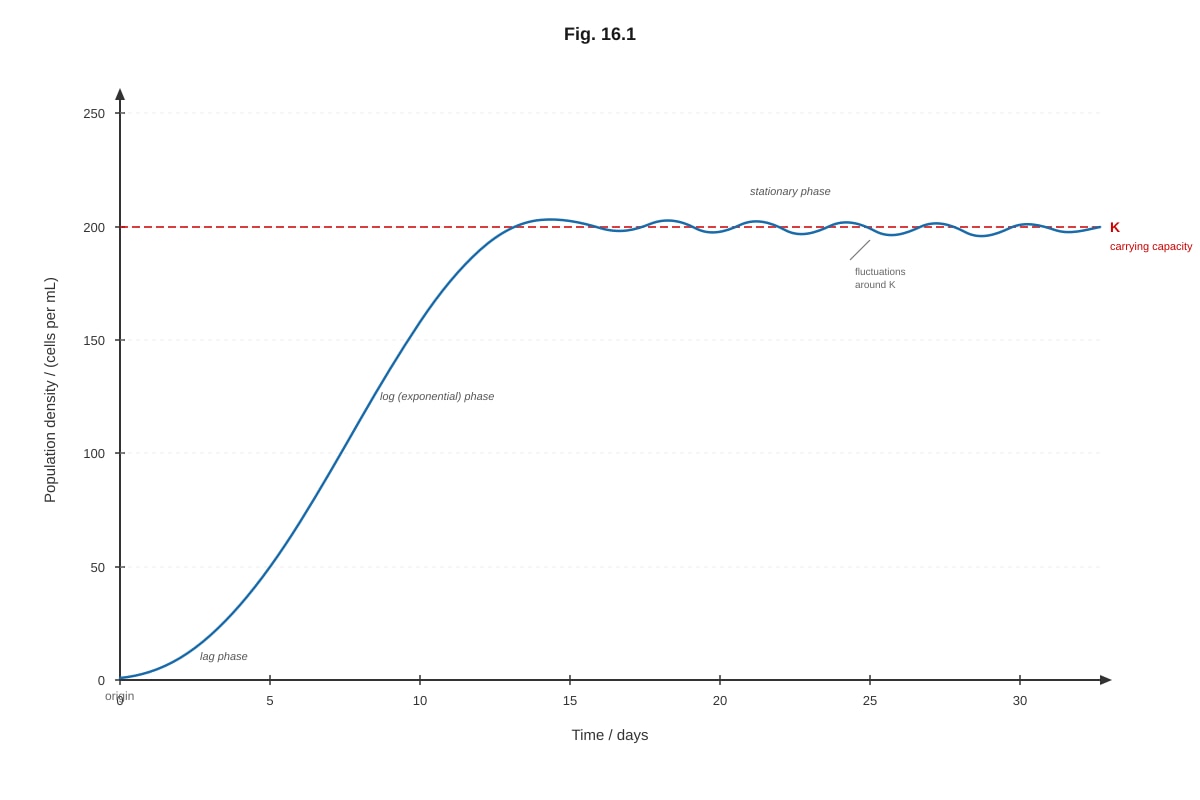
16. Fig. 16.1 shows the growth curve of a laboratory population of Paramecium in a culture flask with a fixed amount of food.
[Diagram shows a sigmoid curve approaching a carrying capacity, K, at 200 cells per mL, then occasional fluctuations.]
(a) State one density-dependent factor that could limit population size in this culture. [1]
(b) Explain how this factor regulates population size around the carrying capacity. [2]
17. Leguminous plants such as soybeans form root nodules containing nitrogen-fixing bacteria.
(a) Name the type of symbiotic relationship between the plant and the bacteria, and explain the benefit to the plant. [2]
(b) Explain how the bacteria benefit from the relationship. [1]
18. A lake receives a large input of nitrate and phosphate fertilisers from surrounding farmland.
(a) Describe the sequence of events that leads to an algal bloom after fertiliser runoff enters the lake. [1]
(b) Explain how the algal bloom can result in the death of fish. [2]
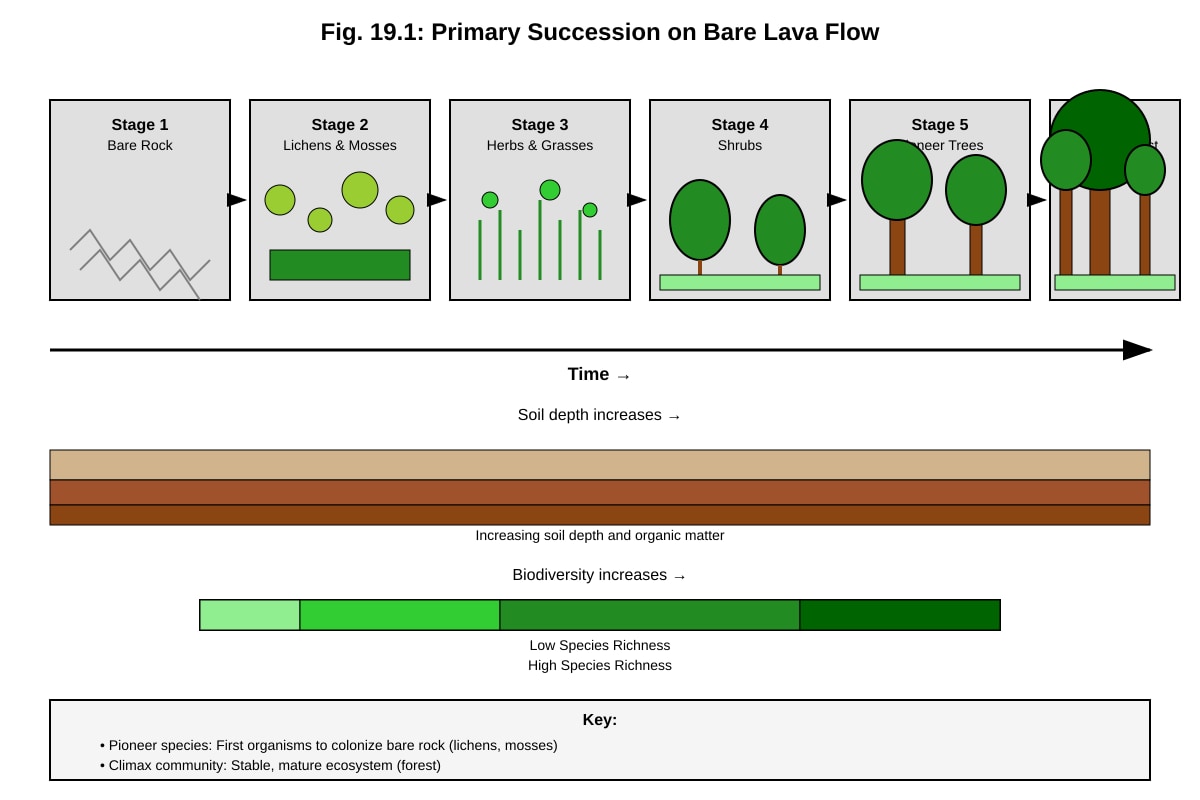
19. Fig. 19.1 shows the stages of primary succession on a bare, cooled lava flow.
[Diagram shows progression: bare rock → lichens and mosses → small herbs and grasses → shrubs → pioneer trees → climax forest.]
(a) Define the term pioneer species. [1]
(b) State one way pioneer species modify the environment, making it suitable for later species. [1]
20. A study recorded the northern range limit of the comma butterfly (Polygonia c-album) in Britain between 1970 and 2000. The limit shifted northwards by 150 km over the period.
Assume a 1°C rise in local mean annual temperature occurred during the same period.
(a) Explain how global warming could cause this northward shift. [2]
END OF QUIZ
Answers
A-Level Biology H2 Quiz - Ecology - Answer Key
Total Marks: 52
Section A: Questions 1–5
1. (a)
Increase from 5% at 0 m to a peak of 60% at 30 m, then decline to 0% by 70 m. [1]
(b)
- Pioneer species Digitaria tolerates harsh conditions (low nutrients, salt spray) and colonises first. [1]
- As soil develops, more competitive species like Cynodon establish and outcompete Digitaria, causing its decline (succession). [1]
2. (a)
Any two from: nutrient depletion, accumulation of toxic waste (e.g., ethanol), lack of oxygen. (Award 1 mark for two valid factors) [1]
(b)
Dormant cells are metabolically inactive, so they resist adverse conditions longer; the population decline is postponed because a large fraction of cells are not immediately killed. [1]
3. (a)
Pyramid of biomass: rectangle widths proportional to biomass:
- Phytoplankton (4.2) → base widest
- Zooplankton (2.1)
- Small fish (0.8)
- Large fish (0.3) → top narrowest.
(2 marks: 1 for correct shape and ordering, 1 for correct labelling of trophic levels)
(b)
Phytoplankton have a high turnover rate; they are eaten rapidly, so standing crop biomass is low. Therefore, consumer biomass (zooplankton) can exceed producer biomass, creating an inverted pyramid. [1]
4. (a)
Genetic variation means some pests carry resistance alleles. Insecticide kills susceptible pests, so resistant ones survive and reproduce, increasing the frequency of resistance alleles over generations → percentage resistant rises. [1]
(b)
Any valid IPM component, e.g.: biological control (use of predators/parasitoids), crop rotation, resistant crop varieties, mechanical traps, or monitoring to spray only when pest numbers reach a threshold. [1]
5. (a)
Process: oxidation of ammonium (or nitrification to nitrite). [1]
Substrate: ammonium ions (NH₄⁺). [1]
(b)
- Waterlogged soil is anaerobic → denitrifying bacteria convert nitrate (NO₃⁻) to N₂ gas, which is lost. [1]
- Nitrifying bacteria need oxygen, so nitrification stops; nitrate is not replenished, leading to low nitrate levels. [1]
Section B: Questions 6–10
6. (a)
Any one: no immigration/emigration, marking does not affect survival or catchability, marks not lost, marked individuals mix randomly. [1]
(b)
N = (M × C) / R
M = 84, C = 72, R = 18
N = (84 × 72) / 18 = 6048 / 18 = 336
Estimated population = 336 woodlice. [2] (1 mark for formula/substitution, 1 for correct answer)
7. (a)
Percentage = (net production zooplankton / gross production phytoplankton) × 100
= (1600 / 38000) × 100 = 4.21% (allow 4.2%). [1]
(b)
- Energy lost as heat via respiration at each level. [1]
- Not all biomass is eaten or digested; excretion, egested material, and non-digestible parts (e.g., bones) are energy lost. Therefore, only a small fraction becomes net production available to the next level. [1]
8. (a)
- Waterlogged, anaerobic, acidic conditions slow decomposition. [0.5]
- Dead plant material accumulates as partially decomposed peat, storing carbon. [0.5]
(Award 1 mark for both points) [1]
(b)
- Draining introduces oxygen → aerobic microbes decompose peat, releasing stored carbon as CO₂. [1]
- CO₂ is a greenhouse gas, so its release enhances the greenhouse effect, contributing to global warming. [1]
9. (a)
Semibalanus density decreases with height: highest at 0.5 m (120 per m²), then declines to zero above 2.0 m; restricted to lower shore. [1]
(b)
Any one: desiccation stress, temperature extremes, or reduced feeding time (shorter submersion). [1]
10. (a)
Primary consumer (second trophic level). [1]
(b)
Bacteria and fungi are decomposers/saprotrophs; they secrete enzymes to break down detritus externally, releasing soluble nutrients and making energy available to detritivores. [1]
Section C: Questions 11–15
11. (a)
Lynx population tends to rise and fall after hare population changes, showing a cyclic relationship with a lag. [1]
(b)
- An increase in hares provides more food for lynx, so lynx population rises. [1]
- As lynx numbers increase, predation pressure reduces hare population, which then limits food for lynx causing lynx numbers to decline. The cycle repeats. [1]
12. (a)
Sum of (n/N)² = 0.09 + 0.0625 + 0.0225 + 0.04 + 0.01 = 0.225
D = 1 – 0.225 = 0.775 [2] (1 mark for summing, 1 mark for correct index)
(b)
D = 0.775 indicates high diversity; diverse ecosystems are generally more stable and resilient to disturbance. [1]
13. (a)
Process X: photosynthesis. [1]
(b)
- Deforestation removes trees that would otherwise photosynthesise and store carbon in biomass, reducing carbon uptake from the atmosphere. [1]
- Decay or burning of felled trees releases stored carbon as CO₂, increasing atmospheric CO₂, which enhances the greenhouse effect. [1]
14. (a)
Point quadrat gives more objective/repeatable measurements because it records presence/absence at specific points rather than estimated by eye, reducing observer bias. [1]
(b)
A large number of quadrats ensures the sample is representative of the whole area, reducing the effects of patchiness and increasing the reliability of the estimate. [1]
15. (a)
An ecological niche is the role of a species within its environment, including its interactions with biotic and abiotic factors, and its habitat, resource use, and behaviour. [1]
(b)
- The two species utilise different proportions of food resources (e.g., Apodemus eats mainly seeds, Clethrionomys prefers insects). [1]
- This resource partitioning reduces direct competition for the same food source, allowing coexistence. [1]
Section D: Questions 16–20
16. (a)
Accept any one: competition for food, accumulation of toxic waste, or disease (density-dependent factor). [1]
(b)
- As population approaches K, food becomes limiting, increasing competition. [1]
- This leads to lower birth rate and/or higher death rate, causing the population to stabilise around K (or fluctuate slightly). [1]
17. (a)
Mutualism. [1]
- Bacteria fix atmospheric nitrogen into ammonia/ammonium, which the plant uses to synthesise amino acids, proteins, etc., enhancing plant growth. [1]
(b)
Bacteria receive carbohydrates/organic compounds (energy source) from the plant’s photosynthesis. [1]
18. (a)
Nutrient (nitrate/phosphate) enrichment causes rapid multiplication of algae, forming an algal bloom. [1]
(b)
- Algal bloom blocks sunlight, so submerged plants die. [1]
- Decomposition of dead algae by aerobic bacteria depletes oxygen → hypoxia/anoxia leads to fish suffocation. [1]
19. (a)
A pioneer species is the first species to colonise bare rock or disturbed habitat, able to tolerate extreme conditions. [1]
(b)
Lichens/mosses weather rock to form soil (or add organic matter), allowing later plants to grow. [1]
20. (a)
- Global warming raises temperatures, making previously cooler northern areas suitable for the butterfly in terms of thermal tolerance. [1]
- The butterfly expands its range northwards as conditions become favourable, tracking its fundamental niche; the range limit shifts. [1]