From Real Exams Quiz
A Level H2 Biology Cells Biomolecules Quiz
Free A Level H2 Biology Cells Biomolecules quiz, HY3 Exam version, with questions, answers, and A Level-style practice for Singapore students.
These static practice materials are generated from the site's syllabus and paper-generation workflow, with source and model context shown so students and parents can evaluate the material before use.
Questions
Free quiz and exam paper access
Enter your details to view this paper
Your access is remembered on this device.
Answers
A-Level Biology H2 Quiz - Cells Biomolecules (Answer Key)
Total Marks: 40
Topic: Cells & Biomolecules (Syllabus 9477 Core Idea 1)
Section A Answers (1–8)
Q1 [2 marks]
- Both have ribosomes for protein synthesis.
- Both are surrounded by a cell membrane (cell surface membrane) and contain genetic material (DNA).
Marking: 1 mark each for any two correct shared features (e.g., ribosomes, plasma membrane, DNA, cytoplasm). Common mistake: stating "nucleus" – prokaryotes lack a membrane-bound nucleus.
Q2 [1 mark]
- Glycosidic bond.
Teaching note: Formed by condensation reaction between two glucose monomers; O-glycosidic in starch (α-1,4 and α-1,6).
Q3 [2 marks]
- Bacterial cell lacks membrane-bound organelles (e.g., no mitochondrion); plant cell has mitochondria and other membrane-bound organelles.
OR Bacterial cell wall is made of peptidoglycan; plant cell wall is cellulose.
Marking: 1 for correct structure named, 1 for accurate comparison. Electron micrograph would show absence of nuclear envelope in bacteria.
Q4 [2 marks]
- Cholesterol restricts movement of phospholipids, reducing membrane fluidity at high temperature and preventing tight packing at low temperature, thus maintaining stability.
Marking: 1 for role in fluidity regulation, 1 for temperature buffering effect.
Q5 [1 mark]
- Influenza virus (or HIV / any enveloped virus from syllabus).
Teaching: Enveloped viruses have a lipid envelope derived from host membrane.
Q6 [2 marks]
- The enzyme's active site changes shape slightly to fit the substrate upon binding, forming an enzyme-substrate complex that lowers activation energy.
Marking: 1 for conformational change, 1 for induced fit concept vs rigid lock-and-key.
Q7 [2 marks]
- Totipotent. Means it can differentiate into all cell types including extra-embryonic tissues (full organism).
Marking: 1 for term, 1 for explanation.
Q8 [2 marks]
- Phagocytosis; lysosome (fuses with phagosome to digest).
Marking: 1 each.
Section B Answers (9–14)
Q9 [3 marks]
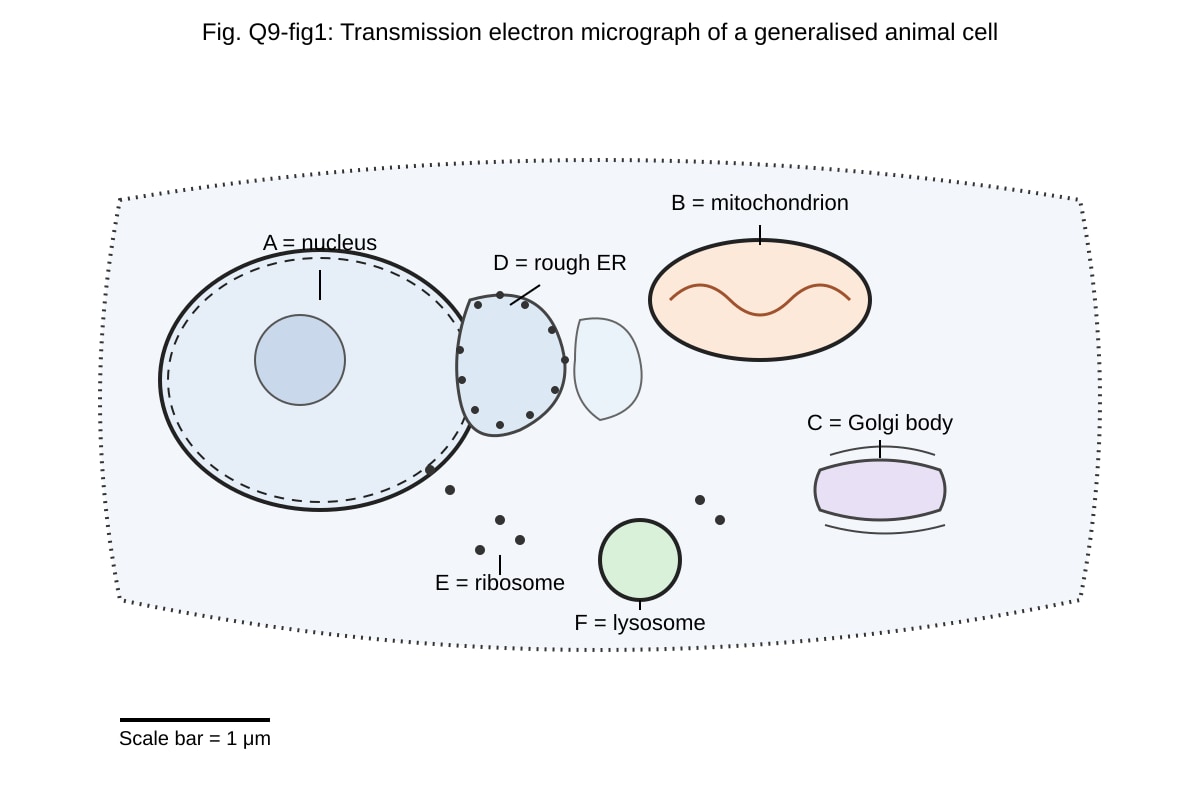
- Structure C = Golgi body (Golgi apparatus). [1]
- Structure B (mitochondrion) function: site of aerobic respiration / ATP production via oxidative phosphorylation. [2]
Marking descriptors: ID 1 mark; function 2 marks for detail (double membrane, cristae, ETC). Image must show labelled C as stacked membranes.
Q10 [3 marks]
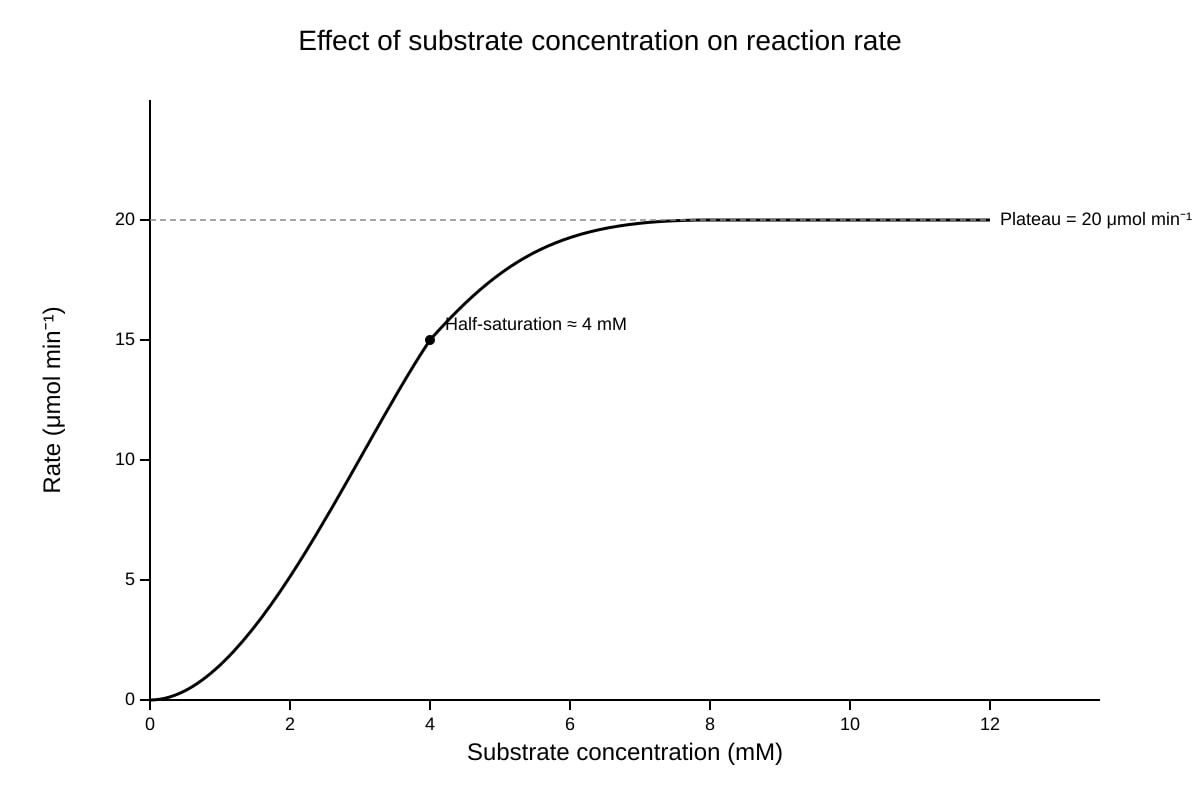
- At high [substrate], all enzyme active sites are saturated with substrate. [1]
- Adding more substrate cannot increase rate because enzyme concentration is fixed. [1]
- Rate is limited by enzyme availability / turnover number. [1]
Teaching: Hyperbolic curve from graph shows zero-order kinetics at plateau.
Q11 [2 marks]
- The two fatty acid tails (hydrocarbon chains) are hydrophobic.
Marking: 1 for fatty acids, 1 for hydrophobic tail concept.
Q12 [4 marks]
- Treatment 1 (ADP+Pi): oxygen consumed at 12.0 because ADP accepts electrons via ETC, driving proton gradient and ATP synthase; O₂ is final electron acceptor. [2]
- Treatment 3 (no ADP): low O₂ use (1.5) because lack of ADP means proton gradient not dissipated, ETC backs up (respiratory control). [2]
Marking: 2+2 for linking ADP to ETC activity and explaining control.
Q13 [2 marks]
- Ionic bond (salt bridge) / disulfide bridge / hydrophobic interaction. (Any one other than H-bond.)
Marking: 1 mark.
Q14 [3 marks]
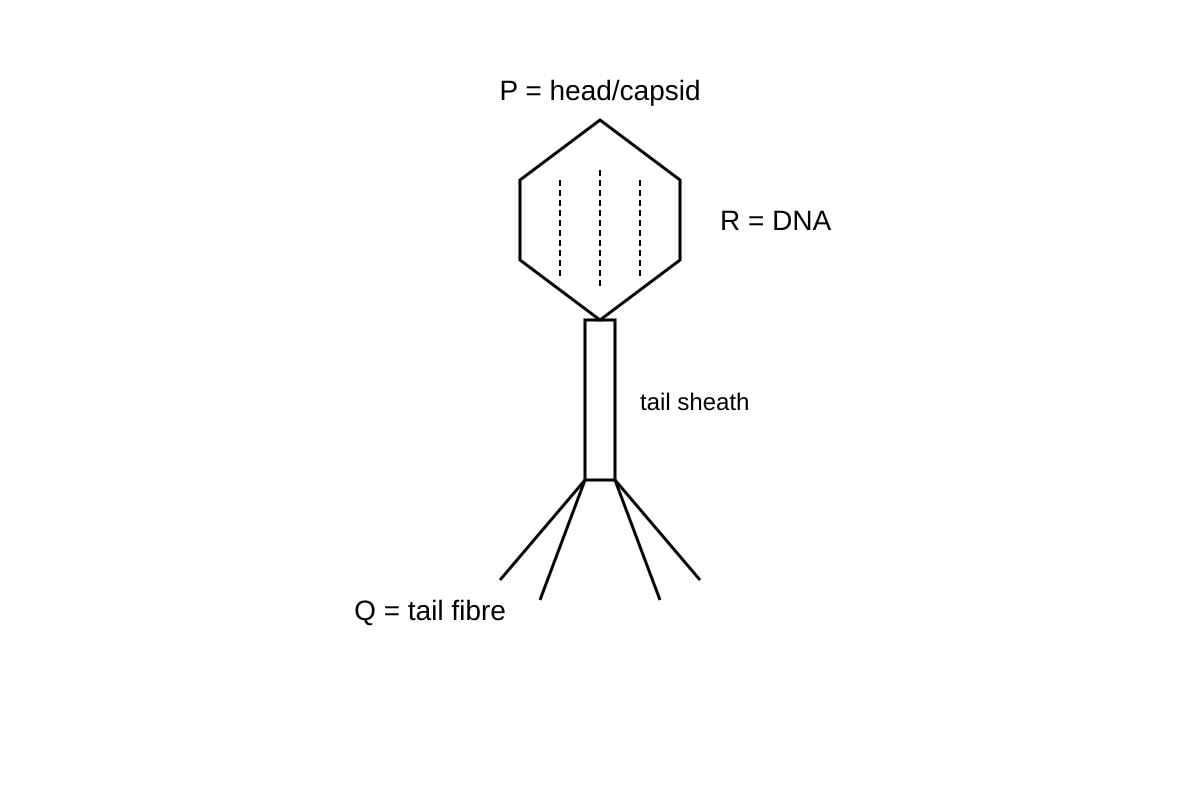
- Genetic material = DNA (double-stranded linear). [1]
- Challenges cell theory because virus is not cellular, cannot reproduce independently without host cell, and is not composed of cells. [2]
Marking: challenges cell theory by lacking cellular organisation.
Section C Answers (15–20)
Q15 [2 marks]
- Glycogen: short-term energy store in animals (liver/muscle). [1]
- Cellulose: structural component of plant cell walls, not used for energy directly. [1]
Q16 [3 marks]
- Triglyceride has 3 fatty acids → high reduced C-H bonds → high energy yield per gram. [1]
- Insoluble in water → no osmotic effect. [1]
- Compact storage in adipose tissue. [1]
Q17 [4 marks]
- Quaternary = 4 polypeptide subunits (2α, 2β). [1]
- Each subunit has haem group binding O₂ cooperatively. [1]
- Globular soluble in RBC cytoplasm. [1]
- Conformational change on O₂ binding increases affinity (sigmoid curve). [1]
Q18 [3 marks]
- Active transport: requires ATP, against gradient, specific carrier. [1.5]
- Facilitated diffusion: down gradient, no ATP, channel/carrier. [1.5]
Table acceptable.
Q19 [3 marks]
- Multipotent: can form multiple specialised cell types of a tissue lineage but not all. [2]
- Use: treat leukaemia via bone marrow transplant (lymphoid/myeloid restore). [1]
Q20 [4 marks]
- Competitive inhibitor binds active site, blocking substrate → lower rate at given [S]. [2]
- Induced-fit: inhibitor mimics substrate shape; increasing [S] outcompetes inhibitor → Vmax restored. [2]
Marking: 2 for mechanism, 2 for substrate reversal.