AI Generated Exam Paper
A Level H2 Biology Practice Paper 5
Free A Level H2 Biology Practice Paper 5, HY3 AI version, with questions, answers, and A Level-style practice for Singapore students.
These static practice materials are generated from the site's syllabus and paper-generation workflow, with source and model context shown so students and parents can evaluate the material before use.
Questions
Free quiz and exam paper access
Enter your details to view this paper
Your access is remembered on this device.
Answers
TuitionGoWhere Practice Paper — Biology H2 A-Level (Version 5) Answer Key
Total Marks: 60
Topic: Cells & Biomolecules
Note: Content generated from LLM-inferred templates (Stage 4/5) aligned to syllabus 9477. Not derived from official past-year papers.
Section A (16 marks)
Q1 [3 marks]
Accepted components of fluid mosaic model:
- Phospholipids (bilayer) — 1
- Proteins (integral/peripheral) — 1
- Cholesterol (animal cells) / glycolipids / glycoproteins — 1
Teaching note: The model describes membrane as mosaic of proteins floating in fluid lipid bilayer. Common mistake: omitting cholesterol.
Q2 [2 marks]
Induced-fit: Enzyme active site changes shape slightly to better fit substrate upon binding (1), forming enzyme-substrate complex that lowers activation energy (1).
Do not accept lock-and-key only.
Q3 [1 mark]
Glycosidic bond.
Q4 [1 mark]
Any one: bacterial cell has no membrane-bound organelles / has circular DNA / has peptidoglycan wall / 70S ribosomes.
Mark first valid difference.
Q5 [1 mark]
Modifies, sorts, and packages proteins/lipids for secretion or delivery.
Q6 [2 marks]
Viruses are non-cellular (1) yet can direct replication using host cell machinery, challenging "cells are smallest unit of life" / "all living things composed of cells" (1).
Q7 [1 mark]
Totipotent (zygotic) stem cell.
Q8 [2 marks]
Quaternary: 4 polypeptide subunits (2 α, 2 β) (1); iron (Fe²⁺) in haem group (1).
Section B (28 marks)
Q9 [3 marks]
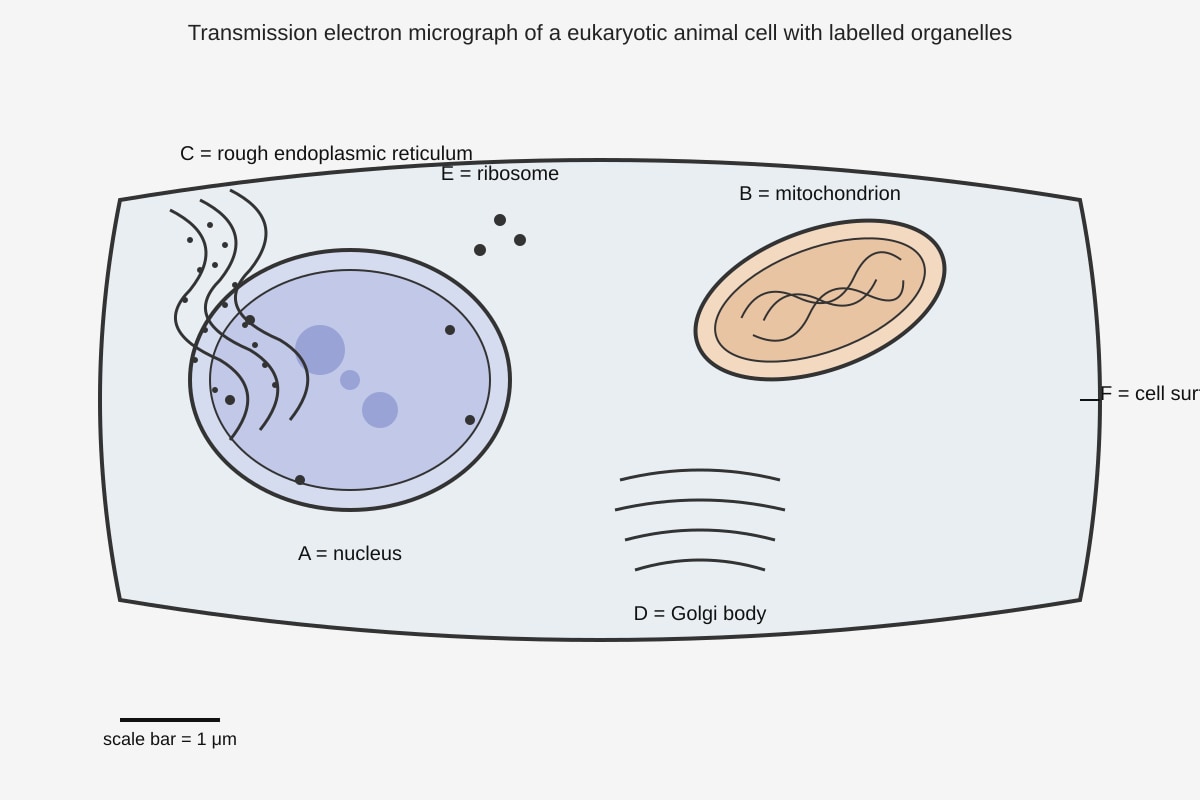
Letter: B (mitochondrion) (1). Structure: cristae increase surface area for electron transport chain (1); double membrane maintains proton gradient for chemiosmosis (1).
Image must show cristae and double membrane.
Q10 [4 marks]
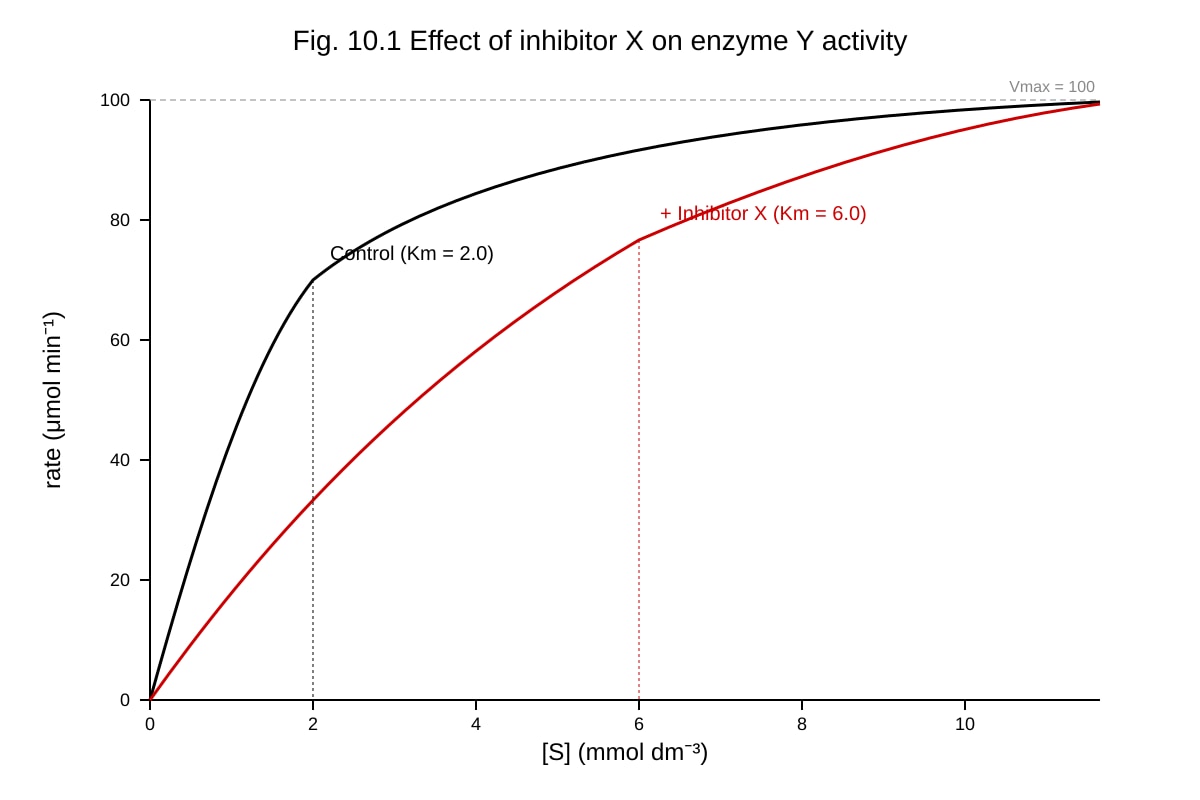
Type: Competitive inhibition (1). Km increased (from 2.0 to 6.0 mmol dm⁻³) because more substrate needed to reach half Vmax (1). Vmax unchanged (100 μmol min⁻¹) as high [S] outcompetes inhibitor (1). Mechanism: inhibitor resembles substrate, binds active site (1).
Q11 [4 marks]
Facilitated diffusion: carrier/channel protein, no ATP, down gradient (e.g., GLUT1 glucose) (2). Primary active: ATP directly, against gradient (e.g., Na⁺/K⁺ pump) (2). Both selective via protein specificity.
Q12 [4 marks]
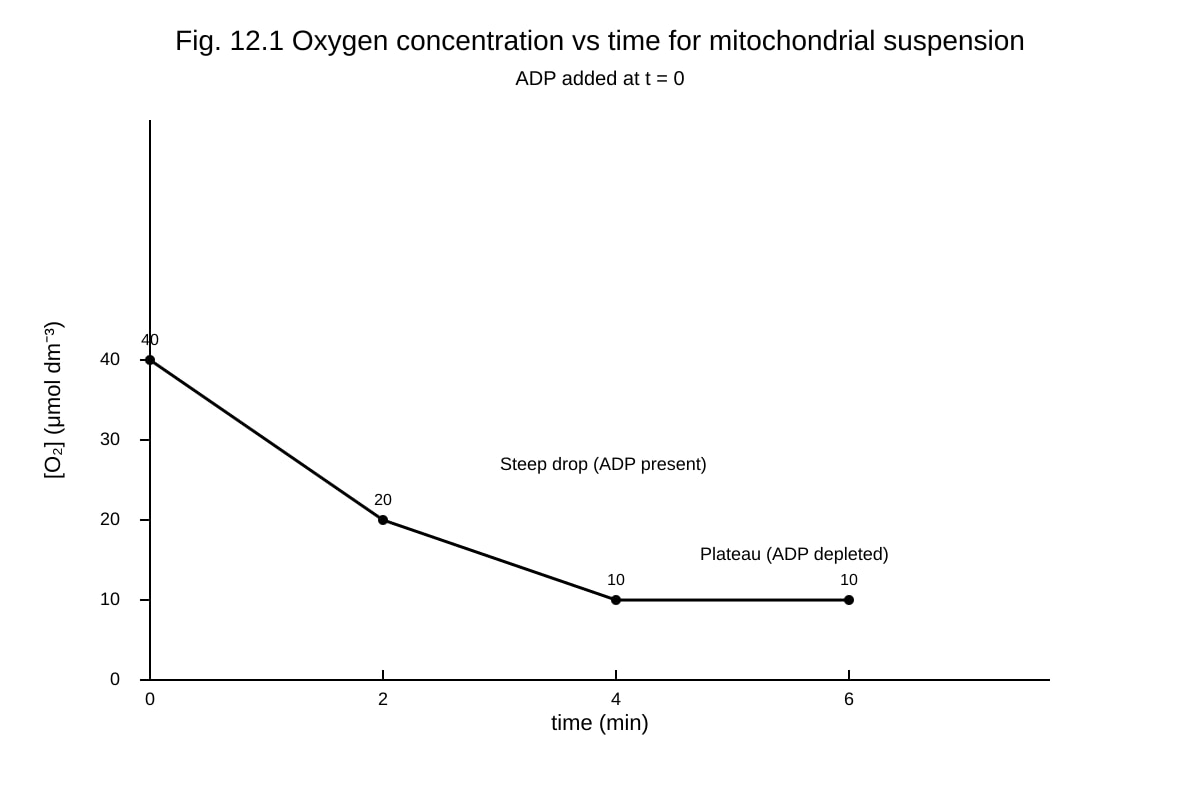
Rate = Δ[O₂]/Δt = (40 − 10)/4 = 7.5 μmol dm⁻³ min⁻¹ (2 marks: 1 for value, 1 for unit).
Plateau: ADP depleted, no substrate for ATP synthase, ETC stops (2).
Q13 [3 marks]
Phospholipids: bilayer barrier, fluid matrix (1). Proteins: transport, receptors, enzymes (1). Cholesterol: restricts movement, stability (1).
Q14 [5 marks]
Primary: peptide bonds (1). Secondary: H-bonds (α-helix/β-sheet) (1). Tertiary: H-bonds, ionic, disulfide, hydrophobic (2). Quaternary: same as tertiary between subunits (1).
Q15 [3 marks]
Potency: multipotent (1). Lymphoid: T/B lymphocyte (1). Myeloid: RBC / neutrophil / macrophage (1).
Section C (16 marks)
Q16 [3 marks]
False claim (1). Starch/glycogen/cellulose are polymers of glucose (1). Triglycerides are not polymers (glycerol + 3 FA, no repeat unit); phospholipids similar (1).
Q17 [3 marks]
Triple helix of 3 α-chains (1), cross-links (covalent) between chains (1), high proline/glycine allows tight packing → tensile strength (1).
Q18 [3 marks]
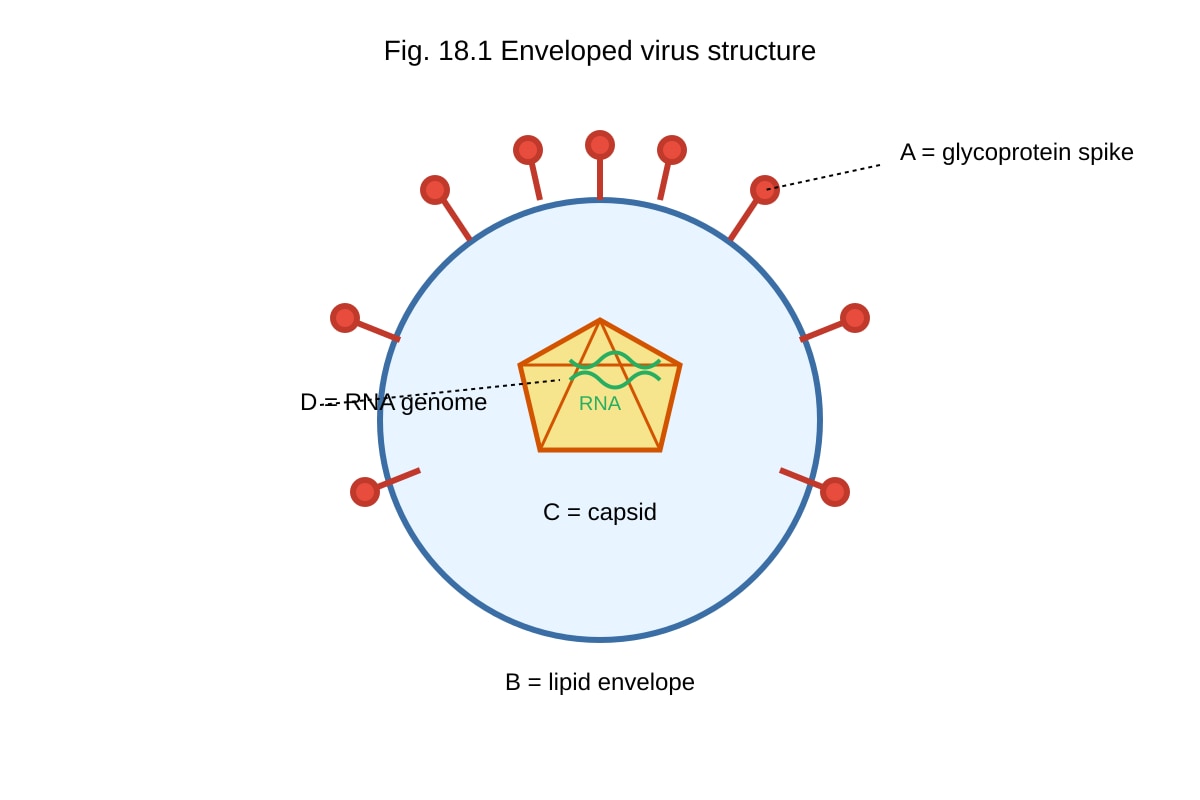
A = glycoprotein spike (1). C = capsid (protein coat) (1). Envelope from host membrane during budding (1).
Q19 [4 marks]
Sketch: hyperbolic curve rising then plateau (2). Plateau: enzyme saturated, all active sites occupied, rate limited by [E] (2).
Q20 [3 marks]
Inducible: only expressed when substrate present (1). Saves energy/resources making enzymes only when needed (1). Example: lactose absent → repressor binds, no lac enzymes (1).