AI Generated Exam Paper
A Level H2 Biology Practice Paper 1
Free A Level H2 Biology Practice Paper 1, HY3 AI version, with questions, answers, and A Level-style practice for Singapore students.
These static practice materials are generated from the site's syllabus and paper-generation workflow, with source and model context shown so students and parents can evaluate the material before use.
Questions
Free quiz and exam paper access
Enter your details to view this paper
Your access is remembered on this device.
Answers
TuitionGoWhere Practice Paper — Answer Key (Version 1)
Subject: Biology H2 | Level: A-Level | Topic: Cells & Biomolecules | Total Marks: 60
Section A (1–8) — Mark Scheme
1. [3 marks]
- All living organisms are composed of cells. (1)
- The cell is the smallest unit of life / basic unit of structure and function. (1)
- All cells arise from pre-existing cells. (1)
Teaching note: These are the three foundational statements of cell theory. Do not confuse with "cells are microscopic" (not a tenet).
2. [2 marks]
- Glycosidic bond. (1)
- Condensation (dehydration) reaction, which releases water. (1)
Teaching note: Monosaccharides join via loss of H₂O to form disaccharides/polysaccharides; hydrolysis reverses it.
3. [2 marks]
Any two of:
- Bacterial cell has peptidoglycan wall, animal cell has no wall (or has flexible membrane). (1)
- Bacterial cell lacks membrane-bound organelles; animal cell has them. (1)
- Bacterial DNA is circular and naked; animal DNA is linear and in nucleus. (1)
- Bacterial ribosomes are 70S; animal are 80S. (1)
Max 2 marks.
4. [2 marks]
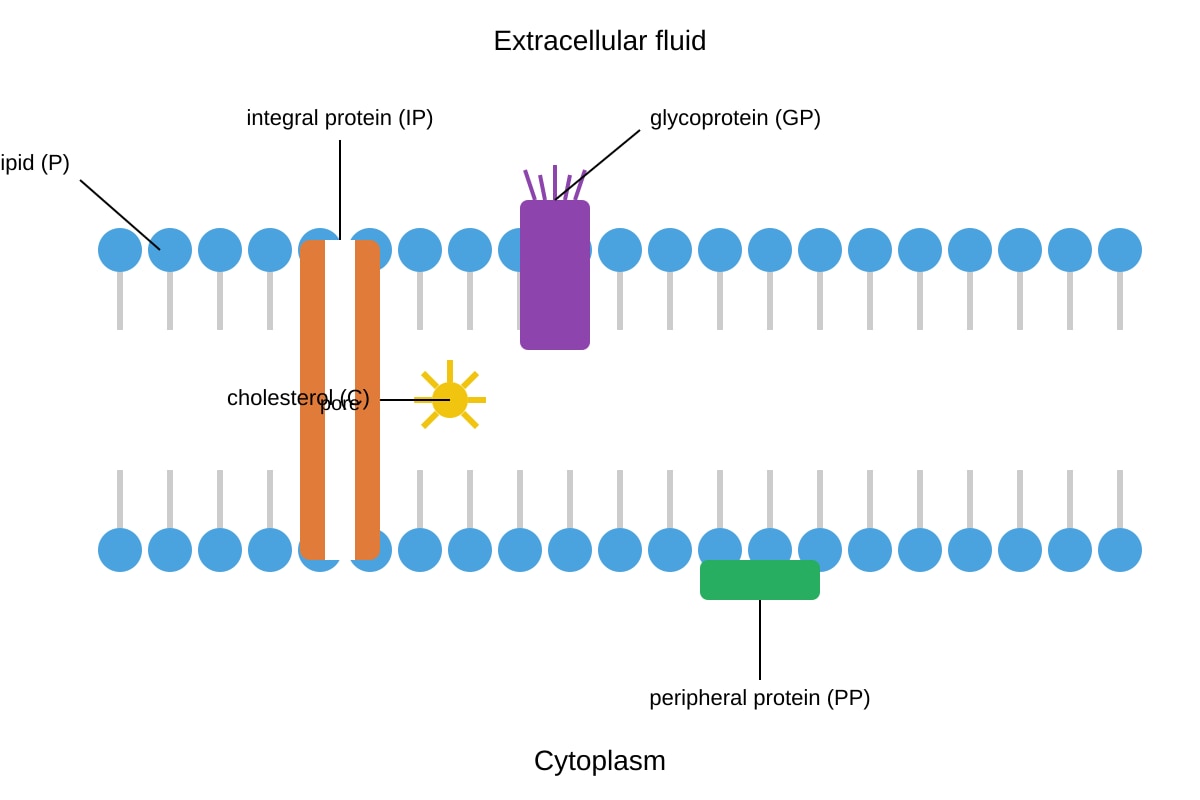
Any two: integral/peripheral proteins, glycoproteins, glycolipids, cholesterol. (1 each)
Teaching note: Fluid mosaic model = phospholipid bilayer with proteins floating like mosaic tiles.
5. [1 mark]
The active site changes shape slightly to better fit the substrate upon binding.
Accept: induced-fit = substrate binding induces conformational change in enzyme.
6. [2 marks]
- Totipotent. (1)
- Can differentiate into all cell types including extra-embryonic tissues (e.g., placenta). (1)
7. [2 marks]
- Mitochondrion (or bacterium if referring to prokaryotic). (1)
- Site of aerobic respiration / ATP production. (1)
Note: Question says circular DNA + 70S ribosomes → typical bacterium; if eukaryote, mitochondrion also has own circular DNA.
8. [1 mark]
Capsid.
Section B (9–14) — Mark Scheme
9. [3 marks]
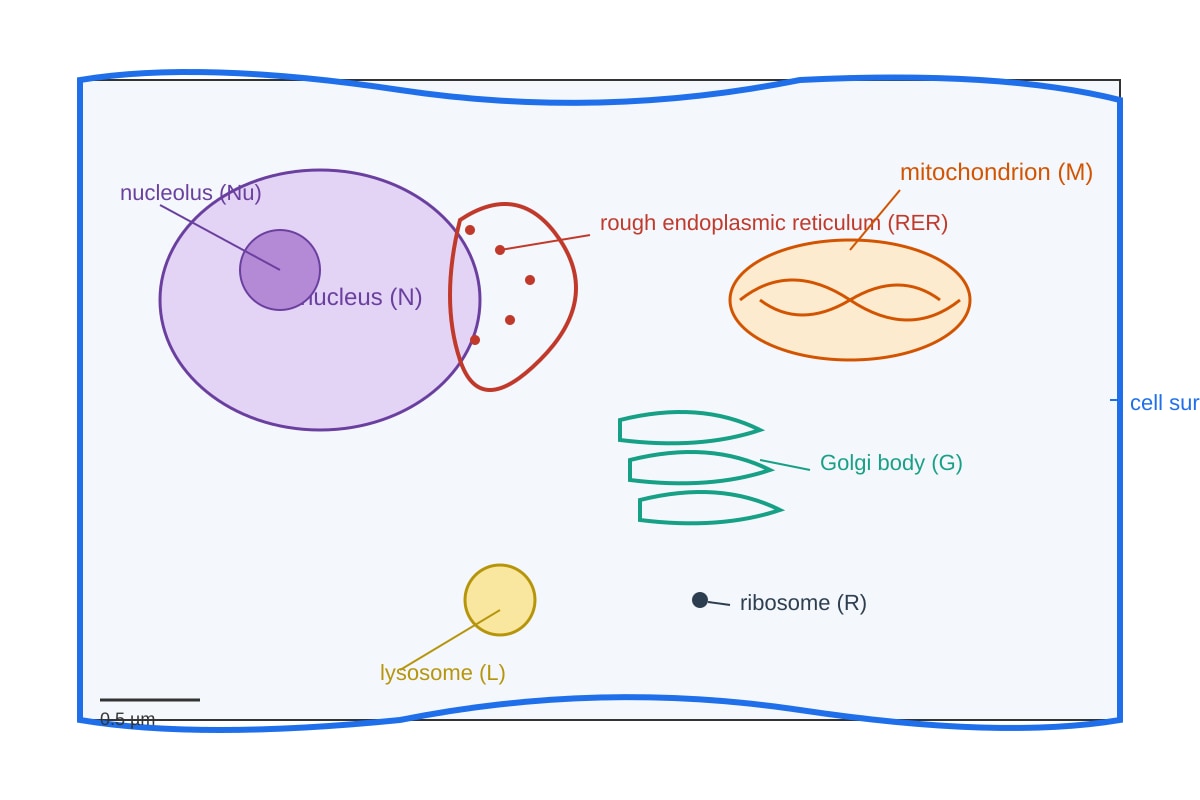
- M = mitochondrion. (1)
- R = ribosome; site of protein synthesis / translation. (2 for identification + role, or 1+1 if split)
Marking: 1 for organelle name, 2 for role description.
10. [3 marks]
- Sodium azide inhibits electron transport chain (cytochrome c oxidase). (1)
- Oxygen is final electron acceptor; blocked ETC stops O₂ consumption. (1)
- Explains lowest rate (0.6) vs control (4.2). (1)
Teaching note: Without ADP, rate low (1.1) because no ATP demand; azide stops proton gradient use entirely.
11. [3 marks]
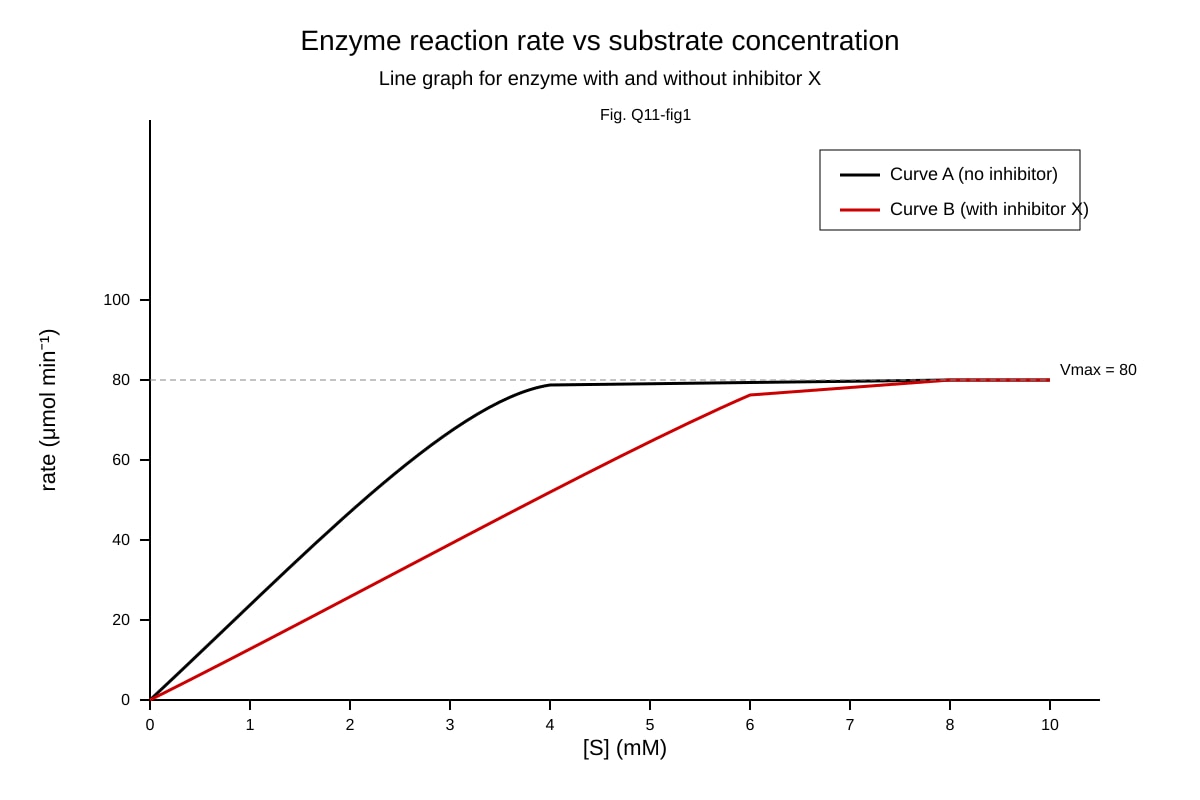
- Km increased (Curve B needs higher [S] for half Vmax). (1)
- Vmax unchanged (both plateau at 80). (1)
- Competitive inhibition. (1)
Teaching note: Competitive inhibitor binds active site; more substrate outcompetes it, so Vmax reachable.
12. [2 marks]
- Glycoprotein has carbohydrate chain external to membrane. (1)
- Acts as recognition site / antigen / receptor for cell–cell signalling. (1)
13. [2 marks]
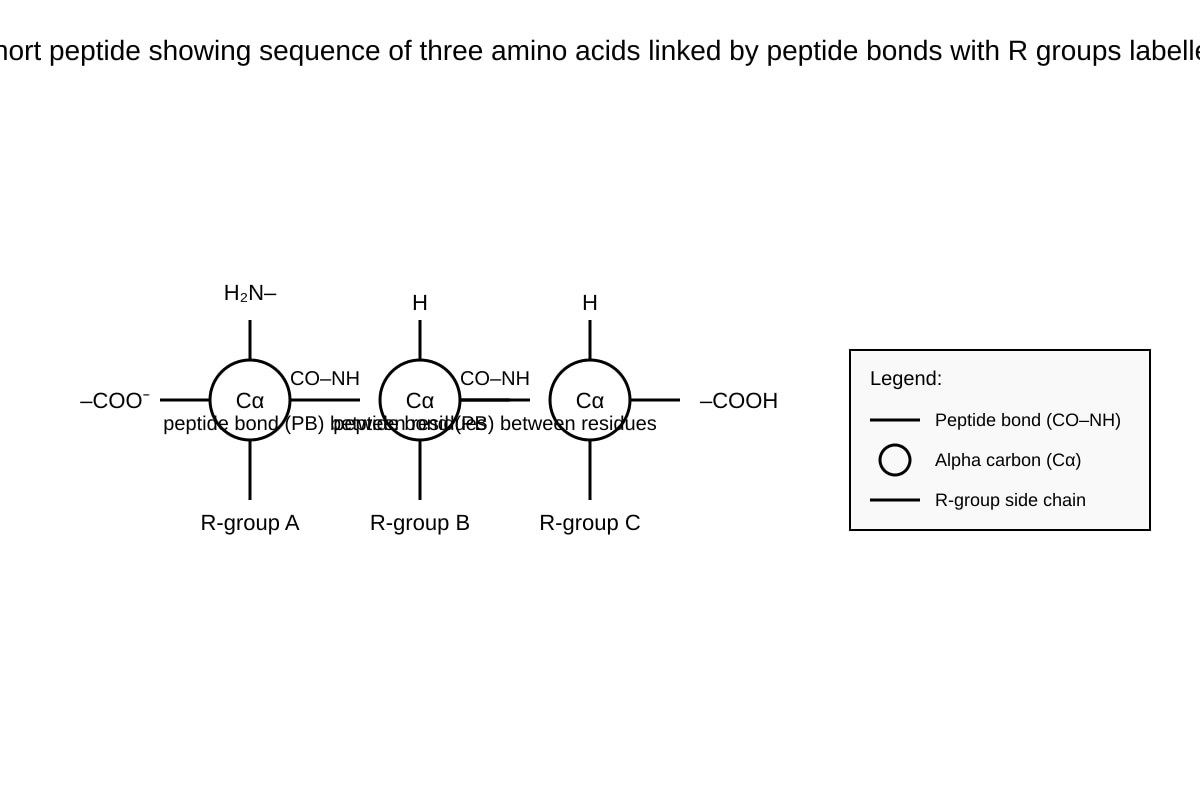
- Secondary: hydrogen bonds between backbone CO and NH. (1)
- Tertiary: hydrophobic interactions / disulfide bridges / ionic bonds between R groups. (1)
14. [3 marks]
- At 80 °C, protein denatured. (1)
- Hydrogen / ionic / disulfide bonds broken, active site lost shape. (1)
- Substrate cannot bind → zero activity. (1)
Section C (15–20) — Mark Scheme
15. [4 marks]
- Mechanism: facilitated diffusion via carrier/channel protein down gradient; active transport via pump against gradient. (1+1)
- Energy: facilitated = none (passive); active = ATP directly. (1)
- Selectivity: both specific to substrate via protein shape; example GLUT1 (glucose) vs Na⁺/K⁺ ATPase. (1)
Marking descriptors: 4 = clear contrast with examples; 2–3 = partial.
16. [3 marks]
- Glycerol + 2 fatty acids + phosphate head (polar). (1)
- Hydrophilic head outward, hydrophobic tails inward → bilayer. (1)
- Unsaturated tails / cholesterol modulate fluidity; kinks prevent packing. (1)
17. [3 marks]
- Quaternary = 4 subunits (2α 2β) each with haem. (1)
- Conformational change on O₂ binding increases affinity (cooperative). (1)
- Globular soluble in RBC, carries O₂ reversibly. (1)
18. [3 marks]
- Viruses are acellular, not composed of cells. (1)
- Cannot self-replicate without host cell machinery. (1)
- Not living because no metabolism / no independent reproduction. (1)
19. [3 marks]
- Multipotent: limited lineages (e.g., blood stem cell → blood cells). (1)
- Pluripotent: all body tissues not extra-embryonic (embryonic stem). (1)
- Totipotent: all incl. extra-embryonic (zygote). (1)
20. [2 marks]
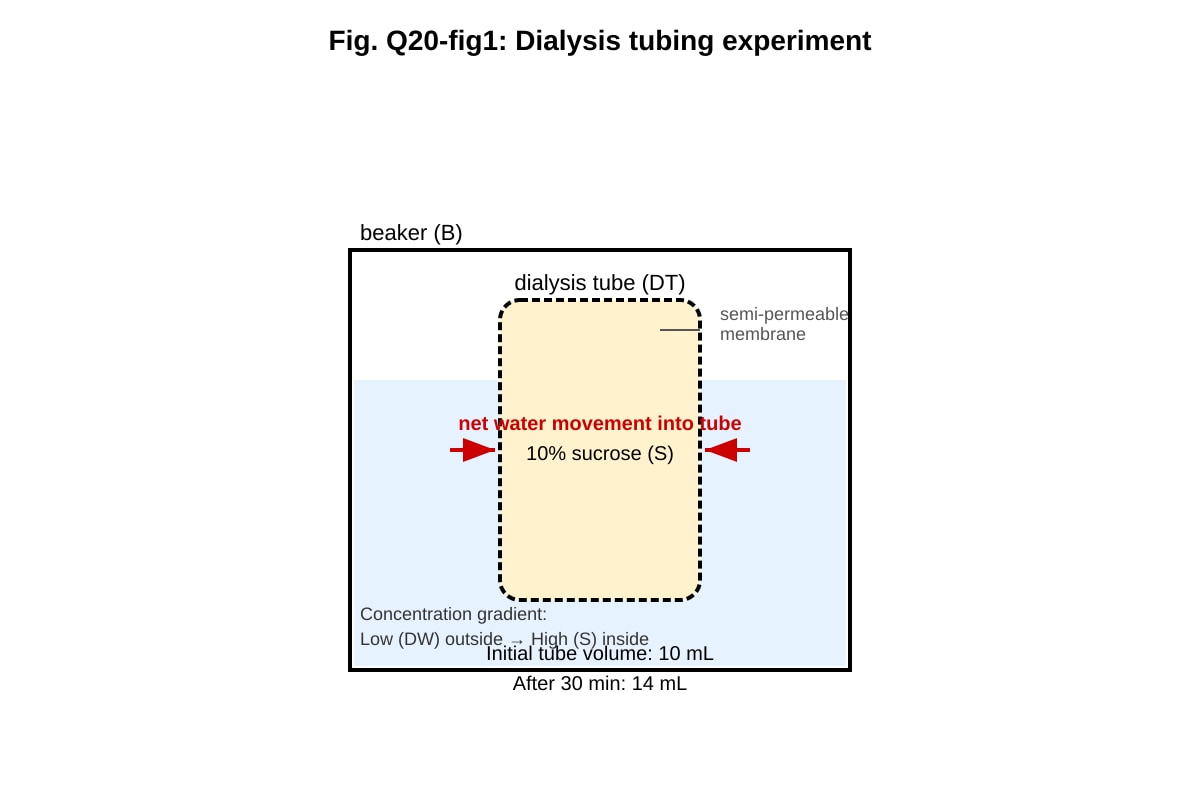
- Osmosis: water moves into tube down water potential gradient. (1)
- % increase = (14−10)/10 × 100 = 40%. (1)
Working: ΔV = 4 mL; 4/10 × 100 = 40%.