From Real Exams Exam Paper
A Level H2 Biology Practice Paper 2
Free A Level H2 Biology Practice Paper 2, HY3 Exam version, with questions, answers, and A Level-style practice for Singapore students.
These static practice materials are generated from the site's syllabus and paper-generation workflow, with source and model context shown so students and parents can evaluate the material before use.
Questions
Free quiz and exam paper access
Enter your details to view this paper
Your access is remembered on this device.
Answers
TuitionGoWhere Exam Practice (AI) — Biology H2 A-Level PRACTICE Paper
Version 2 of 5 — Answer Key
Total Marks: 80
Section A Answers (28 marks)
Q1 [2]
- Presence of membrane-bound organelles (e.g., nucleus, mitochondria) in plant cell, absent in bacterium. [1]
- Presence of a true nucleus with nuclear envelope in plant cell; bacterial DNA is naked/circular in cytoplasm. [1]
Teaching note: Bacteria are prokaryotes; they lack membrane-bound organelles. Plant cells are eukaryotic.
Q2 [4]
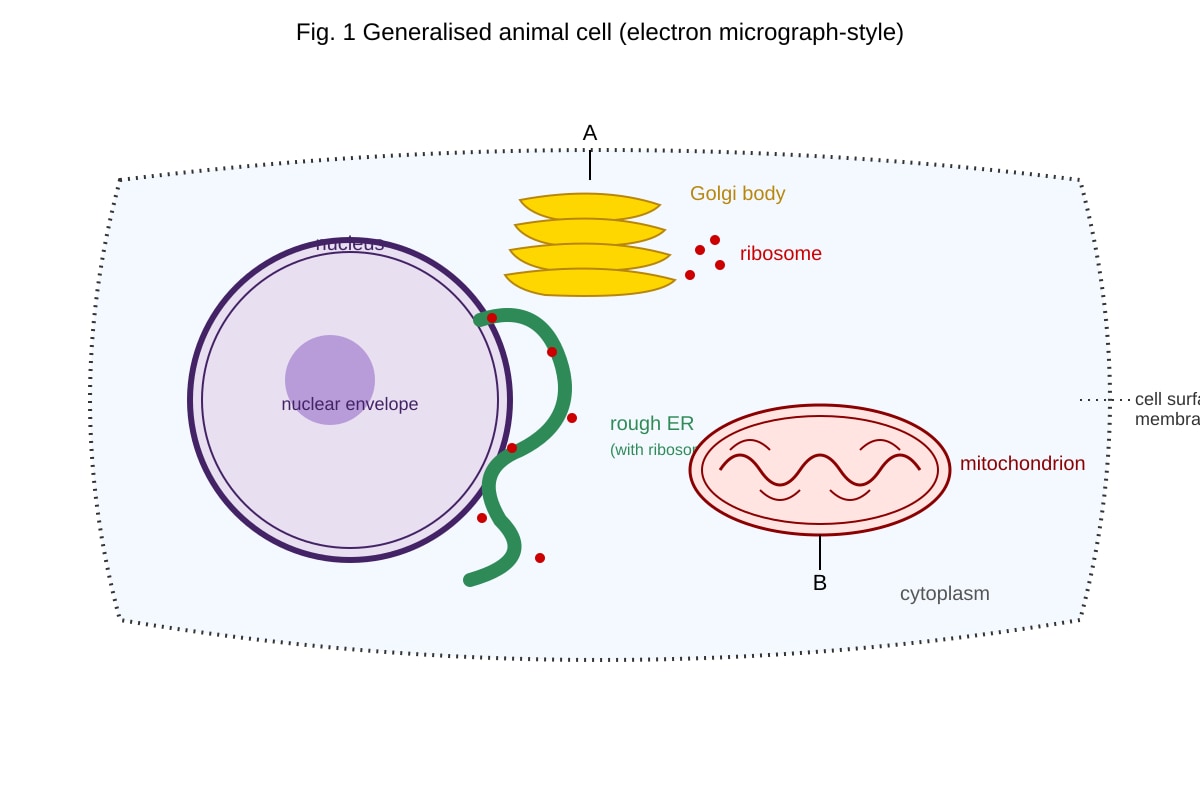
- A: Golgi body (Golgi apparatus) — modifies, sorts, packages proteins into vesicles. [1+1]
- B: Mitochondrion — site of aerobic respiration / ATP production. [1+1]
Marking: Name (1) + function (1) each. Fig shows stacked sacs = Golgi; oval with cristae = mitochondrion.
Q3 [3]
- Cellulose is a polysaccharide of β-glucose linked by β-1,4-glycosidic bonds. [1]
- Straight chains allow hydrogen bonding between adjacent chains forming microfibrils. [1]
- Microfibrils provide tensile strength and rigidity to cell wall. [1]
Common mistake: Confusing with starch (α-glucose, helical, storage).
Q4 [2]
- Products: glycerol + 3 fatty acids. [1]
- Bond: ester bond. [1]
Q5 [4]
- Membrane is a fluid phospholipid bilayer. [1]
- Proteins are embedded/peripheral (mosaic). [1]
- Contains cholesterol (fluidity), glycolipids/glycoproteins (cell recognition). [1]
- Phospholipids mobile laterally; proteins vary in position. [1]
Q6 [2]
- Starch: glycosidic bond. [1]
- Triglyceride: ester bond. [1]
Q7 [3]
- Bacterial DNA is circular and naked; eukaryotic DNA is linear and associated with histones. [1+1]
- Bacteria lack introns; eukaryotes have introns. [1] (or bacteria have single chromosome, eukaryotes multiple)
Any two differences.
Section B Answers (28 marks)
Q8 [2]
- Net movement of water molecules [1]
- from region of higher water potential to lower water potential through selectively permeable membrane. [1]
Q9 [4]
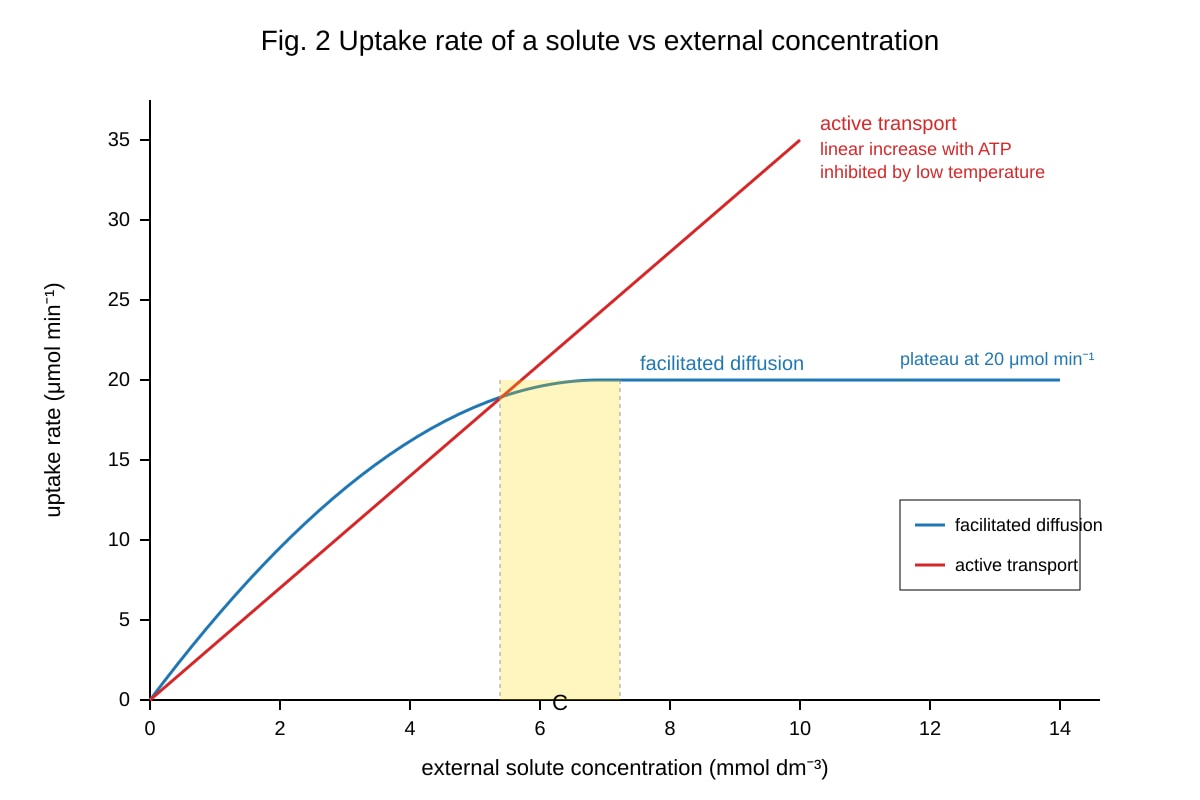
- Facilitated diffusion: down concentration gradient, via channel/carrier, no ATP. [1]
- Active transport: against gradient, requires ATP. [1]
- Fig 2: facilitated diffusion plateaus (saturation of carriers); active transport increases with conc (energy-driven). [1]
- At C, active transport uses pump proteins; facilitated uses passive carriers. [1]
Q10 [3]
- Quaternary: association of two or more polypeptide subunits. [1]
- Haemoglobin has 2α + 2β subunits. [1]
- Allows cooperative binding of O₂; conformational change on binding. [1]
Q11 [3]
- High temp (80 °C) denatures enzyme. [1]
- Disrupts H-bonds, ionic, hydrophobic interactions in tertiary structure. [1]
- Active site lost shape; substrate cannot bind; zero activity. [1]
Q12 [4]
- Hydrogen bond (between polar R groups) [1]
- Ionic bond (between oppositely charged R groups) [1]
- Disulfide bridge (between cysteine residues) [1]
- Hydrophobic interaction (non-polar R groups cluster) [1]
Q13 [3]
- Substrate binds to active site. [1]
- Enzyme changes shape (induced fit) to better fit substrate. [1]
- Lowers activation energy; product released. [1]
Q14 [3]
- Competitive: active site; Vmax unchanged. [1+0.5]
- Non-competitive: allosteric site; Vmax decreased. [1+0.5]
Section C Answers (24 marks)
Q15 [3]
- Envelope (lipid bilayer from host). [1]
- Capsid (protein coat) inside envelope. [1]
- Nucleic acid (DNA or RNA) core. [1]
(Spikes/glycoproteins optional extra)
Q16 [3]
- Cell theory: cells are basic unit of life, from pre-existing cells. [1]
- Viruses are acellular, not made of cells. [1]
- Cannot reproduce independently; need host cell machinery. [1]
Q17 [2]
- Rate at 2 = 22; at 4 = 36. Increase = 14. [1]
- % = (14 / 22) × 100 = 63.6% ≈ 64%. [1]
Answer: 64%.
Q18 [3]
- Non-competitive inhibitor binds allosterically, reduces Vmax. [1]
- Rate halved at same [S] shows Vmax reduced (from ~48 to ~24). [1]
- Km unchanged as affinity unaffected. [1]
Q19 [2]
- Pluripotency: can differentiate into all cell types of body (any germ layer). [1]
- Example: embryonic stem cells. [1]
Q20 [3]
- Type: multipotent. [1]
- Justification: bone marrow stem cells give rise to blood cell lineages only (lymphoid, myeloid), not all tissues. [2]