AI Generated Quiz
A Level H1 Biology Plant Biology Quiz
Free A Level H1 Biology Plant Biology quiz, AI version, with questions, answers, and A Level-style practice for Singapore students.
These static practice materials are generated from the site's syllabus and paper-generation workflow, with source and model context shown so students and parents can evaluate the material before use.
Questions
A-Level Biology H1 Quiz - Plant Biology
Name: _________________________________________ Class: ___________ Date: ___________
Score: ___________ / 50
Duration: 45 minutes
Instructions:
- This quiz consists of 20 questions on Plant Biology.
- Answer all questions in the spaces provided.
- For multiple-choice questions, circle the correct answer.
- For structured and free-response questions, show your working and reasoning where applicable.
- Diagrams may be drawn to illustrate your answers where helpful.
Section A: Multiple-Choice Questions (Questions 1–5, 10 marks)
1. Which of the following is a primary function of the Casparian strip in plant roots? [2]
A) To facilitate the movement of water through the apoplast pathway B) To force water and solutes to enter the symplast pathway C) To provide mechanical support to the endodermal cells D) To secrete suberin into the xylem vessels
Answer: _______
2. The pressure-flow hypothesis describes the mechanism of translocation in phloem. Which of the following statements best explains the role of the companion cell in this process? [2]
A) It provides structural support to the sieve tube elements. B) It actively loads sucrose into the sieve tube elements. C) It synthesises callose to seal damaged sieve plates. D) It transports water into the sieve tube elements by osmosis.
Answer: _______
3. A plant is placed in a solution with a water potential of -800 kPa. The plant's root cells have a water potential of -400 kPa. Which of the following will occur? [2]
A) Water will move from the solution into the root cells by osmosis. B) Water will move from the root cells into the solution by osmosis. C) No net movement of water will occur. D) Solutes will move from the solution into the root cells by active transport.
Answer: _______
4. Which of the following correctly describes the role of abscisic acid (ABA) in plants? [2]
A) It promotes cell elongation in response to auxin. B) It stimulates the closure of stomata during water stress. C) It triggers the ripening of fruits. D) It promotes lateral bud growth.
Answer: _______
5. The transpiration stream is driven primarily by: [2]
A) Active transport of water into root hairs B) Capillary action in the xylem vessels C) The evaporation of water from the mesophyll cell walls in leaves D) Root pressure generated by the endodermis
Answer: _______
Section B: Structured Questions (Questions 6–15, 25 marks)
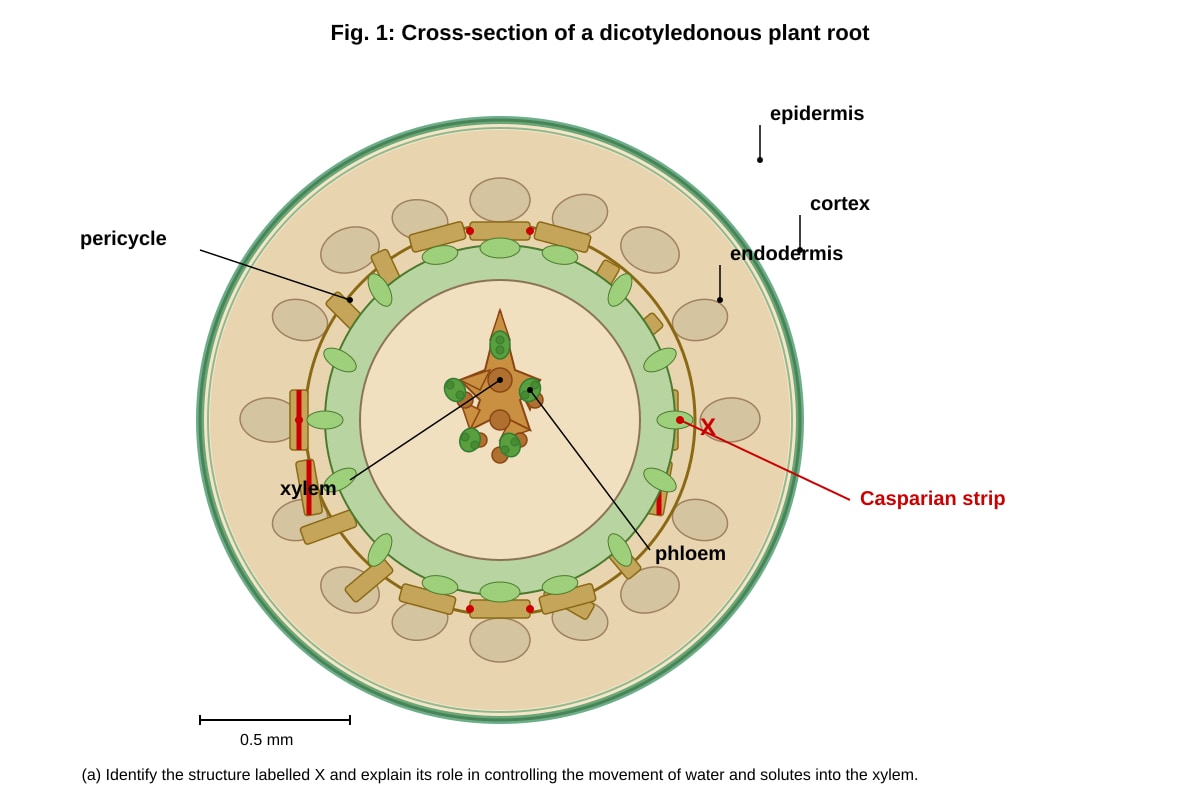
6. Fig. 1 shows a cross-section of a plant root.
Generated diagram for Q6.
(a) Identify the structure labelled X (the Casparian strip) and explain its role in controlling the movement of water and solutes into the xylem. [3]
(b) Describe the difference between the apoplast and symplast pathways for water movement in the root cortex. [2]
7. A student investigates the rate of transpiration in a plant under different environmental conditions. The results are shown in Table 1.
| Condition | Transpiration Rate (cm³ m⁻² h⁻¹) |
|---|---|
| Normal room conditions | 2.5 |
| High humidity | 1.2 |
| Windy conditions | 4.8 |
| Dark room | 1.0 |
(a) Explain why the transpiration rate is highest under windy conditions. [2]
(b) Suggest why the transpiration rate is lowest in the dark room. [2]
8. Describe the structure of a xylem vessel element and explain how its structure is adapted for its function in water transport. [3]
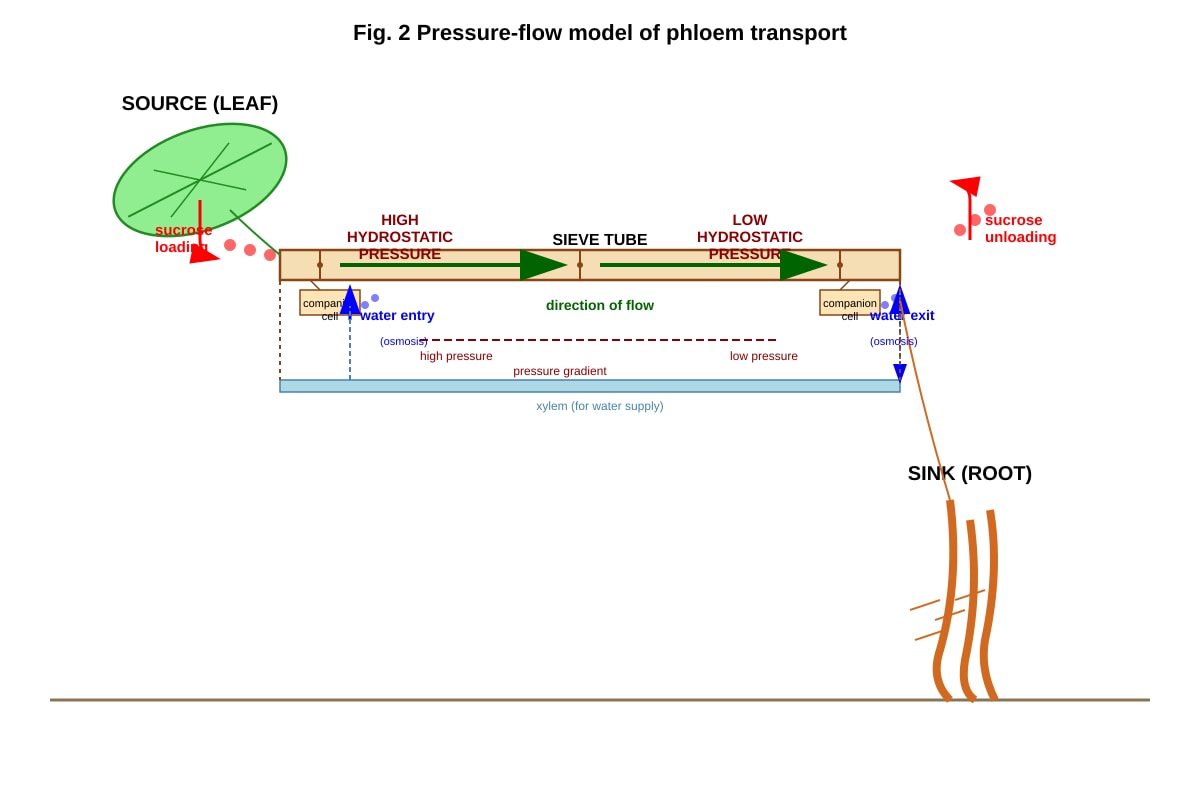
9. Fig. 2 shows the pressure-flow model of phloem transport.
Generated diagram for Q9.
(a) Explain how sucrose is loaded into the sieve tube elements at the source. [2]
(b) Explain how the pressure gradient is maintained between the source and the sink. [2]
10. A plant is grown in soil that has been contaminated with a high concentration of salt. Explain why the plant may wilt even though the soil is moist. [3]
11. Describe the role of the plant hormone auxin in phototropism. [3]
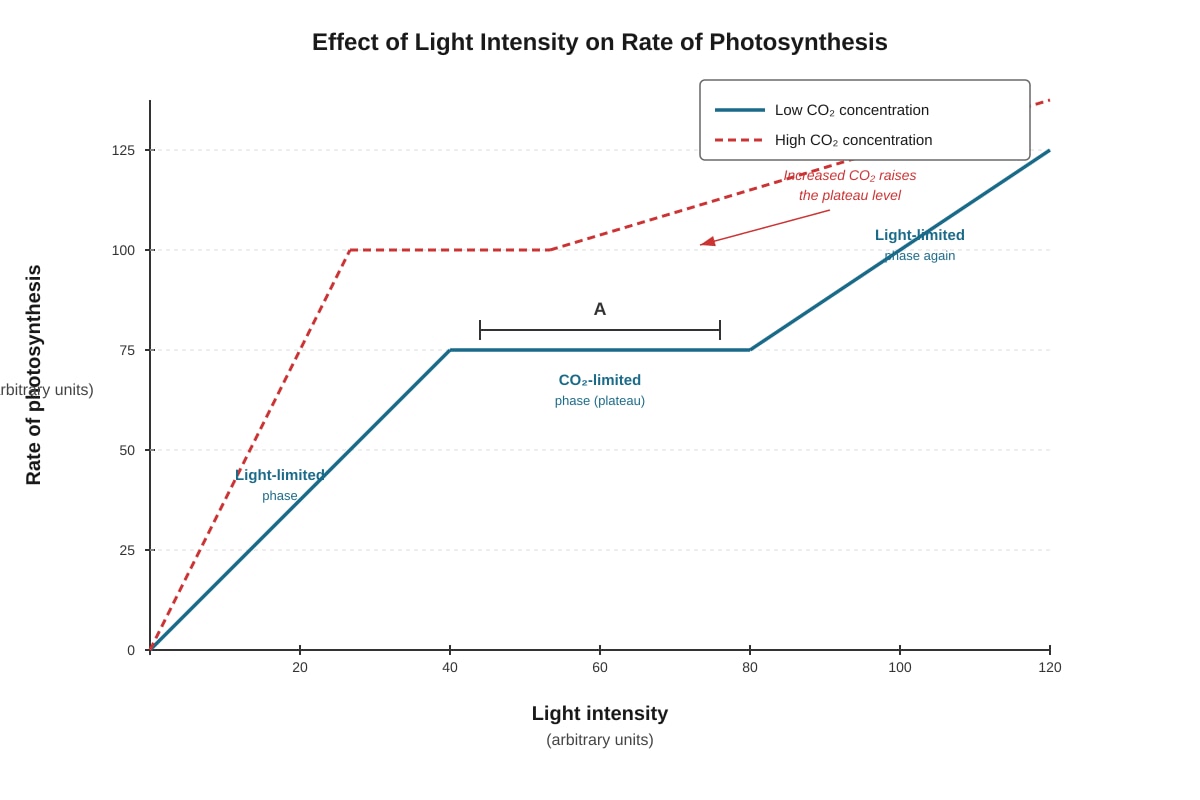
12. Fig. 3 shows a graph of the rate of photosynthesis against light intensity for a plant.
Generated graph for Q12.
(a) Identify the limiting factor in the region labelled A (the plateau). [1]
(b) Explain why the rate of photosynthesis increases when the CO₂ concentration is increased at high light intensities. [2]
13. Explain how the structure of a chloroplast is adapted for the light-dependent reactions of photosynthesis. [3]
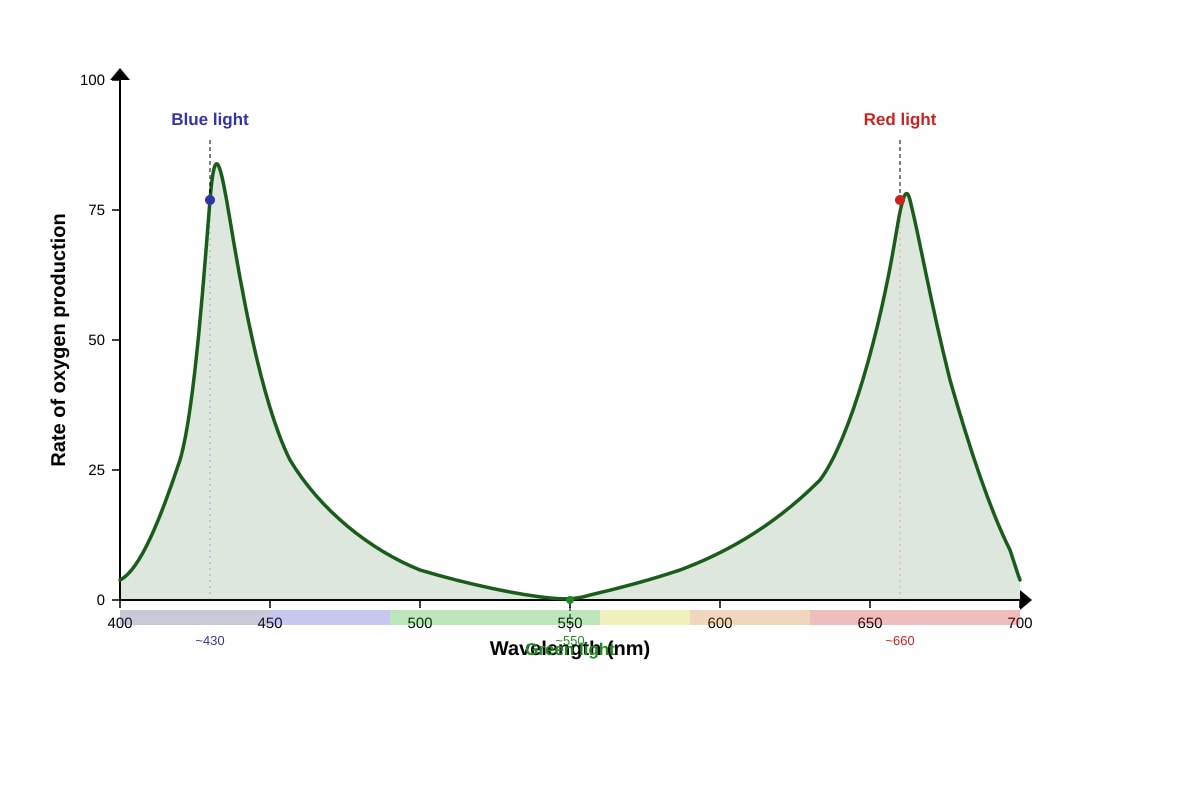
14. A student measures the rate of oxygen production in a plant at different wavelengths of light. The results are shown in Fig. 4.
Generated graph for Q14.
(a) Explain why the rate of oxygen production is highest in the blue and red regions of the spectrum. [2]
(b) Suggest why the rate of oxygen production is low in the green region. [1]
15. Describe the process of nitrogen fixation in the root nodules of leguminous plants and explain its importance to plant growth. [3]
Section C: Free-Response Question (Questions 16–20, 15 marks)
Answer one question from this section. Your answer should be in continuous prose, with clear scientific reasoning and well-structured arguments. Quality of written communication will be assessed.
16. Describe how water is transported from the soil to the leaves of a tall tree, explaining the roles of root pressure, cohesion-tension theory, and transpiration pull. [15]
OR
17. Explain how the structure and function of xylem and phloem are adapted to their roles in long-distance transport in plants. [15]
OR
18. Discuss the roles of plant hormones (auxins, gibberellins, abscisic acid, and ethene) in the growth, development, and responses of plants to environmental stimuli. [15]
OR
19. Describe the process of photosynthesis, including the light-dependent and light-independent reactions, and explain how environmental factors affect the rate of photosynthesis. [15]
OR
20. Explain how plants obtain and transport mineral ions from the soil, and discuss the importance of these ions for plant growth and development. [15]
Answer for Question _____ :
<stage5_quiz_md>
Free quiz and exam paper access
Enter your details to view this paper
Your access is remembered on this device.