AI Generated Quiz
A Level H1 Biology Plant Biology Quiz
Free A Level H1 Biology Plant Biology quiz, AI version, with questions, answers, and A Level-style practice for Singapore students.
These static practice materials are generated from the site's syllabus and paper-generation workflow, with source and model context shown so students and parents can evaluate the material before use.
Questions
Free quiz and exam paper access
Enter your details to view this paper
Your access is remembered on this device.
Answers
A-Level Biology H1 Quiz - Plant Biology: Answer Key
Total Marks: 50
Section A: Multiple-Choice Questions (Questions 1–5, 10 marks)
1. B) To provide structural support and maintain cell shape [2 marks]
Explanation: The cellulose cell wall is a rigid structure that surrounds the plant cell membrane. Its primary function is to provide structural support and maintain the shape of the cell. Cellulose is a polysaccharide made of β-glucose monomers, forming strong microfibrils that resist turgor pressure. Option A describes the function of the cell membrane, not the cell wall. Option C is the function of chloroplasts. Option D is the function of the nucleus.
Common mistake: Students often confuse the functions of the cell wall and cell membrane. The cell wall is permeable and does not control movement; the cell membrane does.
2. C) Osmosis [2 marks]
Explanation: Water moves from the soil into root hair cells by osmosis. Osmosis is the net movement of water molecules from a region of higher water potential (dilute solution, e.g., soil water) to a region of lower water potential (more concentrated solution, e.g., root hair cell sap) across a partially permeable membrane. The root hair cell has a higher solute concentration than the soil water, creating a water potential gradient.
Common mistake: Students may confuse osmosis with active transport. Active transport requires energy and moves substances against a concentration gradient, whereas water moves passively by osmosis.
3. B) Xylem [2 marks]
Explanation: Xylem tissue is responsible for the transport of water and dissolved mineral salts from the roots to the leaves. Xylem vessels are dead, hollow tubes with lignified walls that provide strength and prevent collapse. The movement of water is driven by transpiration pull. Phloem (A) transports sucrose and other organic compounds. Cambium (C) is a meristematic tissue. Epidermis (D) is a protective layer.
Common mistake: Students often mix up xylem and phloem functions. Remember: xylem transports water and minerals (upwards), phloem transports food (in all directions).
4. A) Transpiration [2 marks]
Explanation: Transpiration is the loss of water vapour from the aerial parts of a plant, mainly through the stomata in leaves. It is a passive process driven by evaporation. Translocation (B) is the transport of organic solutes in the phloem. Evaporation (C) is the physical process of liquid turning to vapour. Condensation (D) is the opposite process.
Common mistake: Students may confuse transpiration with evaporation. Transpiration is a biological process that includes evaporation but also involves the plant's control mechanisms (stomatal opening/closing).
5. C) ATP and NADPH [2 marks]
Explanation: The light-dependent stage of photosynthesis occurs in the thylakoid membranes of chloroplasts. Light energy is absorbed by chlorophyll and used to produce ATP (via photophosphorylation) and NADPH (via the reduction of NADP⁺). These are energy carriers used in the light-independent stage (Calvin cycle) to fix carbon dioxide into glucose. Oxygen is a by-product, not a product used in the next stage. Glucose (A) is produced in the light-independent stage.
Common mistake: Students may think oxygen is the main product. While oxygen is released, the key products that drive the rest of photosynthesis are ATP and NADPH.
Section B: Structured Questions (Questions 6–15, 25 marks)
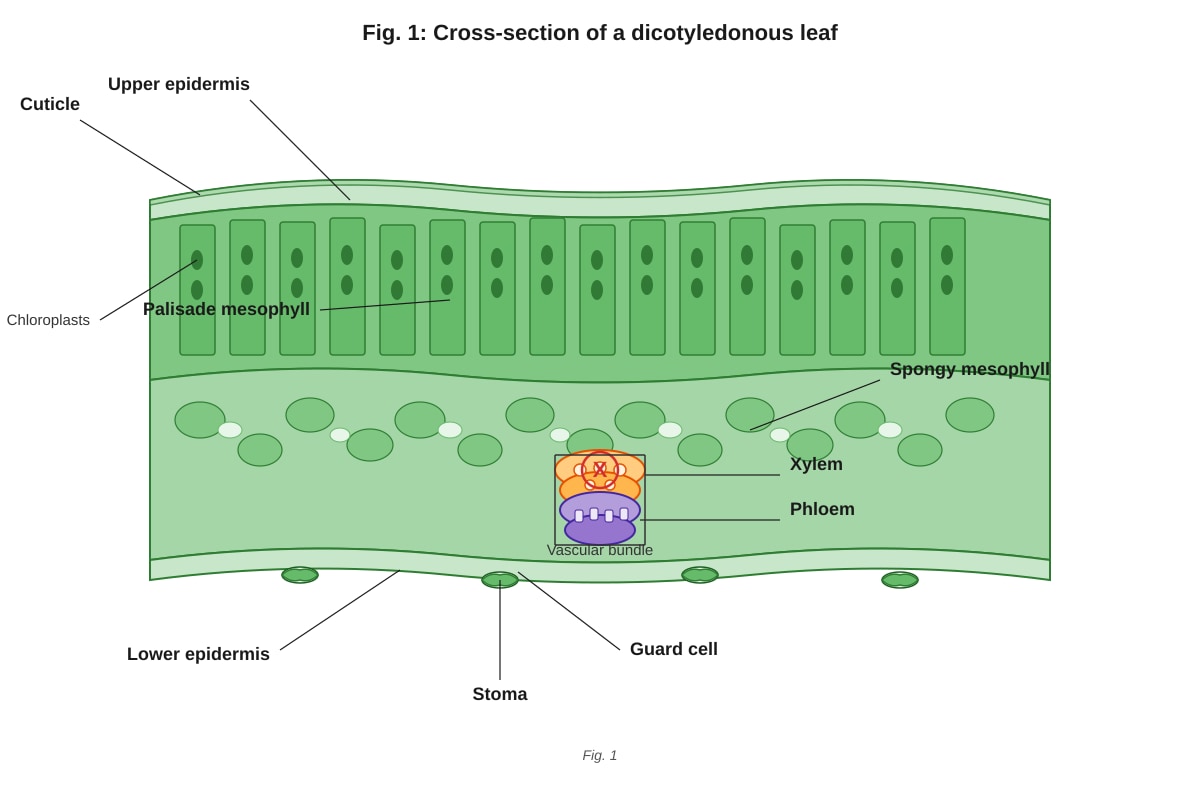
6. (a) Tissue X is the xylem. [1 mark] Its function is to transport water and dissolved mineral salts from the roots to the leaves and to provide structural support. [1 mark] [Total: 2 marks]
Explanation: The xylem is typically located in the vascular bundle towards the upper side of the leaf (in a dicot leaf). It consists of dead, hollow vessels with lignified walls.
(b) The palisade mesophyll is adapted for photosynthesis because: [3 marks]
- Elongated, columnar cells packed closely together, maximizing the number of cells per unit area for light absorption. [1 mark]
- Many chloroplasts located near the cell surface to capture maximum light energy. [1 mark]
- Thin cell walls allow rapid diffusion of carbon dioxide into the cells. [1 mark]
Explanation: The palisade mesophyll is the main photosynthetic tissue in a leaf. Its adaptations are all about maximizing light capture and gas exchange. Students should link structure to function for each point.
Marking notes: Award 1 mark for each valid adaptation with explanation. Accept other valid points such as: large vacuole to push chloroplasts towards cell surface; transparent upper epidermis to allow light penetration.
7. Water transport from roots to leaves involves the following steps: [4 marks]
- Water enters root hair cells by osmosis from the soil. [1 mark]
- Water moves across the root cortex via the apoplast (through cell walls) and symplast (through cytoplasm) pathways until it reaches the xylem. [1 mark]
- Water is pulled up the xylem vessels by transpiration pull: evaporation of water from leaves creates a negative pressure (tension) that draws water upwards. [1 mark]
- Cohesion between water molecules (hydrogen bonding) and adhesion to xylem walls maintains a continuous water column. [1 mark]
Explanation: This is the cohesion-tension theory. Students should mention the key concepts: transpiration pull, cohesion, adhesion, and the continuous water column. The process is passive and does not require energy from the plant.
Common mistake: Students may incorrectly state that water is "pushed" up by root pressure. While root pressure exists, it is not the main mechanism for tall trees; transpiration pull is the dominant force.
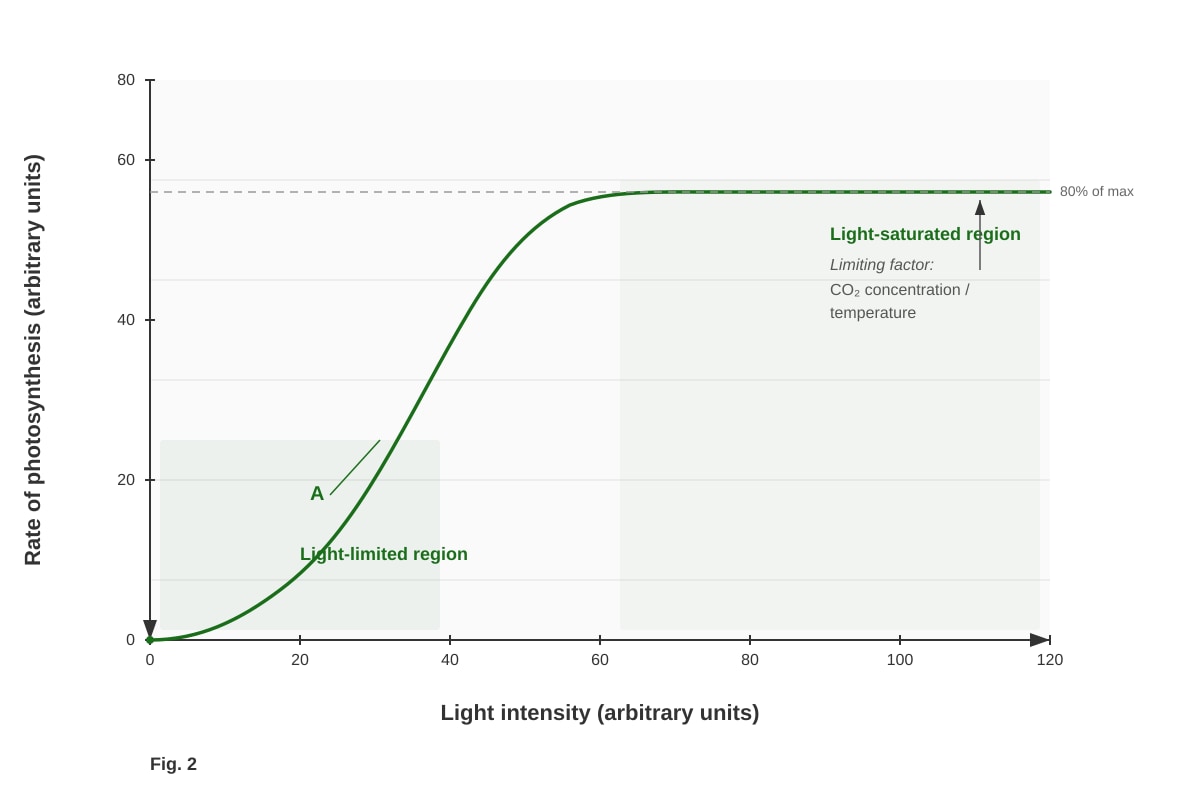
8. (a) The limiting factor in region A is light intensity. [1 mark]
Explanation: In the light-limited region, the rate of photosynthesis increases linearly with light intensity because light is the factor in shortest supply. Increasing light provides more energy for the light-dependent reactions.
(b) The rate of photosynthesis plateaus at high light intensities because another factor becomes limiting. [1 mark] This could be carbon dioxide concentration or temperature (affecting enzyme activity). At this point, increasing light intensity no longer increases the rate because the Calvin cycle is saturated with ATP and NADPH, and the fixation of CO₂ becomes the rate-limiting step. [1 mark] [Total: 2 marks]
Explanation: This is a classic photosynthesis graph. Students must understand the concept of limiting factors. The plateau indicates that light is no longer limiting; another factor (CO₂, temperature) is now in shortest supply.
Common mistake: Students may say the plant is "tired" or "damaged." The correct explanation is that another factor is limiting.
9. Root hair cells are adapted for absorption by: [3 marks]
- Long, thin extensions (root hairs) that greatly increase the surface area for absorption of water and mineral ions. [1 mark]
- Thin cell walls that reduce the distance for diffusion/osmosis. [1 mark]
- Many mitochondria to provide ATP for active transport of mineral ions against their concentration gradient. [1 mark]
Explanation: Root hairs are specialized epidermal cells. The key adaptations are about maximizing surface area and minimizing diffusion distance. Active transport of minerals creates a low water potential in the cell, driving water uptake by osmosis.
Marking notes: Award 1 mark for each valid adaptation with explanation. Accept: large permanent vacuole maintaining water potential gradient; high concentration of solutes in cell sap.
10. Comparison of xylem and phloem: [4 marks]
| Feature | Xylem | Phloem |
|---|---|---|
| Structure | Dead, hollow cells with lignified walls; no cytoplasm | Living cells with sieve tubes and companion cells; sieve plates at ends |
| Function | Transports water and mineral salts (upwards) | Transports sucrose and amino acids (in all directions) |
| Direction of flow | Unidirectional (roots to leaves) | Bidirectional (sources to sinks) |
| Cell type | Vessels and tracheids | Sieve tube elements and companion cells |
Explanation: Students should provide at least two structural and two functional differences. The key difference is that xylem is dead and transports water, while phloem is living and transports food.
Marking notes: Award 1 mark for each valid comparison point (up to 4 marks). Accept tabular or paragraph format.
11. Stomata are small pores (usually on the lower epidermis of leaves) that allow: [2 marks]
- Gas exchange: Carbon dioxide enters for photosynthesis, and oxygen exits as a by-product. [1 mark]
- Transpiration: Water vapour exits the leaf, creating transpiration pull that drives water transport. [1 mark]
Explanation: Stomata are essential for both gas exchange and water regulation. Guard cells control the opening and closing of the stomatal pore.
Common mistake: Students may only mention one function. Both gas exchange and transpiration are key roles.
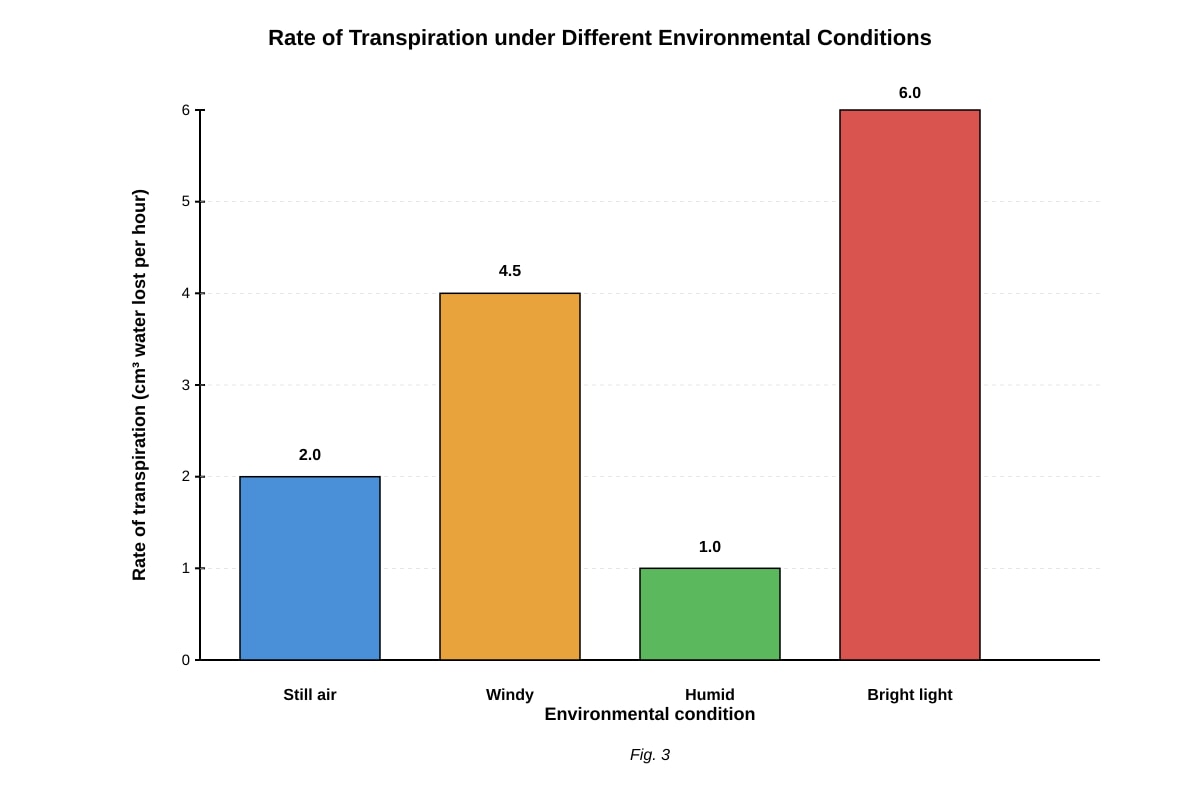
12. (a) Bright light resulted in the highest rate of transpiration (6.0 cm³ water lost per hour). [1 mark]
Explanation: Light stimulates stomatal opening, increasing the surface area for water vapour loss. Light also provides energy for evaporation.
(b) The rate of transpiration is lowest under humid conditions because: [2 marks]
- The air outside the leaf has a high water vapour concentration, so the water potential gradient between the leaf interior and the outside air is small. [1 mark]
- A smaller gradient means a slower rate of diffusion of water vapour out of the leaf. [1 mark]
Explanation: Transpiration is driven by the water potential gradient. High humidity reduces this gradient, slowing water loss. This is why plants in humid environments transpire less.
Common mistake: Students may say that humidity "blocks" the stomata. The correct explanation involves the concentration gradient.
13. The pigment is chlorophyll. [1 mark] It is located in the thylakoid membranes of the chloroplast. [1 mark] [Total: 2 marks]
Explanation: Chlorophyll is the primary photosynthetic pigment. It absorbs light energy (mainly red and blue wavelengths) and converts it to chemical energy. It is embedded in the thylakoid membranes where the light-dependent reactions occur.
Common mistake: Students may say chlorophyll is in the "chloroplast" without specifying the thylakoid membrane. Be precise.
14. Plants need to transport sucrose from leaves (sources) to other parts (sinks) because: [2 marks]
- Leaves produce sucrose during photosynthesis, but other parts of the plant (roots, fruits, developing leaves) cannot photosynthesize and need a supply of energy. [1 mark]
- Sucrose is a stable, soluble form of carbohydrate that can be transported efficiently in the phloem. [1 mark]
Explanation: This is the concept of source-sink relationships in translocation. Sucrose is the main transport sugar because it is less reactive than glucose and can be transported efficiently.
Common mistake: Students may say "glucose" is transported. In plants, sucrose is the main transport carbohydrate.
15. Magnesium is a component of the chlorophyll molecule. [1 mark] A symptom of magnesium deficiency is yellowing of leaves (chlorosis) , especially between the veins. [1 mark] [Total: 2 marks]
Explanation: Magnesium is an essential macronutrient. Without it, chlorophyll cannot be synthesized, leading to chlorosis. Other symptoms include stunted growth and reduced photosynthesis.
Common mistake: Students may say magnesium is needed for "green color" without linking it to chlorophyll structure. Be specific: magnesium is the central atom in the chlorophyll molecule.
Section C: Data-Based and Extended Response Questions (Questions 16–20, 15 marks)
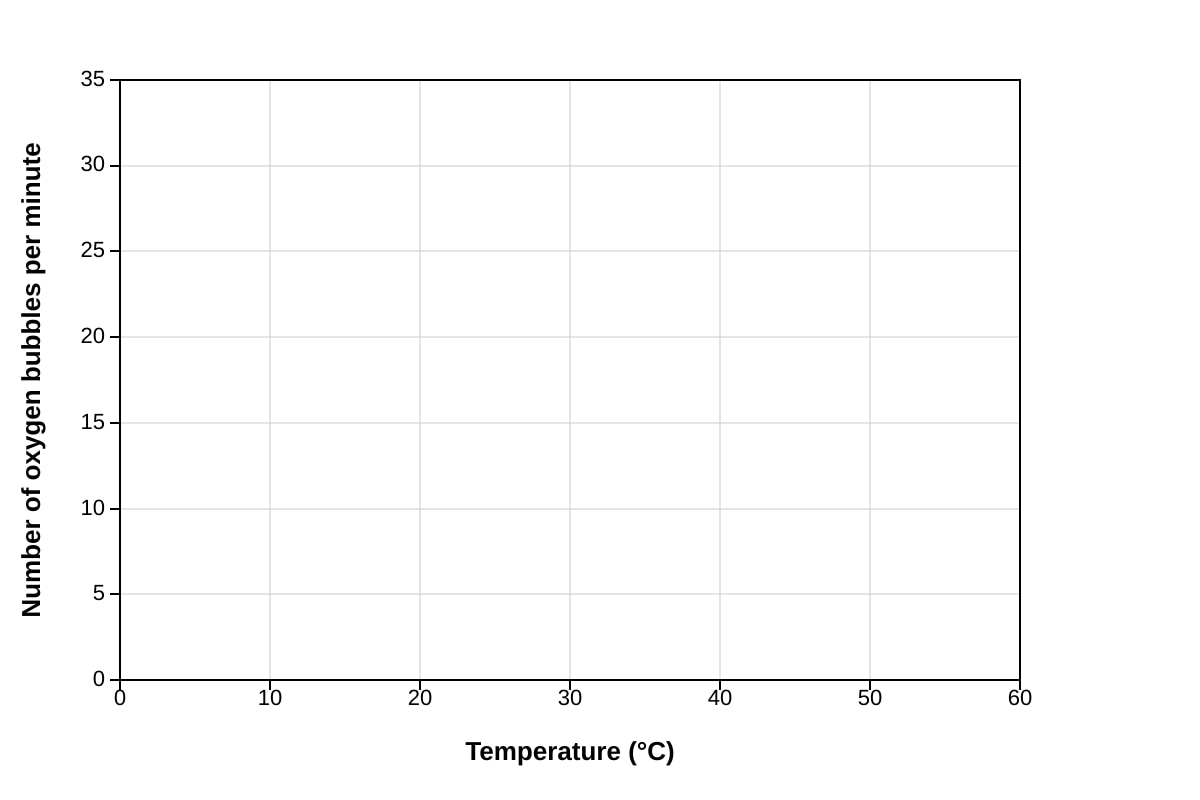
16. (a) Graph plotting: [3 marks]
- Axes correctly labelled with units: Temperature (°C) on x-axis, Number of oxygen bubbles per minute on y-axis. [1 mark]
- Points correctly plotted from Table 1: (10,5), (20,12), (30,20), (40,28), (50,10). [1 mark]
- Smooth curve drawn through the points (not straight line segments). [1 mark]
Explanation: The graph should show a clear trend: increasing rate from 10°C to 40°C, then a sharp decrease at 50°C. The curve should be smooth, not jagged.
Marking notes: Deduct marks for missing labels, incorrect scaling, or points plotted inaccurately.
(b) From 10°C to 40°C, the rate of photosynthesis increases because: [2 marks]
- Increasing temperature increases the kinetic energy of molecules, leading to more frequent collisions between enzymes and substrates. [1 mark]
- This increases the rate of enzyme-catalysed reactions in photosynthesis (both light-dependent and light-independent stages). [1 mark]
Explanation: This is the typical effect of temperature on enzyme activity up to the optimum. Students should link temperature to enzyme kinetics.
(c) At 50°C, the rate of photosynthesis decreased because: [2 marks]
- The high temperature has denatured the enzymes involved in photosynthesis (e.g., Rubisco in the Calvin cycle). [1 mark]
- Denaturation involves the breakdown of hydrogen bonds and other interactions that maintain the enzyme's active site shape, making it non-functional. [1 mark]
Explanation: 50°C is above the optimum temperature for most plant enzymes. Denaturation is irreversible and causes a sharp drop in activity.
Common mistake: Students may say the plant "dies" at 50°C. The specific mechanism is enzyme denaturation.
17. The chloroplast is adapted for photosynthesis by: [3 marks]
- Thylakoid membranes (grana) provide a large surface area for the light-dependent reactions and contain chlorophyll and electron transport chain components. [1 mark]
- Stroma contains enzymes for the Calvin cycle (light-independent reactions) and is the site of CO₂ fixation. [1 mark]
- Double membrane controls the entry and exit of substances, maintaining the internal environment for efficient photosynthesis. [1 mark]
Explanation: Chloroplasts are highly organized organelles. Students should link each structural feature to its specific function in photosynthesis.
Marking notes: Award 1 mark for each valid adaptation with explanation. Accept: presence of starch grains for temporary storage; lipid droplets for membrane synthesis.
18. Stomatal opening and closing are regulated by changes in the turgor pressure of guard cells: [3 marks]
- Opening: When guard cells take up potassium ions (K⁺) actively, their water potential decreases. Water enters by osmosis, making them turgid. The thin outer walls bulge out, pulling the thick inner walls apart, opening the stoma. [1.5 marks]
- Closing: When guard cells lose K⁺, water leaves by osmosis, making them flaccid. The guard cells become less curved, closing the stoma. [1.5 marks]
Explanation: This is the mechanism of stomatal regulation. Factors that influence opening include light (stimulates K⁺ uptake), CO₂ concentration (low CO₂ promotes opening), and water availability (water stress causes closure).
Common mistake: Students may describe the change in shape without explaining the ionic/osmotic mechanism. The K⁺ ion movement is the key driver.
19. Two possible mineral deficiencies causing yellow leaves: [2 marks]
- Magnesium deficiency: Magnesium is needed for chlorophyll synthesis. Without it, leaves become yellow (chlorosis). [1 mark]
- Nitrogen deficiency: Nitrogen is a component of proteins, including enzymes and chlorophyll. Deficiency leads to stunted growth and yellowing of older leaves. [1 mark]
Explanation: Both magnesium and nitrogen are essential for chlorophyll production. Iron deficiency can also cause chlorosis, but iron is needed for chlorophyll synthesis, not as a component.
Marking notes: Award 1 mark for each valid deficiency with explanation. Accept iron deficiency with correct explanation.
20. Importance of transpiration for plant survival: [3 marks]
- Transpiration pull is the main force that draws water and dissolved mineral salts up the xylem from roots to leaves, enabling all cells to receive water. [1 mark]
- Evaporative cooling: Transpiration removes excess heat from leaves, preventing overheating and protein denaturation. [1 mark]
- Maintains cell turgidity: Water loss creates a continuous demand for water uptake, helping maintain turgor pressure in cells, which is essential for structural support and growth. [1 mark]
Explanation: Transpiration is often seen as a "necessary evil" – it is unavoidable because stomata must be open for gas exchange. However, it has important benefits for the plant.
Marking notes: Award 1 mark for each valid point with explanation. Accept: facilitates mineral transport; maintains water potential gradient for water uptake.
End of Answer Key