AI Generated Quiz
A Level H1 Biology Human Physiology Quiz
Free A Level H1 Biology Human Physiology quiz, LongCat AI version, with questions, answers, and A Level-style practice for Singapore students.
These static practice materials are generated from the site's syllabus and paper-generation workflow, with source and model context shown so students and parents can evaluate the material before use.
Questions
Free quiz and exam paper access
Enter your details to view this paper
Your access is remembered on this device.
Answers
A-Level Biology H1 Quiz - Human Physiology
Answer Key
Section A: Multiple Choice Questions
1. C — Inflammation at the site of infection [1]
Explanation: The innate immune response is the body's non-specific, immediate defence. Inflammation (redness, swelling, heat, pain) is a hallmark of innate immunity, triggered by histamine release from mast cells and increased blood flow to the infected area. Options A, B, and D are all features of the adaptive (specific) immune response, which takes days to develop and involves antigen-specific recognition, clonal expansion, and memory cell formation.
2. C — IgG [1]
Explanation: IgG is the most abundant antibody in the blood and is the primary antibody produced during the secondary immune response. It is smaller than IgM and can cross the placenta to provide passive immunity to the foetus. IgM is produced first in the primary response. IgA is found in mucosal secretions (e.g., saliva, tears). IgD functions mainly as a B cell receptor.
3. C — An organism or agent that causes disease [1]
Explanation: A pathogen is any biological agent (bacterium, virus, fungus, parasite, prion) that can cause disease in a host. Not all microorganisms are pathogens — many are harmless or beneficial (e.g., gut flora). An antigen is a molecule that triggers an immune response, which may or may not come from a pathogen.
4. C — They release cytokines that activate B lymphocytes and cytotoxic T lymphocytes. [1]
Explanation: Helper T lymphocytes (CD4⁺ T cells) are central coordinators of the adaptive immune response. When activated by antigen-presenting cells, they release cytokines (chemical signals) that stimulate B cells to differentiate into plasma cells and cytotoxic T cells (CD8⁺) to kill infected cells. Option A describes cytotoxic T cells. Option B describes plasma cells (derived from B cells). Option D describes phagocytes such as macrophages and neutrophils.
5. B — Stimulating the production of memory cells specific to the pathogen [1]
Explanation: Vaccines contain antigens (from attenuated pathogens, dead pathogens, or subunit proteins) that mimic infection without causing disease. This triggers a primary immune response, generating memory B and T cells. Upon subsequent exposure to the real pathogen, these memory cells enable a faster, stronger secondary response. Vaccines do not kill existing pathogens (A), affect red blood cells (C), or non-specifically activate phagocytes (D).
6. B — Tuberculosis [1]
Explanation: Tuberculosis is caused by the bacterium Mycobacterium tuberculosis. Influenza (A) and COVID-19 (D) are caused by viruses. AIDS is caused by the human immunodeficiency virus (HIV). This distinction is important because bacterial infections can be treated with antibiotics, whereas viral infections cannot.
7. C — IgE [1]
Explanation: IgE antibodies bind to receptors on mast cells and basophils. When an allergen cross-links IgE molecules on the mast cell surface, it triggers degranulation — the release of histamine and other inflammatory mediators. This causes the symptoms of an allergic reaction (e.g., hay fever, asthma, anaphylaxis). IgG, IgA, and IgM do not trigger histamine release from mast cells.
8. C — Skin and mucous membranes [1]
Explanation: The first line of defence consists of physical and chemical barriers that prevent pathogens from entering the body. The skin provides a tough, keratinised barrier. Mucous membranes (in the respiratory, digestive, and urogenital tracts) secrete mucus that traps pathogens, and contain antimicrobial substances such as lysozyme. Antibodies (A), T lymphocytes (B), and memory B cells (D) are all part of the adaptive immune response, which is activated only after pathogens breach these barriers.
9. B — Allows the virus to evade the host's existing memory cells [1]
Explanation: Antigenic variation occurs when the surface antigens (e.g., haemagglutinin and neuraminidase on influenza viruses) change through mutation (antigenic drift) or reassortment (antigenic shift). Memory cells generated from a previous infection or vaccination recognise the original antigens. If the antigens have changed, the memory cells may not recognise the new strain, allowing the virus to cause infection. This is why flu vaccines are updated annually.
10. C — It involves the transfer of ready-made antibodies from another source. [1]
Explanation: Passive immunity occurs when an individual receives antibodies produced by another organism, rather than producing their own. Examples include maternal IgG crossing the placenta to the foetus, IgA in breast milk, and injection of antiserum (e.g., anti-tetanus immunoglobulin). Passive immunity is temporary because the antibodies are gradually broken down and no memory cells are formed. Options A, B, and D describe active immunity.
Section B: Structured Questions
11. (a) Any TWO of the following: [1] each, [2] total
| Innate Immunity | Adaptive Immunity |
|---|---|
| Non-specific — responds to broad classes of pathogens | Specific — recognises particular antigens |
| Responds immediately (within hours) | Takes days to develop on first exposure |
| Does not produce memory cells | Produces memory cells for long-term immunity |
| Same response every time | Secondary response is faster and stronger |
| Includes physical barriers, phagocytes, inflammation | Includes B lymphocytes, T lymphocytes, antibodies |
Accept any valid, clearly stated difference. Award 1 mark per distinct, correct difference.
(b) The secondary immune response is faster and stronger because memory B and T cells were produced during the primary response. [1] Upon re-exposure to the same antigen, these memory cells are already present in the body in greater numbers than the original naive lymphocytes. [1] Memory cells are activated more quickly, undergo rapid clonal expansion, and differentiate into plasma cells that produce large quantities of antibody in a shorter time. [1]
Marking: [1] for mentioning memory cells; [1] for explaining they are already present / greater numbers; [1] for explaining rapid activation / clonal expansion / greater antibody production.
[4]
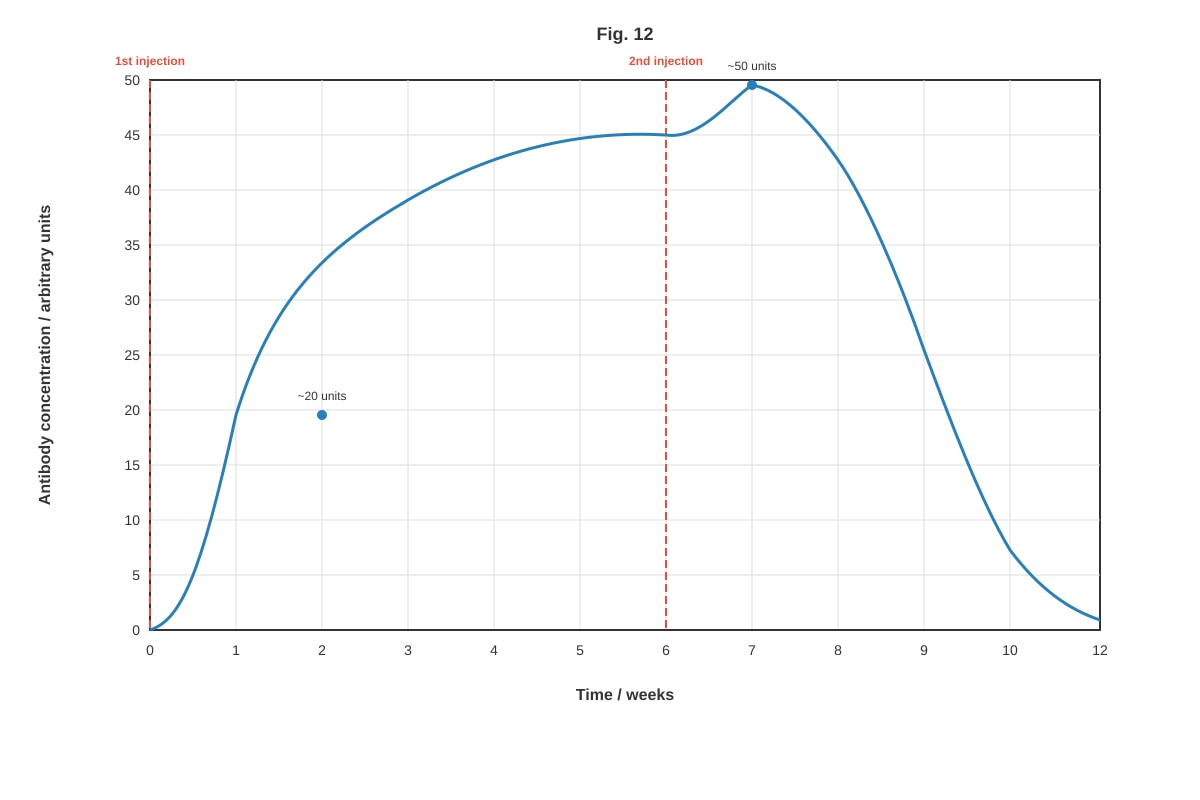
12. (a) After the first injection, antibody concentration rises gradually from zero, reaching a peak at approximately week 2. [1] After the peak, antibody concentration declines steadily over the following weeks. [1]
Marking: [1] for describing the rise to a peak; [1] for describing the subsequent decline. Accept approximate values read from the graph.
(b) The second response produces a higher peak of antibody concentration than the first response. [1] This is because memory B cells were formed during the primary response to the first injection. [1] Upon the second injection, these memory cells are rapidly activated and undergo clonal expansion, differentiating into plasma cells that secrete large amounts of antibody. [1] The response is also faster — the second peak is reached more quickly than the first. [1]
Marking: [1] for stating the second peak is higher; [1] for mentioning memory B cells; [1] for explaining rapid activation / clonal expansion / greater antibody output; [1] for noting the faster response time.
[5]
13. (a) An antigen is a molecule (usually a protein or polysaccharide) on the surface of a pathogen or foreign substance that is recognised by the immune system and triggers an immune response. [1]
Marking: [1] for a correct definition. Must include the idea of a molecule that is recognised by the immune system / triggers an immune response. Accept "foreign molecule" or "molecule on pathogen surface" as part of the definition.
(b) B lymphocytes are activated when their specific B cell receptor (surface antibody) binds to a complementary antigen. [1] The B cell internalises and processes the antigen, presenting it on its surface using MHC class II molecules. [1] A helper T lymphocyte that recognises the same antigen binds to the B cell and releases cytokines, which stimulate the B cell to undergo clonal expansion and differentiate into plasma cells and memory B cells. [1]
Marking: [1] for antigen binding to B cell receptor; [1] for antigen processing and presentation via MHC II; [1] for helper T cell interaction and cytokine signalling leading to activation.
(c) Plasma cells secrete (produce) large quantities of antibodies specific to the antigen. [1]
Marking: [1] for stating that plasma cells produce/secrete antibodies.
[5]
14. (a) Any TWO of the following: [1] each
- Inhalation of airborne droplets containing the bacteria (coughing, sneezing, talking) [1]
- Inhalation of aerosolised bacteria in contaminated air [1]
- Close prolonged contact with an infected person [1]
Accept any valid transmission route for TB. Do not accept "touching" or "sharing food" as primary routes — TB is primarily airborne.
(b) Antibiotics target structures or processes specific to bacteria, such as cell wall synthesis (e.g., penicillin inhibits peptidoglycan formation), protein synthesis (e.g., tetracycline binds to bacterial ribosomes), or DNA replication. [1] Viruses lack these structures — they have no cell wall, no ribosomes, and rely on host cell machinery for replication. [1] Therefore, antibiotics cannot target viruses without also damaging host cells. [1]
Marking: [1] for stating antibiotics target bacterial-specific structures/processes; [1] for explaining viruses lack these structures; [1] for explaining why this makes antibiotics ineffective against viruses.
(c) Any ONE of the following: [1]
- Screening and early detection programmes (e.g., chest X-rays, tuberculin skin tests) to identify and treat infected individuals early
- Contact tracing to identify and test people who have been in close contact with infected individuals
- Ensuring infected individuals complete their full course of antibiotic treatment to prevent spread and reduce the development of antibiotic-resistant strains
- Improving ventilation in public spaces to reduce airborne transmission
- Public health education about covering coughs and seeking early treatment
Marking: [1] for any valid public health strategy. Must be distinct from vaccination.
[5]
15. (a) Active immunity occurs when the individual's own immune system produces antibodies and memory cells in response to antigen exposure (either through natural infection or vaccination). [1] Passive immunity occurs when ready-made antibodies are transferred from another source (e.g., maternal antibodies, antiserum injection) and the individual's immune system is not activated. [1]
Marking: [1] for correct description of active immunity; [1] for correct description of passive immunity. The distinction must be clear — the key difference is whether the individual produces their own antibodies.
(b) When a high proportion of a population is vaccinated (and therefore immune), the pathogen cannot easily spread from person to person. [1] This reduces the probability that a susceptible (unvaccinated) individual will come into contact with an infected person. [1] The pathogen is effectively "blocked" from reaching unvaccinated individuals because transmission chains are broken. [1]
Marking: [1] for explaining reduced transmission in the population; [1] for explaining reduced chance of contact with infected individuals; [1] for explaining broken transmission chains.
(c) Any ONE of the following: [1]
- Herd immunity only works if a sufficiently high proportion of the population is vaccinated (typically >80–95%, depending on the disease)
- It does not protect against diseases where the pathogen mutates rapidly (e.g., influenza), requiring updated vaccines
- Unvaccinated individuals remain susceptible if vaccination rates drop
- It cannot protect immunocompromised individuals if the vaccine is live-attenuated (they cannot be vaccinated themselves)
- Newborns and very young infants may not yet be eligible for certain vaccines
Marking: [1] for any valid limitation.
[5]
Section C: Free Response Questions
16. Phagocytosis is the process by which phagocytes (e.g., macrophages, neutrophils) engulf and destroy pathogens. [1]
The process begins when opsonins (such as antibodies or complement proteins) bind to the surface of the pathogen, coating it. [1] This opsonisation makes the pathogen more recognisable to phagocytes, which have receptors for opsonins (e.g., Fc receptors for antibodies). [1] The phagocyte extends pseudopodia around the pathogen, engulfing it into a vesicle called a phagosome. [1]
Lysosomes within the phagocyte fuse with the phagosome, forming a phagolysosome. [1] The lysosomes contain hydrolytic enzymes (e.g., lysozyme) and reactive oxygen species that digest and destroy the pathogen. [1]
In macrophages and dendritic cells, after digestion, fragments of the pathogen (antigens) are displayed on the cell surface bound to MHC class II molecules. [1] This antigen presentation activates helper T lymphocytes, linking innate and adaptive immunity. [1]
Marking descriptors:
- [1] Definition of phagocytosis / identification of phagocytes
- [1] Role of opsonins in coating pathogens
- [1] Recognition of opsonised pathogens by phagocyte receptors
- [1] Engulfment via pseudopodia / formation of phagosome
- [1] Fusion of lysosomes with phagosome / formation of phagolysosome
- [1] Digestion by hydrolytic enzymes
- [1] Antigen presentation on MHC class II
- [1] Activation of helper T cells / link to adaptive immunity
Award up to [5] marks for a well-structured response covering the key stages. Credit valid points even if not in the order above.
[5]
17. When a virus enters the body, the first defence involves interferons. [1] Interferons are signalling proteins released by virus-infected cells. [1] They bind to receptors on neighbouring uninfected cells, triggering the production of antiviral proteins that inhibit viral replication within those cells. [1] Interferons also activate natural killer (NK) cells and enhance the activity of cytotoxic T lymphocytes. [1]
Cytotoxic T lymphocytes (CD8⁺ T cells) recognise viral antigens presented on the surface of infected cells via MHC class I molecules. [1] Once activated (with help from helper T cells), cytotoxic T cells release perforins, which create pores in the membrane of the infected cell. [1] They also release granzymes, which enter through the pores and trigger apoptosis (programmed cell death) of the infected cell, preventing the virus from replicating further. [1]
Antibodies, produced by plasma cells (derived from B lymphocytes), play several roles in defending against viruses. [1] They can neutralise viruses by binding to viral surface proteins, preventing the virus from attaching to and entering host cells. [1] Antibodies also opsonise viruses, marking them for destruction by phagocytes. [1] Additionally, antibodies can activate the complement system, which can lyse enveloped viruses directly. [1]
Marking descriptors:
- [1] Interferons released by infected cells
- [1] Interferons signal neighbouring cells to produce antiviral proteins
- [1] Interferons activate NK cells / enhance cytotoxic T cell activity
- [1] Cytotoxic T cells recognise viral antigens on MHC I
- [1] Release of perforins to create pores
- [1] Release of granzymes to trigger apoptosis
- [1] Antibodies neutralise viruses by blocking attachment to host cells
- [1] Antibodies opsonise viruses for phagocytosis
- [1] Antibodies activate complement system
Award up to [5] marks. Credit any valid, clearly explained point. Quality of written communication is assessed — answers should be coherent and well-organised.
[5]
18. Monoclonal antibodies (mAbs) are identical antibodies produced by a single clone of hybridoma cells, all specific to one epitope. [1]
Advantages:
- High specificity: mAbs bind to a single epitope on an antigen, allowing precise targeting of diseased cells (e.g., cancer cells) while minimising damage to healthy cells. [1]
- Diagnostic applications: mAbs are used in diagnostic tests (e.g., ELISA, pregnancy tests) to detect specific antigens or hormones with high sensitivity and accuracy. [1]
- Therapeutic applications: mAbs can be used to treat diseases such as cancer (e.g., trastuzumab targets HER2-positive breast cancer), autoimmune diseases (e.g., infliximab targets TNF-α in rheumatoid arthritis), and to prevent organ transplant rejection. [1]
- Can be engineered: mAbs can be modified (e.g., humanised) to reduce the risk of immune reactions when used in patients. [1]
Disadvantages:
- Expensive and time-consuming to produce: The hybridoma technology process is complex, requiring cell fusion, screening, and large-scale culture. [1]
- Potential side effects: Some patients may develop immune reactions against the monoclonal antibodies, especially if they are murine (mouse-derived). Side effects can include allergic reactions, fever, and nausea. [1]
- Limited effectiveness against mutating pathogens: Because mAbs target a single epitope, a mutation in that epitope (as seen in influenza or SARS-CoV-2) can render the mAb ineffective. [1]
- Not suitable for all diseases: mAbs are large proteins that cannot cross the blood-brain barrier easily and cannot target intracellular pathogens effectively. [1]
Marking descriptors:
- [1] Definition of monoclonal antibodies
- [2] At least two valid advantages, clearly explained (1 mark each)
- [2] At least two valid disadvantages, clearly explained (1 mark each)
Award up to [5] marks. Answers should present a balanced discussion. Quality of written communication is assessed.
[5]
19. (a) Existing vaccines contain antigens from previously circulating strains of the virus. [1] Memory B and T cells generated by vaccination recognise these specific antigens. [1] If the new strain has undergone significant antigenic change (antigenic shift or drift), the surface antigens will differ from those in the vaccine. [1] The existing memory cells may not recognise the new antigens, so the secondary immune response will not be effectively triggered. [1]
Marking: [1] for explaining vaccines contain antigens from previous strains; [1] for explaining memory cells recognise specific antigens; [1] for explaining antigenic change means new antigens are different; [1] for concluding that memory cells won't recognise the new strain.
(b) Scientists would isolate the new strain and identify its surface antigens (e.g., haemagglutinin and neuraminidase). [1] Genes encoding these antigens would be inserted into a vaccine vector (e.g., inactivated virus, recombinant protein, or mRNA platform). [1] The vaccine would be tested in clinical trials for safety and efficacy before being approved for public use. [1]
Marking: [1] for identifying new antigens; [1] for describing vaccine production using new antigens; [1] for mentioning clinical testing.
(c) Because the population has no pre-existing immunity to the new strain (no memory cells), the virus can spread rapidly through the population. [1] If the virus is also highly transmissible and can spread before symptoms appear, it can infect large numbers of people across multiple countries, leading to a pandemic. [1]
Marking: [1] for explaining lack of pre-existing immunity; [1] for explaining rapid spread / pandemic potential.
[5]
20. Memory cells are long-lived lymphocytes (memory B cells and memory T cells) that are formed during the primary immune response. [1] When a pathogen is first encountered, naive B and T lymphocytes that recognise the antigen undergo clonal expansion. [1] Most differentiate into effector cells (plasma cells and cytotoxic T cells), but a small proportion become memory cells that persist in the body for years or even a lifetime. [1]
Memory cells circulate in the blood and lymphatic system, remaining in a resting state until re-exposed to the same antigen. [1] Upon re-exposure, memory cells are activated much more quickly than naive lymphocytes because they are already present in greater numbers and have a lower activation threshold. [1] Memory B cells rapidly differentiate into plasma cells that produce large quantities of antibody, while memory T cells quickly become effector T cells. [1] This results in a faster, stronger secondary immune response that often eliminates the pathogen before symptoms develop, providing long-term protection. [1]
Marking descriptors:
- [1] Memory cells are long-lived B and T cells formed during primary response
- [1] Formed by clonal expansion of activated lymphocytes
- [1] Persist in body for years / lifetime
- [1] Circulate in blood and lymphatic system
- [1] Activated more quickly upon re-exposure (lower activation threshold / greater numbers)
- [1] Memory B cells → plasma cells → rapid antibody production
- [1] Memory T cells → effector T cells → rapid cell-mediated response
- [1] Secondary response is faster and stronger, often preventing disease
Award up to [5] marks for a well-structured response. Credit valid points. Quality of written communication is assessed.
[5]
Mark Summary
| Section | Marks |
|---|---|
| A: Multiple Choice (Q1–10) | 10 |
| B: Structured (Q11–15) | 25 |
| C: Free Response (Q16–20) | 15 |
| Total | 50 |