AI Generated Quiz
A Level H1 Biology Human Physiology Quiz
Free A Level H1 Biology Human Physiology quiz, HY3 AI version, with questions, answers, and A Level-style practice for Singapore students.
These static practice materials are generated from the site's syllabus and paper-generation workflow, with source and model context shown so students and parents can evaluate the material before use.
Questions

Free quiz and exam paper access
Enter your details to view this paper
Your access is remembered on this device.
Answers
A-Level Biology H1 Quiz - Human Physiology (Answer Key)
Topic: Human Physiology
Version: 1 of 5
Total Marks: 40
Section A Answers (1–10)
1. [1 mark]
Function: The trachea (windpipe) conducts air from the larynx to the bronchi / filters, warms, and moistens incoming air.
Teaching note: The trachea is part of the conducting airway; it is supported by cartilage rings to keep it open.
2. [1 mark]
Answer: Artery.
Teaching note: Arteries carry blood away from the heart under high pressure, hence thick muscular walls.
3. [1 mark]
Answer: It contains a non-protein group (haem / iron-containing prosthetic group) attached to globin protein.
Teaching note: Conjugated proteins have a prosthetic group; in haemoglobin it is haem with Fe²⁺.
4. [1 mark]
Answer: Diffusion.
Teaching note: Oxygen moves down its partial pressure gradient from alveolus (high ) to capillary (low ).
5. [1 mark]
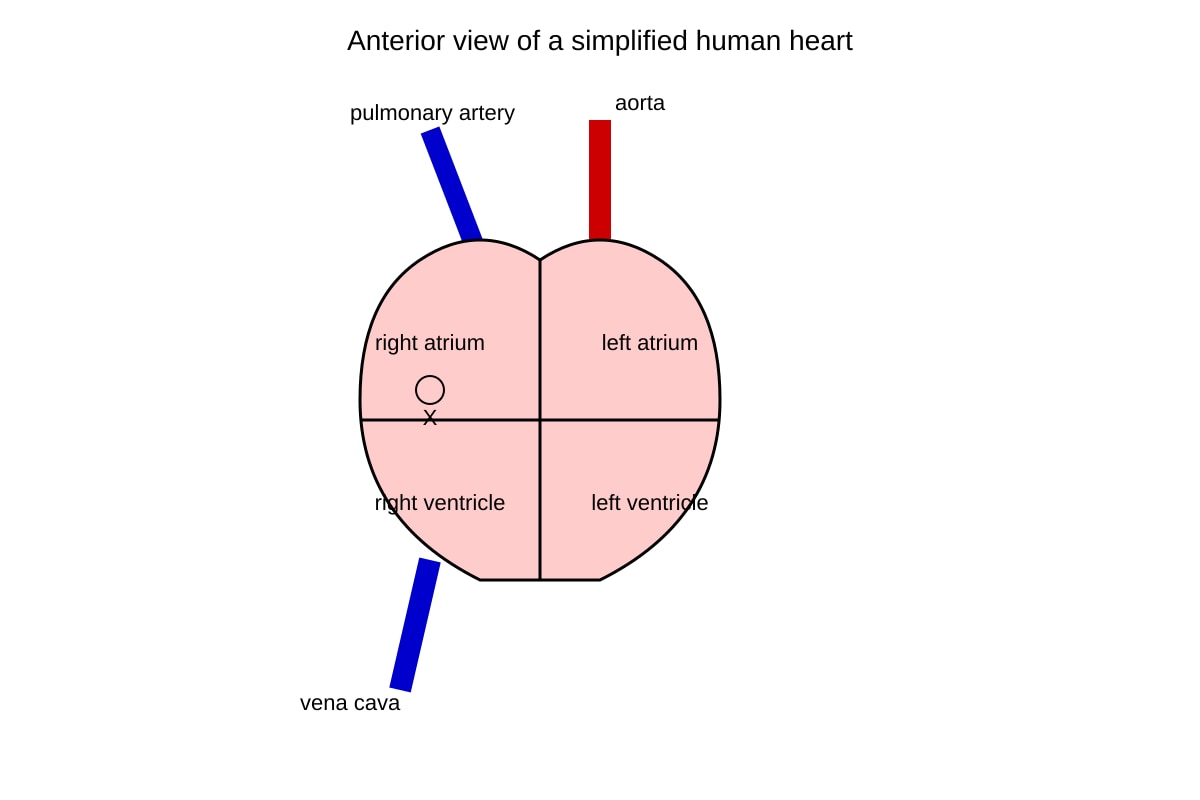
Answer: Right atrium.
Expected visual: Fig.1 shows vena cava entering the right-side upper chamber. That chamber is the right atrium.
Teaching note: Deoxygenated blood from the body enters the right atrium via the vena cava.
6. [1 mark]
Answer: Urea.
Teaching note: Urea is produced in the liver from deamination of amino acids and excreted by kidneys.
7. [1 mark]
Answer: Emulsify fats / increase surface area for lipase action.
Teaching note: Bile salts break large fat droplets into smaller ones (emulsification).
8. [1 mark]
Answer: Renal pelvis (or Bowman's capsule is incorrect; urine collects in renal pelvis before ureter).
Teaching note: Filtrate becomes urine in collecting duct → renal pelvis → ureter.
9. [1 mark]
Answer: Red blood cells / erythrocytes.
Teaching note: Erythrocytes contain haemoglobin for O₂ transport.
10. [1 mark]
Answer: Wall is one cell thick (thin epithelium) / large surface area / moist surface.
Teaching note: Thin wall shortens diffusion distance.
Section B Answers (11–15)
11. [2 marks]
Calculation:
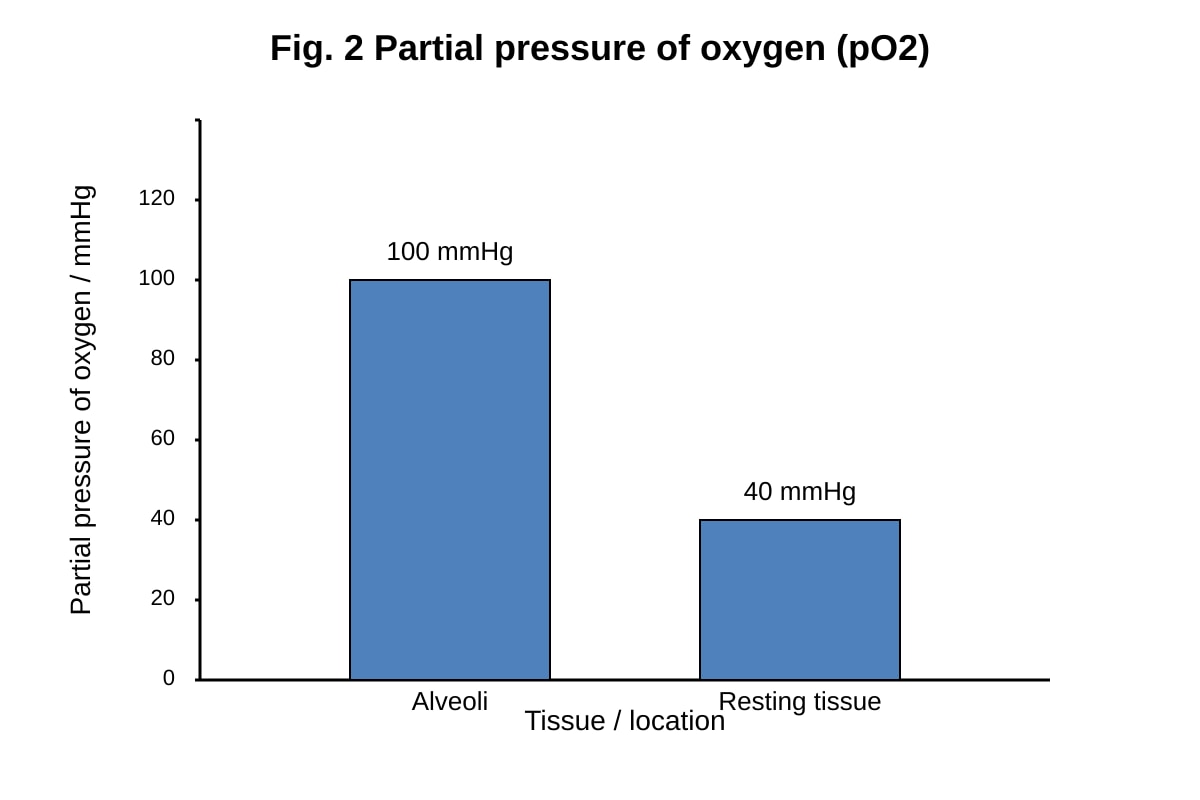
Alveoli = 100 mmHg
Resting tissue = 40 mmHg
Difference = 100 − 40 = 60 mmHg.
Marking: 1 mark for correct values used, 1 mark for correct difference.
Teaching note: Diffusion depends on pressure gradient; larger difference drives faster diffusion.
12. [2 marks]
Answer: Oxygen diffuses from alveoli to blood because alveolar (100 mmHg) is higher than blood (~40 mmHg in tissue capillaries). Diffusion occurs down the partial pressure gradient.
Marking: 1 mark for referencing gradient, 1 mark for direction.
Teaching note: Gases move from high to low partial pressure.
13. [1 mark]
Answer: Student C (145/95).
Teaching note: Hypertension threshold systolic ≥140 or diastolic ≥90; only C meets it.
14. [3 marks]
Answer:
- Blood enters glomerulus via afferent arteriole (wider) and leaves via efferent arteriole (narrower), raising hydrostatic pressure. [1]
- High pressure forces water and small solutes (glucose, urea, ions) out of glomerular capillaries into Bowman's capsule. [1]
- Large proteins and cells remain in blood due to size barrier of capillary endothelium and basement membrane. [1]
Teaching note: Ultrafiltration is pressure-driven, not energy-driven.
15. [2 marks]
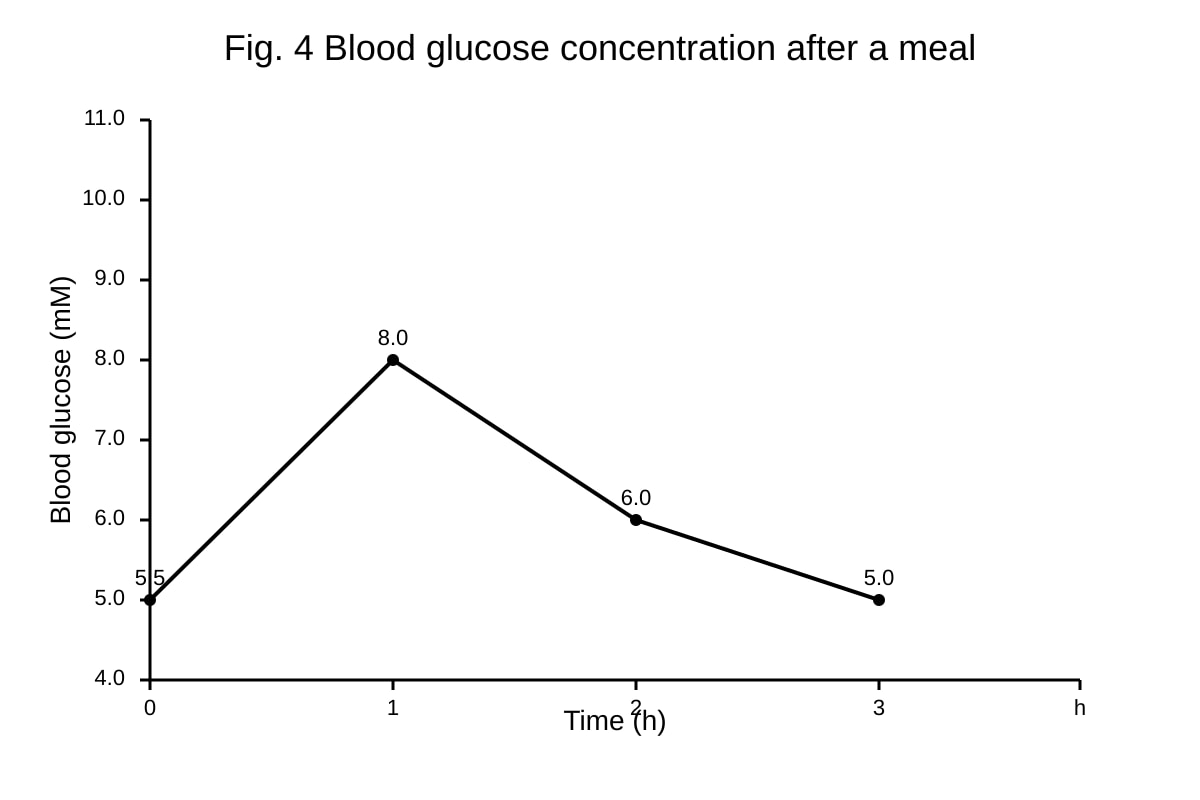
Answer: Maximum = 8.0 mM at 1 hour.
Marking: 1 mark for value, 1 mark for time.
Expected visual: Fig.4 curve peaks at (1, 8.0).
Section C Answers (16–20)
16. [4 marks]
Answer:
- Haemoglobin is a quaternary protein with 4 polypeptide chains (2 α, 2 β). [1]
- Each chain has a haem group with Fe²⁺ that binds one O₂ molecule, so one Hb carries 4 O₂. [1]
- It shows cooperative binding: binding of first O₂ changes shape to ease further binding. [1]
- Reversible binding allows O₂ uptake in lungs (high ) and release in tissues (low ). [1]
Teaching note: Structure (multiple subunits + prosthetic groups) enables efficient transport and release.
17. [3 marks]
Answer: Nose → pharynx → larynx → trachea → bronchus → bronchiole → alveoli. (Any 3 structures named: e.g., pharynx, trachea, bronchus.) [1 each]
Teaching note: Air is filtered, warmed, moistened along pathway.
18. [3 marks]
Answer:
- Spectrin maintains erythrocyte biconcave shape and flexibility. [1]
- Defect causes fragile, spherical cells (spherocytosis) that may rupture (haemolysis). [1]
- Reduced cell count / destroyed cells lower haemoglobin amount, reducing O₂ capacity. [1]
Teaching note: Shape is vital for passage through capillaries and surface area.
19. [4 marks]
Answer:
- Ventilation brings air with high (100 mmHg) to alveoli continuously. [1]
- Blood in pulmonary capillaries has lower (40 mmHg), maintaining gradient along whole capillary. [1]
- As blood moves, it always meets air with higher (not equilibrated prematurely), so diffusion continues. [1]
- This counter-current-like maintenance of gradient maximises O₂ uptake. [1]
Teaching note: In lungs it is actually cross-current, but gradient maintained along length improves efficiency.
20. [4 marks]
Answer:
- Glomerular filter allows small molecules (glucose, urea) through due to pore size. [1]
- Plasma proteins are large (≈7 g/100 mL, macromolecules) and cannot pass capillary wall / basement membrane. [1]
- Glucose is small and freely filtered, so present in filtrate at same concentration as plasma. [1]
- Proteins retained in blood maintain osmotic pressure; absence in filtrate confirms size selectivity. [1]
Teaching note: Ultrafiltration is size-based; no protein in filtrate is normal.