AI Generated Quiz
A Level H1 Biology Human Physiology Quiz
Free A Level H1 Biology Human Physiology quiz, AI version, with questions, answers, and A Level-style practice for Singapore students.
These static practice materials are generated from the site's syllabus and paper-generation workflow, with source and model context shown so students and parents can evaluate the material before use.
Questions
Free quiz and exam paper access
Enter your details to view this paper
Your access is remembered on this device.
Answers
A-Level Biology H1 Quiz - Human Physiology: Answer Key
Total Marks: 50
Section A: Multiple-Choice Questions (10 marks)
1. B – The sinoatrial (SA) node is the primary pacemaker of the heart, located in the right atrium. It generates electrical impulses that initiate each heartbeat and set the heart rate. Option A describes the atrioventricular (AV) node, which delays the impulse. Option C describes the AV node and bundle of His. Option D describes the Purkinje fibres.
2. C – Oxygen moves from the alveoli (high pO₂ = 13.3 kPa) into the pulmonary capillaries (low pO₂ = 5.3 kPa) down its concentration gradient by simple diffusion. Oxygen is a small, non-polar molecule that can diffuse directly through the phospholipid bilayer. Active transport (A) requires ATP and moves substances against a gradient. Facilitated diffusion (B) requires carrier/channel proteins. Osmosis (D) is the movement of water.
3. B – ADH increases the permeability of the collecting duct to water by inserting aquaporin-2 channels into the apical membrane. This allows more water to be reabsorbed from the filtrate back into the blood, concentrating the urine and reducing water loss. Option A describes the action of aldosterone. Option C is incorrect; ADH increases blood pressure by increasing water retention. Option D is incorrect; ADH does not affect filtration rate directly.
4. A – The Bohr effect describes how an increase in carbon dioxide concentration (or decrease in pH) decreases the affinity of haemoglobin for oxygen, shifting the oxygen dissociation curve to the right. This facilitates oxygen unloading in metabolically active tissues. Options B, C, and D describe other physiological relationships but are not the Bohr effect.
5. B – The correct sequence of the cardiac cycle is: atrial systole (atria contract, forcing blood into ventricles) → ventricular systole (ventricles contract, forcing blood into arteries) → ventricular diastole (ventricles relax and fill with blood from atria). Option A has the order wrong. Options C and D are incorrect sequences.
6. C – The alveolus is a structure in the lungs, not in the kidney. The nephron is the functional unit of the kidney and includes the Bowman's capsule (A), loop of Henle (B), and collecting duct (D).
7. B – The liver plays a key role in blood glucose regulation by converting glycogen to glucose (glycogenolysis) in response to glucagon, and converting glucose to glycogen (glycogenesis) in response to insulin. Option A is incorrect; insulin is secreted by the pancreas. Option C is incorrect; the kidneys filter glucose, not the liver. Option D is incorrect; the liver stores glucose as glycogen, not fat.
8. A – Glucagon is secreted by the alpha cells of the islets of Langerhans in the pancreas. It raises blood glucose concentration by stimulating glycogenolysis and gluconeogenesis in the liver. Beta cells (B) secrete insulin. The adrenal medulla (C) secretes adrenaline. The anterior pituitary (D) secretes many hormones but not glucagon.
9. B – The left ventricle pumps blood to the entire body (systemic circulation), which requires much higher pressure than the right ventricle, which pumps blood only to the lungs (pulmonary circulation). The thicker muscular wall generates the higher pressure needed to overcome the greater resistance of the systemic circulation. Option A is incorrect; the right ventricle pumps blood to the lungs. Option C is incorrect; the left ventricle receives blood from the lungs at higher pressure. Option D is incorrect; the left ventricle has a larger volume.
10. C – Ultrafiltration in the glomerulus is driven by the hydrostatic pressure of the blood in the glomerular capillaries. This pressure forces water and small solutes (but not large proteins or blood cells) through the filtration barrier into the Bowman's capsule. Active transport (A) is involved in reabsorption, not filtration. Osmotic pressure (B) opposes filtration. Diffusion (D) is not the primary driving force for bulk flow of filtrate.
Section B: Structured Questions (20 marks)
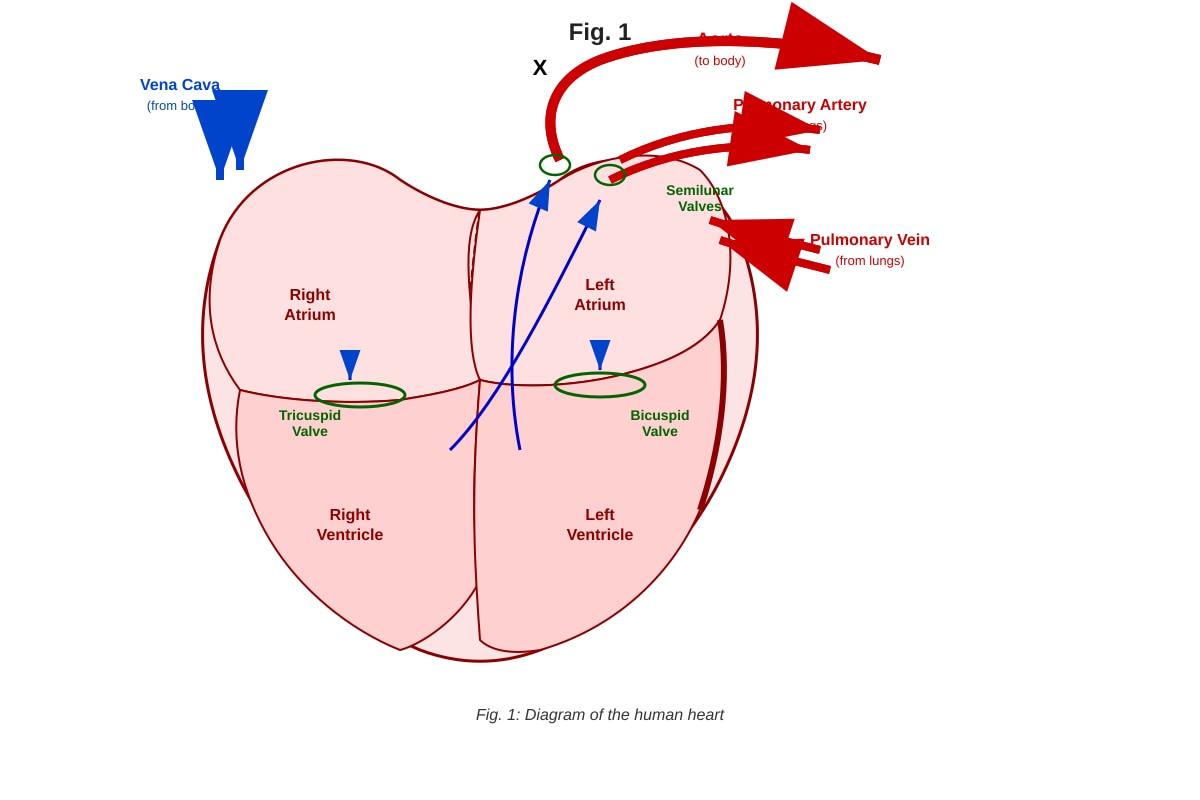
11. (a) Aorta [1 mark]
(b) Pathway: Vena cava → right atrium → tricuspid valve → right ventricle → pulmonary semilunar valve → pulmonary artery → lungs → pulmonary vein → left atrium → bicuspid (mitral) valve → left ventricle → aortic semilunar valve → aorta. [3 marks – 1 mark for correct sequence through the right side, 1 mark for correct sequence through the left side, 1 mark for naming the valves correctly]
(c) The left ventricle pumps blood to the entire body (systemic circulation), which requires a higher pressure to overcome the greater resistance of the systemic circulation. The right ventricle pumps blood only to the lungs (pulmonary circulation), which is a shorter, lower-resistance pathway. The thicker muscular wall of the left ventricle generates the higher pressure needed. [2 marks – 1 mark for identifying the systemic vs. pulmonary circulation, 1 mark for explaining the need for higher pressure]
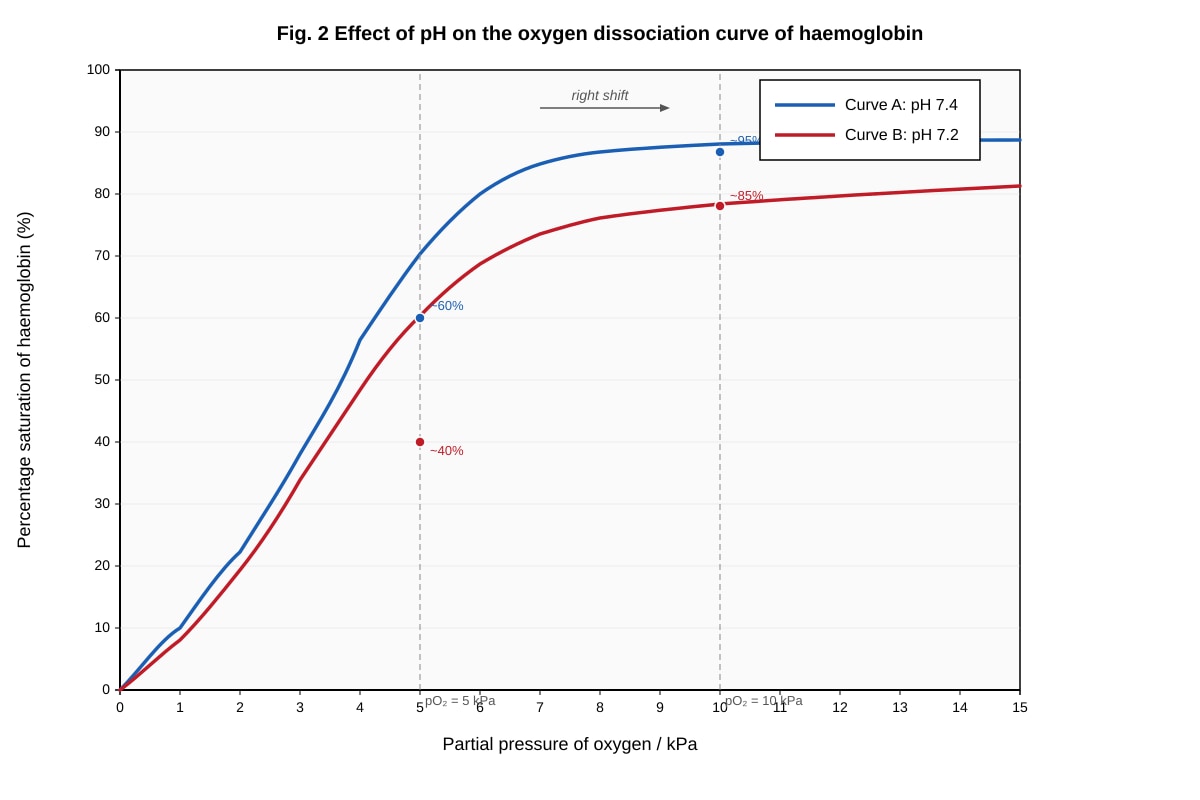
12. (a) The Bohr effect is the phenomenon where an increase in carbon dioxide concentration (or decrease in pH) decreases the affinity of haemoglobin for oxygen, causing the oxygen dissociation curve to shift to the right. [1 mark]
(b) At pO₂ = 5 kPa and pH 7.4, the percentage saturation is approximately 60%. At pH 7.2, the percentage saturation is approximately 40%. [1 mark – accept values within ±5%]
(c) During vigorous exercise, muscles produce more CO₂ and lactic acid, lowering the pH of the blood in the capillaries. This lower pH (Bohr effect) decreases haemoglobin's affinity for oxygen, causing more oxygen to be released from haemoglobin at the same pO₂. This ensures that actively respiring muscles receive more oxygen to support aerobic respiration and ATP production. [3 marks – 1 mark for linking exercise to increased CO₂/lactic acid production, 1 mark for explaining the effect on haemoglobin's oxygen affinity, 1 mark for explaining the physiological benefit of increased oxygen delivery to muscles]
13. The loop of Henle creates a concentration gradient in the medulla of the kidney, which is essential for water reabsorption and urine concentration. The descending limb is permeable to water but not to salts, so water leaves the filtrate by osmosis as it descends into the increasingly concentrated medulla. The ascending limb is impermeable to water but actively transports Na⁺ and Cl⁻ ions out of the filtrate, making the medulla more concentrated. This countercurrent multiplier system establishes a gradient from ~300 mOsm/L in the cortex to ~1200 mOsm/L in the medulla. When ADH is present, the collecting duct becomes permeable to water, and water moves out of the filtrate down the concentration gradient, producing concentrated urine. [4 marks – 1 mark for describing the descending limb function, 1 mark for describing the ascending limb function, 1 mark for explaining the countercurrent multiplier, 1 mark for linking to urine concentration with ADH]
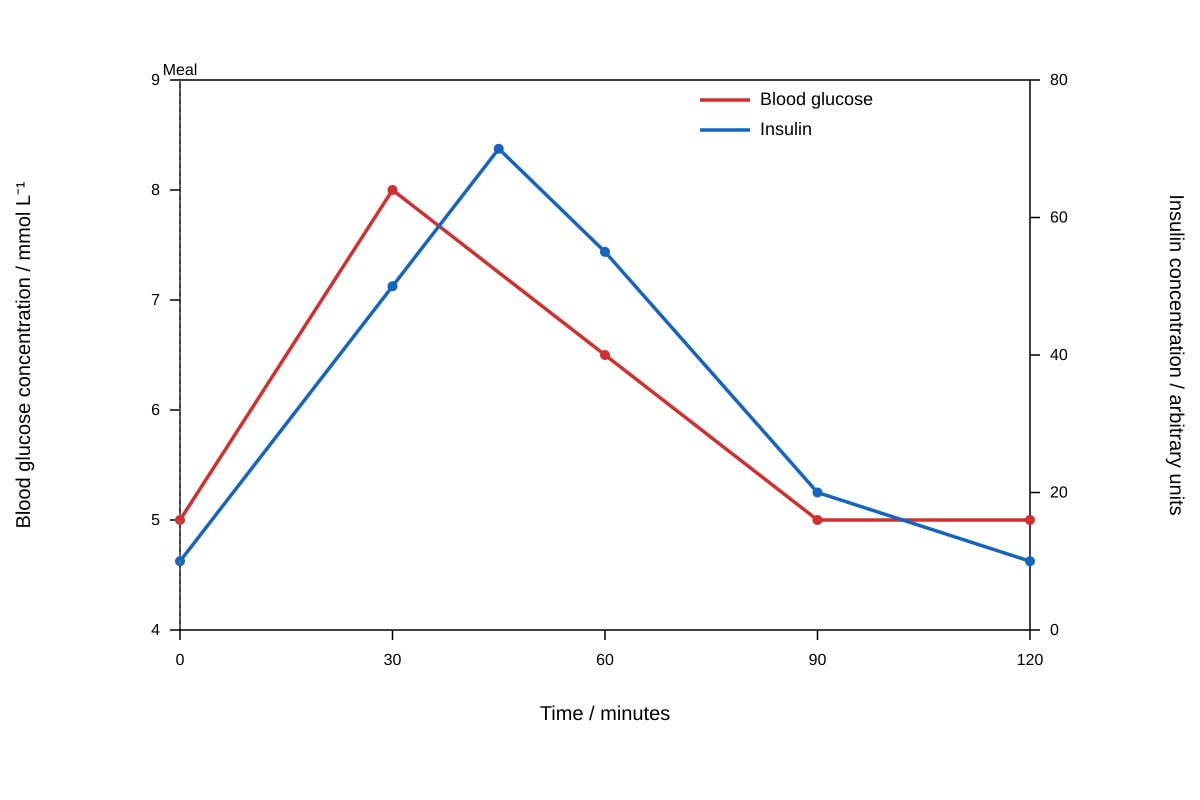
14. (a) After the meal, blood glucose concentration rises from ~5 mmol/L to a peak of ~8 mmol/L at 30 minutes. It then gradually decreases, returning to the baseline level of ~5 mmol/L by 90 minutes and remaining stable thereafter. [2 marks – 1 mark for describing the rise, 1 mark for describing the return to baseline]
(b) The rise in blood glucose concentration after the meal stimulates the beta cells of the islets of Langerhans in the pancreas to secrete insulin. Insulin concentration rises, peaking at ~45 minutes (slightly after the glucose peak). Insulin promotes the uptake of glucose by body cells (especially muscle and liver cells) and stimulates the liver to convert glucose to glycogen (glycogenesis). This causes blood glucose concentration to decrease back to the normal range. As blood glucose falls, insulin secretion decreases, returning to baseline levels. [3 marks – 1 mark for identifying the stimulus (glucose rise → insulin secretion), 1 mark for explaining insulin's effects (glucose uptake, glycogenesis), 1 mark for explaining the negative feedback loop (glucose fall → reduced insulin)]
Section C: Free-Response Questions (20 marks)
Answer ONE question from this section. Each question is worth 20 marks.
15. Marking Scheme (20 marks):
- Pancreas (4 marks): Beta cells secrete insulin (1); alpha cells secrete glucagon (1); islets of Langerhans detect blood glucose changes (1); response is via negative feedback (1).
- Liver (4 marks): Glycogenesis – glucose → glycogen (1); glycogenolysis – glycogen → glucose (1); gluconeogenesis – amino acids/glycerol → glucose (1); storage of glycogen in hepatocytes (1).
- Insulin action (4 marks): Binds to receptors on target cells (1); increases glucose uptake by cells (via GLUT4 transporters) (1); stimulates glycogenesis in liver/muscle (1); inhibits glycogenolysis/gluconeogenesis (1).
- Glucagon action (4 marks): Binds to liver receptors (1); stimulates glycogenolysis (1); stimulates gluconeogenesis (1); raises blood glucose concentration (1).
- Other hormones (2 marks): Adrenaline raises blood glucose (1); cortisol/thyroid hormones have permissive roles (1).
- Clinical relevance (2 marks): Diabetes mellitus – Type 1 (insulin deficiency) and Type 2 (insulin resistance) (1); hypoglycaemia/hyperglycaemia consequences (1).
16. Marking Scheme (20 marks):
- Ultrafiltration (5 marks): Glomerulus – high hydrostatic pressure (1); filtration barrier (endothelium, basement membrane, podocytes) (1); small molecules pass (water, glucose, ions, urea) (1); large proteins and blood cells retained (1); filtrate enters Bowman's capsule (1).
- Selective reabsorption (5 marks): Proximal convoluted tubule – all glucose reabsorbed by active transport (1); sodium reabsorbed (1); water follows by osmosis (1); microvilli increase surface area (1); mitochondria provide ATP (1).
- Loop of Henle (5 marks): Descending limb – permeable to water, impermeable to salts (1); ascending limb – impermeable to water, actively transports Na⁺/Cl⁻ out (1); countercurrent multiplier creates medullary gradient (1); gradient from cortex (~300 mOsm/L) to medulla (~1200 mOsm/L) (1); enables water reabsorption in collecting duct (1).
- Response to dehydration (5 marks): Decreased blood volume/pressure detected (1); osmoreceptors in hypothalamus detect increased plasma osmolarity (1); ADH released from posterior pituitary (1); ADH increases collecting duct permeability (aquaporins) (1); more water reabsorbed, concentrated urine produced (1).
Section D: Additional Short-Answer Questions (10 marks)
17. Two differences between artery and vein:
- Artery has thicker muscular/elastic wall; vein has thinner wall. [1 mark]
- Artery has no valves (except at heart); vein has valves to prevent backflow. [1 mark] (Accept other valid differences: lumen size, blood pressure, direction of blood flow.)
18. The walls of the alveoli are one cell thick to minimise the diffusion distance for oxygen and carbon dioxide. This allows rapid gas exchange between the alveoli and the pulmonary capillaries by simple diffusion, ensuring efficient oxygenation of blood and removal of CO₂. [2 marks – 1 mark for minimising diffusion distance, 1 mark for enabling rapid gas exchange]
19. The atrioventricular (AV) node delays the electrical impulse from the atria to the ventricles by approximately 0.1 seconds. This delay ensures that the atria have completed contraction (atrial systole) and emptied their blood into the ventricles before the ventricles begin to contract (ventricular systole). [2 marks – 1 mark for delaying the impulse, 1 mark for ensuring atrial contraction completes before ventricular contraction]
20. When blood pressure decreases, the kidneys release renin. Renin converts angiotensinogen (from the liver) into angiotensin I, which is then converted to angiotensin II by ACE (angiotensin-converting enzyme) in the lungs. Angiotensin II stimulates the adrenal cortex to release aldosterone. Aldosterone increases sodium reabsorption in the distal convoluted tubule and collecting duct, which causes water to follow by osmosis, increasing blood volume and thus blood pressure. [2 marks – 1 mark for renin release and angiotensin cascade, 1 mark for aldosterone action increasing sodium/water reabsorption and blood pressure]