AI Generated Quiz
A Level H1 Biology Genetics Inheritance Quiz
Free A Level H1 Biology Genetics Inheritance quiz, LongCat AI version, with questions, answers, and A Level-style practice for Singapore students.
These static practice materials are generated from the site's syllabus and paper-generation workflow, with source and model context shown so students and parents can evaluate the material before use.
Questions

Free quiz and exam paper access
Enter your details to view this paper
Your access is remembered on this device.
Answers
A-Level Biology H1 Quiz - Genetics Inheritance
Answer Key & Teaching Notes
Section A: Multiple Choice & Short Answer (Questions 1–10)
1. Answer: B) 3 tall : 1 short [2]
Teaching Notes:
A monohybrid cross between two heterozygotes (Tt × Tt) produces offspring with the genotypic ratio 1 TT : 2 Tt : 1 tt. Since T (tall) is dominant over t (short), both TT and Tt individuals are tall. Therefore, the phenotypic ratio is 3 tall : 1 short. This is the classic Mendelian monohybrid ratio. Students should be able to construct a Punnett square to verify this.
Common Mistake: Selecting A (1:1) — this is the ratio for a test cross (Tt × tt), not a heterozygote × heterozygote cross.
2. Answer: 50% (or 1/2) [2]
Teaching Notes:
Colour blindness is X-linked recessive. Let = normal allele and = colour blind allele. The woman is a carrier: . The husband has normal vision: .
| (normal female) | (normal son) | |
| (carrier female) | (colour blind son) |
Sons inherit their single X chromosome from their mother. There is a 50% chance the son receives and is colour blind.
Common Mistake: Forgetting that sons inherit the X chromosome from the mother, not the father. The father contributes the Y chromosome to sons.
3. Answer:
An allele is an alternative form of a gene that arises by mutation and is found at the same locus (position) on a homologous chromosome. Alleles arise through mutation — changes in the DNA sequence (e.g., base substitution, insertion, or deletion) that produce a variant form of the gene. [2]
Teaching Notes:
Key points for full marks: (1) definition of allele as an alternative form of a gene; (2) alleles arise by mutation. Students should understand that different alleles may produce different versions of the same protein, leading to variation in phenotype.
4. Answer:
- Genotype refers to the genetic makeup of an organism — the combination of alleles an individual carries for a particular gene. Example: In pea plants, the genotype for a heterozygous tall plant is Tt.
- Phenotype refers to the observable physical or biochemical characteristics of an organism, resulting from the interaction of genotype and environment. Example: A pea plant with genotype Tt has the phenotype tall. [2]
Teaching Notes:
Students must clearly distinguish between the genetic constitution (genotype) and the expressed trait (phenotype). The example must be specific — vague answers like "genotype is genes" are insufficient.
5. Answer: 9 : 3 : 3 : 1 [2]
Teaching Notes:
A dihybrid cross between two heterozygotes (RrYy × RrYy) produces the classic Mendelian dihybrid phenotypic ratio: 9 round yellow : 3 round green : 3 wrinkled yellow : 1 wrinkled green. This ratio arises from the independent assortment of the two genes during meiosis (assuming the genes are on different chromosomes).
Common Mistake: Confusing genotypic and phenotypic ratios, or giving the monohybrid ratio (3:1) instead.
6. Answer:
A test cross is a cross between an individual showing a dominant phenotype (but of unknown genotype) and a homozygous recessive individual. Its purpose is to determine whether the dominant individual is homozygous dominant or heterozygous. If any offspring show the recessive phenotype, the parent must be heterozygous. If all offspring show the dominant phenotype, the parent is likely homozygous dominant. [2]
Teaching Notes:
Students should understand that the test cross works because the homozygous recessive parent can only contribute recessive alleles, so the phenotype of offspring directly reveals the alleles contributed by the unknown parent.
7. Answer: D) 100% [2]
Teaching Notes:
Let = normal allele and = haemophilia allele. The haemophiliac man is . The woman who is not a carrier is .
All daughters will be — carriers (heterozygous). None will be haemophiliac because they inherit a normal from their mother. The question asks for the probability that a daughter is a carrier, which is 100%.
Common Mistake: Confusing "carrier" with "affected." Daughters are carriers but not affected because the condition is recessive.
8. Answer:
(i) Mitosis produces two genetically identical diploid daughter cells (clones), whereas meiosis produces four genetically different haploid daughter cells (gametes). [1]
(ii) Meiosis involves two rounds of cell division (meiosis I and II) and includes crossing over and independent assortment, which generate genetic variation. Mitosis involves one division and does not include crossing over. [1]
Teaching Notes:
Any two valid differences related to inheritance are acceptable. Other acceptable answers include: meiosis reduces chromosome number (diploid → haploid); mitosis maintains chromosome number; meiosis produces gametes for sexual reproduction; crossing over occurs in meiosis but not mitosis.
9. Answer: 1 red : 2 red-and-white (roan) : 1 white [2]
Teaching Notes:
In codominance, both alleles are fully expressed in the heterozygote. = red, = red and white patches (roan), = white.
| (red) | (roan) | |
| (roan) | (white) |
Genotypic ratio: 1:2:1. Phenotypic ratio: 1 red : 2 roan : 1 white.
Common Mistake: Confusing codominance with incomplete dominance. In incomplete dominance, the heterozygote shows a blended intermediate phenotype (e.g., pink flowers from red × white). In codominance, both phenotypes are expressed simultaneously.
10. Answer:
This is a substitution mutation (one base is replaced by another). The original DNA triplet CAT would be transcribed to mRNA codon GUA, which codes for valine. The mutated triplet CGT would be transcribed to mRNA codon GCA, which codes for alanine. This is a missense mutation — a different amino acid is incorporated into the protein, which may alter the protein's structure and function depending on the importance of the affected amino acid. [2]
Teaching Notes:
Students should note: (1) identify the type of mutation (substitution); (2) explain the effect on the protein. The actual amino acid change depends on which strand is the template. If CAT is the coding strand, the mRNA codon is CAU (histidine), and CGU codes for arginine. Either interpretation is acceptable as long as the student shows correct working. The key point is that a different amino acid is specified.
Section B: Structured Response (Questions 11–17)
11. [7]
(a) (i) Red-eyed male: [1]
(ii) White-eyed female: [1]
(b) (i) Genetic diagram: [4]
The red-eyed female's father was white-eyed (), so she must have inherited from him. Since she is red-eyed, her genotype is .
The red-eyed male is .
| (red-eyed female) | (red-eyed male) | |
| (red-eyed female) | (white-eyed male) |
Mark breakdown:
- Correct parental genotypes: 1 mark
- Correct gametes: 1 mark
- Correct offspring genotypes: 1 mark
- Correct offspring phenotypes: 1 mark
(ii) Phenotypic ratio: 3 red-eyed : 1 white-eyed (or 2 red-eyed females : 1 red-eyed male : 1 white-eyed male) [1]
Teaching Notes:
This is a standard X-linked cross. The key insight is that the female's genotype must be deduced from her father's phenotype — a white-eyed father must pass his to all his daughters.
12. [6]
(a) Incomplete dominance occurs when the phenotype of the heterozygous individual is intermediate between the phenotypes of the two homozygous individuals. Neither allele is completely dominant over the other, so both alleles contribute to the phenotype. In sickle cell anaemia, individuals have a mixture of normal and sickled red blood cells — an intermediate phenotype. [2]
(b) (i) Genetic diagram: [3]
| (normal) | (sickle cell trait) | |
| (sickle cell trait) | (sickle cell anaemia) |
Mark breakdown: Correct parental genotypes (1), correct gametes/Punnett square (1), correct offspring genotypes and phenotypes (1).
(ii) Probability of child having sickle cell anaemia () = 1/4 or 25% [1]
13. [4]
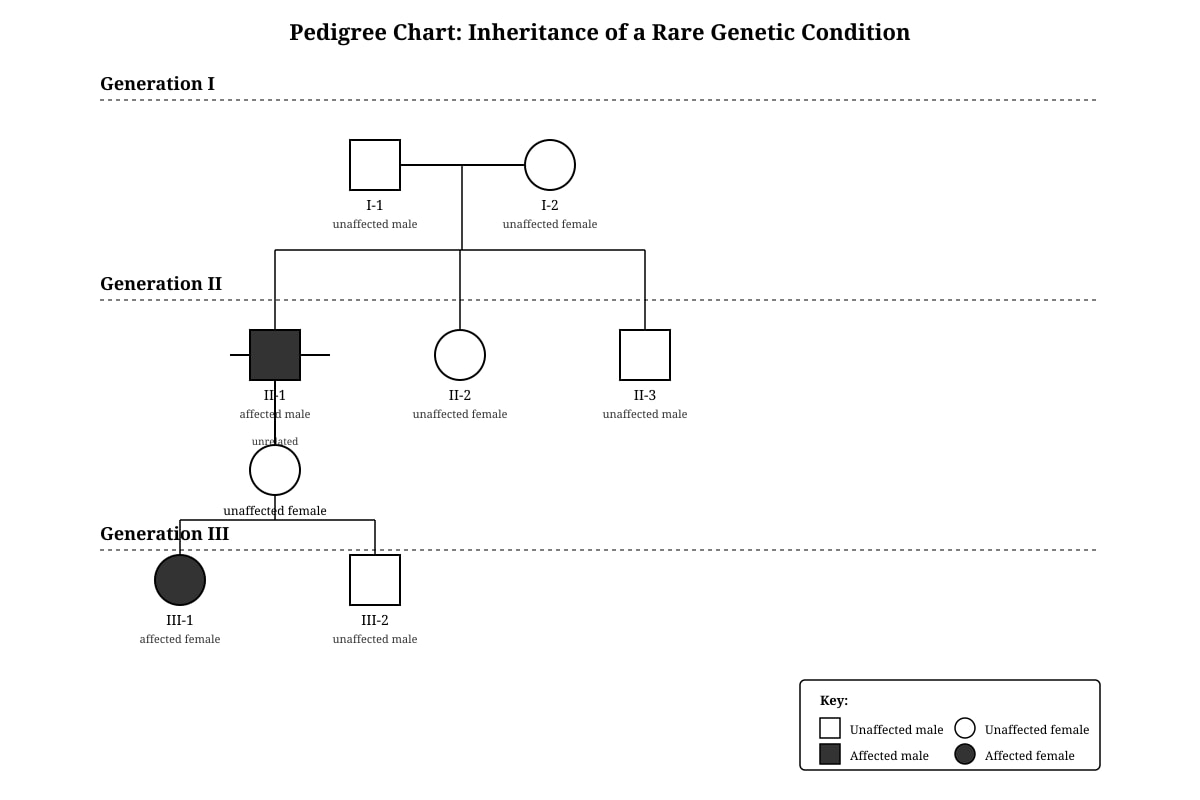
(a) The condition is inherited as autosomal recessive. [1]
Reasoning:
- The condition appears in both males and females, ruling out X-linked inheritance (or making it very unlikely).
- Two unaffected parents (Generation I) have an affected child (II-1), which means both parents must be carriers of a recessive allele. This is only possible if the condition is recessive.
- The affected male (II-1) has an affected daughter (III-1) with an unaffected wife — this is consistent with autosomal recessive inheritance (the affected father is homozygous recessive, and the mother must be a carrier). [2]
(b) Evidence: Two unaffected parents (I-1 and I-2) produced an affected offspring (II-1). This is only possible if the condition is recessive, as both parents must be heterozygous carriers. [1]
Teaching Notes:
Students should systematically eliminate other inheritance patterns. X-linked recessive is unlikely because an affected father (II-1) would pass the affected X to all daughters — but the mother is unaffected and not a carrier, so X-linked recessive would not produce an affected daughter in this scenario. Autosomal dominant is ruled out because unaffected parents cannot produce an affected child under dominant inheritance.
14. [6]
(a) In incomplete dominance, the heterozygote () shows a blended intermediate phenotype (pink) that is distinct from either homozygous phenotype (red or white). In codominance, both alleles are fully and separately expressed in the heterozygote (e.g., red and white patches appearing together, not blended). Since the pink phenotype is a blend of red and white, this is incomplete dominance. [2]
(b) (i) Genotypic ratio: 1 RR : 2 Rr : 1 rr [1]
(ii) Phenotypic ratio: 1 red : 2 pink : 1 white [1]
(c) Cross: (pink) × (white)
| (pink) | (white) | |
| (pink) | (white) |
Percentage of pink offspring = 50% (2 out of 4 = 1/2) [2]
Mark breakdown: Correct cross set-up (1), correct answer (1).
15. [5]
(a) The results suggest that the two genes are linked (located on the same chromosome). [1] In a standard dihybrid cross with independent assortment, the expected phenotypic ratio is 9:3:3:1, with roughly equal numbers of each recombinant type. Here, the parental phenotypes (Purple Smooth and Yellow Wrinkled) are much more frequent (382 and 379) than the recombinant phenotypes (Purple Wrinkled and Yellow Smooth, 118 and 121). [1] This indicates that the genes tend to be inherited together because they are physically close on the same chromosome, and crossing over between them is relatively infrequent. [1]
(b) Recombinant offspring = Purple Wrinkled + Yellow Smooth = 118 + 121 = 239 [2]
Working: Total offspring = 382 + 118 + 121 + 379 = 1000. Recombinants = 118 + 121 = 239.
Teaching Notes:
Students should understand that recombinant phenotypes arise from crossing over during meiosis. The recombination frequency can be calculated as 239/1000 × 100 = 23.9%, indicating the genes are relatively close together on the chromosome.
16. [5]
(a) For an autosomal recessive disorder, affected individuals = .
[2]
Working shown: ,
(b) , so
Carrier frequency = (approximately 3.92% or about 1 in 25) [2]
Working shown: ,
(c) One assumption that may not hold: No natural selection — in reality, individuals with cystic fibrosis may have reduced reproductive fitness, which would alter allele frequencies over time. [1]
Other acceptable answers: no mutation, no migration/gene flow, random mating, large population size (no genetic drift).
17. [4]
(a) Expected ratio: 1 long-winged : 1 short-winged (1:1) [1]
This is a test cross: Ll × ll → 1 Ll (long) : 1 ll (short).
(b) (i) Null hypothesis: There is no significant difference between the observed and expected results; the observed ratio fits the expected 1:1 ratio. [1]
(ii) Since the calculated value (0.36) is less than the critical value (3.84) at , the student should accept the null hypothesis. [1] This means the observed results do not differ significantly from the expected 1:1 ratio, and any deviation is due to chance alone. [1]
Teaching Notes:
Students should understand that < critical value means the difference is not statistically significant, so we fail to reject (accept) the null hypothesis.
Section C: Data Interpretation & Extended Response (Questions 18–20)
18. [7]
(a) A frameshift mutation alters the reading frame of the gene from the point of mutation onwards, changing every subsequent codon and therefore every amino acid in the downstream portion of the protein. [1] This usually results in a completely non-functional protein with a drastically altered amino acid sequence. [1] In contrast, a substitution mutation changes only one codon, affecting at most a single amino acid (in the case of a missense mutation), and may have little or no effect on protein function (especially if the substituted amino acid has similar properties, or if the mutation is silent). [1]
(b) (i) mRNA sequence: 5' – AUG CCU GAA UUU – 3' [1]
(Note: mRNA is transcribed from the template strand, which is complementary and antiparallel to the coding strand. The coding strand has the same sequence as mRNA except T is replaced by U.)
(ii) The original DNA coding strand: 5' – ATG CCT GAA TTT – 3'
The mutated DNA coding strand: 5' – ATG CCT GTA TTT – 3'
The codon GAA (DNA coding strand) → mRNA codon GAA → codes for glutamic acid.
The codon GTA (DNA coding strand) → mRNA codon GUA → codes for valine. [1]
This is a missense mutation — a single nucleotide substitution (A → T at the third position of the codon) results in a different amino acid being incorporated. [1] This may alter the protein's structure and function, depending on the role of the affected amino acid in the protein's folding or active site. [1]
Teaching Notes:
This type of question mirrors the sickle cell anaemia mutation, where a single base change (GAG → GTG in the coding strand, or the corresponding change on the template strand) changes glutamic acid to valine in the β-globin chain.
19. [7]
(a) DNA replication is semi-conservative because each new DNA molecule consists of one original (parental) strand and one newly synthesised strand. [1] After replication, both daughter DNA molecules retain half of the original genetic material, ensuring genetic continuity. [1]
(b) (i) DNA polymerase catalyses the addition of nucleotides to the 3' end of a growing DNA strand, synthesising new DNA in the 5' → 3' direction. It also proofreads and corrects errors. [1]
(ii) RNA primer provides a free 3'-OH group for DNA polymerase to begin DNA synthesis. DNA polymerase cannot initiate synthesis de novo; it can only add nucleotides to an existing strand. [1]
(c) DNA polymerase can only synthesise DNA in the 5' → 3' direction. [1] The lagging strand template runs in the 3' → 5' direction (relative to the direction of the replication fork), so DNA polymerase must work away from the replication fork in short segments. [1] RNA primers are laid down repeatedly on the lagging strand, and DNA polymerase synthesises short Okazaki fragments (100–200 nucleotides in eukaryotes) from each primer. These fragments are later joined by DNA ligase to form a continuous strand. [1]
Teaching Notes:
Students must clearly link the directionality constraint of DNA polymerase (5'→3' synthesis only) to the need for discontinuous synthesis on the lagging strand.
20. [10]
(a) [3]
| Genotype | Phenotype (Blood Group) |
|---|---|
| A | |
| A | |
| B | |
| B | |
| AB | |
| O |
Mark breakdown: 1 mark for each correct row (6 rows, 3 marks total — allow 3 marks for all correct, deduct for errors).
(b) (i) Man with blood group A whose mother was blood group O (): The man must have inherited from his mother, so his genotype is . [1]
Woman with blood group B whose father was blood group O (): The woman must have inherited from her father, so her genotype is . [1]
(ii) Genetic diagram: [3]
| (AB) | (B) | |
| (A) | (O) |
Possible blood groups of children: A, B, AB, and O (each with 25% probability).
Mark breakdown: Correct parental genotypes (1), correct gametes/Punnett square (1), correct offspring genotypes and phenotypes (1).
(c) Codominance: Alleles and are codominant because when both are present in the genotype , both A and B antigens are expressed equally on the surface of red blood cells (blood group AB). Neither allele masks the expression of the other. [1]
Multiple alleles: The ABO blood group system is controlled by three alleles (, , and ) at a single gene locus. While any individual can only carry two alleles, the population has more than two alleles for this gene, making it an example of multiple alleles. [1]
Mark Summary
| Question | Marks |
|---|---|
| 1 | 2 |
| 2 | 2 |
| 3 | 2 |
| 4 | 2 |
| 5 | 2 |
| 6 | 2 |
| 7 | 2 |
| 8 | 2 |
| 9 | 2 |
| 10 | 2 |
| 11 | 7 |
| 12 | 6 |
| 13 | 4 |
| 14 | 6 |
| 15 | 5 |
| 16 | 5 |
| 17 | 4 |
| 18 | 7 |
| 19 | 7 |
| 20 | 10 |
| Total | 50 |
End of Answer Key