AI Generated Quiz
A Level H1 Biology Evolution Diversity Quiz
Free A Level H1 Biology Evolution Diversity quiz, HY3 AI version, with questions, answers, and A Level-style practice for Singapore students.
These static practice materials are generated from the site's syllabus and paper-generation workflow, with source and model context shown so students and parents can evaluate the material before use.
Questions
Free quiz and exam paper access
Enter your details to view this paper
Your access is remembered on this device.
Answers
A-Level Biology H1 Quiz - Evolution Diversity (Answer Key)
Total Marks: 40
Topic: Evolution & Diversity (Core Idea 4, 2026 H1 Syllabus)
Answers are teaching notes for syllabus-first practice. Not derived from specific past-year questions.
1. [1 mark]
A species is a group of organisms that can interbreed and produce fertile offspring in nature (biological species concept).
Teaching note: This definition emphasises reproductive isolation from other groups. Common mistake: saying "same appearance" — looks alone do not define species.
2. [1 mark]
Natural selection.
Teaching note: The process favours traits that increase survival/reproduction; over time allele frequencies shift.
3. [1 mark]
Any one: mutation, sexual reproduction/recombination, gene flow, or random mating effects.
Teaching note: Mutation is the ultimate source of new alleles.
4. [2 marks]
Natural selection is the process where individuals with traits better suited to the environment survive and reproduce more successfully (1), passing those favourable heritable traits to the next generation (1).
Marking: 1 for survival/reproduction advantage, 1 for inheritance of traits.
5. [1 mark]
Convergent evolution produces similar traits in unrelated lineages; divergent evolution produces different traits from a common ancestor.
Accept any valid single difference.
6. [2 marks]
Random mutation in bacterial DNA may produce a resistant allele (1). When antibiotic is applied, susceptible bacteria die, resistant ones survive and reproduce, increasing resistance frequency (1).
Marking: 1 for mutation origin, 1 for selection by antibiotic.
7. [1 mark]
Molecular / DNA sequence evidence.
8. [1 mark]
Homologous structures are similar in anatomy due to shared ancestry, even if functions differ.
9. [1 mark]
The gene pool is the total collection of alleles in a reproducing population at a given time.
10. [1 mark]
Low diversity means fewer traits available for selection; a new stressor may affect all individuals similarly, risking extinction.
11. [4 marks total]
(a) [1] B% Gen1 = 20 / (80+20) × 100 = 20%.
(b) [1] B increased from 20% to ~79% over generations.
(c) [2] Predation favoured B (1); B survivors reproduced, shifting allele frequency toward B (1).
Teaching: Use table to show directional selection.
12. [2 marks]
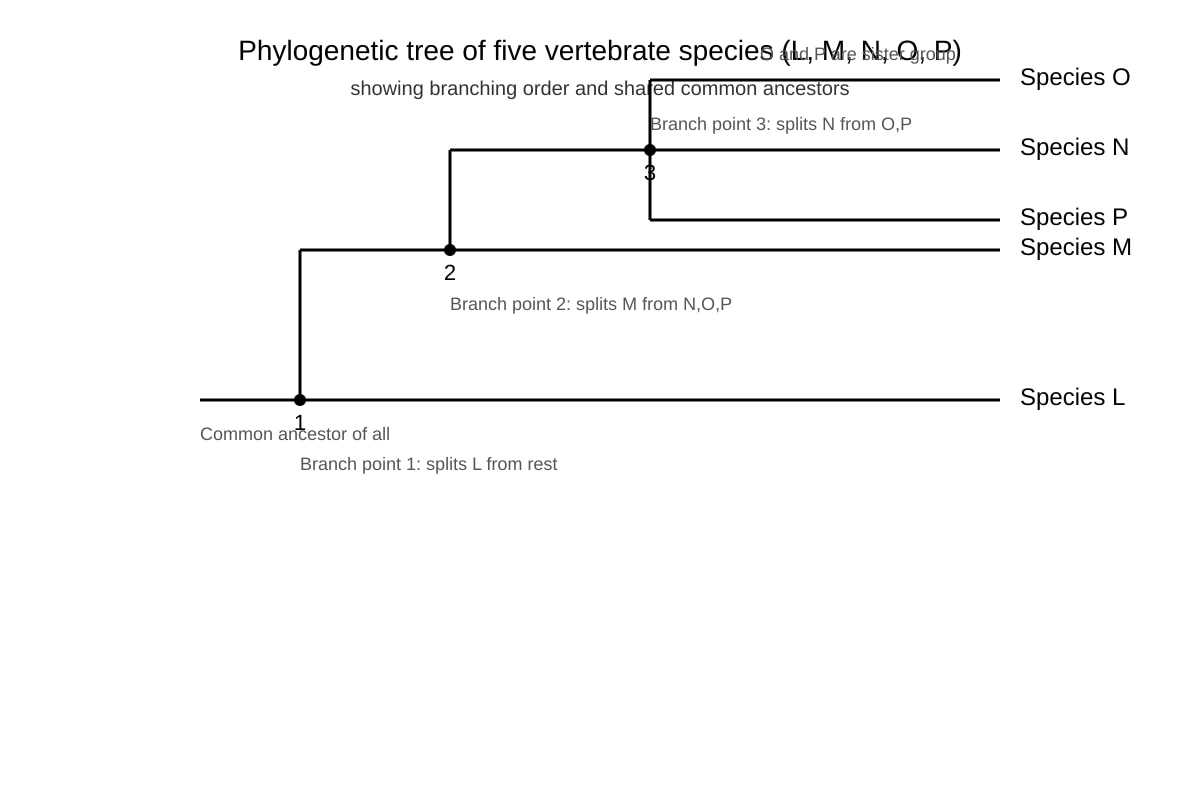
Most closely related: O and P (1). Reason: they are sister group sharing most recent branch point 3 (1).
From placeholder: tree shows O,P split last.
13. [4 marks total]
(a) [1] Predation by birds on green beetles (blackened ground).
(b) [1] Decrease in green allele frequency.
(c) [2] Green beetles more visible/detected (1); lower survival reduces contribution to gene pool (1).
14. [3 marks]
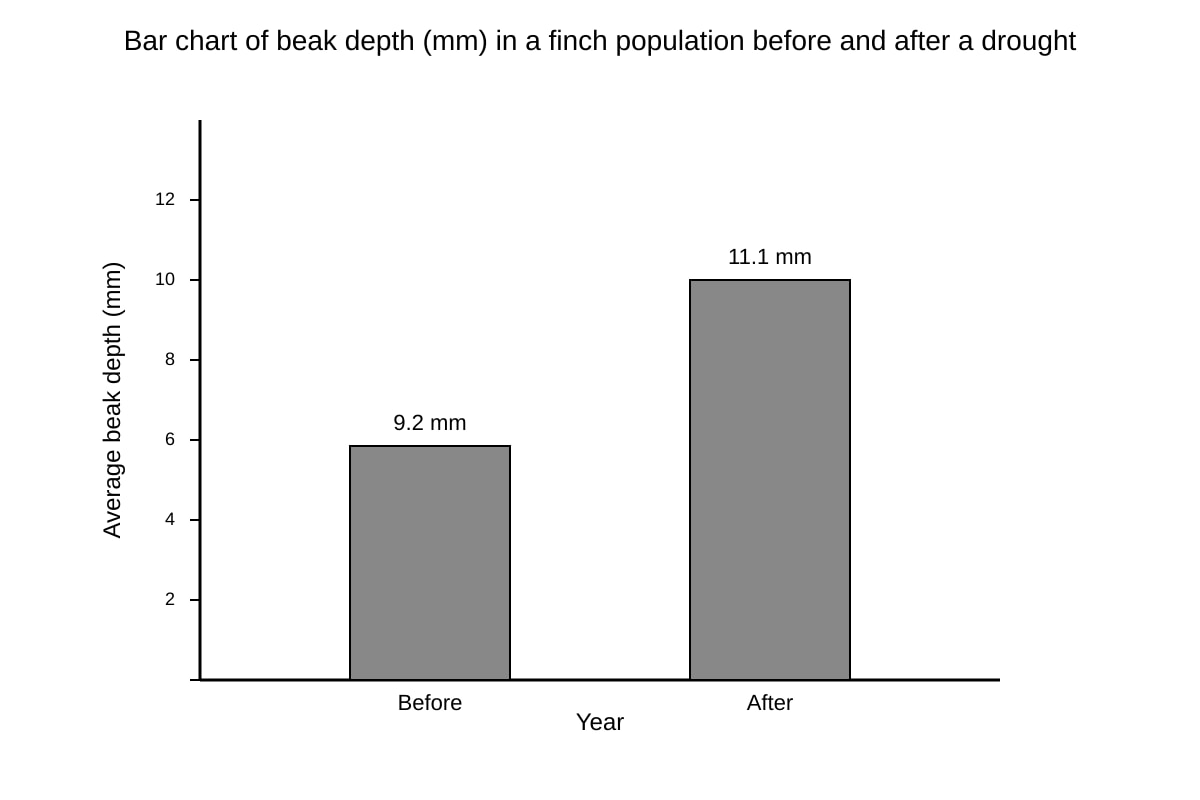
Change: increased from 9.2 to 11.1 mm (1). Explanation: drought reduced soft seeds; birds with deeper beaks accessed hard seeds and survived (1); trait inherited, shifting population mean (1).
From placeholder: bars show values.
15. [2 marks]
Fossils show chronological change in forms (1). Example: Archaeopteryx shows bird-reptile transition (1).
16. [3 marks]
Variation provides differences among individuals (1). Inheritance passes traits to offspring (1). Selection acts on variation, changing allele frequencies over generations (1).
17. [4 marks]
Homologous: same structure from common ancestor, different function (e.g., human arm / whale flipper) (2). Analogous: similar function, different origin (e.g., insect wing / bird wing) (2).
Marking: 1 each for def, 1 each example.
18. [4 marks]
(a) [3] Initial weed population had genetic variation incl. resistant mutants (1). Herbicide killed susceptible, resistant survived (1). Repeated use selected resistant alleles, frequency rose (1).
(b) [1] Rotate herbicides / mix modes of action.
19. [3 marks]
Genetic drift = random allele frequency change (1). Significant in small populations / bottlenecks / founder effect (1). Can reduce diversity irrespective of fitness (1).
20. [4 marks]
Compare sequences; fewer differences = closer relation (2). Limitation: convergent molecular changes or horizontal gene transfer can mislead (2).