AI Generated Quiz
A Level H1 Biology Ecology Quiz
Free A Level H1 Biology Ecology quiz, HY3 AI version, with questions, answers, and A Level-style practice for Singapore students.
These static practice materials are generated from the site's syllabus and paper-generation workflow, with source and model context shown so students and parents can evaluate the material before use.
Questions
Free quiz and exam paper access
Enter your details to view this paper
Your access is remembered on this device.
Answers
A-Level Biology H1 Quiz - Ecology (Answer Key)
Topic: Ecology
Total Marks: 40
Note: Content generated from LLM-inferred syllabus-first templates (Stage 4/5). Not derived from past-year exam papers.
Section A Answers (1–10)
1. [2 marks]
Definition: An ecosystem is a community of living organisms (biotic components) interacting with each other and with their non-living (abiotic) environment in a particular area.
Marking: 1 mark for living community, 1 mark for abiotic interaction.
Teaching note: Ecosystem includes both parts and their exchanges of energy/matter.
2. [2 marks]
Abiotic: e.g., temperature / dissolved oxygen / pH.
Biotic: e.g., predation / competition / parasite.
Marking: 1 mark each.
Common mistake: Giving two biotic or two abiotic factors.
3. [2 marks]
A food chain is a linear sequence showing energy transfer from producer to successive consumers; a food web is a network of interconnected food chains showing multiple feeding relationships.
Marking: 1 mark each.
4. [2 marks]
Working: Increase = 260 − 200 = 60.
Percentage = (60 / 200) × 100 = 30%.
Answer: 30%.
Marking: 1 mark working, 1 mark answer.
5. [1 mark]
Photosynthesis.
6. [2 marks]
Energy is lost as heat and through undigested material at each trophic level (≈10% transfer). Less energy reaches higher levels, so fewer organisms can be supported.
Marking: 1 mark energy loss, 1 mark consequence.
7. [2 marks]
Any two: CO₂, CH₄, N₂O, water vapour.
Marking: 1 mark each.
8. [2 marks]
e.g., Higher temperature may allow a plant to grow at previously cooler altitudes; or heat stress may kill plants unable to tolerate new range.
Marking: 1 mark mechanism, 1 mark effect.
9. [2 marks]
Carrying capacity is the maximum population size of a species that an environment can sustain indefinitely given resource limits (food, space, etc.).
Marking: 1 mark max size, 1 mark resource limit.
10. [2 marks]
Warmer temperatures shorten mosquito development time and increase reproduction/biting rate, expanding transmission season.
Marking: 1 mark faster development, 1 mark more spread.
Section B Answers (11–15)
11. [3 marks]
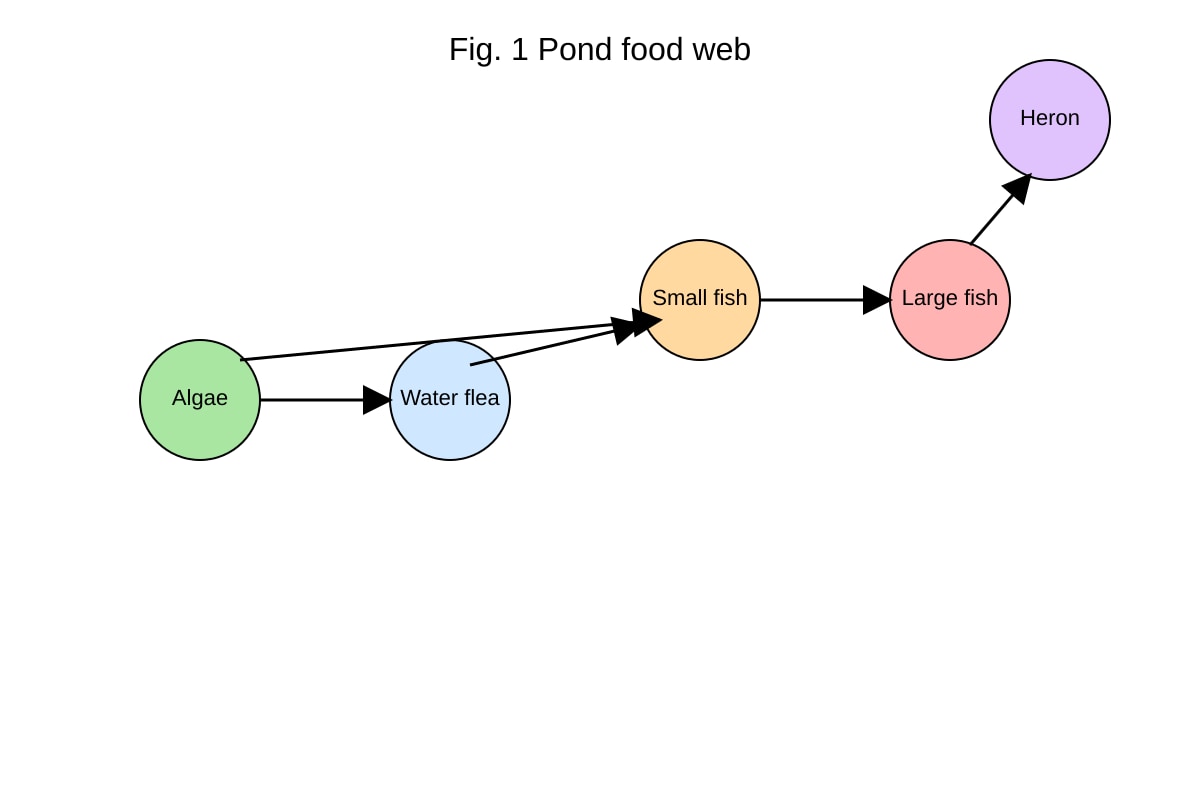
(a) Heron. [1]
(b) Large fish population may increase due to removal of top predator (release from predation). [2: 1 for increase, 1 for reason]
Visual needed: Fig. 1 must show heron at top.
12. [3 marks]
Surface has higher O₂ due to photosynthesis by algae/plants producing O₂ and diffusion from air. Bottom has less light so less photosynthesis, plus decomposition consumes O₂. [3: 1 surface photosynthesis, 1 bottom low light, 1 decomposition use]
13. [4 marks]
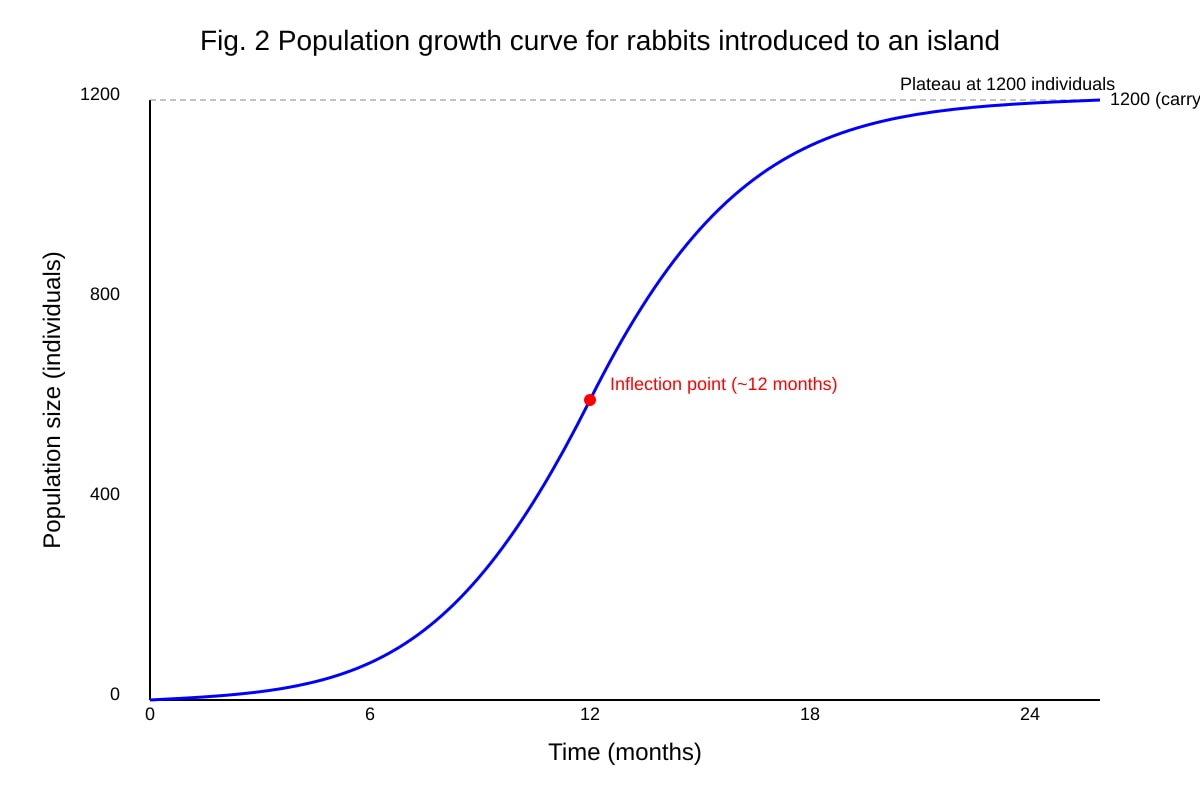
(a) Logistic growth. [1]
(b) 1200 individuals. [1]
(c) Resources (food, space) become limiting; birth rate falls / death rate rises; population stabilises at carrying capacity. [2]
Visual: Graph plateau at 1200.
14. [3 marks]
Area of field = 20 × 20 = 400 m².
Density = 40 daisies / 1 m² = 40 per m².
Estimated total = 40 × 400 = 16 000.
Marking: 1 mark area, 1 mark density, 1 mark total.
15. [2 marks]
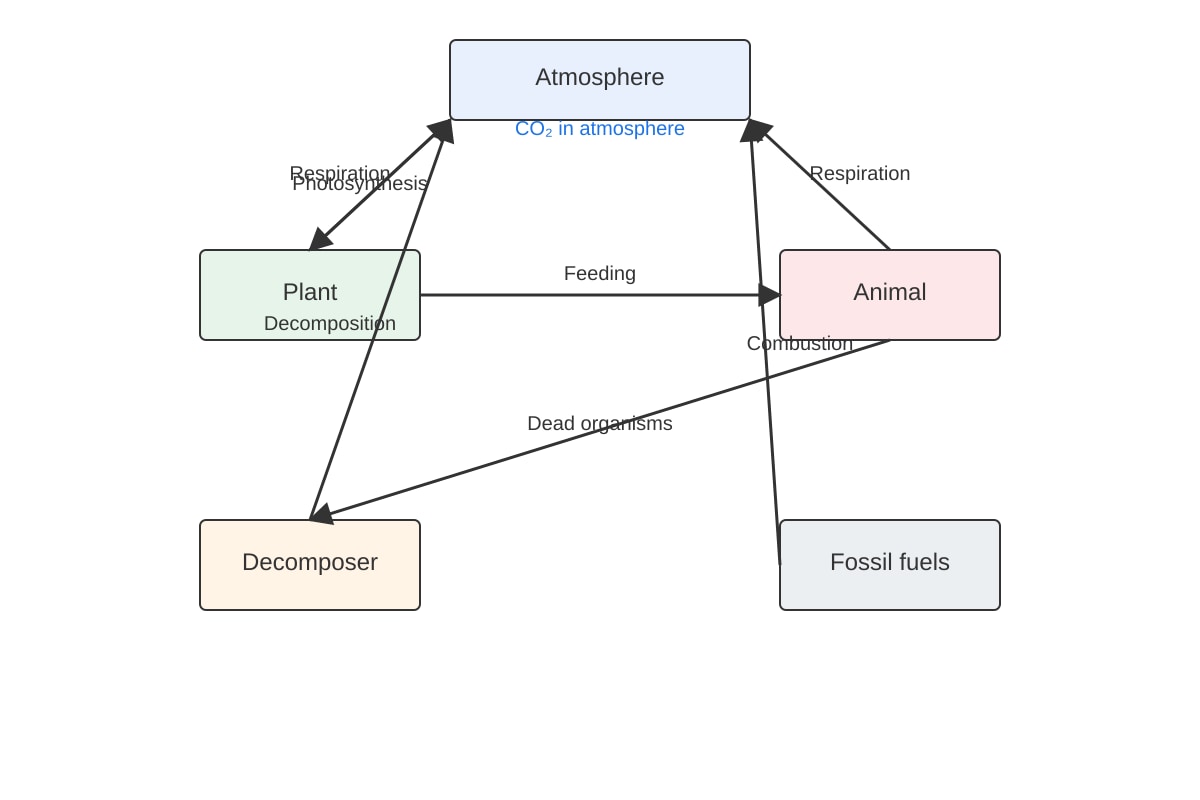
Respiration, decomposition, combustion (any two). [1 each]
Section C Answers (16–20)
16. [4 marks]
CO₂ dissolves in seawater forming carbonic acid: CO₂ + H₂O ⇌ H₂CO₃ ⇌ H⁺ + HCO₃⁻, lowering pH. [2]
Effect: Shell-forming organisms (e.g., corals, molluscs) cannot calcify properly due to lower carbonate availability. [2]
17. [3 marks]
Species adapted to 28 °C may decline; heat-tolerant species may dominate. [1]
Some species may migrate to higher altitudes/shade. [1]
Overall diversity may drop if specialists cannot adapt. [1]
18. [3 marks]
Warmer temperatures remove cold-limit on Aedes survival. [1]
Longer breeding season and faster larval development. [1]
More human–mosquito contact in cities with stagnant water. [1]
19. [4 marks]
Fertiliser adds nitrates → algal bloom. [1]
Algae die and decomposers respire, using O₂. [1]
Dissolved O₂ drops (hypoxia). [1]
Fish suffocate and die. [1]
20. [3 marks]
e.g., Subsidise reduced tillage to keep soil carbon. [1]
Reduces CO₂ release from soil. [1]
May improve yield / water retention. [1]
Marking: Strategy + mechanism + benefit.