AI Generated Quiz
A Level H1 Biology Ecology Quiz
Free A Level H1 Biology Ecology quiz, AI version, with questions, answers, and A Level-style practice for Singapore students.
These static practice materials are generated from the site's syllabus and paper-generation workflow, with source and model context shown so students and parents can evaluate the material before use.
Questions
Free quiz and exam paper access
Enter your details to view this paper
Your access is remembered on this device.
Answers
A-Level Biology H1 Quiz - Ecology: Answer Key
Total Marks: 50
Section A: Multiple-Choice Questions (10 marks)
1. B) A group of individuals of the same species living in the same area at the same time [1]
- Explanation: A population is defined ecologically as all individuals of a single species that live together in a particular area and can interbreed. Option A describes a community (all organisms of different species). Option C also describes a community. Option D describes the habitat or environment.
- Common mistake: Confusing population with community.
2. C) Producers [1]
- Explanation: Producers (plants, algae) form the base of the food chain and capture energy from the sun. They have the highest biomass because they convert solar energy into organic matter. Biomass decreases at each successive trophic level due to energy loss (approximately 90% loss per level).
- Common mistake: Thinking primary consumers have the highest biomass.
3. C) Nitrogen fixation [1]
- Explanation: Nitrogen fixation is the process by which atmospheric nitrogen (N₂) is converted into ammonia (NH₃) by nitrogen-fixing bacteria (e.g., Rhizobium in root nodules, free-living bacteria like Azotobacter). Nitrification is the conversion of ammonia to nitrites and then nitrates. Denitrification converts nitrates back to N₂. Ammonification releases ammonia from dead organic matter.
- Common mistake: Confusing nitrogen fixation with nitrification.
4. C) Competition for food [1]
- Explanation: Density-dependent factors are those whose effects on a population change with population density. Competition for food becomes more intense as population size increases. Earthquakes, floods, and volcanic eruptions are density-independent factors—their effects are not related to population density.
- Common mistake: Thinking all natural disasters are density-dependent.
5. C) A producer [1]
- Explanation: In a pyramid of numbers, producers (usually plants) are at the base because they are the most numerous organisms in most ecosystems. The number of organisms decreases at each successive trophic level.
- Common mistake: In some ecosystems (e.g., a single large tree supporting many herbivores), the pyramid can be inverted, but the standard pyramid has producers at the base.
6. B) Carbon dioxide [1]
- Explanation: Burning fossil fuels (coal, oil, natural gas) releases large amounts of carbon dioxide (CO₂) into the atmosphere. CO₂ is the most significant anthropogenic greenhouse gas. Methane is also a potent greenhouse gas but is more associated with agriculture (livestock, rice paddies).
- Common mistake: Thinking methane is the primary gas from fossil fuel combustion.
7. C) To break down dead organic matter and release nutrients [1]
- Explanation: Decomposers (bacteria, fungi) break down dead organisms and waste products, releasing inorganic nutrients (e.g., nitrogen, phosphorus) back into the ecosystem for reuse by producers. This is essential for nutrient cycling.
- Common mistake: Confusing decomposers with detritivores (which physically break down matter) or with nitrogen-fixing bacteria.
8. A) The maximum number of individuals a habitat can support sustainably [1]
- Explanation: Carrying capacity (K) is the maximum population size of a species that an environment can sustain indefinitely, given the available resources (food, water, shelter). When a population exceeds carrying capacity, resources become limiting and the population declines.
- Common mistake: Confusing carrying capacity with population growth rate.
9. B) 10% [1]
- Explanation: On average, only about 10% of the energy stored at one trophic level is transferred to the next trophic level. The remaining 90% is used for metabolic processes (respiration), lost as heat, or not consumed/digested.
- Common mistake: Thinking the transfer efficiency is higher (e.g., 50% or 90%).
10. B) A predator that has a disproportionately large effect on its environment relative to its abundance [1]
- Explanation: A keystone species is one whose impact on its ecosystem is much larger than its biomass or abundance would suggest. For example, sea otters control sea urchin populations, preventing overgrazing of kelp forests. Their removal can cause dramatic ecosystem changes.
- Common mistake: Confusing keystone species with dominant species (which have high biomass).
Section B: Structured Questions (20 marks)
11. (a) An ecosystem is a community of living organisms (biotic components) interacting with each other and with their non-living (abiotic) environment. [2]
- Marking: 1 mark for mentioning biotic components (living organisms) and 1 mark for abiotic components (non-living environment) and their interactions.
(b) Biotic components: [2]
- Trees, grasses, shrubs (producers)
- Deer, rabbits, insects (consumers)
- Fungi, bacteria (decomposers) (Any two valid biotic components – 1 mark each)
Abiotic components: [2]
- Sunlight
- Temperature
- Water/rainfall
- Soil type/nutrients
- Air (Any two valid abiotic components – 1 mark each)
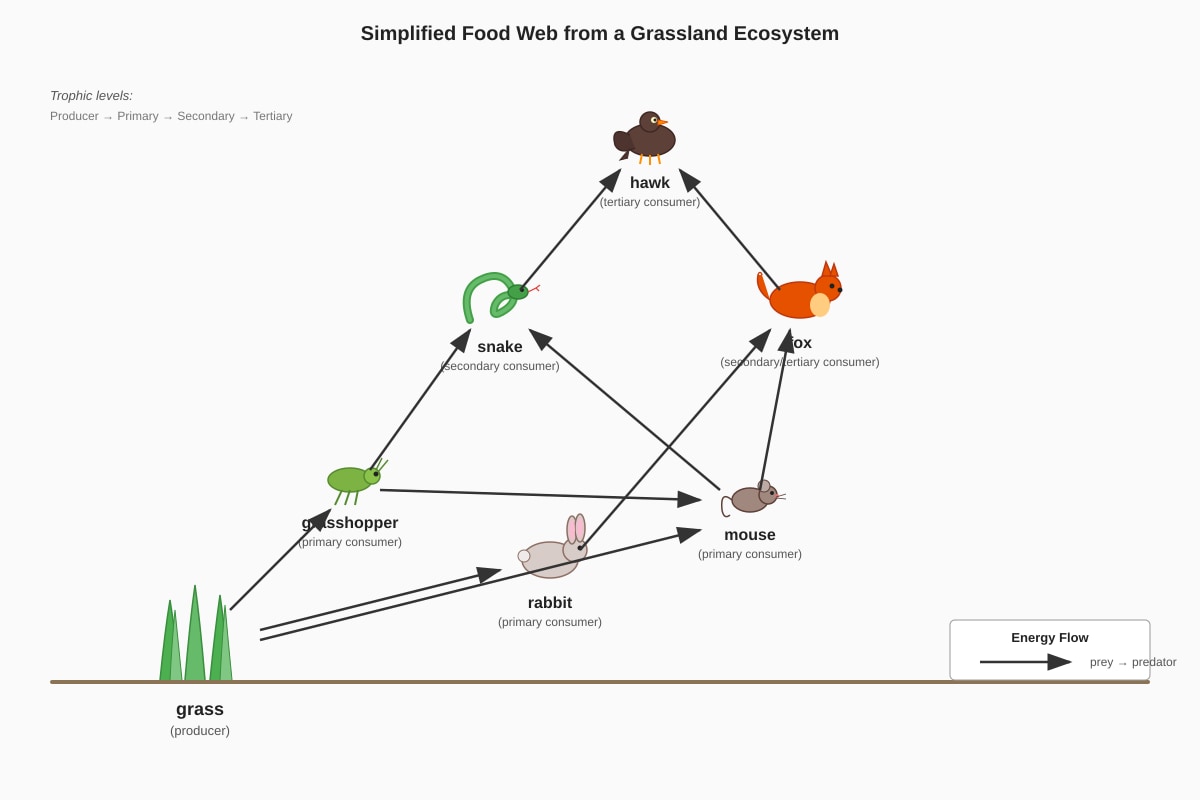
12. (a) The snake is a secondary consumer (it eats primary consumers like grasshoppers and mice). [1]
(b) If all snakes were removed: [3]
- The population of grasshoppers would initially increase because there are fewer predators eating them. [1]
- However, the mouse population might also increase (since snakes also eat mice), leading to increased competition between grasshoppers and mice for grass (the producer). [1]
- Eventually, the grasshopper population might decline due to overgrazing of grass (food shortage) or increased competition, leading to a new equilibrium. The ecosystem would be less stable. [1]
- Marking: 1 mark for initial increase, 1 mark for secondary effects (competition/food shortage), 1 mark for final outcome/equilibrium.
13. (a) Mean = (4 + 6 + 3 + 5 + 7 + 4 + 5 + 6 + 3 + 7) / 10 = 50 / 10 = 5 beetles per quadrat. [1]
(b) Total population estimate: [2]
- Area of each quadrat = 0.25 m²
- Number of quadrats that fit in 1 m² = 1 / 0.25 = 4 quadrats [1]
- Estimated total population = Mean per quadrat × Number of quadrats per m² = 5 × 4 = 20 beetles [1]
- Marking: 1 mark for calculating number of quadrats, 1 mark for correct final answer with working.
14. Eutrophication process: [4]
- Excess nutrients (e.g., nitrates and phosphates from fertilisers or sewage) enter a lake or water body. [1]
- This causes rapid growth of algae (algal bloom) on the water surface. [1]
- The algal bloom blocks sunlight from reaching plants below, causing them to die. [1]
- Decomposers (bacteria) break down the dead plants, using up large amounts of oxygen in the water (oxygen depletion). This leads to the death of fish and other aquatic organisms due to lack of oxygen (hypoxia/anoxia). [1]
- Marking: 1 mark for each correct step in the sequence. Must mention nutrient input, algal bloom, light blockage/plant death, and oxygen depletion/fish death.
15. (a) The second law of thermodynamics (energy transfers are inefficient; some energy is always lost as heat). [1]
- Explanation: The second law states that when energy is converted from one form to another, some energy is lost as heat and is unavailable for further work. This limits the efficiency of energy transfer between trophic levels.
(b) Fewer organisms at higher trophic levels because: [2]
- Energy is lost at each trophic level (approximately 90% loss) through respiration, heat, and undigested material. [1]
- Therefore, less energy is available to support organisms at higher trophic levels, so fewer individuals can be sustained. [1]
- Marking: 1 mark for energy loss concept, 1 mark for consequence on population size.
Section C: Data-Based and Extended-Response Questions (20 marks)
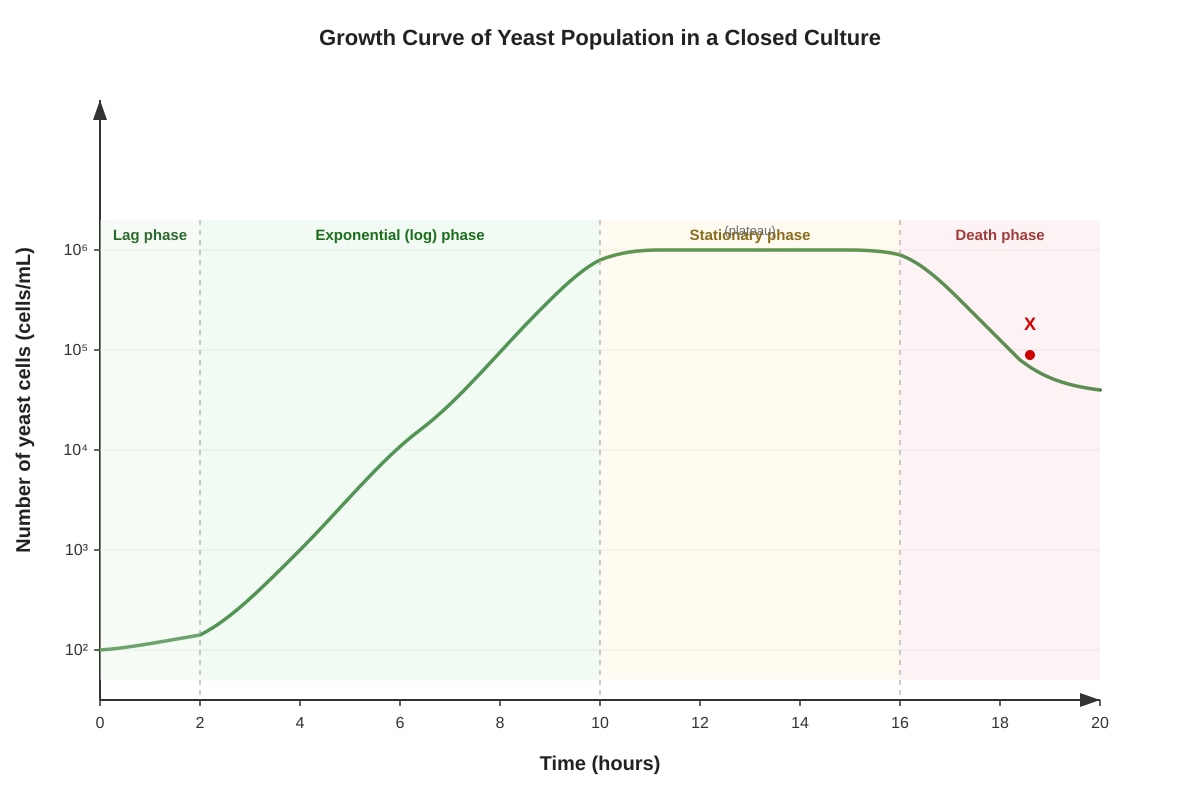
16. (a) Phase X is the exponential (log) phase. [1]
(b) The population enters the stationary phase because: [3]
- Nutrients in the culture medium become depleted/limited. [1]
- Waste products (e.g., ethanol, CO₂) accumulate and become toxic. [1]
- The rate of cell division equals the rate of cell death, so the population size remains constant. [1]
- Marking: 1 mark for nutrient limitation, 1 mark for waste accumulation, 1 mark for equal birth and death rates.
(c) If fresh nutrient medium was added at hour 12: [2]
- The yeast population would resume growth (enter a new exponential phase). [1]
- Because the limiting factor (nutrients) has been removed, allowing cells to divide rapidly again until nutrients are once again depleted or other factors become limiting. [1]
- Marking: 1 mark for prediction (growth resumes), 1 mark for explanation.
17. (a) Two processes that release CO₂ into the atmosphere: [2]
- Respiration (by plants, animals, and decomposers)
- Combustion (burning of fossil fuels and biomass)
- Volcanic eruptions (Any two – 1 mark each)
(b) Human activities altering the carbon cycle: [4]
- Activities: Burning of fossil fuels (coal, oil, gas) for energy and transportation; deforestation (clearing forests reduces CO₂ absorption by photosynthesis); industrial processes (cement production). [2]
- Consequence: Increased atmospheric CO₂ concentration enhances the greenhouse effect, leading to global warming and climate change. This causes rising sea levels, more frequent extreme weather events, changes in precipitation patterns, and shifts in species distributions. [2]
- Marking: 2 marks for describing human activities (at least two), 2 marks for explaining one consequence with detail.
18. (a) Hypothesis: The rate of decomposition of leaf litter increases with temperature (up to an optimum), so the mass of leaf litter remaining will be lowest at 35°C and highest at 10°C. [1]
- Marking: Must be a testable statement predicting the relationship between temperature and decomposition rate.
(b) Independent variable: Temperature (10°C, 25°C, 35°C) [1] Dependent variable: Mass of leaf litter remaining (or rate of decomposition) [1]
(c) The student should have included a control (e.g., a container with leaf litter but no soil/microorganisms) to: [2]
- Ensure that any change in mass is due to decomposition by microorganisms and not other factors (e.g., physical breakdown, leaching). [1]
- Provide a baseline for comparison, increasing the validity and reliability of the results. [1]
- Marking: 1 mark for purpose of control, 1 mark for explanation of how it improves validity.
19. Ecological succession after a wildfire: [4]
- Primary vs. Secondary Succession: Wildfire recovery is an example of secondary succession because soil remains. [1]
- Stages:
- Pioneer stage: Fast-growing grasses, herbs, and fire-adapted plants colonise the area first. These species are good at dispersing and tolerating harsh conditions.
- Intermediate stage: Shrubs and small trees begin to grow, providing shade and shelter. Biodiversity increases as more species establish.
- Climax community: Eventually, larger trees (e.g., oak, pine) dominate, forming a stable forest community similar to the original. [2]
- Biodiversity changes: Biodiversity is low immediately after the fire, increases rapidly during intermediate stages as new species colonise, and stabilises (or slightly decreases) in the climax community as competition excludes some species. [1]
- Marking: 1 mark for identifying secondary succession, 2 marks for describing stages (at least two stages), 1 mark for biodiversity changes.
20. Climate change and Aedes aegypti mosquito: [4]
- Temperature and mosquito life cycle: Rising global temperatures accelerate the life cycle of Aedes aegypti mosquitoes (egg to adult), allowing more generations per year and increasing population size. [1]
- Geographic range expansion: Warmer temperatures allow the mosquito to survive in regions that were previously too cold, expanding its geographic range to higher latitudes and altitudes. [1]
- Disease transmission: The mosquito is a vector for diseases such as dengue fever, Zika virus, and chikungunya. Higher temperatures can increase the rate of viral replication within the mosquito and shorten the extrinsic incubation period (time needed for the virus to become transmissible). [1]
- Overall impact: The combination of larger mosquito populations, wider geographic distribution, and faster disease transmission increases the risk of outbreaks in new areas, including temperate regions like parts of Europe and North America. [1]
- Marking: 1 mark for each well-explained point (life cycle, range expansion, disease transmission, overall impact).
End of Answer Key