AI Generated Quiz
A Level H1 Biology Ecology Quiz
Free A Level H1 Biology Ecology quiz, AI version, with questions, answers, and A Level-style practice for Singapore students.
These static practice materials are generated from the site's syllabus and paper-generation workflow, with source and model context shown so students and parents can evaluate the material before use.
Questions

Free quiz and exam paper access
Enter your details to view this paper
Your access is remembered on this device.
Answers
A-Level Biology H1 Quiz - Ecology: Answer Key
Total Marks: 50
Section A: Multiple-Choice Questions (Questions 1–5)
1. B [1]
- Explanation: Decomposers (e.g., bacteria and fungi) break down dead organic matter and release inorganic nutrients such as nitrogen and phosphorus back into the soil. Option A describes producers (photosynthesis). Option C describes consumers (herbivores). Option D describes nitrogen-fixing bacteria, which are a specific type of bacteria, but the question asks for the general role of decomposers.
2. B [1]
- Explanation: On average, only about 10% of the energy at one trophic level is transferred to the next trophic level. The remaining 90% is lost as heat through respiration, used for metabolic processes, or not consumed/digested.
3. C [1]
- Explanation: Density-dependent factors are those whose effects on a population vary with population density. Competition for food, disease, and predation are density-dependent. Earthquakes, floods, and volcanic eruptions are density-independent factors because their effects are not related to population density.
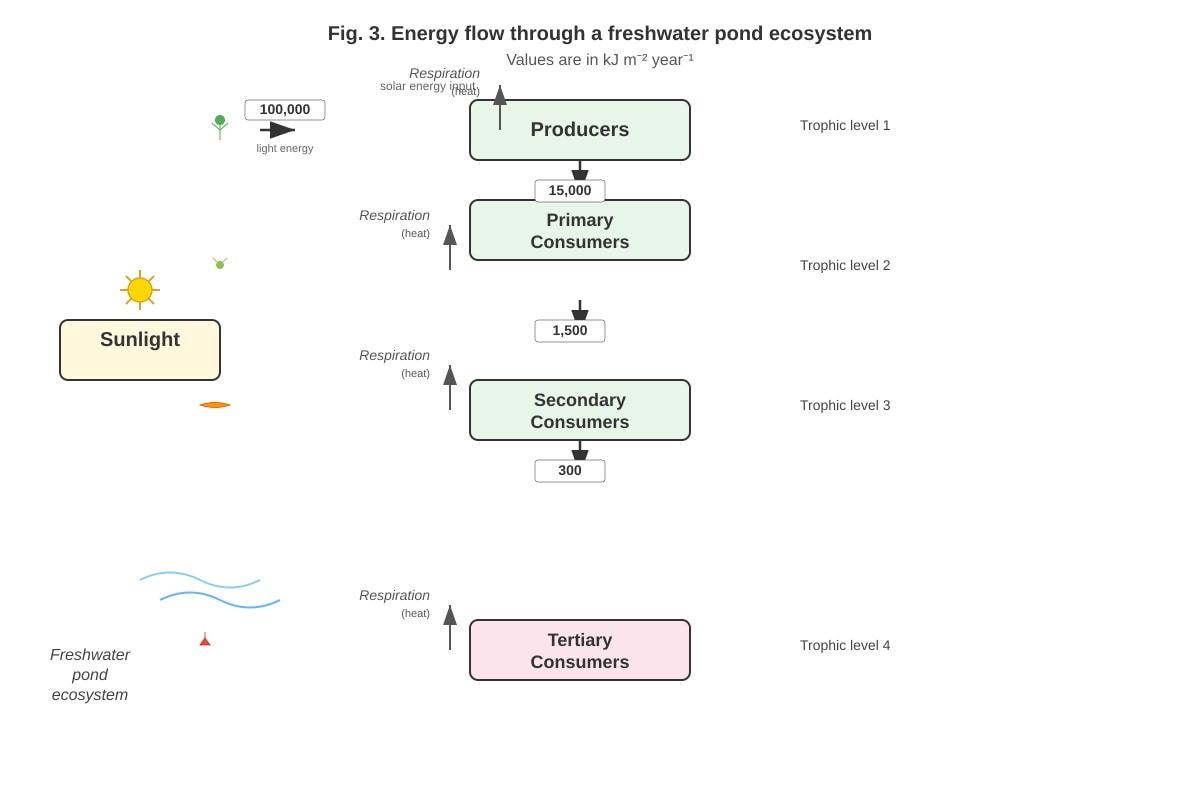
4. A [1]
- Explanation: Arrow A points downwards from the "Producers" box and is labelled as energy lost as heat during respiration. Arrow B represents energy lost as heat from primary consumers. Arrow C represents energy transferred from producers to primary consumers. Arrow D represents energy transferred to decomposers.
5. C [1]
- Explanation: Combustion of fossil fuels (e.g., coal, oil, and natural gas) releases stored carbon as carbon dioxide into the atmosphere. Photosynthesis removes carbon dioxide from the atmosphere. Respiration releases carbon dioxide into the atmosphere. Decomposition releases carbon dioxide into the atmosphere.
Section B: Short-Structured Questions (Questions 6–10)
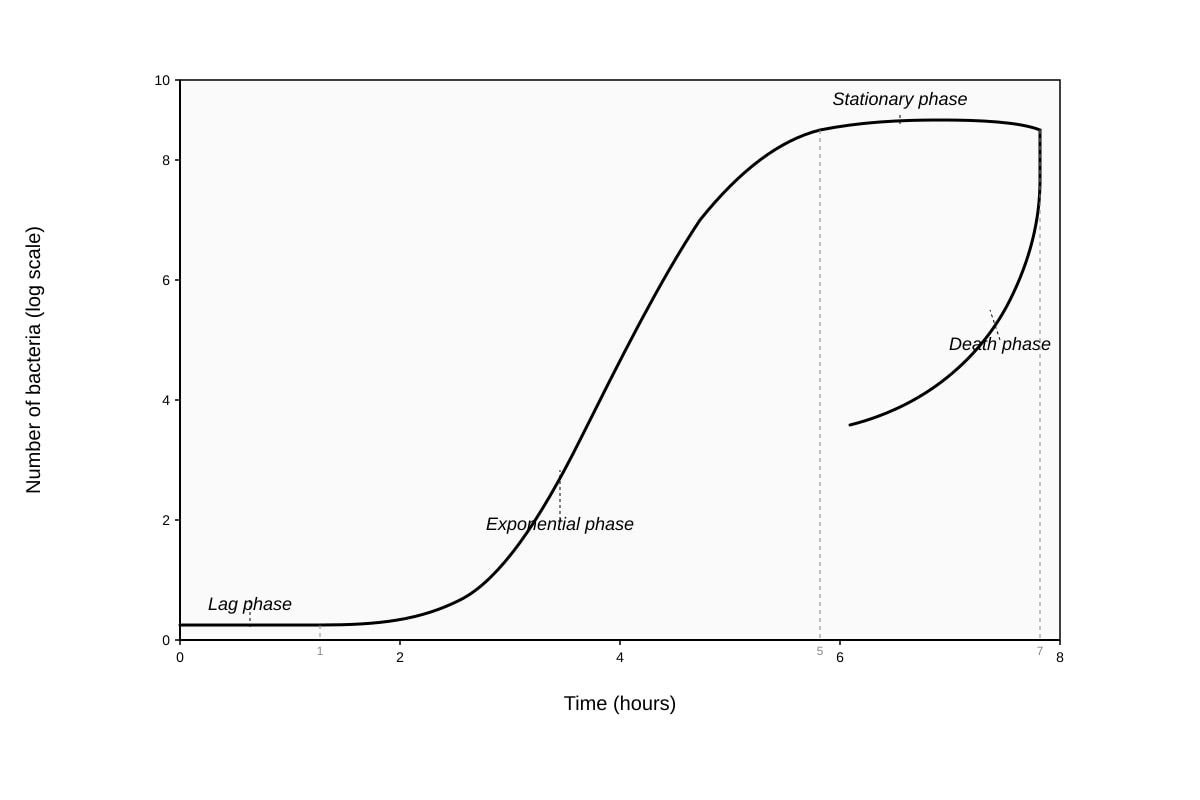
6. (a) Lag phase [1]
- Explanation: The lag phase is the initial period of slow growth where bacteria are adapting to their new environment and synthesizing enzymes and other molecules needed for growth.
(b) The growth rate slows down and eventually stops during the stationary phase (Y) because: [2]
- Nutrients become depleted (1 mark).
- Toxic metabolic waste products accumulate (1 mark).
- Marking note: Award 1 mark for each valid reason, up to a maximum of 2 marks. Accept "space becomes limiting" or "oxygen becomes depleted" as valid reasons.
(c) The population enters the death phase (Z) because: [1]
- Nutrients are exhausted and/or toxic waste products have reached lethal levels.
- Marking note: Award 1 mark for any valid reason that explains a decline in the number of living bacteria.
7. (a) Grass → Rabbit → Fox [1]
- Explanation: Earthworms are decomposers and are not part of a simple grazing food chain. The food chain must start with a producer (grass), followed by a primary consumer (rabbit), and then a secondary consumer (fox).
(b) Tertiary consumer [1]
- Explanation: In the food chain Grass (producer) → Rabbit (primary consumer) → Fox (secondary consumer), the fox is the secondary consumer. Wait, the question asks for the trophic level of the foxes. In this 3-step chain, the fox is the secondary consumer and occupies the third trophic level. The answer should be "Secondary consumer" or "Third trophic level". [1]
- Correction: The fox is the secondary consumer (third trophic level).
(c) The biomass of foxes is likely to be much smaller than the biomass of grass because: [2]
- Energy is lost between trophic levels (e.g., through respiration, heat loss, and uneaten parts) (1 mark).
- Only about 10% of energy is transferred to the next trophic level, so less energy is available to support the foxes (1 mark).
- Marking note: Award 1 mark for mentioning energy loss and 1 mark for linking this to the reduced biomass at higher trophic levels.
8. (a) Simpson's Index of Diversity for Habitat 1: [2]
- Formula:
- For Habitat 1: Species P = 10, Q = 10, R = 10. Total (N) = 30.
- Answer: D = 0.69 (to 2 decimal places).
- Marking note: Award 1 mark for correct substitution into the formula and 1 mark for the correct final answer.
(b) Habitat 2 has a higher species diversity. [2]
- Calculation for Habitat 2: Species P = 45, Q = 5, R = 5. Total (N) = 55.
- Justification: Habitat 1 has a higher Simpson's Index (0.69) than Habitat 2 (0.32). A higher value indicates greater diversity because it reflects a more even distribution of individuals among species. Habitat 1 has an even distribution (10, 10, 10), while Habitat 2 is dominated by one species (45 of one species).
- Marking note: Award 1 mark for correctly calculating or stating the index for Habitat 2 and 1 mark for the justification based on evenness or the index value.
9. Role of nitrogen-fixing bacteria: [2]
- Nitrogen-fixing bacteria (e.g., Rhizobium in root nodules of legumes, Azotobacter in soil) convert atmospheric nitrogen () into ammonia () or ammonium ions () (1 mark).
- This makes nitrogen available to plants for the synthesis of amino acids, proteins, and nucleic acids (1 mark).
- Marking note: Award 1 mark for identifying the conversion of to ammonia/ammonium and 1 mark for explaining its significance to plants.
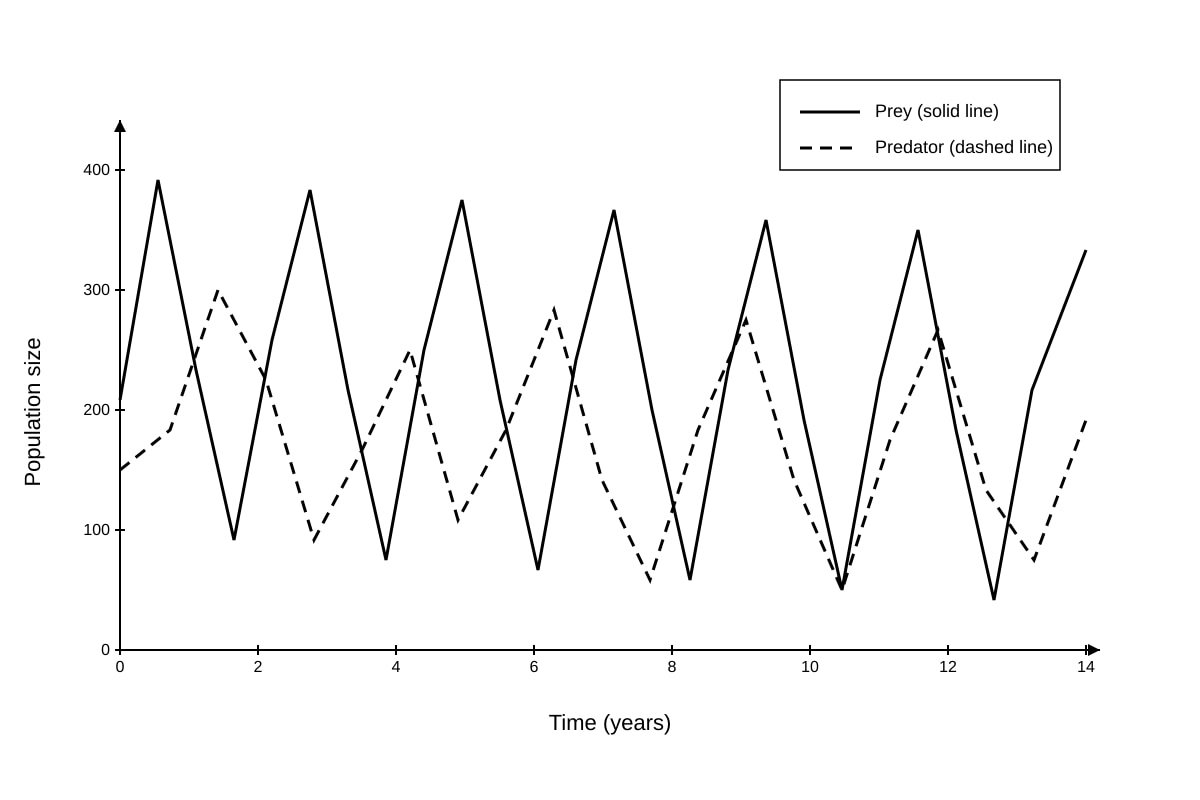
10. (a) The predator and prey populations show cyclical fluctuations, with the predator population peaking shortly after the prey population peaks. [1]
- Explanation: The predator population lags behind the prey population.
(b) An increase in the prey population could lead to a subsequent increase in the predator population because: [2]
- More food is available for the predators (1 mark).
- This leads to increased survival and reproduction of predators, causing the predator population to increase (1 mark).
Section C: Data-Based and Extended Response Questions (Questions 11–20)
11. (a) As light intensity increases, the rate of photosynthesis increases proportionally up to 30 arbitrary units, then plateaus at 20 bubbles per minute. [2]
- Marking note: Award 1 mark for describing the initial increase and 1 mark for describing the plateau.
(b) Between light intensities of 40 and 60 arbitrary units, the rate of photosynthesis remains constant because light is no longer the limiting factor. [2]
- Another factor (e.g., carbon dioxide concentration or temperature) is now limiting the rate of photosynthesis (1 mark).
- The plant cannot photosynthesize any faster despite the increase in light intensity (1 mark).
(c) Carbon dioxide concentration or temperature. [1]
- Marking note: Award 1 mark for either correct answer.
12. Ecological succession is the gradual, directional change in the species composition of an ecosystem over time. [4]
- Example: Primary succession on a newly formed volcanic island.
- Explanation:
- Pioneer species (e.g., lichens and mosses) colonize the bare rock (1 mark).
- These species break down the rock and contribute organic matter, forming a thin layer of soil (1 mark).
- This allows larger plants (e.g., grasses, shrubs, and eventually trees) to establish (1 mark).
- The community becomes more complex and stable over time, eventually reaching a climax community (1 mark).
- Marking note: Award marks for the definition, a named example, and a clear sequence of stages. Accept other valid examples such as secondary succession after a forest fire or abandonment of farmland.
13. (a) Percentage of energy transferred from producers to primary consumers: [2]
- Answer: 15%
- Marking note: Award 1 mark for correct substitution and 1 mark for the correct final answer.
(b) The percentage of energy transferred is not 100% because: [2]
- Energy is lost as heat through respiration (1 mark).
- Energy is lost in uneaten parts (e.g., bones, roots) and in waste products (e.g., faeces) (1 mark).
- Marking note: Award 1 mark for each valid reason, up to a maximum of 2 marks.
(c) Energy lost as heat from tertiary consumers could be reduced by: [1]
- Reducing the metabolic rate of the tertiary consumers (e.g., by keeping them in a cooler environment) or reducing their activity levels.
- Marking note: Award 1 mark for any valid suggestion that reduces heat loss.
14. Impact of deforestation on the carbon cycle and the greenhouse effect: [4]
- Deforestation reduces the number of trees available to absorb carbon dioxide during photosynthesis (1 mark).
- Burning or decomposing of cleared trees releases stored carbon back into the atmosphere as carbon dioxide (1 mark).
- This increases the concentration of carbon dioxide, a greenhouse gas, in the atmosphere (1 mark).
- Increased greenhouse gas concentration enhances the greenhouse effect, trapping more heat and leading to global warming (1 mark).
- Marking note: Award 1 mark for each valid point, up to a maximum of 4 marks.
15. (a) Estimated population size using the Lincoln-Petersen index: [2]
- Formula:
- Where: M = number marked in first sample (80), C = total number caught in second sample (100), R = number of marked individuals recaptured (20).
- Answer: 400 beetles
- Marking note: Award 1 mark for correct substitution and 1 mark for the correct final answer.
(b) One assumption of the mark-release-recapture method: [1]
- The population is closed (no immigration, emigration, birth, or death during the study period).
- OR: The marked individuals mix randomly with the rest of the population.
- OR: The marking does not affect the survival or behaviour of the individuals.
- Marking note: Award 1 mark for any one valid assumption.
16. Role of decomposers in the nitrogen cycle: [3]
- Decomposers (e.g., bacteria and fungi) break down dead organic matter (e.g., dead plants and animals, faeces) (1 mark).
- They convert organic nitrogen compounds (e.g., proteins and nucleic acids) into ammonia () or ammonium ions () through a process called ammonification (1 mark).
- This makes nitrogen available for plants to absorb and use (1 mark).
- Marking note: Award 1 mark for each valid point, up to a maximum of 3 marks.
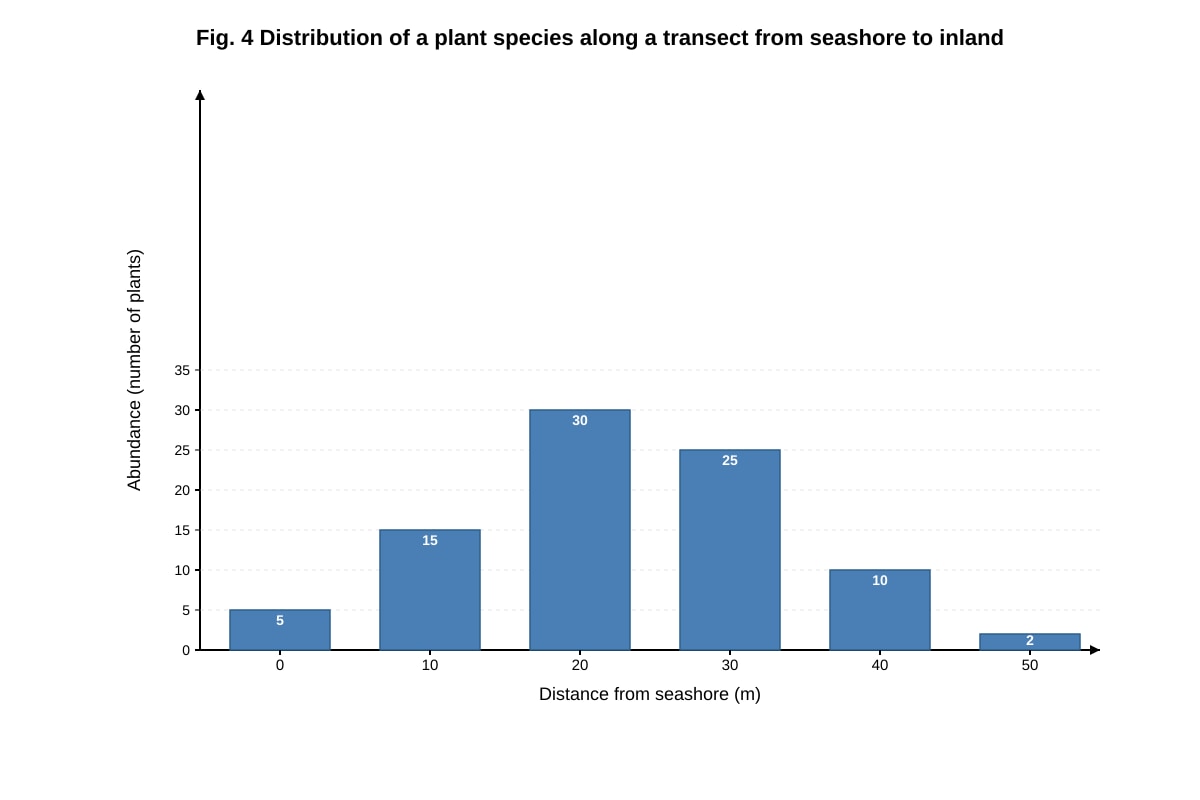
17. (a) The plant species is most abundant at 20-30 m from the seashore, with lower abundance closer to the sea and further inland. [1]
- Marking note: Award 1 mark for a description that includes the peak at 20-30 m and the decline on either side.
(b) Salinity (salt concentration in the soil) or water availability. [1]
- Explanation: Plants closer to the seashore may be exposed to high salinity, which is stressful. Further inland, water may be less available.
- Marking note: Award 1 mark for any valid abiotic factor that could explain the distribution.
18. How the greenhouse effect leads to global warming: [3]
- Greenhouse gases (e.g., carbon dioxide, methane, water vapour) in the atmosphere trap heat from the sun (1 mark).
- These gases allow short-wave solar radiation to pass through but absorb and re-radiate long-wave infrared radiation (heat) back to the Earth's surface (1 mark).
- An increase in the concentration of greenhouse gases (e.g., from burning fossil fuels) enhances this effect, trapping more heat and causing the Earth's average temperature to rise (global warming) (1 mark).
19. Evolution of pesticide resistance in insects: [4]
- Within the insect population, there is genetic variation due to random mutations (1 mark).
- Some insects may have a mutation that confers resistance to the pesticide (1 mark).
- When the pesticide is applied, susceptible insects die, but resistant insects survive and reproduce (1 mark).
- The resistant allele is passed on to the next generation, and the frequency of the resistance allele increases in the population over time (1 mark).
- Marking note: Award 1 mark for each valid point, up to a maximum of 4 marks. This is an example of natural selection.
20. Ecological consequences of introducing a non-native species: [4]
- Competition: The non-native species may outcompete native species for resources (e.g., food, space, light), leading to a decline in native populations (1 mark).
- Predation: The non-native species may prey on native species that have no natural defences against it, leading to population crashes or even extinction (1 mark).
- Disease: The non-native species may introduce new diseases to which native species have no immunity (1 mark).
- Disruption of food webs and ecosystem processes: The introduction can alter the balance of the ecosystem, leading to a loss of biodiversity (1 mark).
- Marking note: Award 1 mark for each valid consequence, up to a maximum of 4 marks.
END OF ANSWER KEY