AI Generated Quiz
A Level H1 Biology Ecology Quiz
Free A Level H1 Biology Ecology quiz, DeepSeek AI version, with questions, answers, and A Level-style practice for Singapore students.
These static practice materials are generated from the site's syllabus and paper-generation workflow, with source and model context shown so students and parents can evaluate the material before use.
Questions
Free quiz and exam paper access
Enter your details to view this paper
Your access is remembered on this device.
Answers
A-Level Biology H1 Quiz - Ecology: Answer Key
Section A: Multiple Choice
- C
- D
- C
- A
- D
Section B: Structured Questions
6.
(a) Ecosystem: A biological community of interacting organisms and their physical environment, functioning as a unit. [2]
(b) A habitat is the place where an organism lives (its address), whereas a niche is the role of the organism in its environment (its profession), including its interactions, resource use, and way of life. [2]
7.
(a) Algae [1]
(b) Stickleback (or Mayfly nymph – accept either as long as correct). [1]
(c) Energy is lost at each trophic level (only about 10% is transferred); algae use solar energy, but losses occur through respiration, movement, uneaten parts, and excretion, so the biomass available to higher trophic levels decreases; therefore pike biomass is much smaller. [2]
8.
(a) Any two from:
- Loss as heat from respiration
- Loss in undigested food (faeces)
- Loss in excretory products (urine)
- Energy used in movement/life processes [2]
(b) With each transfer, energy is lost, so very little energy remains after 4–5 trophic levels; insufficient energy is available to support another trophic level; food chains are limited by energy availability. [2]
9.
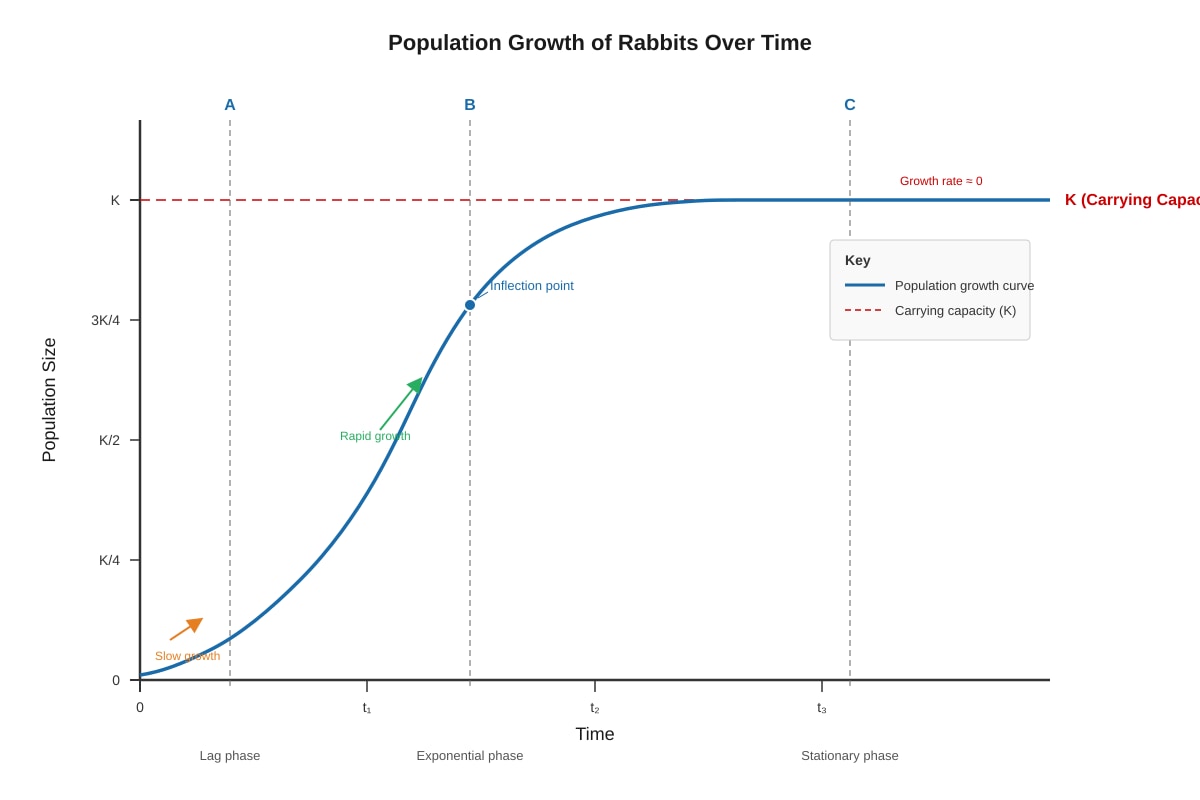
(a) Sigmoid (S‑shaped) growth curve. [1]
(b) The initial population size is small, so reproduction is slow; organisms are still adapting to the new environment (lag phase). [1]
(c) Any density‑dependent factor, e.g. competition for food, disease, predation, accumulation of wastes. [1]
(d) The rabbit population would decrease because predation increases the death rate; it may stabilise at a lower level. [1]
10.
(a) Biodiversity: The variety of life in all its forms, levels, and combinations; includes diversity within species, between species, and of ecosystems. [2]
(b) One reason, e.g.: High biodiversity ensures ecosystem resilience/stability; or it provides essential ecosystem services (pollination, water purification); or it maintains nutrient cycles and regulates climate. Explanation must be given for the full 2 marks. Accept any valid biological reason clearly explained. [2]
Section C: Data‑Based Questions
11.
(a) The area of forest cleared increased steadily from 2010 to 2020 / the trend is an increase. [1]
(b) Increase = 22 900 – 12 500 = 10 400 hectares; percentage increase = (10 400 / 12 500) × 100 = 83.2%. [2]
12.
Two reasons from:
- Trees act as carbon sinks; deforestation removes them, reducing the uptake of CO₂ by photosynthesis.
- When forests are cleared and burned (combustion), stored carbon is released as CO₂.
- Decomposition of felled organic matter releases CO₂.
(Award 1 mark for each correctly explained reason, up to 3 marks. A third reason can be given for an extra mark if one explanation is less complete – but total 3 marks.) [3]
13.
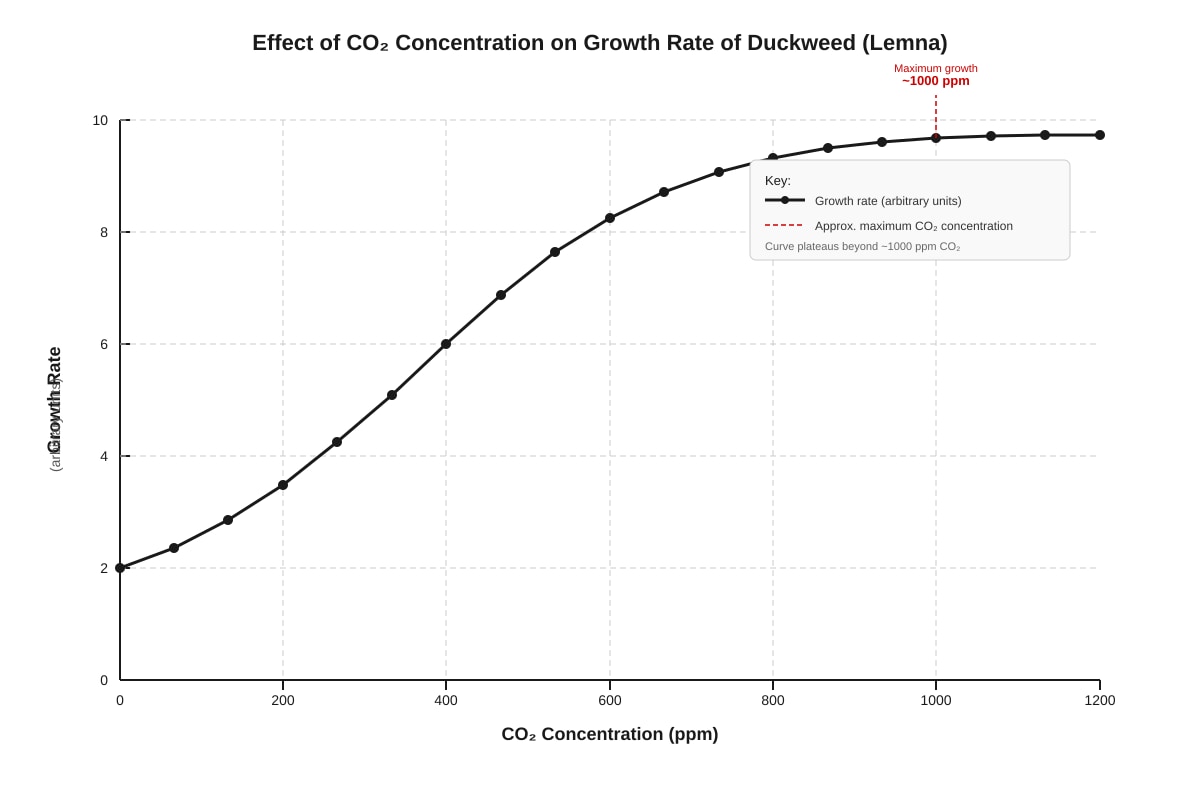
(a) 1000 ppm (accept the value read from the graph, e.g. 1000 ppm). [1]
(b) At low CO₂ concentrations, the rate of photosynthesis is limited by CO₂ availability; increasing CO₂ increases the rate of photosynthesis, so growth rate rises. Beyond the optimum concentration, other factors (e.g. light intensity, temperature, nutrient availability) become limiting, so the growth rate no longer increases and plateaus. [2]
14.
(a) Nitrate is likely limiting. Pond B has very low nitrate (2 mg/L) and phosphate (0.5 mg/L), but nitrate is often the primary limiting nutrient for aquatic plant growth; duckweed requires nitrates for protein and nucleic acid synthesis. (Accept phosphate if justified: both are low, but typically nitrate is more critical. Award 1 mark for identification, 1 mark for explanation.) [2]
(b) Duckweed growth would increase (or the duckweed population would grow rapidly) because the added nutrients remove limitation. [1]
15.
(a) The two populations show a cyclic/oscillating relationship: fox numbers rise after rabbit numbers rise, and fall after rabbit numbers fall. [1]
(b) When foxes are few, predation pressure is low, so more rabbits survive to reproduce, leading to population increase. (Accept: death rate decreases; birth rate exceeds death rate; less predation allows exponential growth until resources become limiting.) [2]
Section D: Essay Questions
16.
Burning fossil fuels releases CO₂ that was stored underground for millions of years, increasing the atmospheric CO₂ concentration and disturbing the balance of the carbon cycle. (2 marks for a clear explanation linking combustion to the carbon cycle.) [2]
17.
Deforestation reduces the number of trees available for photosynthesis, removing a major carbon sink; burning or decomposition of cleared vegetation releases stored CO₂; thus both removal of uptake and addition of CO₂ alter the carbon cycle. (2 marks for two distinct effects, e.g., reduced absorption and increased release.) [2]
18.
Any two, e.g.:
- Global warming leads to habitat loss (e.g., melting ice caps, rising sea levels).
- Shifts in species distribution as species migrate to suitable climates.
- Coral bleaching due to increased ocean temperatures.
- More frequent extreme weather events disrupt ecosystems.
(1 mark per consequence, up to 2 marks.) [2]
19.
High biodiversity increases ecosystem stability because it ensures multiple species perform similar ecological roles (functional redundancy); if one species is lost, others can compensate, maintaining ecosystem processes. Diverse ecosystems are more resilient to disturbances and can recover more quickly. (2 marks for a clear explanation linking biodiversity to stability.) [2]
20.
One measure: e.g., reforestation / afforestation, switching to renewable energy sources, improving energy efficiency, carbon capture technology. Explanation: Reforestation increases carbon sequestration through photosynthesis, removing CO₂ from the atmosphere and helping to mitigate the greenhouse effect. (2 marks: 1 for the measure, 1 for how it reduces CO₂ emissions or enhances sinks.) [2]
End of Answer Key