AI Generated Quiz
A Level H1 Biology Cells Biomolecules Quiz
Free A Level H1 Biology Cells Biomolecules quiz, Claude AI version, with questions, answers, and A Level-style practice for Singapore students.
These static practice materials are generated from the site's syllabus and paper-generation workflow, with source and model context shown so students and parents can evaluate the material before use.
Questions
Free quiz and exam paper access
Enter your details to view this paper
Your access is remembered on this device.
Answers
A-Level Biology H1 Quiz - Cells Biomolecules (Answer Key)
Total Marks: 45
Section A: Short Answer Questions [15 marks]
1. State two functions of the phospholipid bilayer in cell membranes. [2]
Answer: (a) Controls the passage of substances into and out of the cell / selective permeability [1] (b) Provides structural support / maintains cell shape / compartmentalization [1]
Alternative acceptable answers: Maintains concentration gradients, provides fluidity, allows membrane fusion
2. Name the organelle where the following processes occur: [3]
Answer: (a) Protein synthesis involving ribosomes: Rough endoplasmic reticulum [1] (b) ATP synthesis during cellular respiration: Mitochondria [1] (c) Modification and packaging of proteins: Golgi apparatus/Golgi body [1]
Marking notes: Accept "rough ER" for part (a). Do not accept just "ribosomes" as this is not an organelle.
3. Define the term 'enzyme specificity' and explain why it is important in metabolic reactions. [3]
Answer: Definition: Enzyme specificity means that each enzyme catalyses only one specific reaction or acts on one specific substrate [1]
Importance: This ensures that metabolic pathways proceed in the correct sequence / prevents unwanted side reactions / allows precise control of metabolism [2]
Marking notes: Award 1 mark for correct definition mentioning specificity for substrate/reaction. Award 2 marks for explaining importance with reference to metabolic control.
4. List three factors that affect the rate of enzyme-catalysed reactions. [3]
Answer: (a) Temperature [1] (b) pH [1] (c) Substrate concentration / enzyme concentration / presence of inhibitors [1]
Alternative acceptable answers: Cofactors, coenzymes, competitive inhibitors, non-competitive inhibitors
5. State the molecular formula for glucose and describe its role as a respiratory substrate. [4]
Answer: Molecular formula: C₆H₁₂O₆ [1]
Role: Glucose is broken down during cellular respiration to release energy [1]. It is oxidised in glycolysis to form pyruvate [1], which then enters the Krebs cycle to produce ATP, NADH and FADH₂ for energy production [1].
Marking notes: Accept alternative descriptions of glucose breakdown mentioning energy release and ATP production.
Section B: Structured Response Questions [20 marks]
6. Fig. 1 shows the structure of a mitochondrion.
(a) Identify structures A and C. [2]
Answer: A: Outer membrane [1] C: Cristae [1]
(b) Explain how the structure of the inner membrane (B) is adapted for ATP synthesis during cellular respiration. [4]
Answer:
- The inner membrane is folded into cristae [1]
- This provides a large surface area [1]
- For electron transport chain proteins and ATP synthase [1]
- The membrane is impermeable to protons, maintaining the proton gradient needed for chemiosmosis [1]
Marking notes: Accept descriptions of increased surface area and its significance. Must mention ATP synthase or chemiosmosis for full marks.
(c) State the location where the Krebs cycle occurs and explain why this location is suitable. [3]
Answer: Location: Matrix (of mitochondria) [1]
Explanation: The matrix contains the enzymes needed for the Krebs cycle [1]. It also contains NAD⁺ and FAD which are reduced during the cycle / high concentration of substrates [1].
7. The diagram below shows the movement of substances across a cell membrane.
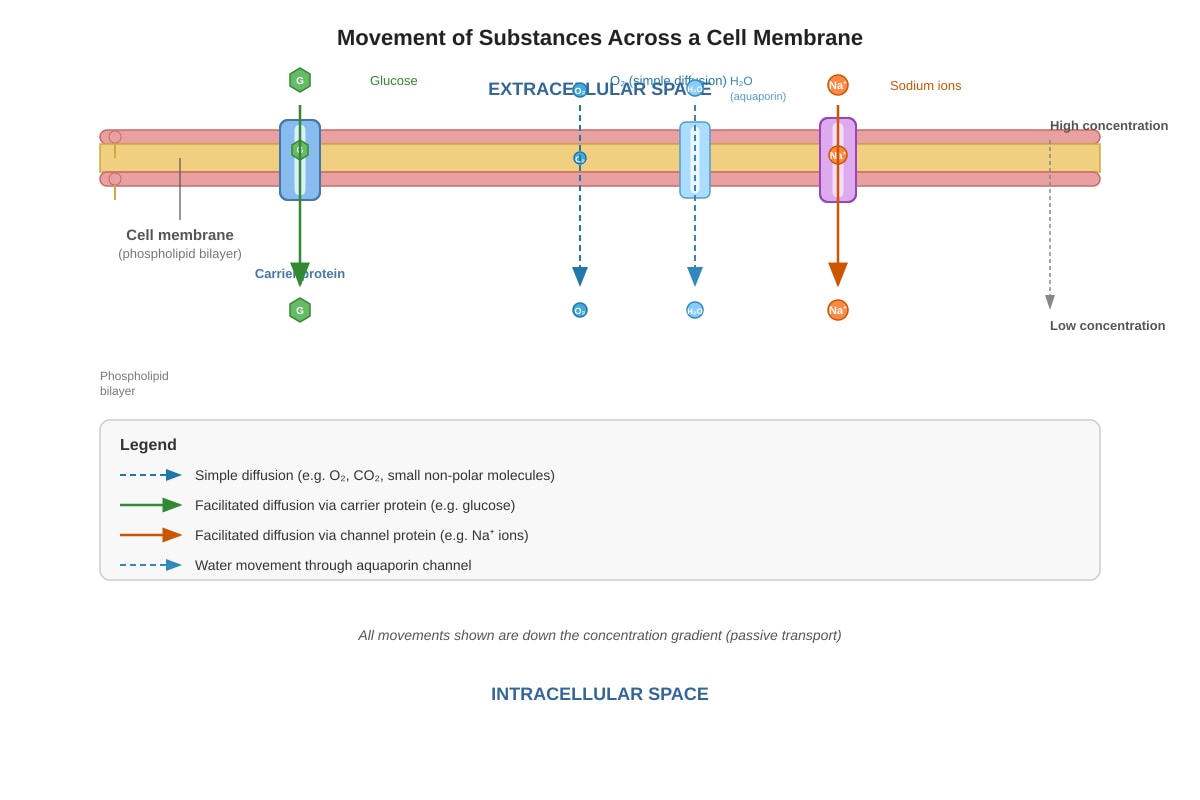
Generated diagram for this question.
(a) Name the type of transport shown for the movement of glucose molecules. [1]
Answer: Facilitated diffusion [1]
(b) Explain why glucose cannot cross the membrane by simple diffusion. [2]
Answer: Glucose is a large, polar molecule [1] that cannot pass through the hydrophobic phospholipid bilayer [1].
Marking notes: Must mention both size and polarity, or impermeability of lipid bilayer to polar molecules.
(c) Describe how active transport differs from the transport mechanism in part (a). [3]
Answer:
- Active transport requires energy/ATP [1]
- Active transport can move substances against their concentration gradient [1]
- Active transport uses carrier proteins that change shape / facilitated diffusion uses channel or carrier proteins but no energy required [1]
8. An investigation was carried out to study the effect of temperature on enzyme activity.
(a) Identify the optimum temperature for this enzyme. [1]
Answer: 40°C [1]
(b) Explain the change in enzyme activity between 10°C and 40°C. [2]
Answer: As temperature increases, kinetic energy of molecules increases [1], leading to more frequent successful collisions between enzyme and substrate / increased rate of reaction [1].
(c) Account for the decrease in enzyme activity above 40°C. [2]
Answer: High temperature causes enzyme denaturation [1]. The active site changes shape so substrate can no longer bind / enzyme loses its specific shape [1].
Section C: Extended Response [10 marks]
9. Describe the structure and function of proteins, explaining how their structure relates to their diverse roles in living organisms. Include examples of different types of proteins in your answer. [10]
Answer: Structure:
- Proteins are made of amino acids joined by peptide bonds [1]
- Primary structure is the sequence of amino acids [1]
- Secondary structure includes α-helices and β-pleated sheets held by hydrogen bonds [1]
- Tertiary structure is the 3D folding held by various bonds (hydrogen, ionic, disulfide) [1]
- Quaternary structure involves multiple polypeptide chains [1]
Structure-Function Relationship:
- The specific 3D shape determines protein function [1]
- Active sites in enzymes have complementary shape to substrates [1]
Examples and Functions:
- Enzymes: catalyse reactions (e.g., amylase breaks down starch) [1]
- Structural proteins: provide support (e.g., collagen in connective tissue) [1]
- Transport proteins: carry substances (e.g., haemoglobin carries oxygen) [1]
Marking Scheme:
- Award marks for accurate description of protein structure levels
- Award marks for explaining structure-function relationships
- Award marks for appropriate examples with correct functions
- Look for clear, scientific language and logical organization
- Maximum 10 marks total