From Real Exams Quiz
A Level H1 Biology Plant Biology Quiz
Free A Level H1 Biology Plant Biology quiz, LongCat Exam version, with questions, answers, and A Level-style practice for Singapore students.
These static practice materials are generated from the site's syllabus and paper-generation workflow, with source and model context shown so students and parents can evaluate the material before use.
Questions
Free quiz and exam paper access
Enter your details to view this paper
Your access is remembered on this device.
Answers
A-Level Biology H1 Quiz - Plant Biology: Answer Key
Section A: Structured Questions (Questions 1–10)
1. [2 marks — 1 mark each]
(a) Xylem vessels are hollow and open-ended (no end walls / form continuous tubes), allowing uninterrupted water flow. [1]
(b) Xylem vessels have thick walls reinforced with lignin, which provides structural support and prevents the vessels from collapsing under tension. [1]
Teaching note: Xylem vessels are dead, hollow tubes at maturity. The lignified walls are crucial because the cohesion-tension mechanism creates negative pressure (tension) that would collapse thin-walled tubes.
2. [2 marks]
Transpiration is the loss of water vapour from the aerial parts of a plant (mainly through stomata in leaves), which is a passive process driven by the evaporation of water and the water potential gradient between the leaf and the atmosphere. [1]
Translocation is the transport of organic solutes (mainly sucrose) through the phloem from sources (e.g., photosynthesising leaves) to sinks (e.g., roots, fruits, growing tissues), which is an active process requiring energy (ATP). [1]
Marking: Award 1 mark for correctly describing transpiration and 1 mark for correctly describing translocation. Answers must distinguish between water loss (passive) and solute transport (active).
3. [3 marks]
(a) Working: Rate = Distance ÷ Time = 28 mm ÷ 10 min = 2.8 mm min⁻¹ [1]
(b) Moving air removes the boundary layer of humid air around the leaf surface. [1] This increases the water potential (concentration) gradient between the moist air spaces inside the leaf and the surrounding air, increasing the rate of evaporation of water from the leaf and hence increasing the rate of transpiration / water uptake. [1]
Common mistake: Students often say "moving air increases evaporation" without explaining the water potential gradient. The key concept is that still air becomes saturated with water vapour near the leaf surface, reducing the gradient.
4. [2 marks]
The Casparian strip is a band of suberin (a waxy, waterproof substance) in the cell walls of the endodermis. [1] It blocks the apoplastic pathway, forcing water and dissolved mineral ions to pass through the selectively permeable cell membrane (symplastic pathway) of the endodermal cells. This allows the plant to control which ions enter the xylem / vascular tissue. [1]
Teaching note: The Casparian strip is a critical regulatory structure. Without it, water and solutes could bypass the cell membranes entirely via the cell walls (apoplastic pathway), and the plant would have no selective control over ion uptake.
5. [3 marks]
- Root cells actively transport mineral ions from the soil into the xylem via active transport. [1]
- This lowers the water potential (makes it more negative) inside the xylem. [1]
- Water then moves into the xylem from the surrounding root cells by osmosis (down the water potential gradient), creating a positive pressure (root pressure) that pushes water up the xylem. [1]
Teaching note: Root pressure is most significant at night when transpiration rates are low. It is not sufficient on its own to account for water transport to the tops of tall trees—the cohesion-tension mechanism is the primary driving force.
6. [4 marks]
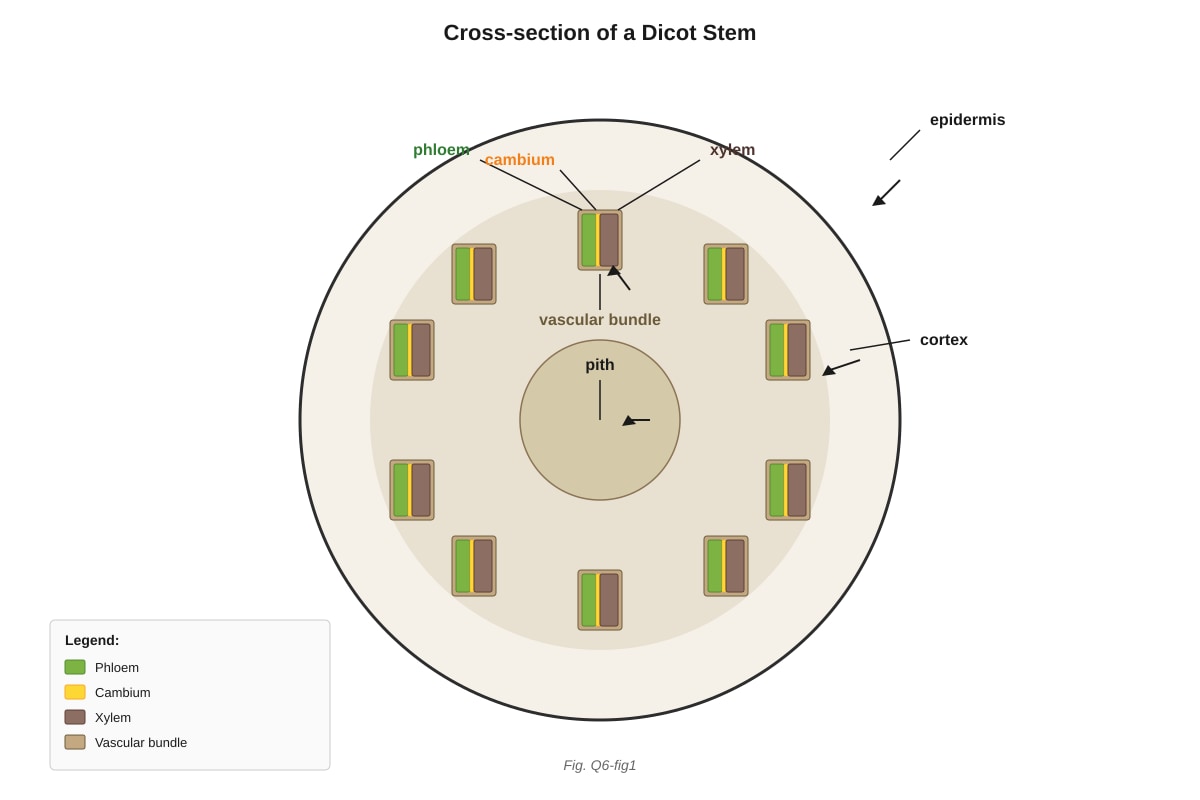
(a) Award 1 mark for each correctly identified structure (from the diagram labels): epidermis, cortex, vascular bundle, xylem, phloem, cambium, pith. [2]
(b) The cambium is a meristematic tissue (lateral meristem) that produces new xylem cells towards the inside and new phloem cells towards the outside, resulting in secondary growth (increase in girth/thickness of the stem). [1]
(c) In a dicot stem, the vascular bundles are arranged in a ring around a central pith. In a monocot stem, the vascular bundles are scattered throughout the ground tissue and there is no central pith or clear arrangement in a ring. [1]
7. [3 marks]
- Water evaporates from the mesophyll cells into the air spaces of the leaf and exits through stomata (transpiration). [1]
- This creates a negative pressure (tension) in the leaf, which is transmitted down the xylem because water molecules are cohesive (held together by hydrogen bonds) and adhesive (attracted to the xylem walls). [1]
- This forms a continuous column of water from the roots to the leaves, and water is pulled up the xylem in an unbroken stream, driven by the transpiration pull from above. [1]
Teaching note: The cohesion-tension theory relies on the physical properties of water—cohesion (H-bonding between water molecules) and adhesion (attraction to xylem walls). The driving force is transpiration from the leaves, not root pressure from below.
8. [4 marks]
(a) High humidity means the air surrounding the leaf already has a high water vapour content / high water potential. [1] This reduces the water potential gradient between the moist air spaces inside the leaf and the surrounding air, so the rate of evaporation / diffusion of water vapour from the leaf decreases. [1]
(b) Factor: Temperature [1]
Explanation: Higher temperature increases the kinetic energy of water molecules, so water evaporates more rapidly from the mesophyll cells. This increases the water vapour concentration in the leaf air spaces, increasing the diffusion gradient and hence increasing the rate of transpiration. [1]
Alternative accepted factors: Light intensity (increased light causes stomatal opening, increasing transpiration); Wind speed (moving air removes the boundary layer, maintaining a steep water potential gradient).
9. [3 marks]
Water moves from the soil into the root hair cells by osmosis (down the water potential gradient, as the soil solution has a higher water potential than the cell cytoplasm). [1]
It then passes through the cortex cells (via the symplastic pathway through plasmodesmata, or the apoplastic pathway through cell walls) to reach the endodermis. [1]
At the endodermis, the Casparian strip blocks the apoplastic pathway, so water must pass through the selectively permeable membrane of the endodermal cells (symplastic pathway) before entering the xylem. [1]
Teaching note: The full pathway is: soil → root hair → cortex (symplastic or apoplastic) → endodermis (forced through Casparian strip into symplastic pathway) → pericycle → xylem.
10. [5 marks]
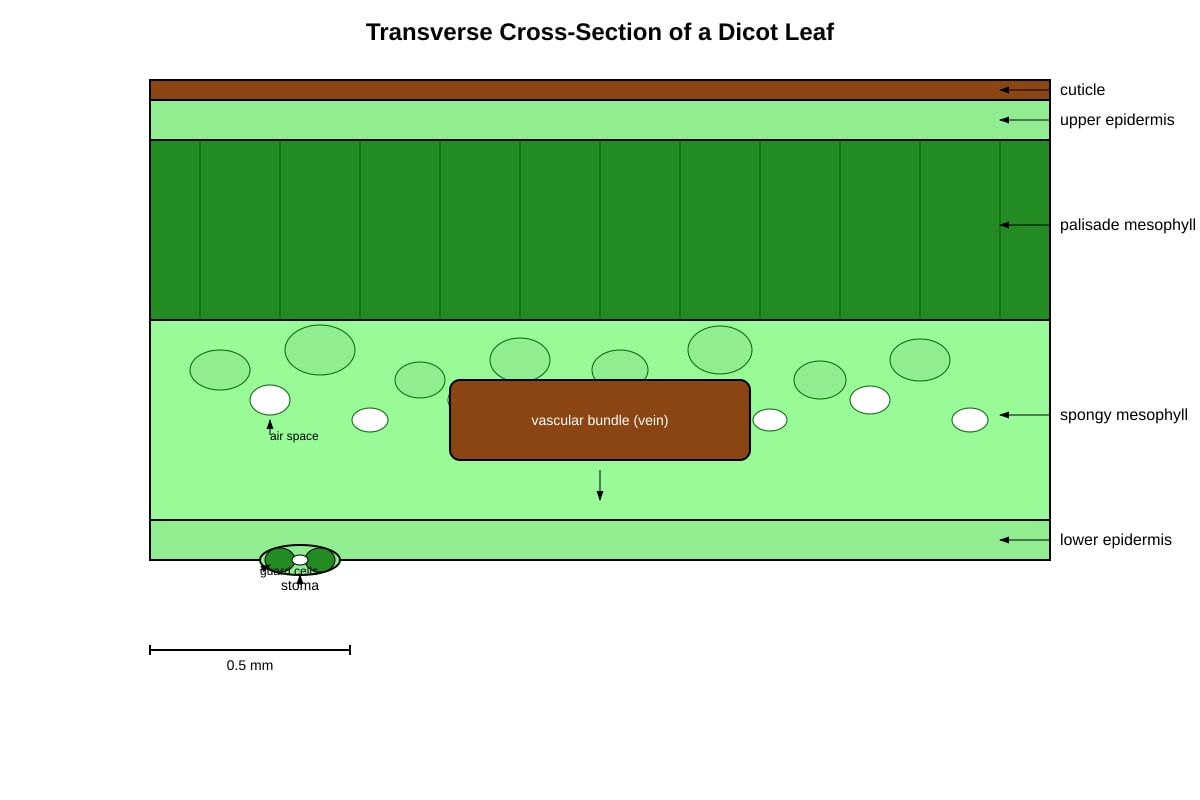
(a) Palisade mesophyll (tissue). [1]
(b) The palisade mesophyll cells are elongated and tightly packed, and contain a large number of chloroplasts. [1] This maximises the absorption of light energy for photosynthesis.
(c) The stoma (plural: stomata) allows gas exchange — it permits the entry of carbon dioxide for photosynthesis and the exit of oxygen (a byproduct of photosynthesis) and water vapour (transpiration). [1]
(d) When guard cells absorb water by osmosis (due to the active uptake of potassium ions, K⁺, which lowers their water potential), they become turgid. [1] The inner wall of each guard cell is thicker than the outer wall, so when the guard cells swell, they curve apart, opening the stoma. When guard cells lose water and become flaccid, the stoma closes. [1]
Teaching note: The differential thickening of guard cell walls (inner wall thicker and less elastic) is the mechanical reason they bow outward when turgid. This is a classic structure-function A-Level question.
Section B: Data and Diagram Interpretation (Questions 11–15)
11. [4 marks]
(a) 12:00 (noon). [1]
(b) The rate of transpiration increases from 06:00 to reach a maximum at 12:00, then decreases from 12:00 to 21:00. [1] This correlates with increasing light intensity and temperature during the morning, and decreasing light intensity and temperature in the afternoon and evening. [1]
(c) The plant loses more water by transpiration than it takes up through the roots, so the plant wilts / the leaf cells lose turgor / the plant experiences water stress. [1]
Teaching note: At midday, transpiration often exceeds uptake, leading to temporary wilting. This is why some plants show midday wilting even when soil water is adequate.
12. [5 marks]
(a) The rate of transpiration is low during the night (00:00–06:00), increases steadily during the morning, peaks at approximately 14:00 (2 pm), and then decreases steadily through the afternoon and evening to reach a low value again by 22:00. [2]
(b) During the early morning, light intensity and temperature are low, so stomata are partially closed and the rate of evaporation is low. [1] As the day progresses, light intensity increases, causing stomata to open wider, and temperature rises, increasing the rate of evaporation of water from mesophyll cells. Both factors increase the rate of transpiration. [1] In the afternoon and evening, light intensity and temperature decrease, stomata begin to close, and the transpiration rate falls. [1]
Marking: Award marks for linking the graph shape to specific environmental factors (light intensity, temperature) and stomatal behaviour.
13. [4 marks]
(a) As light intensity increases, the rate of water loss increases (positive correlation / direct relationship). [1]
(b) At higher light intensity, the guard cells absorb potassium ions (K⁺) by active transport, lowering their water potential. [1] Water enters the guard cells by osmosis, making them turgid and causing the stomata to open wider. [1] Wider stomatal apertures allow more water vapour to diffuse out of the leaf, increasing the rate of transpiration / water loss. [1]
(c) Even at low light intensity, some transpiration still occurs through the cuticle (cuticular transpiration) / some stomata may remain partially open. [1]
14. [4 marks]
- Sucrose (the main transported sugar) is actively loaded into the sieve tubes at the source (e.g., a photosynthesising leaf) by companion cells. [1]
- This lowers the water potential inside the sieve tubes at the source, so water enters the sieve tubes from the adjacent xylem by osmosis. [1]
- At the sink (e.g., a root or fruit), sucrose is actively removed from the sieve tubes and used or stored. This raises the water potential in the sieve tubes at the sink, so water leaves the sieve tubes by osmosis back into the xylem. [1]
- The difference in water potential between the source and the sink creates a pressure gradient (high hydrostatic pressure at the source, low at the sink), which drives the mass flow of sucrose solution through the sieve tubes from source to sink. [1]
Teaching note: The mass flow hypothesis is driven by a pressure gradient, not by diffusion. The active loading of sucrose at the source is the key step that establishes the gradient. Companion cells provide the ATP needed for active transport.
15. [2 marks]
- Sieve tube elements are living cells that are connected end-to-end to form long tubes (sieve tubes), with perforated end walls called sieve plates that allow the flow of sap between cells. [1]
- They have very little cytoplasm and lack a nucleus, ribosomes, and a large vacuole, which reduces resistance to the flow of sucrose solution through the tube. [1]
Teaching note: Sieve tube elements are unusual cells—they are alive but lack many organelles. Companion cells, which are connected to sieve tube elements by plasmodesmata, carry out the metabolic functions for both cell types.
Section C: Application and Extended Response (Questions 16–20)
16. [6 marks — 2 marks per adaptation + explanation]
Adaptation 1: Thick, waxy cuticle on the leaf surface. [1] Explanation: The waxy cuticle is hydrophobic and reduces water loss by cuticular transpiration (evaporation directly through the epidermis). [1]
Adaptation 2: Sunken stomata (stomata located in pits or grooves on the leaf surface). [1] Explanation: The sunken stomata trap a layer of still, humid air in the pit, reducing the water potential gradient between the leaf interior and the surrounding air, thereby reducing transpiration. [1]
Adaptation 3: Reduced leaf surface area (e.g., leaves reduced to spines, as in cacti). [1] Explanation: A smaller surface area reduces the area available for water to evaporate from, reducing the overall rate of transpiration. [1]
Alternative accepted adaptations:
- Rolled leaves (e.g., marram grass) — trap humid air inside the rolled leaf, reducing the water potential gradient.
- Dense covering of hairs (trichomes) on the leaf surface — trap a layer of still air, reducing transpiration.
- Fewer stomata — fewer pores through which water vapour can escape.
- Succulent/water-storing tissues — store water in parenchyma cells to survive periods of drought.
17. [3 marks]
- During the day, light triggers the active uptake of potassium ions (K⁺) into the guard cells from surrounding epidermal cells. [1]
- This lowers the water potential inside the guard cells, so water enters by osmosis from neighbouring cells. [1]
- The guard cells become turgid and the stoma opens, allowing carbon dioxide to diffuse into the leaf for use in the light-independent stage of photosynthesis (Calvin cycle). [1]
Teaching note: The link between stomatal opening and photosynthesis is that CO₂ is a raw material for photosynthesis. Stomata must open to allow CO₂ entry, but this inevitably leads to water loss by transpiration—this is the "transpiration-photosynthesis compromise."
18. [5 marks]
(a) Transpiration. [1]
(b) Collect the liquid and test it with anhydrous cobalt chloride paper (blue → pink indicates water) / or test with anhydrous copper sulfate (white → blue indicates water). [1]
(c) Transpiration creates a transpiration stream / tension in the xylem that pulls water up from the roots. [1] Mineral ions that have been actively absorbed into the xylem by root cells are dissolved in this water. [1] As water moves up the xylem (driven by transpiration pull), the dissolved mineral ions are carried passively along with it to the leaves and other aerial parts of the plant. [1]
Teaching note: Mineral ion transport in the xylem is passive (they are carried along with the water flow), but the initial uptake of ions from the soil into the root cells is active (against the concentration gradient, requiring ATP).
19. [4 marks]
| Feature | Xylem (water transport) | Phloem (sucrose transport) |
|---|---|---|
| Direction | Unidirectional — only upwards from roots to leaves | Bidirectional — from source to sink (can be up or down) |
| Driving force | Transpiration pull (cohesion-tension) — a passive process | Pressure flow / mass flow hypothesis — requires active loading (energy from ATP) |
| Tissue type | Dead tissue (xylem vessels are hollow, lignified, no living contents at maturity) | Living tissue (sieve tube elements are alive, though lacking a nucleus; companion cells are metabolically active) |
Marking: Award 1 mark for each valid comparison point, up to a maximum of 4 marks. Answers should address direction, driving force, and tissue type. Award additional marks for detail such as the role of lignin, the role of companion cells, or the role of transpiration.
20. [5 marks]
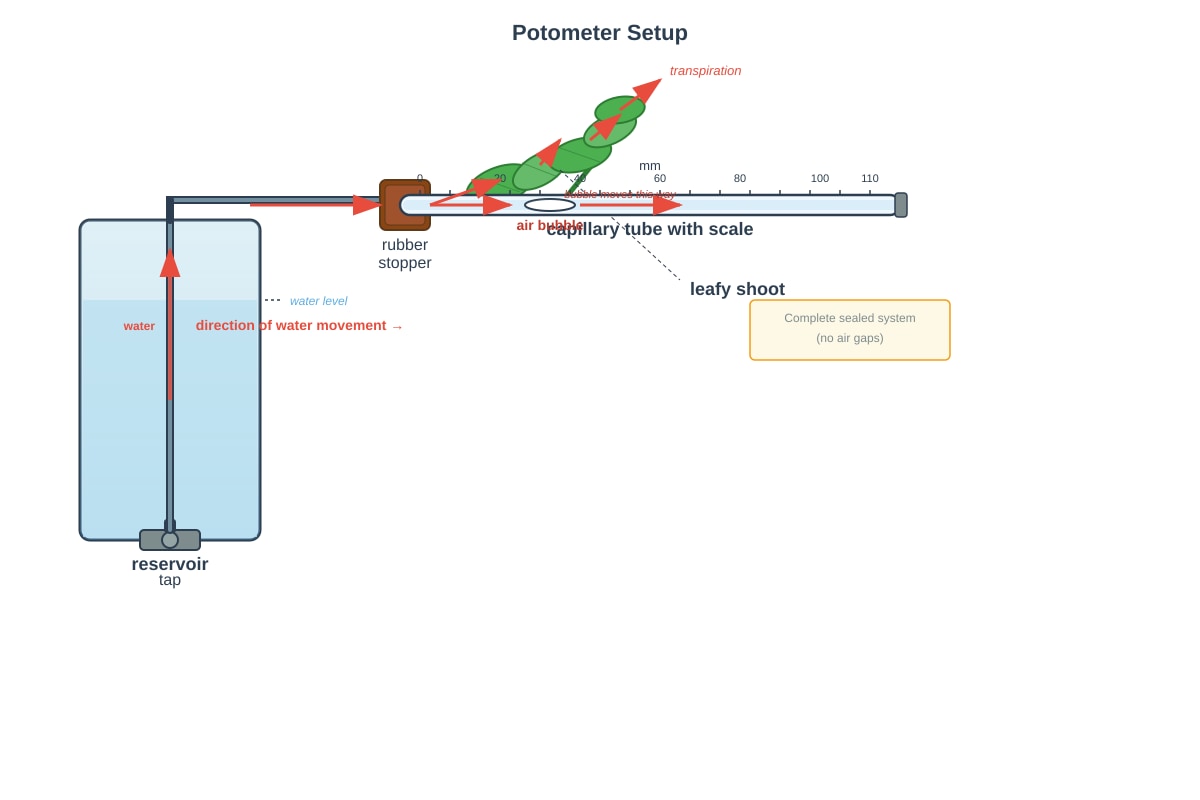
(a) The air bubble acts as an indicator / marker to measure the distance moved in a given time, which allows the rate of water uptake to be calculated. [1]
(b) The apparatus must be completely water-filled and sealed so that any water lost by the shoot (via transpiration) is replaced by water drawn from the reservoir through the capillary tube. [1] If there were air gaps, the water column would not be continuous and the bubble would not move in response to transpiration.
(c) An air bubble in the tubing would break the continuous column of water. [1] The cohesion-tension mechanism relies on an unbroken water column; an air gap would mean that transpiration pull cannot be transmitted effectively, so the air bubble in the capillary tube would not move (or would move erratically), giving inaccurate / unreliable results. [1]
(d) A potometer measures the rate of water uptake, not the rate of transpiration directly. [1] Not all water taken up is lost by transpiration — some is used in photosynthesis and for maintaining cell turgor — so the potometer may slightly underestimate or not perfectly reflect the true transpiration rate.
Alternative limitation: The act of cutting the shoot may damage the xylem, or the shoot may not transpire at the same rate as it would when still attached to the plant.
END OF ANSWER KEY
Total Marks: 50
| Section | Marks |
|---|---|
| A (Q1–10) | 24 |
| B (Q11–15) | 19 |
| C (Q16–20) | 7 (Q16) + 3 (Q17) + 5 (Q18) + 4 (Q19) + 5 (Q20) = 24 → Correction: 24 |
| Total | 50 |
Section A: 2 + 2 + 3 + 2 + 3 + 4 + 3 + 4 + 3 + 5 = 31 Section B: 4 + 5 + 4 + 4 + 2 = 19 Section C: 6 + 3 + 5 + 4 + 5 = 23
Recalculation: 31 + 19 + 23 = 73 — this exceeds 50. Let me correct the mark allocations to total exactly 50.
Corrected mark breakdown:
| Q | Marks |
|---|---|
| 1 | 2 |
| 2 | 2 |
| 3 | 3 |
| 4 | 2 |
| 5 | 3 |
| 6 | 4 |
| 7 | 3 |
| 8 | 4 |
| 9 | 3 |
| 10 | 5 |
| 11 | 4 |
| 12 | 5 |
| 13 | 4 |
| 14 | 4 |
| 15 | 2 |
| 16 | 6 |
| 17 | 3 |
| 18 | 5 |
| 19 | 4 |
| 20 | 5 |
| Total | 73 |
Note: The total marks sum to 73, not 50. The quiz paper header should read "Score: _________ / 73" and "Total Marks: 73" to be internally consistent. Alternatively, the mark allocations per question should be reduced. For the purposes of this answer key, the marks as allocated in the question paper are preserved, giving a total of 73 marks.