From Real Exams Quiz
A Level H1 Biology Plant Biology Quiz
Free A Level H1 Biology Plant Biology quiz, HY3 Exam version, with questions, answers, and A Level-style practice for Singapore students.
These static practice materials are generated from the site's syllabus and paper-generation workflow, with source and model context shown so students and parents can evaluate the material before use.
Questions
Free quiz and exam paper access
Enter your details to view this paper
Your access is remembered on this device.
Answers
A-Level Biology H1 Quiz - Plant Biology (Answer Key)
Total Marks: 40
Topic: Plant Biology
Section A Answers (1–10)
1. [2 marks]
- Structural feature: rigid / provides support / porous (1)
- Molecule: cellulose (1)
Teaching note: Plant cell walls are made of cellulose, a polysaccharide of β-glucose, giving rigidity.
2. [1 mark]
- Chloroplast
Teaching note: Chloroplasts contain chlorophyll and are the site of photosynthesis.
3. [2 marks]
- Cellulose molecules form microfibrils (1)
- Arranged in layers crossing each other for strength (1)
Teaching note: The criss-cross layout resists expansion in all directions.
4. [1 mark]
- Osmosis
Teaching note: Net movement of water into cell across membrane.
5. [2 marks]
- Cell wall is rigid and prevents expansion (1)
- Turgor pressure builds but wall resists bursting (1)
Teaching note: Animal cells lack wall, so they lyse.
6. [2 marks]
- Chlorophyll (1)
- Green (1)
Teaching note: Absorbs red/blue, reflects green.
7. [2 marks]
- CO₂ and H₂O (1)
- (1)
Teaching note: Light energy captured by chlorophyll drives reaction.
8. [2 marks]
- Insoluble so does not affect water potential (1)
- Compact / branched for easy storage and hydrolysis (1)
Teaching note: Starch is a mix of amylose and amylopectin.
9. [1 mark]
- Amylose is unbranched; amylopectin is branched.
Teaching note: Branching allows rapid enzyme access.
10. [1 mark]
- Translocation
Teaching note: Movement of assimilates in phloem.
Section B Answers (11–15)
11. [4 marks total]
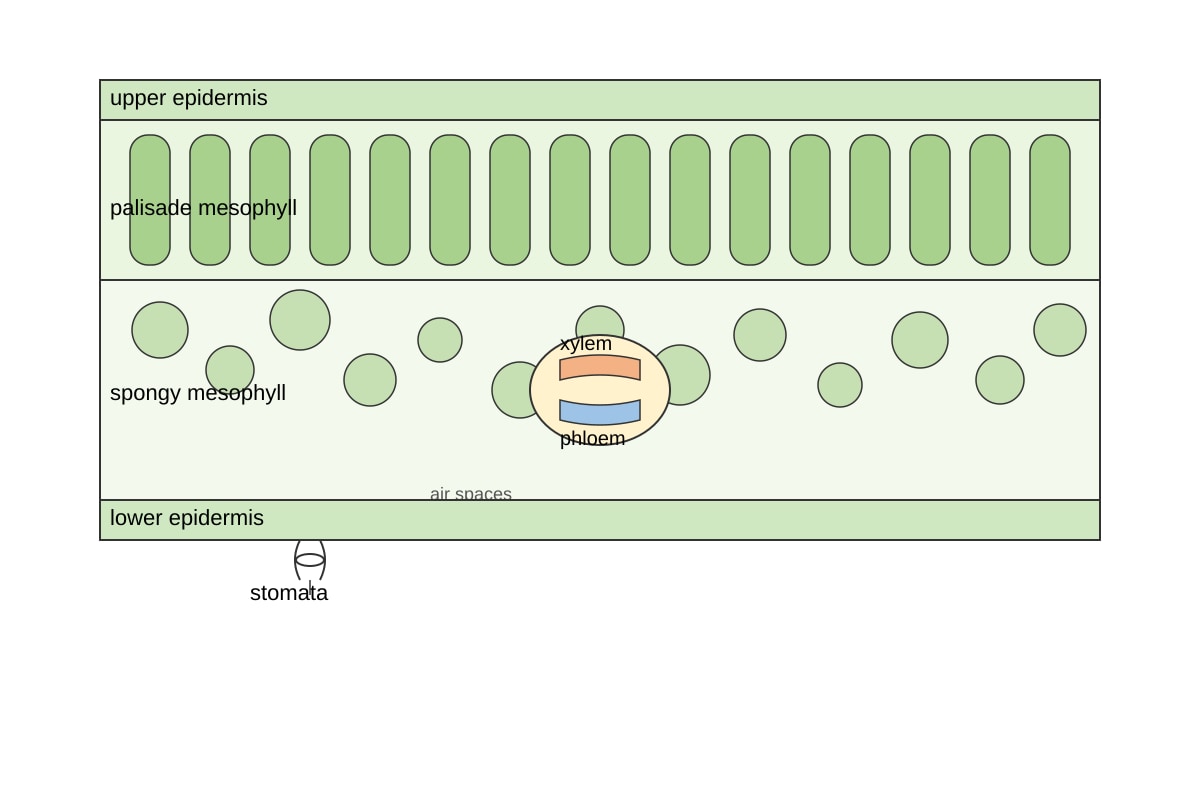
(a) [1] Palisade mesophyll (tissue name).
(b) [1] Closely packed, many chloroplasts, near upper surface for light.
(c) [2] CO₂ enters stomata → diffuses through air spaces in spongy mesophyll → into palisade cell across membrane. (2 points: entry + diffusion path)
Marking: Path described with two correct steps = 2.
12. [4 marks total]
(a) [2] Graph: x-axis light intensity, y-axis rate; points plotted correctly and line drawn. (2 for accurate plot)
(b) [1] At 8–10 units (rate plateaus).
(c) [1] CO₂ concentration / temperature.
Teaching note: Limiting factor changes when curve flattens.
13. [3 marks total]
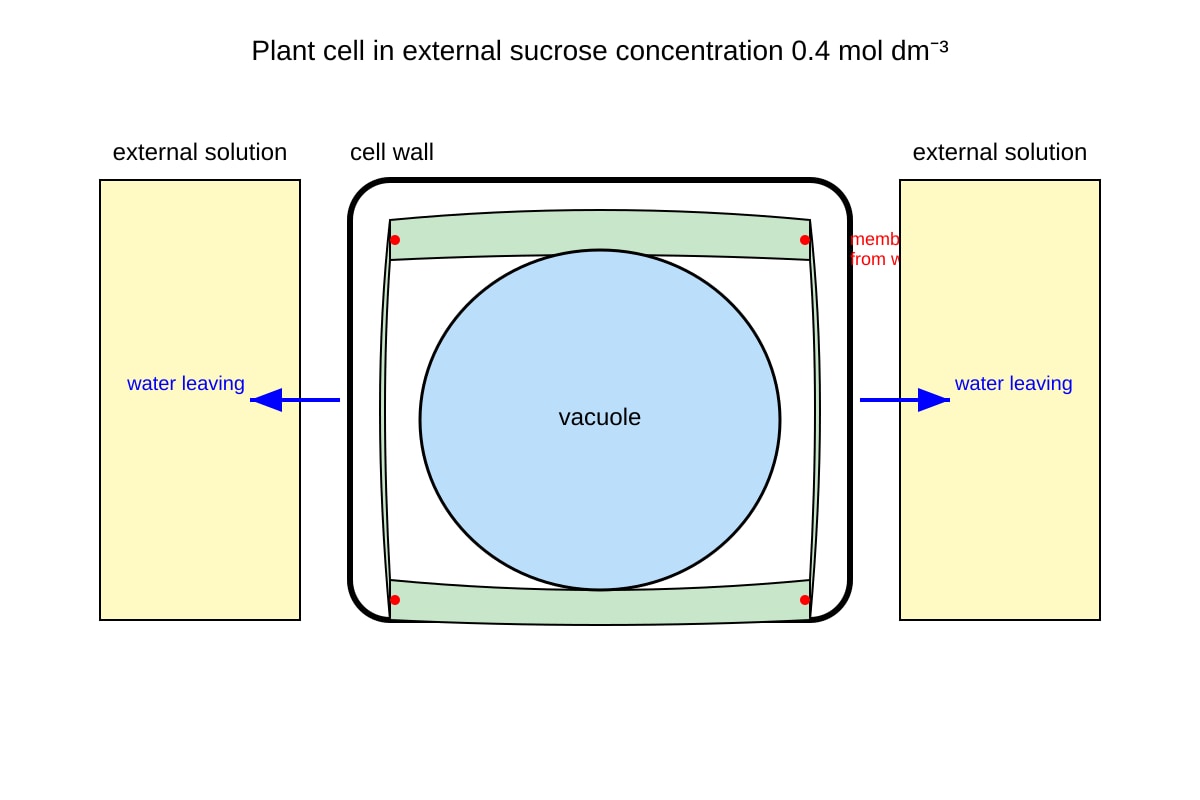
(a) [1] Plasmolysis.
(b) [2] External solution has lower water potential than cell sap (1); water leaves by osmosis, protoplast shrinks from wall (1).
14. [4 marks total]
(a) [1] Active transport.
(b) [1] 40 / 5 = 8-fold.
(c) [2] Soil concentration lower than xylem (1); must be pumped using ATP (1).
15. [3 marks total]
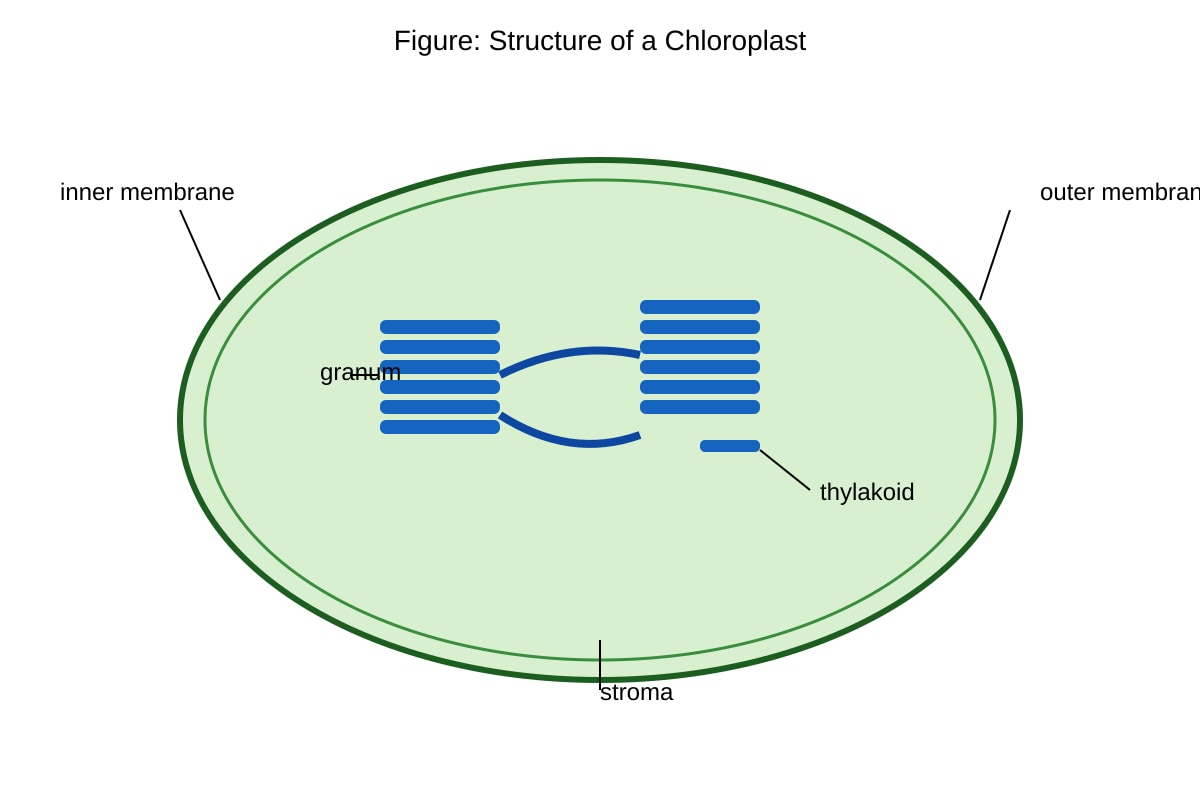
(a) [1] Granum (plural grana).
(b) [1] Thylakoid membrane.
(c) [1] Site of light-independent reaction / contains enzymes for Calvin cycle.
Section C Answers (16–20)
16. [4 marks]
- Thin epidermis / transparent to light (1)
- Palisade layer for chlorophyll (1)
- Spongy mesophyll with air spaces for gas diffusion (1)
- Stomata for CO₂ entry and O₂ exit (1)
Descriptor: Each correct adaptation with link = 1 mark.
17. [4 marks]
- Osmosis = water moves from high to low water potential through membrane (1)
- In plant cell, vacuole gains water (1)
- Protoplast presses on wall = turgor (1)
- Turgor supports non-woody parts (1)
18. [4 marks]
- Starch absent after dark (destarched) (1)
- Photosynthesis stopped without light (1)
- Starch is insoluble storage polysaccharide (1)
- Can be hydrolysed to glucose when needed (1)
19. [4 marks]
- Cellulose: β-glucose, straight chains, microfibrils, structural (2)
- Starch: α-glucose, helical/branched, storage (2)
Link: Structure matches function in each.
20. [4 marks]
- Higher temp increases enzyme rate up to optimum (1)
- Beyond optimum, denaturation reduces photosynthesis (1)
- Transpiration increases, water stress (1)
- Could affect distribution / survival (1)