From Real Exams Quiz
A Level H1 Biology Genetics Inheritance Quiz
Free A Level H1 Biology Genetics Inheritance quiz, LongCat Exam version, with questions, answers, and A Level-style practice for Singapore students.
These static practice materials are generated from the site's syllabus and paper-generation workflow, with source and model context shown so students and parents can evaluate the material before use.
Questions
Free quiz and exam paper access
Enter your details to view this paper
Your access is remembered on this device.
Answers
A-Level Biology H1 Quiz - Genetics Inheritance
Answer Key
Question 1
Answer: B
Explanation: DNA polymerase can only add nucleotides to the 3′ hydroxyl (–OH) end of a growing DNA strand, so synthesis always proceeds in the 5′ → 3′ direction. This is a fundamental property of DNA polymerase and is essential for understanding replication. Option A is incorrect because DNA polymerase cannot synthesise in the 3′ → 5′ direction. Option C is incorrect because although the overall replication of both strands occurs, each individual strand is synthesised 5′ → 3′ (the lagging strand is synthesised in Okazaki fragments, each still 5′ → 3′).
[1 mark]
Question 2
Answer: C (50%)
Explanation: Haemophilia is X-linked recessive. Let X^H = normal allele, X^h = haemophilia allele.
- Father: X^h Y (affected)
- Mother: X^H X^h (carrier)
Cross: X^h Y × X^H X^H → daughters: X^H X^h (carrier) or X^h X^h (affected)
Daughters receive X^h from father (always) and either X^H or X^h from mother. So 50% of daughters are carriers (X^H X^h) and 50% are affected (X^h X^h). The question asks specifically for the probability that a daughter is a carrier, which is 50%.
[1 mark]
Question 3
Answer: B
Explanation: A gene is a segment of DNA that codes for a particular protein or polypeptide. An allele is a specific variant form of that gene. For example, the gene for flower colour may have alleles for purple and white. Option A reverses the relationship. Option C is incorrect because they are not the same. Option D is incorrect because a gene (not allele) codes for a protein.
[1 mark]
Question 4
Answer: C (Nonsense mutation)
Explanation: UAC codes for tyrosine, while UAG is a stop codon (amber). This means translation would terminate prematurely, producing a truncated protein. This is a nonsense mutation — a point mutation that changes an amino acid codon into a stop codon. A silent mutation would code for the same amino acid; a missense mutation would code for a different amino acid; a frameshift mutation involves insertion or deletion of nucleotides (not substitution).
[1 mark]
Question 5
Answer: C (9 : 3 : 3 : 1)
Explanation: A dihybrid cross between two heterozygotes (AaBb × AaBb) produces the classic Mendelian phenotypic ratio of 9 : 3 : 3 : 1 when the two genes assort independently (i.e., they are on different chromosomes or far apart on the same chromosome). The 9 represents the double dominant phenotype, the two 3s represent single dominant phenotypes, and the 1 represents the double recessive phenotype.
[1 mark]
Question 6
Any two of the following [1 mark each, total 2 marks]:
| Feature | DNA Replication | Transcription |
|---|---|---|
| Template | Both DNA strands | Only one DNA strand (template strand) |
| Product | Double-stranded DNA | Single-stranded RNA (pre-mRNA) |
| Enzyme | DNA polymerase | RNA polymerase |
| Nucleotides used | Deoxyribonucleotides (A, T, G, C) | Ribonucleotides (A, U, G, C) |
| Extent | Entire genome replicated | Only specific genes transcribed |
Teaching note: Both processes use a DNA template and synthesise a new strand in the 5′ → 3′ direction, but they differ in purpose, product, and the enzyme involved.
[2 marks]
Question 7
(a) Locus: The specific position of a gene on a chromosome. [1 mark]
(b) Homozygous: Having two identical alleles for a particular gene (e.g., AA or aa). [1 mark]
Teaching note: The locus is like an "address" for a gene on a chromosome. Homozygous means both copies of the gene (one from each parent) are the same allele.
[2 marks]
Question 8
(a) Parent 1 (purple): PP; Parent 2 (white): pp [1 mark]
Since all F₁ offspring are purple, the purple parent must be homozygous dominant (PP). If the purple parent were heterozygous (Pp), some white offspring would appear.
(b) F₁ genotype: Pp (all heterozygous)
Cross: Pp × Pp
| P | p | |
|---|---|---|
| P | PP | Pp |
| p | Pp | pp |
Phenotypic ratio: 3 Purple : 1 White [2 marks]
[3 marks]
Question 9
Explanation: A sex-linked gene is a gene located on a sex chromosome (usually the X chromosome in humans). Because males have only one X chromosome, they are more likely to express recessive sex-linked conditions. [1 mark]
Example: Haemophilia (or colour blindness / Duchenne muscular dystrophy). [1 mark]
Teaching note: Sex-linked genes are most commonly X-linked because the X chromosome carries many more genes than the Y chromosome. X-linked recessive conditions are more common in males because they have only one X chromosome — a single recessive allele will be expressed.
[2 marks]
Question 10
(a) Template strand: 3′–TACGGCATTACG–5′ [1 mark]
The template strand is complementary to the coding strand and antiparallel. A pairs with T, G pairs with C. The coding strand runs 5′→3′, so the template strand runs 3′→5′.
(b) mRNA sequence: 5′–AUGCCGUAAUGC–3′ [2 marks]
The mRNA is complementary to the template strand (and therefore has the same sequence as the coding strand, except U replaces T). Transcription produces mRNA in the 5′→3′ direction.
- Template: 3′–T A C G G C A T T A C G–5′
- mRNA: 5′–A U G C C G U A A U G C–3′
[3 marks]
Question 11
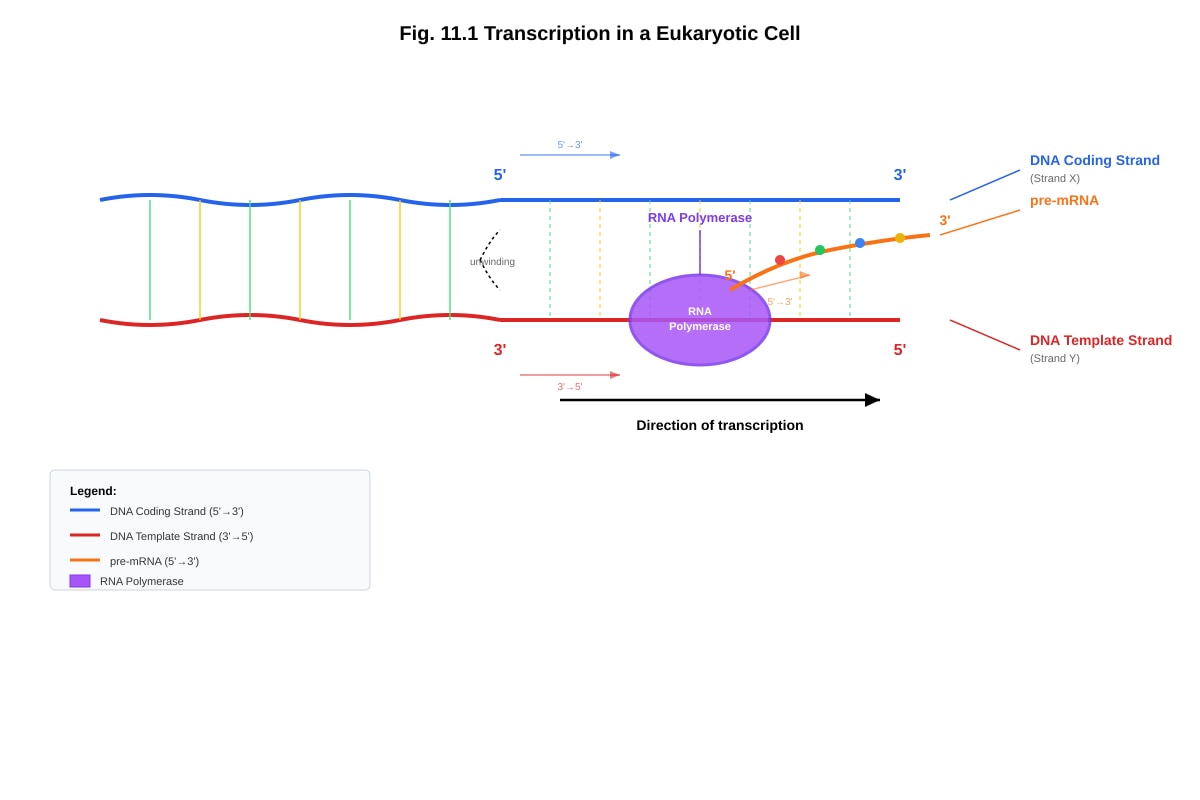
(a) Strand X: Coding strand (sense strand) [1 mark] Strand Y: Template strand (antisense strand) [1 mark]
The template strand is the one read by RNA polymerase to synthesise mRNA. The coding strand has the same sequence as the mRNA (except T instead of U).
(b) Enzyme Z: RNA polymerase [1 mark]
(c) Pre-mRNA in eukaryotes contains both exons (coding sequences) and introns (non-coding sequences). Before translation, the pre-mRNA must undergo RNA splicing to remove introns and join exons together. [1 mark] Additionally, a 5′ cap and a 3′ poly-A tail are added to protect the mRNA from degradation and facilitate its export from the nucleus to the cytoplasm. [1 mark]
Teaching note: This processing step is unique to eukaryotes. Prokaryotes do not have introns (generally) and can begin translation while transcription is still occurring.
[5 marks]
Question 12
(a)
Parental phenotypes: Tortoiseshell female × Orange male [½ mark]
Parental genotypes: X^O X^B × X^B Y [1 mark]
Gametes from female: X^O and X^B; Gametes from male: X^B and Y
| X^B | Y | |
|---|---|---|
| X^O | X^O X^B (tortoiseshell ♀) | X^O Y (orange ♂) |
| X^B | X^B X^B (black ♀) | X^B Y (orange ♂) |
Offspring genotypes: X^O X^B, X^B X^B, X^O Y, X^B Y [1 mark]
Offspring phenotypic ratio: 1 Tortoiseshell female : 1 Black female : 2 Orange males [1½ marks]
(b) The gene for fur colour is located on the X chromosome. [1 mark] Tortoiseshell phenotype requires the expression of both alleles (B and O), which only occurs in females (XX) because they have two X chromosomes. Males (XY) have only one X chromosome and therefore can only express one allele — either black or orange, not both. [1 mark]
Teaching note: This is an example of X-linked codominance. The tortoiseshell pattern in females is also related to X-inactivation (lyonisation), where different cells randomly inactivate one X chromosome, producing patches of different colour.
[6 marks]
Question 13
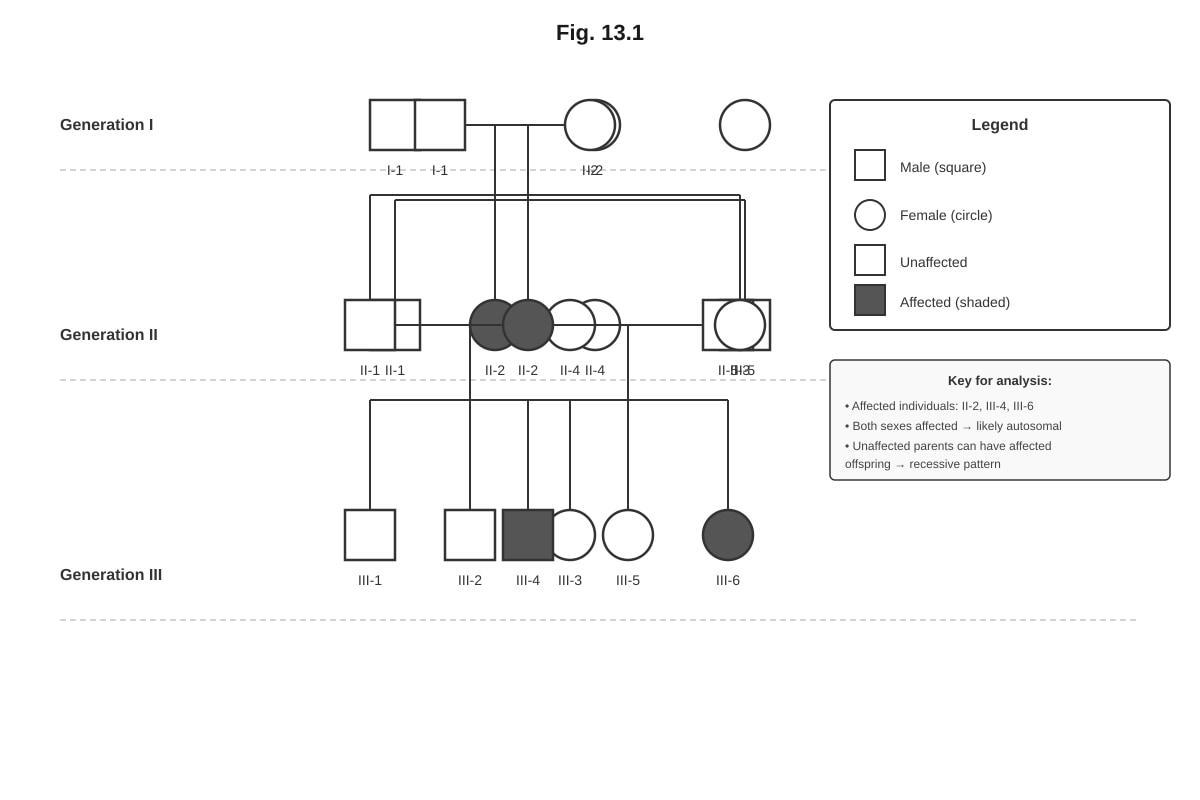
(a) The condition is autosomal. [1 mark] If it were X-linked recessive, an affected female (II-2) would need to have an affected father, but her father (I-1) is unaffected. Also, the condition appears in both males and females across generations, which is consistent with autosomal inheritance. [1 mark]
(b) The condition is recessive. [1 mark] Two unaffected parents (I-1 and I-2) have an affected child (II-2), which means both parents must be carriers of a recessive allele. This is only possible if the condition is recessive (unaffected parents are heterozygous carriers). [1 mark]
(c) Individual II-3 is unaffected but has an affected sister (II-2), so both his parents must be carriers (Aa). II-3 is unaffected, so he could be AA or Aa. Since the cross is Aa × Aa, the probability of an unaffected offspring being Aa is 2/3. However, the question asks for the genotype — since II-3 is unaffected and his parents are both carriers, the most likely expected answer is Aa (carrier), though AA is also possible. Accept Aa or AA with explanation. [1 mark]
Common mistake: Students often assume an unaffected individual in a pedigree must be homozygous dominant. In autosomal recessive conditions, unaffected offspring of carrier parents have a 2/3 chance of being heterozygous carriers.
[5 marks]
Question 14
(a) Gene mutation (or point mutation / substitution mutation). [1 mark]
(b) The base substitution changes the codon in the mRNA from GAG to GUG during transcription. [1 mark] This results in valine being incorporated instead of glutamic acid at position 6 of the β-globin chain during translation. The change from a hydrophilic amino acid (glutamic acid) to a hydrophobic one (valine) alters the tertiary structure of haemoglobin, causing it to polymerise under low oxygen conditions, distorting red blood cells into a sickle shape. [1 mark]
(c) Heterozygous individuals (HbA HbS) produce both normal and abnormal haemoglobin. [1 mark] Their red blood cells are partially resistant to infection by the malaria parasite (Plasmodium), because the parasite's growth is impaired in cells containing some HbS, and sickled cells are more readily removed by the spleen, taking the parasite with them. [1 mark] This gives heterozygotes a selective advantage in malaria-endemic regions, explaining the higher frequency of the HbS allele in these populations (heterozygote advantage / balancing selection).
[5 marks]
Question 15
(a)
Parental phenotypes: Pink × Pink [given]
Parental genotypes: Rr × Rr [1 mark]
Gametes: R and r from each parent [shown in table]
| R | r | |
|---|---|---|
| R | RR (Red) | Rr (Pink) |
| r | Rr (Pink) | rr (White) |
Genotypic ratio: 1 RR : 2 Rr : 1 rr [1 mark]
Phenotypic ratio: 1 Red : 2 Pink : 1 White [1 mark]
(b) The student is incorrect because this cross involves only one gene controlling petal colour. [1 mark] Mendel's law of independent assortment applies to the inheritance of two or more genes on different chromosomes. Since only one gene is involved here, this cross demonstrates the law of segregation, not independent assortment. [1 mark]
[5 marks]
Question 16
Marking scheme — award 1 mark for each valid point up to 5 marks:
- Translation occurs at ribosomes in the cytoplasm (or on the rough ER).
- mRNA carries the genetic code from DNA (transcribed in the nucleus) to the ribosome in the form of codons (triplets of bases).
- tRNA molecules carry specific amino acids to the ribosome; each tRNA has an anticodon that is complementary to a specific mRNA codon.
- The ribosome moves along the mRNA, reading each codon, and tRNA molecules bring the corresponding amino acids in the correct sequence.
- Peptide bonds form between adjacent amino acids, building a polypeptide chain.
- Translation begins at a start codon (AUG) and ends at a stop codon (UAA, UAG, or UGA).
- The polypeptide chain is released and folds into a functional protein.
Teaching note: Translation is the process by which the genetic information in mRNA is used to synthesise a polypeptide. The key molecules are mRNA (template), tRNA (adaptor), and ribosomes (catalytic machinery).
[5 marks]
Question 17
(a) The black-furred parent is heterozygous (Bb). [1 mark] A test cross with a homozygous recessive (bb) produces approximately equal numbers of dominant and recessive phenotypes (6 black : 5 white ≈ 1:1 ratio), which is only possible if the black parent is heterozygous. If the parent were homozygous dominant (BB), all offspring would be black. [1 mark]
(b) The ratio of 6:5 is close to but not exactly 1:1. [1 mark] This is because genetic crosses involve random fertilisation events, and small sample sizes will show deviation from expected ratios due to chance. A 1:1 ratio is the expected probability, but actual results in small samples will vary. The student should not expect exact ratios with small numbers of offspring. [1 mark]
[4 marks]
Question 18
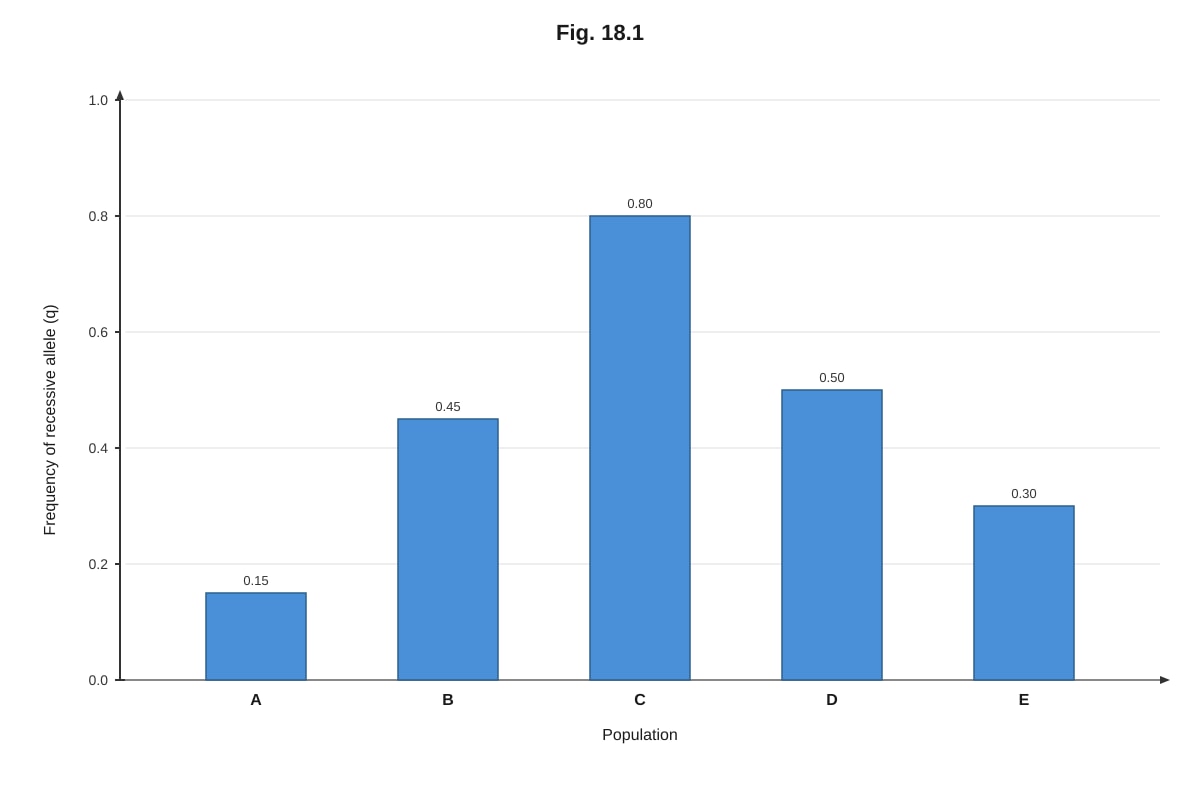
(a) For Population C: q = 0.80
Frequency of homozygous recessive (q²) = (0.80)² = 0.64 [2 marks]
(b) For Population A: q = 0.15
p = 1 – q = 1 – 0.15 = 0.85 [1 mark]
Frequency of heterozygotes (2pq) = 2 × 0.85 × 0.15 = 0.255 (or 0.26 to 2 s.f.) [2 marks]
(c) Any one of: [1 mark]
- Genetic drift (random changes in allele frequency, especially in small populations)
- Natural selection (different environmental pressures in different locations)
- Gene flow / migration between populations
- Mutation
- Non-random mating
[6 marks]
Question 19
(a)
(i) Frequency of affected individuals (q²) = 160/10,000 = 0.016
q = √0.016 = 0.126 (or 0.13 to 2 s.f.) [1 mark]
(ii) p = 1 – q = 1 – 0.126 = 0.874 (or 0.87 to 2 s.f.) [1 mark]
(iii) Frequency of heterozygotes (2pq) = 2 × 0.874 × 0.126 = 0.220
Number of carriers = 0.220 × 10,000 = 2,200 individuals [2 marks]
(b) Any two of: [1 mark each]
- No mutation
- No natural selection (no selective advantage or disadvantage)
- Random mating
- No gene flow (no migration into or out of the population)
- Large population size (no genetic drift)
[6 marks]
Question 20
(a) A substitution mutation changes one codon, resulting in one different amino acid in the polypeptide. [1 mark] The effect depends on the position and nature of the substitution — if the new amino acid has similar properties (e.g., both hydrophobic), the protein may function normally; if the properties differ significantly, the tertiary structure may be disrupted, affecting protein function. [1 mark]
(b) An insertion of one nucleotide shifts the reading frame of the mRNA from the point of insertion onwards (frameshift mutation). [1 mark] All codons downstream of the mutation are changed, resulting in a completely different sequence of amino acids from that point. [1 mark] This usually produces a non-functional protein, as the altered amino acid sequence disrupts the tertiary and quaternary structure. A premature stop codon may also be introduced, resulting in a truncated protein. [1 mark]
(c) A deletion of three nucleotides removes exactly one codon, so one amino acid is lost from the polypeptide chain. [1 mark] The reading frame is not altered (because 3 nucleotides = 1 codon), so the rest of the amino acid sequence remains unchanged. [1 mark] The effect on protein function depends on the importance of the missing amino acid — if it is in a critical region (e.g., the active site of an enzyme), the protein may be non-functional; if it is in a less critical region, the protein may retain partial or full function.
[7 marks]
Total: 50 marks
Mark Distribution Summary
| Question | Marks | Type |
|---|---|---|
| 1 | 1 | MCQ |
| 2 | 1 | MCQ |
| 3 | 1 | MCQ |
| 4 | 1 | MCQ |
| 5 | 1 | MCQ |
| 6 | 2 | Short Answer |
| 7 | 2 | Short Answer |
| 8 | 3 | Short Answer / Genetic Diagram |
| 9 | 2 | Short Answer |
| 10 | 3 | Short Answer / Calculation |
| 11 | 5 | Diagram Interpretation |
| 12 | 6 | Genetic Diagram / Explanation |
| 13 | 5 | Pedigree Analysis |
| 14 | 5 | Structured Response |
| 15 | 5 | Genetic Diagram / Explanation |
| 16 | 5 | Extended Response |
| 17 | 4 | Test Cross / Explanation |
| 18 | 6 | Data Interpretation / Calculation |
| 19 | 6 | Calculation / Short Answer |
| 20 | 7 | Extended Response |
| Total | 50 |