From Real Exams Quiz
A Level H1 Biology Genetics Inheritance Quiz
Free A Level H1 Biology Genetics Inheritance quiz, HY3 Exam version, with questions, answers, and A Level-style practice for Singapore students.
These static practice materials are generated from the site's syllabus and paper-generation workflow, with source and model context shown so students and parents can evaluate the material before use.
Questions
Free quiz and exam paper access
Enter your details to view this paper
Your access is remembered on this device.
Answers
A-Level Biology H1 Quiz - Genetics Inheritance: Answer Key
Total Marks: 40
Topic: Genetics and Inheritance (Core Idea 2)
Section A: Short Structured Questions (1–10)
1. [1] Mutation
Teaching note: A mutation is any permanent alteration in the DNA sequence. Key idea: changes at gene or chromosome level.
2. [1] Substitution (or base substitution)
Teaching note: One base pair replaced by another; does not shift reading frame.
3. [1] deletion
Teaching note: Frameshift = insertion or deletion of bases not in multiples of three.
4. [1] Translocation / duplication / inversion / deletion (any one structural aberration)
Teaching note: Structural = arrangement change of chromosome segments.
5. [1] Down syndrome
Teaching note: Trisomy 21 = three copies of chromosome 21 → Down syndrome.
6. [1] 3′ (three prime)
Teaching note: DNA polymerase extends strand at 3′ OH end.
7. [1] pre-mRNA (or mRNA)
Teaching note: Transcription produces RNA complementary to template strand.
8. [1] translation
Teaching note: Ribosome decodes mRNA to polypeptide.
9. [1] sickle cell
Teaching note: Substitution in β-globin → valine instead of glutamic acid.
10. [1] mitosis
Teaching note: Mitosis = identical cells for growth/repair.
Section B: Data and Diagram Interpretation (11–15)
11. [4]
(a) [2] I-1: Aa; I-2: Aa
Marking: 1 mark each genotype.
(b) [2] Both parents are heterozygous (carriers); each carries one recessive a allele but A masks it. Cross Aa x Aa can produce aa (affected) children with 1/4 probability.
Teaching note: Recessive trait needs two copies; unaffected parents can be carriers.
12. [4]
(a) [2] Round : wrinkled = 547 : 183 ≈ 2.99 : 1 ≈ 3 : 1.
Working: 547 ÷ 183 = 2.989.
(b) [2] Expected 3:1 (monohybrid heterozygote cross). Observed close to 3:1, good fit.
Teaching note: Rr x Rr → 3 round : 1 wrinkled.
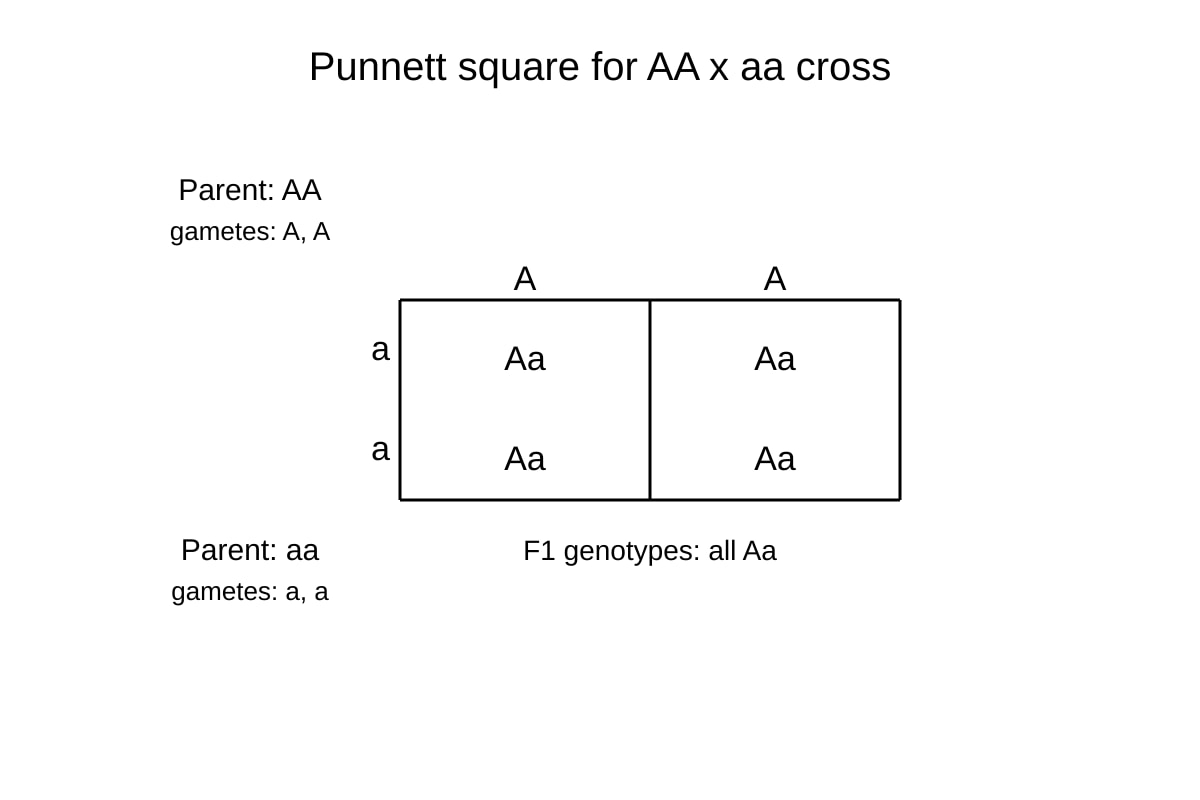
13. [2] All F1 = Aa
From image: AA parent gametes A, A; aa parent a, a → all Aa.
Teaching note: Homozygous cross yields uniform heterozygotes.
14. [3]
(a) [1] Substitution
(b) [2] Glutamic acid → valine
Teaching note: Single base change GAG→GUG alters amino acid; example of sickle cell.
15. [3]
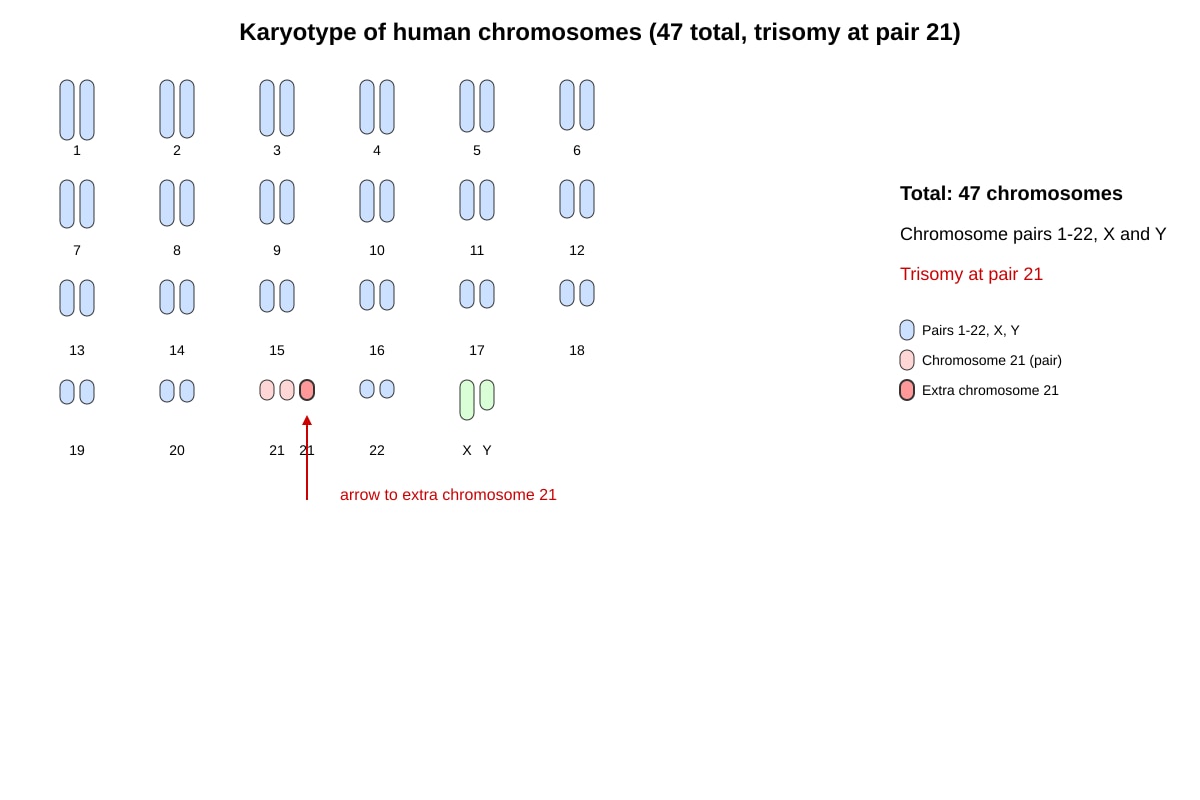
(a) [1] Down syndrome
(b) [2] Numerical chromosomal aberration / aneuploidy (trisomy)
From image: 47 chromosomes, extra 21.
Teaching note: Trisomy = extra whole chromosome.
Section C: Extended Response (16–20)
16. [4]
- Deletion removes bases → frameshift if not multiple of 3. [1]
- All downstream codons read incorrectly. [1]
- Substitution changes only one codon/amino acid. [1]
- Frameshift often produces nonfunctional protein; substitution may be silent/missense. [1]
Teaching note: Severity from reading frame disruption.
17. [4]
- RNA polymerase binds promoter. [1]
- Template strand read 3′→5′; complementary RNA synthesised 5′→3′. [1]
- Pre-mRNA formed with introns + exons. [1]
- Splicing removes introns → mature mRNA exits nucleus. [1]
Teaching note: Eukaryotic transcription includes processing.
18. [4]
- Consideration 1: Right to know vs anxiety (1) explanation (1). [2]
- Consideration 2: Termination choice ethical dilemma / disability rights (1) explanation (1). [2]
Teaching note: Balanced ethical discussion required.
19. [4]
- Punnett: Aa x Aa → AA, Aa, Aa, aa. [2]
- Affected = aa = 1/4 = 25%. [2]
Teaching note: Carrier cross risk calculation.
20. [4]
- Alleles = alternative DNA sequences. [1]
- Different codon → different amino acid (Glu→Val). [1]
- Altered β-globin structure → haemoglobin polymerises. [1]
- Sickled RBCs = anaemia phenotype. [1]
Teaching note: Genotype–protein–phenotype chain.