From Real Exams Quiz

A Level H1 Biology Evolution Diversity Quiz

Free Exam-Derived Qwen3.7 Plus A Level H1 Biology Evolution Diversity quiz with questions and answers for Singapore students. This page is rendered as a direct URL so the questions and answers can be discovered without pressing in-page buttons.

These static practice materials are generated from the site's syllabus and paper-generation workflow, with source and model context shown so students and parents can evaluate the material before use.

A Level H1 Biology From Real Exams Generated by Qwen3.7 Plus Updated 2026-06-04

Questions

<!-- TuitionGoWhere generation metadata: stage=3-0; model=qwen/qwen3.7-plus; model_label=Qwen3.7 Plus; generated=2026-06-04; Sources: Stage 2-1 real exam-derived templates and Stage 2-2 exam-enriched syllabus. -->

A-Level Biology H1 Quiz - Evolution Diversity

Name: __________________________
Class: __________________________
Date: __________________________
Score: _________ / 40

Duration: 45 minutes
Total Marks: 40

Instructions to Candidates:

  • Answer all questions.
  • Write your answers in the spaces provided.
  • The number of marks is given in brackets [ ] at the end of each question or part question.
  • You are advised to spend approximately 2 minutes per mark.

Section A: Natural Selection and Adaptation (Questions 1-5)

1. The peppered moth (Biston betularia) exists in two main forms: a light-coloured typica form and a dark-coloured carbonaria form. In the 19th century, during the Industrial Revolution in England, the frequency of the carbonaria form increased dramatically in industrial areas.

(a) Explain how natural selection resulted in the increase of the carbonaria form in industrial areas. [3]

<br> <br> <br>

(b) In recent years, clean air legislation has reduced soot pollution, causing tree bark to become lighter again. Predict and explain the likely change in the allele frequencies of the Biston betularia population in these areas. [2]

<br> <br>

2. Antibiotic resistance in bacteria is a contemporary example of evolution. Staphylococcus aureus has developed resistance to methicillin (MRSA).

(a) Describe the mechanism by which a population of S. aureus becomes resistant to methicillin over several generations. [3]

<br> <br> <br>

(b) Explain why the overuse of antibiotics in agriculture accelerates this process. [2]

<br> <br>

3. Scientists studied the effect of heavy metal pollution on the evolution of grass (Agrostis tenuis) growing near a copper mine. They collected seeds from plants growing on the contaminated mine soil and from plants growing on uncontaminated soil nearby. They grew these seeds in two different conditions: soil with high copper concentration and soil with low copper concentration. They measured the root length of the seedlings after 2 weeks.

The results are shown in Table 1.

Table 1: Mean root length (mm) of Agrostis tenuis seedlings

Source of SeedsGrown in Low Copper SoilGrown in High Copper Soil
Uncontaminated Soil45.212.1
Contaminated Mine Soil42.838.5

(a) Calculate the percentage decrease in root length for the seeds from uncontaminated soil when grown in high copper soil compared to low copper soil. Show your working. [2]

<br> <br>

(b) Analyse the data in Table 1 to explain how natural selection has acted on the grass population near the mine. [3]

<br> <br> <br>

(c) Suggest why the seeds from the contaminated mine soil still show a slightly shorter root length in low copper soil (42.8 mm) compared to the uncontaminated seeds (45.2 mm). [1]

<br>

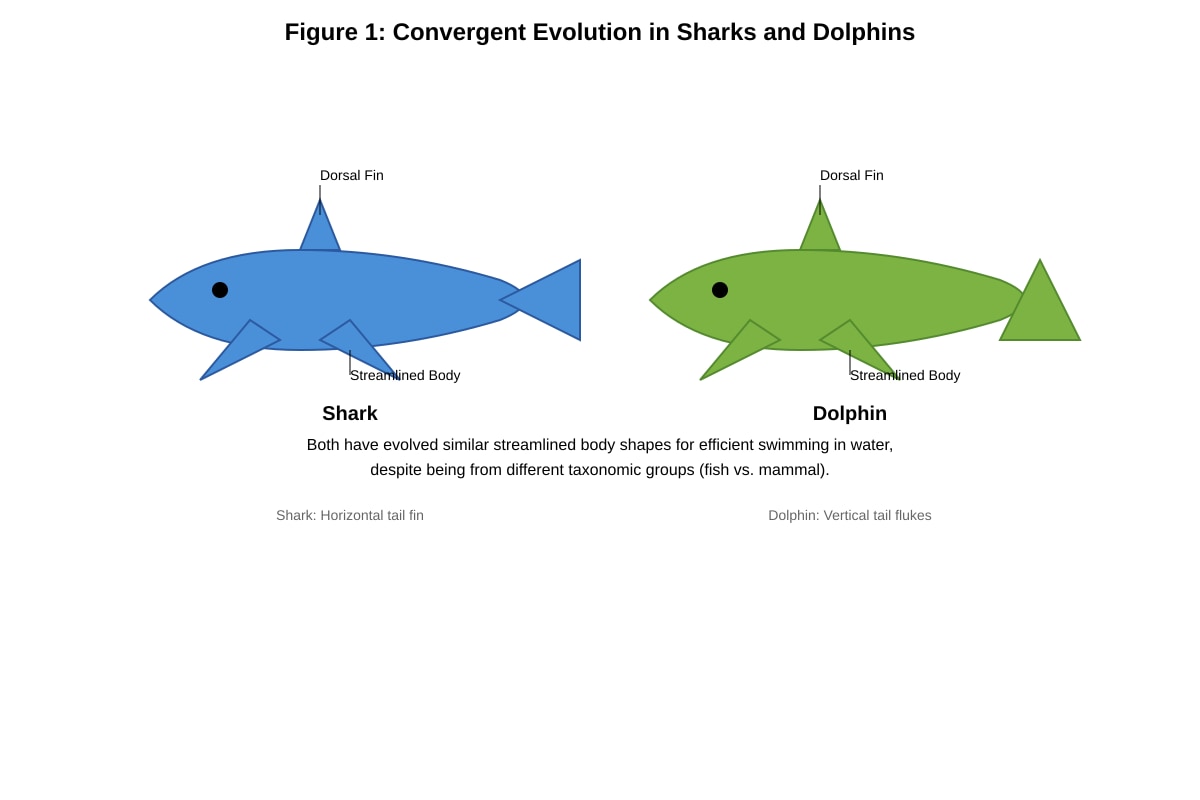
4. Convergent evolution occurs when unrelated species evolve similar traits due to similar environmental pressures. Figure 1 shows the body shape of a shark (a fish) and a dolphin (a mammal).

<image_placeholder> id: Q4-fig1 type: diagram linked_question: Q4 description: Side-by-side illustrations of a shark and a dolphin swimming. Both have a streamlined, fusiform body shape, dorsal fins, and pectoral flippers/fins. The tail orientation is different (vertical for dolphin, horizontal for shark), but the overall hydrodynamic shape is similar. labels: Shark, Dolphin, Streamlined Body, Dorsal Fin values: None must_show: The visual similarity in body shape despite the different taxonomic groups. </image_placeholder>

(a) Explain why sharks and dolphins have evolved similar body shapes despite being distantly related. [2]

<br> <br>

(b) Define the term analogous structures and state whether the dorsal fins of sharks and dolphins are homologous or analogous. [2]

<br> <br>

5. Isolation mechanisms are crucial for maintaining species integrity.

(a) Distinguish between pre-zygotic and post-zygotic isolating mechanisms. [2]

<br> <br>

(b) Give one example of a pre-zygotic isolating mechanism and explain how it prevents gene flow. [2]

<br> <br>

Section B: Speciation and Evidence for Evolution (Questions 6-10)

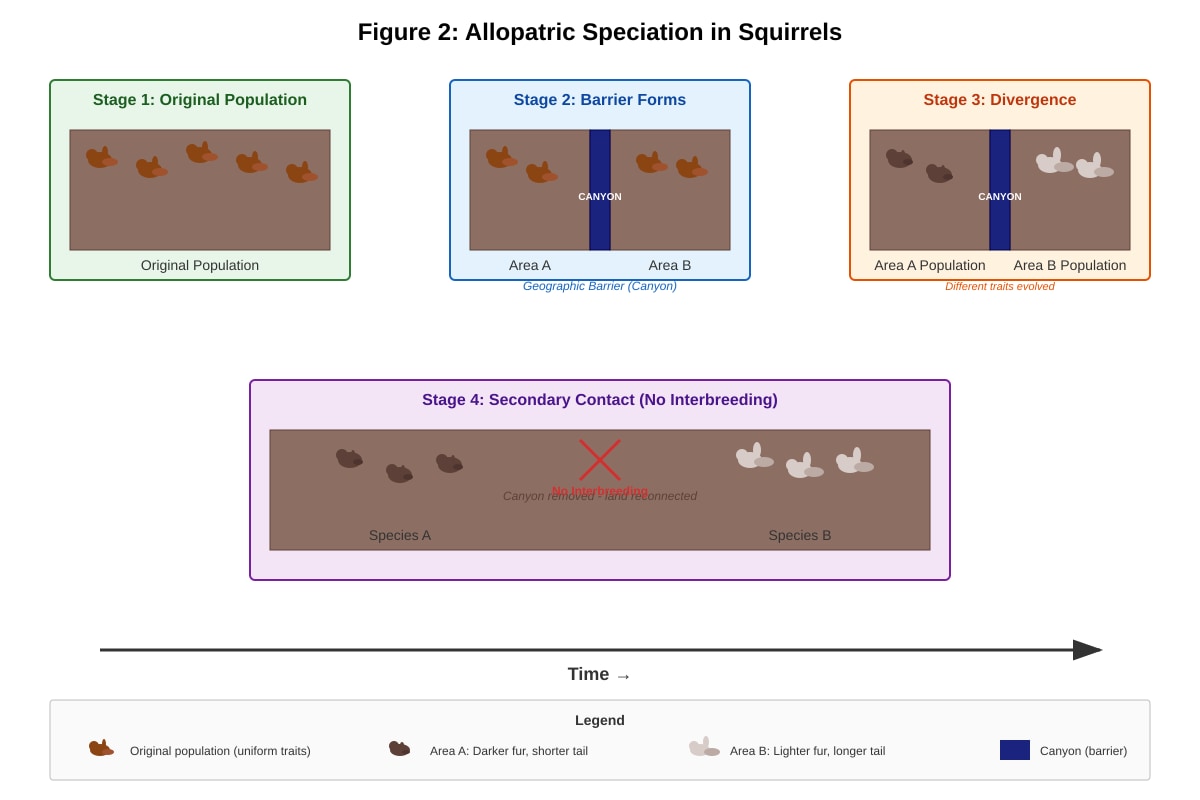
6. Speciation is the formation of new species. Figure 2 illustrates the process of allopatric speciation in a population of squirrels separated by the formation of a canyon.

<image_placeholder> id: Q6-fig2 type: diagram linked_question: Q6 description: A diagram showing a single population of squirrels on a continuous landmass. A river/canyon forms, splitting the land into two isolated areas (Area A and Area B). Over time, the squirrels in Area A and Area B develop different physical traits (e.g., tail length, fur colour). Finally, the canyon is removed, but the two groups do not interbreed. labels: Original Population, Geographic Barrier (Canyon), Area A Population, Area B Population, Time arrow values: None must_show: The physical separation of the population and the subsequent divergence in traits before secondary contact. </image_placeholder>

(a) With reference to Figure 2, explain how geographic isolation leads to speciation. [3]

<br> <br> <br>

(b) State one type of reproductive isolating mechanism that might prevent the two squirrel populations from interbreeding if they come back into contact, and explain how it works. [2]

<br> <br>

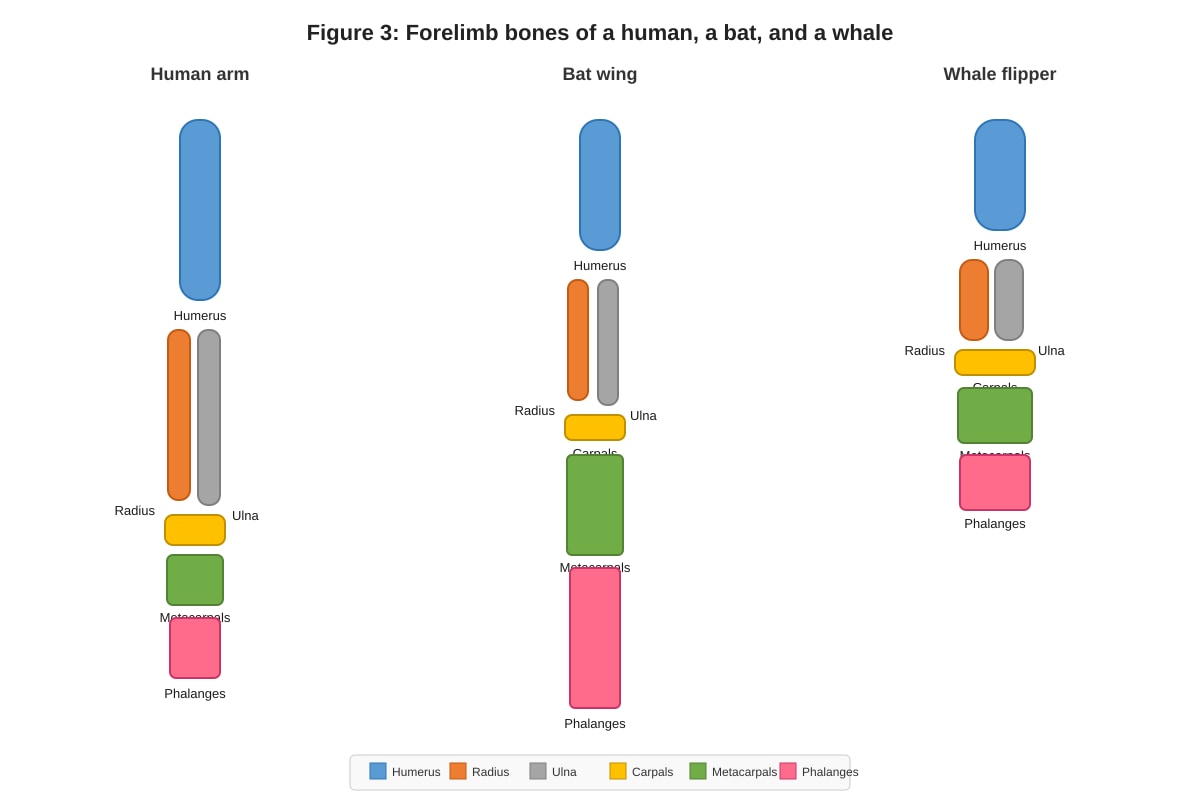
7. Homologous structures provide evidence for evolution. Figure 3 shows the forelimb bones of a human, a bat, and a whale.

<image_placeholder> id: Q7-fig3 type: diagram linked_question: Q7 description: Three skeletal diagrams of forelimbs side-by-side. Left: Human arm. Middle: Bat wing. Right: Whale flipper. The bones (humerus, radius, ulna, carpals, metacarpals, phalanges) are coloured similarly to show correspondence despite different shapes and sizes. labels: Humerus, Radius, Ulna, Carpals, Metacarpals, Phalanges values: None must_show: The same basic bone arrangement in all three limbs, but with different proportions (e.g., elongated phalanges in bat and whale). </image_placeholder>

(a) Define the term homologous structures. [1]

<br>

(b) Explain how the structures in Figure 3 support the theory of evolution by common descent. [2]

<br> <br>

8. The classification of living organisms has changed with new evidence. Traditionally, organisms were classified into five kingdoms. Modern classification uses three domains.

(a) Name the three domains of life. [1]

<br>

(b) State two differences between the cell structure of organisms in the domain Bacteria and the domain Eukarya. [2]

<br> <br>

(c) Explain why the domain Archaea was separated from Bacteria despite both being prokaryotic. [1]

<br>

9. Figure 4 shows a phylogenetic tree constructed using DNA sequence data for five species of primates: Human, Chimpanzee, Gorilla, Orangutan, and Gibbon.

<image_placeholder> id: Q9-fig4 type: diagram linked_question: Q9 description: A cladogram/phylogenetic tree. The root splits into two main branches. One branch leads to Gibbon. The other branch splits again: one leading to Orangutan, the other continuing. This continuing branch splits into Gorilla and a final pair: Human and Chimpanzee, which share the most recent common node. labels: Gibbon, Orangutan, Gorilla, Chimpanzee, Human, Node A (Human/Chimp ancestor), Node B (Great Apes ancestor) values: None must_show: The branching order clearly showing Humans and Chimpanzees as sister taxa, Gorilla as the next closest, then Orangutan, then Gibbon as the outgroup. </image_placeholder>

(a) Identify the two species that are most closely related based on Figure 4. [1]

<br>

(b) Explain what the nodes (branching points) in the phylogenetic tree represent. [1]

<br>

(c) Molecular evidence suggests that the DNA sequence difference between Humans and Chimpanzees is approximately 1.2%, while the difference between Humans and Gorillas is 1.6%. Explain how this data supports the branching pattern shown in Figure 4. [2]

<br> <br>

(d) State one advantage of using molecular evidence (DNA/protein sequences) over morphological evidence for constructing phylogenetic trees. [1]

<br>

10. The Hardy-Weinberg principle allows scientists to estimate allele frequencies in a population. In a population of 1000 mice, coat colour is determined by a single gene with two alleles: B (black, dominant) and b (white, recessive). 160 mice have white coats.

(a) Calculate the frequency of the recessive allele (b) in this population. Show your working. [3]

<br> <br> <br>

(b) Calculate the number of heterozygous mice in this population. Show your working. [3]

<br> <br> <br>

(c) State two conditions that must be met for the Hardy-Weinberg principle to apply accurately to this population. [2]

<br> <br>

Section C: Advanced Applications and Synthesis (Questions 11-15)

11. A population of beetles exhibits variation in shell colour, ranging from light green to dark green. A new predator that hunts by sight is introduced to the habitat. The predator finds it easier to spot light green beetles against the dark foliage.

(a) Describe the type of natural selection likely to occur in this beetle population. [1]

<br>

(b) Sketch a graph showing the change in the distribution of shell colour in the beetle population before and after the introduction of the predator. Label the axes. [2]

<br> <br> <br>

(c) Explain how this selection pressure affects the genetic diversity of the beetle population over time. [2]

<br> <br>

12. Artificial selection is often used in agriculture. Farmers have bred wild mustard (Brassica oleracea) to produce crops such as cabbage, broccoli, and kale.

(a) Distinguish between artificial selection and natural selection. [2]

<br> <br>

(b) Explain one potential risk to the crop population resulting from intensive artificial selection. [2]

<br> <br>

13. Genetic drift is a mechanism of evolution that is distinct from natural selection.

(a) Define genetic drift. [1]

<br>

(b) Explain the "founder effect" and how it can lead to a high frequency of certain genetic disorders in isolated human populations. [3]

<br> <br> <br>

(c) State why genetic drift has a greater effect on small populations than on large populations. [1]

<br>

14. The fossil record provides evidence for evolution, but it is incomplete.

(a) Explain why the fossil record is considered incomplete. [2]

<br> <br>

(b) Describe how transitional fossils, such as Archaeopteryx, support the theory of evolution. [2]

<br> <br>

15. Comparative embryology provides evidence for common ancestry.

(a) State one similarity observed in the early embryonic stages of vertebrates (e.g., fish, chickens, humans). [1]

<br>

(b) Explain how these embryonic similarities support the theory of evolution. [2]

<br> <br>

Section D: Data Analysis and Critical Evaluation (Questions 16-20)

16. A study investigated the beak depth of Ground Finches (Geospiza fortis) on an island in the Galapagos. During a severe drought, small seeds became scarce, leaving mostly large, hard seeds.

Table 2: Beak Depth Data

GroupMean Beak Depth (mm)Standard Deviation
Pre-drought Population9.20.5
Survivors of Drought10.10.4
Offspring of Survivors9.90.5

(a) Suggest why the mean beak depth of the survivors was greater than that of the pre-drought population. [2]

<br> <br>

(b) Explain why the mean beak depth of the offspring is similar to that of the survivors. [2]

<br> <br>

(c) State whether this is an example of microevolution or macroevolution, and justify your answer. [1]

<br>

17. Scientists compared the amino acid sequence of cytochrome c, a protein involved in respiration, across four species. The table below shows the number of amino acid differences between each species.

Table 3: Amino Acid Differences in Cytochrome c

Species ASpecies BSpecies CSpecies D
Species A-51220
Species B5-1321
Species C1213-15
Species D202115-

(a) Identify the two species that are most closely related. [1]

<br>

(b) Construct a simple phylogenetic tree showing the relationship between Species A, B, C, and D based on the data. [2]

<br> <br> <br>

(c) Explain why cytochrome c is a suitable protein for comparing evolutionary relationships across diverse species. [2]

<br> <br>

18. In a certain plant species, flower colour is controlled by a single gene with two alleles: R (red, dominant) and r (white, recessive). A population of 500 plants is in Hardy-Weinberg equilibrium. 45 plants have white flowers.

(a) Calculate the frequency of the dominant allele (R). Show your working. [3]

<br> <br> <br>

(b) Calculate the expected number of homozygous dominant plants in this population. Show your working. [2]

<br> <br>

19. Ring species are a special case of speciation. The Ensatina salamanders in California form a ring around the Central Valley. Populations adjacent to each other can interbreed, but the populations at the two ends of the ring (where they meet in Southern California) cannot interbreed.

(a) Explain how gene flow occurs in a ring species. [2]

<br> <br>

(b) Explain why the two end populations are considered separate species despite being connected by a chain of interbreeding populations. [2]

<br> <br>

20. Evaluate the statement: "Evolution is just a theory, not a fact."

(a) Define the scientific meaning of the term "theory". [2]

<br> <br>

(b) Explain why evolution is considered both a fact and a theory in scientific terms. [3]

<br> <br> <br>

Answers

<!-- TuitionGoWhere generation metadata: stage=3-0; model=qwen/qwen3.7-plus; model_label=Qwen3.7 Plus; generated=2026-06-04; Sources: Stage 2-1 real exam-derived templates and Stage 2-2 exam-enriched syllabus. -->

A-Level Biology H1 Quiz - Evolution Diversity (Answer Key)

1. (a)

  • Concept: Natural Selection / Differential Survival.
  • Explanation:
    1. In industrial areas, soot darkened the tree bark. [1]
    2. The dark carbonaria moths were better camouflaged against predators (birds) than the light typica moths. [1]
    3. Therefore, carbonaria moths had a higher survival rate and reproduced more, passing on the dark allele to the next generation, increasing its frequency. [1]

(b)

  • Prediction: The frequency of the typica (light) allele will increase, and the carbonaria (dark) allele will decrease. [1]
  • Explanation: As tree bark becomes lighter, light moths are better camouflaged and have higher survival/reproductive success than dark moths. [1]

2. (a)

  • Mechanism:
    1. Genetic variation exists in the S. aureus population due to random mutation; some bacteria possess a gene for methicillin resistance. [1]
    2. When methicillin is used, non-resistant bacteria die, while resistant bacteria survive (selection pressure). [1]
    3. Resistant bacteria reproduce and pass the resistance gene to offspring, increasing the frequency of the resistant allele in the population over generations. [1]

(b)

  • Explanation: Overuse of antibiotics creates a strong and continuous selection pressure. [1] This kills off susceptible bacteria rapidly, leaving only resistant strains to reproduce and spread, accelerating the evolution of resistance in the population. [1]

3. (a)

  • Working:
    • Decrease = 45.212.1=33.145.2 - 12.1 = 33.1 mm
    • Percentage decrease = (33.1/45.2)×100(33.1 / 45.2) \times 100
    • Calculation: 73.23%73.23\%
  • Answer: 73.2% (accept 73.23%) [2] (1 mark for correct working, 1 mark for correct answer).

(b)

  • Analysis:
    1. Seeds from uncontaminated soil grow poorly in high copper (short roots), showing they are not adapted. [1]
    2. Seeds from contaminated soil grow well in high copper (long roots), showing they have evolved tolerance. [1]
    3. This indicates that in the mine environment, copper-tolerant alleles were selected for, leading to a population adapted to high copper levels. [1]

(c)

  • Explanation: There may be a metabolic cost to maintaining copper tolerance (e.g., energy used for pumping out copper), which reduces growth slightly even in non-toxic conditions. [1]

4. (a)

  • Explanation:
    1. Both sharks and dolphins live in the same aquatic environment and face similar selection pressures (need to move efficiently through water). [1]
    2. Natural selection favoured a streamlined body shape in both lineages independently to reduce drag, leading to convergent evolution. [1]

(b)

  • Definition: Analogous structures are structures that have similar functions but different evolutionary origins/anatomical structures. [1]
  • Classification: The dorsal fins are analogous. [1]

5. (a)

  • Distinction:
    • Pre-zygotic mechanisms prevent the formation of a zygote (fertilization) from occurring. [1]
    • Post-zygotic mechanisms prevent the hybrid zygote from developing into a viable, fertile adult after fertilization has occurred. [1]

(b)

  • Example: Geographical isolation. [1]
  • Explanation: Physical barriers (mountains, oceans) prevent populations from meeting, so mating cannot occur. [1] (Alternative: Temporal isolation - breed at different times; Behavioural isolation - different courtship).

6. (a)

  • Explanation:
    1. The canyon physically separates the population into two groups, preventing gene flow (interbreeding) between them. [1]
    2. Each group experiences different environmental conditions/mutation pressures/genetic drift, leading to different alleles being selected for/against in each area. [1]
    3. Over time, the genetic differences accumulate to the point where the two groups can no longer interbreed successfully even if the barrier is removed. [1]

(b)

  • Example: Temporal isolation (breeding at different times) OR Behavioural isolation (different courtship rituals). [1]
  • Explanation: If they breed at different times, gametes never meet, preventing fertilization and gene flow. [1] (Or: If courtship rituals differ, mating does not occur).

7. (a)

  • Definition: Structures that have the same basic anatomical plan/origin (from a common ancestor) but may have different functions. [1]

(b)

  • Explanation:
    1. The presence of the same bone arrangement (humerus, radius, ulna, etc.) in humans, bats, and whales suggests they inherited this structure from a common ancestor. [1]
    2. The modification of these bones for different functions (grasping, flying, swimming) shows adaptive radiation/divergent evolution from that common ancestor. [1]

8. (a)

  • Domains: Bacteria, Archaea, Eukarya. [1] (All three must be correct).

(b)

  • Differences:
    1. Eukarya have membrane-bound organelles (e.g., nucleus, mitochondria); Bacteria do not. [1]
    2. Eukarya have larger ribosomes (80S); Bacteria have smaller ribosomes (70S). [1] (Alternative: Eukarya have linear DNA associated with histones; Bacteria have circular DNA not associated with histones.)

(c)

  • Explanation: Archaea have different cell wall compositions (no peptidoglycan) and different membrane lipid structures compared to Bacteria, and their genetic machinery (e.g., RNA polymerase) is more similar to Eukarya. [1]

9. (a)

  • Answer: Human and Chimpanzee. [1]

(b)

  • Answer: Nodes represent the most recent common ancestor of the lineages branching from that point. [1]

(c)

  • Explanation:
    1. Fewer DNA differences indicate a more recent divergence from a common ancestor. [1]
    2. Since 1.2% < 1.6%, Humans and Chimpanzees shared a common ancestor more recently than Humans and Gorillas did, supporting the tree structure where Human/Chimp branch off after the Gorilla line. [1]

(d)

  • Advantage: Molecular evidence is quantitative and objective (can be measured precisely), whereas morphological traits can be subjective or influenced by convergent evolution. [1]

10. (a)

  • Working:
    • Frequency of recessive phenotype (q2q^2) = 160/1000=0.16160 / 1000 = 0.16
    • Frequency of recessive allele (qq) = 0.16\sqrt{0.16}
    • q=0.4q = 0.4
  • Answer: 0.4 [3] (1 mark for q2q^2, 1 mark for square root, 1 mark for final answer).

(b)

  • Working:
    • p+q=1p=10.4=0.6p + q = 1 \Rightarrow p = 1 - 0.4 = 0.6
    • Frequency of heterozygotes (2pq2pq) = 2×0.6×0.4=0.482 \times 0.6 \times 0.4 = 0.48
    • Number of heterozygotes = 0.48×1000=4800.48 \times 1000 = 480
  • Answer: 480 mice [3] (1 mark for pp, 1 mark for 2pq2pq, 1 mark for final number).

(c)

  • Conditions:
    1. No mutation. [1]
    2. No migration (gene flow). [1] (Alternatives: Large population size, Random mating, No natural selection).

11. (a)

  • Answer: Directional selection. [1]

(b)

  • Graph:
    • X-axis: Shell Colour (Light to Dark). Y-axis: Frequency/Number of Beetles. [1]
    • Curve shifts to the right (towards darker colour) in the "After" distribution compared to "Before". [1]

(c)

  • Explanation:
    1. Genetic diversity decreases as alleles for light shell colour are eliminated from the population. [1]
    2. The population becomes more uniform for the dark shell colour trait. [1]

12. (a)

  • Distinction:
    • Artificial selection is driven by human choice for desired traits. [1]
    • Natural selection is driven by environmental pressures and survival/reproductive success. [1]

(b)

  • Risk: Reduced genetic diversity. [1]
  • Explanation: This makes the crop population more vulnerable to diseases or environmental changes, as there may be no resistant alleles present. [1]

13. (a)

  • Definition: Random changes in allele frequencies in a population due to chance events. [1]

(b)

  • Explanation:
    1. A small group breaks away from the main population to establish a new colony. [1]
    2. The allele frequencies in this small group may not represent the original population (by chance, some alleles may be over/under-represented). [1]
    3. If a rare allele for a disorder is present in the founders, it may become common in the descendant population. [1]

(c)

  • Explanation: In small populations, chance events have a larger proportional impact on allele frequencies. [1]

14. (a)

  • Explanation:
    1. Fossilization requires specific conditions (e.g., rapid burial, lack of oxygen) which are rare. [1]
    2. Many organisms have soft bodies that do not fossilize well. [1]

(b)

  • Explanation:
    1. Transitional fossils show characteristics intermediate between ancestral and descendant groups. [1]
    2. Archaeopteryx has features of both reptiles (teeth, tail) and birds (feathers, wings), linking the two groups. [1]

15. (a)

  • Similarity: Presence of pharyngeal pouches/slits or a post-anal tail. [1]

(b)

  • Explanation:
    1. These similarities suggest that vertebrates share a common ancestor that had these features. [1]
    2. The genes controlling early development are conserved across these species. [1]

16. (a)

  • Explanation:
    1. Birds with larger/deeper beaks were better able to crack the large, hard seeds that remained. [1]
    2. Therefore, they had higher survival rates during the drought. [1]

(b)

  • Explanation:
    1. Beak depth is a heritable trait. [1]
    2. Survivors passed the alleles for larger beaks to their offspring. [1]

(c)

  • Answer: Microevolution. [1]
  • Justification: It involves a change in allele frequencies within a population, not the formation of a new species. [1] (Note: Mark awarded for correct classification and brief justification).

17. (a)

  • Answer: Species A and Species B. [1]

(b)

  • Tree:
    • A and B branch from a recent common node. [1]
    • C branches off earlier, and D branches off earliest (or C and D form a clade separate from A/B, but D is most distant). Correct topology: ((A,B),C),D). [1]

(c)

  • Explanation:
    1. Cytochrome c is essential for respiration, so it is found in almost all aerobic organisms. [1]
    2. It evolves slowly, allowing comparisons between distantly related species. [1]

18. (a)

  • Working:
    • q2q^2 (white) = 45/500=0.0945 / 500 = 0.09
    • qq (recessive allele r) = 0.09=0.3\sqrt{0.09} = 0.3
    • pp (dominant allele R) = 10.3=0.71 - 0.3 = 0.7
  • Answer: 0.7 [3] (1 mark for q2q^2, 1 mark for qq, 1 mark for pp).

(b)

  • Working:
    • Frequency of homozygous dominant (p2p^2) = 0.72=0.490.7^2 = 0.49
    • Number of plants = 0.49×500=2450.49 \times 500 = 245
  • Answer: 245 plants [2] (1 mark for p2p^2, 1 mark for final number).

19. (a)

  • Explanation:
    1. Gene flow occurs between adjacent populations in the ring. [1]
    2. Alleles can spread around the ring through this chain of interbreeding. [1]

(b)

  • Explanation:
    1. Reproductive isolation has evolved between the two end populations. [1]
    2. They can no longer exchange genes directly, fulfilling the biological species concept criteria for separate species. [1]

20. (a)

  • Definition: In science, a theory is a well-substantiated explanation of some aspect of the natural world that is acquired through the scientific method and repeatedly tested and confirmed through observation and experimentation. [2]

(b)

  • Explanation:
    1. Evolution is a fact because we observe changes in allele frequencies and species over time (e.g., antibiotic resistance). [1]
    2. Evolution is a theory because it provides the comprehensive framework (natural selection, genetic drift, etc.) that explains how and why these changes occur, supported by vast evidence from multiple fields. [2]