From Real Exams Quiz
A Level H1 Biology Evolution Diversity Quiz
Free A Level H1 Biology Evolution Diversity quiz, LongCat Exam version, with questions, answers, and A Level-style practice for Singapore students.
These static practice materials are generated from the site's syllabus and paper-generation workflow, with source and model context shown so students and parents can evaluate the material before use.
Questions
Free quiz and exam paper access
Enter your details to view this paper
Your access is remembered on this device.
Answers
A-Level Biology H1 Quiz - Evolution Diversity
Answer Key
Section A: Short Answer Questions (Questions 1–10)
1. [2 marks]
Answer: Any two from:
- The fossil record shows that species have changed over time (older rock layers contain simpler organisms; more complex organisms appear in younger layers).
- Homologous structures (e.g., pentadactyl limb) in different vertebrates suggest common ancestry.
- DNA/molecular evidence shows that closely related species have more similar DNA sequences than distantly related species.
- Observable examples of natural selection (e.g., antibiotic resistance in bacteria, melanism in peppered moths).
- Biogeography — the distribution of species matches patterns expected from evolution (e.g., island species resemble nearest mainland species).
Marking: 1 mark per valid piece of evidence, max 2 marks.
Teaching note: Evidence for evolution comes from multiple independent lines of inquiry. The key is that each piece of evidence independently supports the idea that species change over time and share common ancestors. Students should be able to cite at least two distinct categories.
2. [2 marks]
Answer: Speciation is the process by which new species arise from existing species. It occurs when populations become reproductively isolated from each other and accumulate sufficient genetic differences that they can no longer interbreed to produce fertile offspring.
Marking: 1 mark for "formation of new species" or "new species arise"; 1 mark for reference to reproductive isolation / inability to interbreed / accumulation of genetic differences.
Teaching note: Speciation is the endpoint of divergence between populations. The biological species concept defines a species as a group of organisms that can interbreed to produce fertile offspring, so speciation requires reproductive isolation.
3. [2 marks]
Answer:
- Allopatric speciation occurs when populations are separated by a geographic barrier (e.g., a mountain range, river, or ocean), preventing gene flow between them, leading to divergence and eventual speciation.
- Sympatric speciation occurs within the same geographic area, without physical separation, often driven by ecological, behavioural, or genetic factors (e.g., polyploidy in plants, or different mating preferences).
Marking: 1 mark for correct description of allopatric speciation (must mention geographic barrier/isolation); 1 mark for correct description of sympatric speciation (must mention same area / no geographic barrier).
Teaching note: The key distinction is whether a physical barrier is involved. Allopatric speciation is more common and easier to understand; sympatric speciation is rarer but well-documented in plants (via polyploidy) and some animals.
4. [2 marks]
Answer: A gene pool is the total collection of all the genes (and their alleles) in a population at a given time. It includes all the genetic variation present in that population.
Marking: 1 mark for "total collection of all genes/alleles"; 1 mark for "in a population" or reference to genetic variation within a population.
Teaching note: The concept of the gene pool is central to population genetics and the Hardy-Weinberg principle. It represents the genetic diversity available for natural selection to act upon.
5. [2 marks]
Answer: Any two from:
- No mutation
- No natural selection (all genotypes have equal fitness)
- Random mating (no sexual selection)
- No gene flow (no migration into or out of the population)
- Large population size (no genetic drift)
Marking: 1 mark per valid condition, max 2 marks.
Teaching note: The Hardy-Weinberg equilibrium describes a theoretical population where allele frequencies remain constant. In reality, at least one of these conditions is always being violated, which is why evolution occurs. Students should know all five conditions.
6. [2 marks]
Answer:
- Homozygous recessive frequency:
- Therefore:
- Since :
- The frequency of the dominant allele is 0.4
Marking: 1 mark for correctly calculating ; 1 mark for correctly calculating (final answer).
Common mistake: Students may confuse with , or forget to subtract from 1 to find . Remind them: and .
Teaching note: The Hardy-Weinberg equation is , where is the frequency of the dominant allele and is the frequency of the recessive allele. Given the homozygous recessive frequency (), take the square root to find , then subtract from 1 to find .
7. [2 marks]
Answer: The fossil record is incomplete because:
- Fossilisation is a rare event requiring specific conditions (rapid burial, presence of hard body parts, low oxygen to prevent decomposition).
- Many organisms are soft-bodied and do not fossilise well.
- Geological processes (erosion, metamorphism) destroy many fossils.
- Many fossils have not yet been discovered.
Marking: 1 mark per valid reason, max 2 marks.
Teaching note: Despite being incomplete, the fossil record still provides powerful evidence for evolution. The sequence of fossils in rock layers consistently shows a progression from simple to complex organisms, and transitional fossils (e.g., Archaeopteryx) bridge gaps between major groups.
8. [2 marks]
Answer:
- Adaptive radiation is the rapid evolution of many different species from a single common ancestor, each adapted to a different ecological niche.
- Example: Darwin's finches on the Galápagos Islands (or: Hawaiian honeycreepers, marsupials in Australia, cichlid fish in African lakes).
Marking: 1 mark for correct definition (must mention multiple species from one ancestor / different niches); 1 mark for a valid example.
Teaching note: Adaptive radiation typically occurs when a colonising species encounters a variety of unoccupied ecological niches (e.g., on islands or in newly formed lakes). Natural selection drives the divergence of beak shapes, body sizes, and other traits to exploit different food sources.
9. [2 marks]
Answer: Any two from:
- Temporal isolation — populations reproduce at different times (e.g., different flowering seasons).
- Behavioural isolation — differences in mating rituals or courtship behaviour prevent interbreeding.
- Mechanical isolation — physical incompatibility of reproductive organs.
- Gametic isolation — sperm and egg are incompatible (cannot fertilise).
- Geographic isolation — physical barrier separates populations.
- Hybrid inviability or infertility — hybrids do not survive or are sterile.
Marking: 1 mark per valid type, max 2 marks.
Teaching note: Reproductive isolation mechanisms are classified as pre-zygotic (before fertilisation) or post-zygotic (after fertilisation). Any mechanism that prevents gene flow between populations can contribute to speciation.
10. [2 marks]
Answer:
- Mutations are random changes in the DNA sequence of an organism.
- They create new alleles, which introduce new genetic variation into the population.
- This variation provides the raw material upon which natural selection can act.
- If a mutation confers a selective advantage (e.g., better survival or reproduction), the allele frequency of that mutation will increase in the population over generations.
Marking: 1 mark for stating that mutations create new alleles / new genetic variation; 1 mark for linking this variation to natural selection (raw material for selection / advantageous alleles increase in frequency).
Teaching note: Mutation alone does not drive evolution — it is the combination of mutation (creating variation) and natural selection (sorting that variation) that leads to adaptive change. Most mutations are neutral or harmful; only a few are beneficial.
Section B: Structured and Data Interpretation Questions (Questions 11–18)
11. [7 marks]
(a) [2 marks]
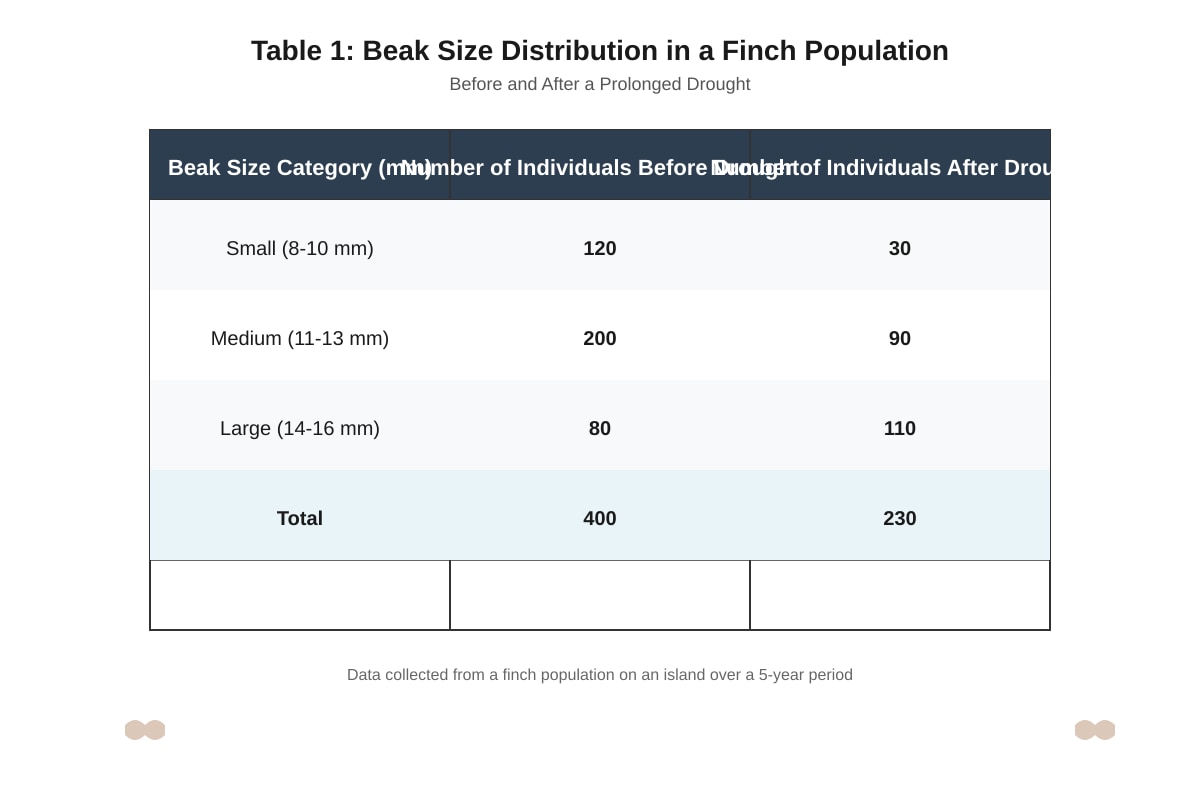
Answer: Before the drought, the most common beak size was medium (11–13 mm) with 200 individuals. After the drought, the most common beak size shifted to large (14–16 mm) with 110 individuals. The number of small-beaked finches decreased dramatically from 120 to 30, and medium-beaked finches decreased from 200 to 90, while large-beaked finches increased from 80 to 110.
Marking: 1 mark for describing the shift from medium/small to large beaks; 1 mark for reference to specific data values from the table.
(b) [3 marks]
Answer:
- The drought likely reduced the availability of small, soft seeds, leaving mostly large, hard seeds that require larger, stronger beaks to crack.
- Finches with larger beaks were better able to feed on the available food, giving them a selective advantage.
- These finches were more likely to survive and reproduce, passing on the alleles for larger beak size to the next generation.
- Over time, the frequency of alleles for larger beak size increased in the population.
Marking: 1 mark for linking drought to change in food availability (hard/large seeds); 1 mark for explaining selective advantage of large beaks; 1 mark for explaining increased survival/reproduction and inheritance of advantageous alleles.
(c) [2 marks]
Answer:
- Directional selection occurs when selection favours one extreme of a phenotypic range over the other.
- In this case, the drought favoured finches with larger beaks (one extreme of the beak size range) over those with smaller beaks.
- This caused the mean beak size in the population to shift towards the larger end of the distribution.
Marking: 1 mark for defining directional selection (favouring one extreme); 1 mark for applying it to the data (larger beaks favoured / mean shifted towards larger size).
Teaching note: This question mirrors the classic example of the Grants' research on Galápagos finches. Directional selection shifts the mean phenotype in one direction. Contrast with stabilising selection (favours the mean) and disruptive selection (favours both extremes).
12. [6 marks]
(a) [2 marks]
Answer:
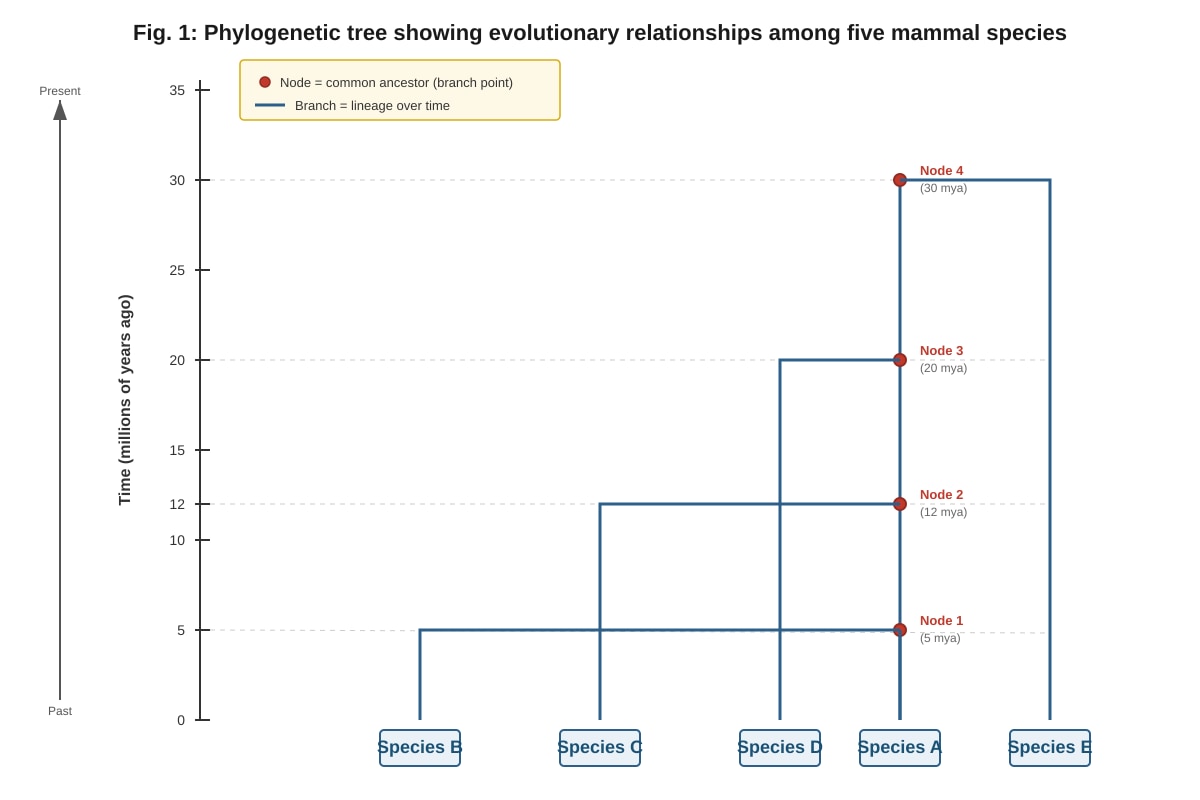
- Species A and B are most closely related.
- This is because they share the most recent common ancestor (Node 1, at 5 mya), meaning they diverged from each other more recently than from any other species.
Marking: 1 mark for identifying A and B; 1 mark for correct explanation (most recent common ancestor / diverged most recently).
(b) [1 mark]
Answer: Species C diverged from the lineage leading to A and B at approximately 12 million years ago (Node 2).
Marking: 1 mark for correct answer (12 mya).
(c) [2 marks]
Answer:
- Phylogenetic trees show the pattern of evolutionary relationships among species, with branch points representing common ancestors.
- They demonstrate that species share common ancestors and have diverged over time, which is consistent with the theory of evolution.
- The branching pattern shows that all life is related through common descent.
Marking: 1 mark for stating that branch points represent common ancestors; 1 mark for explaining that this shows divergence from common ancestors / supports evolution.
(d) [1 mark]
Answer: Any one from:
- DNA sequence comparisons
- Amino acid sequence comparisons of proteins
- Morphological/anatomical comparisons
- Fossil evidence
Marking: 1 mark for any valid data type.
Teaching note: Phylogenetic trees are hypotheses about evolutionary relationships. Modern trees are primarily constructed using molecular data (DNA/protein sequences) because these provide quantitative measures of genetic divergence. The more similar the sequences, the more closely related the species.
13. [8 marks]
(a) [2 marks]
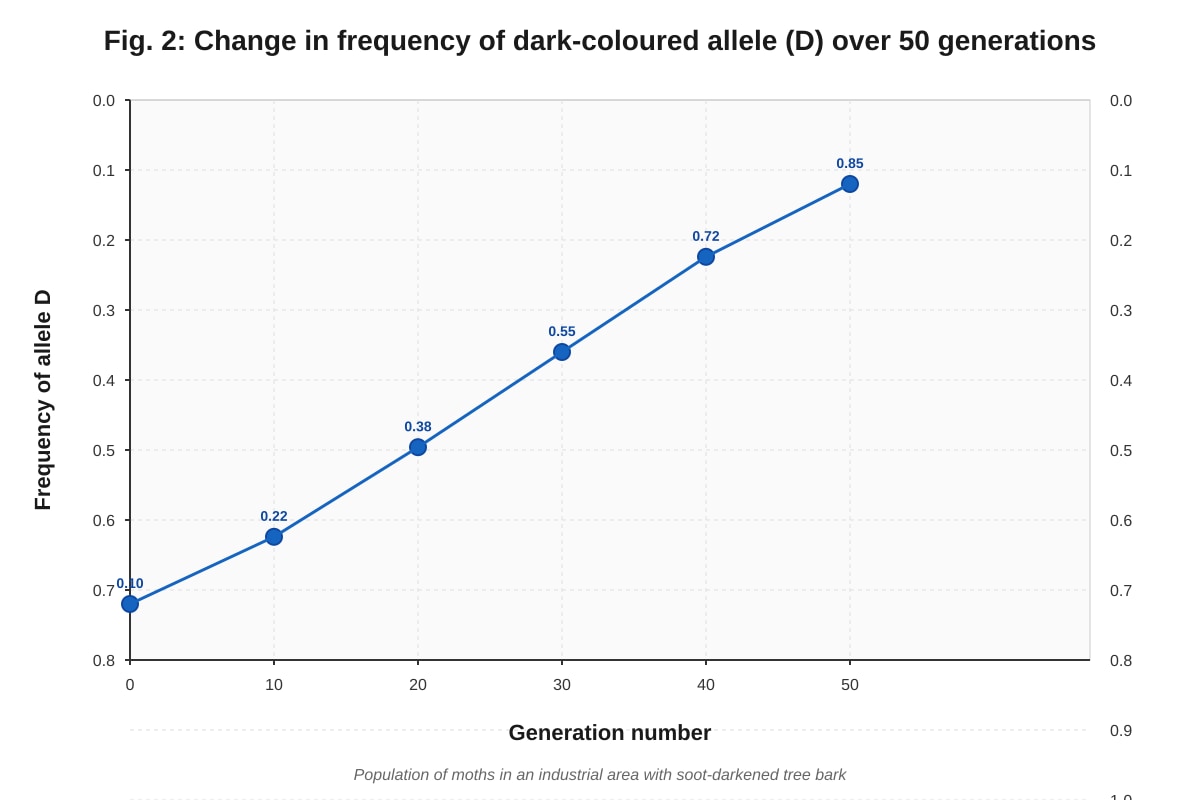
Answer: The frequency of the dark-coloured allele D increased steadily over the 50 generations, from 0.10 at generation 0 to 0.85 at generation 50. The rate of increase was gradual and consistent throughout the period.
Marking: 1 mark for describing the overall increase; 1 mark for quoting specific data values (start and end frequencies).
(b) [4 marks]
Answer:
- Before industrial pollution, light-coloured moths were better camouflaged against light tree bark and had higher survival rates.
- As pollution darkened the tree bark with soot, dark-coloured moths became better camouflaged from predators (e.g., birds).
- Dark-coloured moths had a selective advantage — they were less likely to be eaten and more likely to survive and reproduce.
- The dark-coloured allele (D) was passed on to offspring, causing its frequency to increase in the population over successive generations.
- This is an example of natural selection — the environment changed, and the phenotype with the highest fitness in the new environment became more common.
Marking: 1 mark for initial advantage of light moths; 1 mark for change in selection pressure due to pollution (dark bark favours dark moths); 1 mark for differential survival/reproduction; 1 mark for increase in allele frequency over generations.
(c) [2 marks]
Answer:
- The frequency of allele D would decrease over time.
- If the tree bark becomes lighter again, light-coloured moths would regain their camouflage advantage and be less likely to be predated.
- Light-coloured moths would have higher survival and reproductive success, so the frequency of the light-coloured allele would increase while the frequency of allele D would decrease.
Marking: 1 mark for predicting a decrease in frequency of D; 1 mark for correct explanation (lighter bark favours light moths / reversed selection pressure).
Teaching note: This is the classic example of industrial melanism in the peppered moth (Biston betularia). It demonstrates that natural selection is not directional in an absolute sense — if the environment changes, the direction of selection can reverse.
14. [8 marks]
(a) [3 marks]
Answer:
- The ocean between islands acted as a geographic barrier, preventing finches on different islands from interbreeding.
- This stopped gene flow between the populations on different islands.
- Each island population was exposed to different environmental conditions (different food sources, different selection pressures).
- Natural selection acted differently on each population, causing them to diverge genetically over time.
- Eventually, the genetic differences accumulated to the point where the populations could no longer interbreed — they had become separate species (allopatric speciation).
Marking: 1 mark for identifying the ocean as a geographic barrier; 1 mark for explaining cessation of gene flow; 1 mark for explaining divergence due to different selection pressures / accumulation of genetic differences.
(b) [3 marks]
Answer:
- Within the ancestral finch population, there was natural variation in beak shape (due to genetic variation from mutations and sexual reproduction).
- On islands where large, hard seeds were the main food source, finches with thicker, stronger beaks were better able to crack the seeds and obtain food.
- These finches had a selective advantage — they survived longer and produced more offspring, passing on the alleles for thicker beaks.
- Over many generations, the average beak size and strength increased in that population.
- On islands where insects were the main food source, finches with slender, pointed beaks were better at catching insects, and natural selection favoured this beak type instead.
Marking: 1 mark for mentioning variation in beak shape within the population; 1 mark for linking beak type to food source and selective advantage; 1 mark for explaining differential survival/reproduction and change over generations.
(c) [2 marks]
Answer:
- Adaptive radiation is the evolution of many different species from a single common ancestor, each adapted to a different ecological niche.
- Darwin's finches evolved from one ancestral species that colonised the islands, and then diversified into multiple species with different beak shapes adapted to different food sources (seeds, insects, cactus, etc.).
- This fits the definition of adaptive radiation — one ancestor, many descendant species, each occupying a different niche.
Marking: 1 mark for defining adaptive radiation; 1 mark for applying it to Darwin's finches (one ancestor → many species with different beak adaptations).
Teaching note: Darwin's finches are one of the most important examples in evolutionary biology. The key concept is that geographic isolation + different selection pressures + time = speciation. The Grants' long-term research on the Galápagos provided direct evidence of natural selection occurring in real time.
15. [5 marks]
(a) [2 marks]
Answer: Genetic drift is the random change in allele frequencies in a population due to chance events, rather than natural selection. It is a mechanism of evolution that is not driven by the fitness of alleles.
Marking: 1 mark for "random change in allele frequencies"; 1 mark for "due to chance" (not natural selection).
(b) [2 marks]
Answer:
- In a small populations, chance events (e.g., a few individuals dying before reproducing) can significantly alter allele frequencies because each individual represents a larger proportion of the total gene pool.
- In a large populations, the loss or gain of a few individuals has a negligible effect on overall allele frequencies because the gene pool is much larger and more stable.
- Therefore, genetic drift causes more rapid and dramatic changes in allele frequencies in small populations.
Marking: 1 mark for explaining that each individual has a greater impact on small populations; 1 mark for contrasting with large populations (more stable / less effect).
(c) [1 mark]
Answer: Any one from:
- Bottleneck effect — a drastic reduction in population size due to a random event (e.g., natural disaster, disease).
- Founder effect — a small group of individuals colonises a new area, carrying only a small, random sample of the original population's genetic diversity.
Marking: 1 mark for any valid example.
Teaching note: Genetic drift is a non-adaptive mechanism of evolution — changes in allele frequency are due to chance, not fitness. It is particularly important in small populations and can lead to the loss of genetic variation. The bottleneck and founder effects are two classic scenarios.
16. [6 marks]
(a) [2 marks]
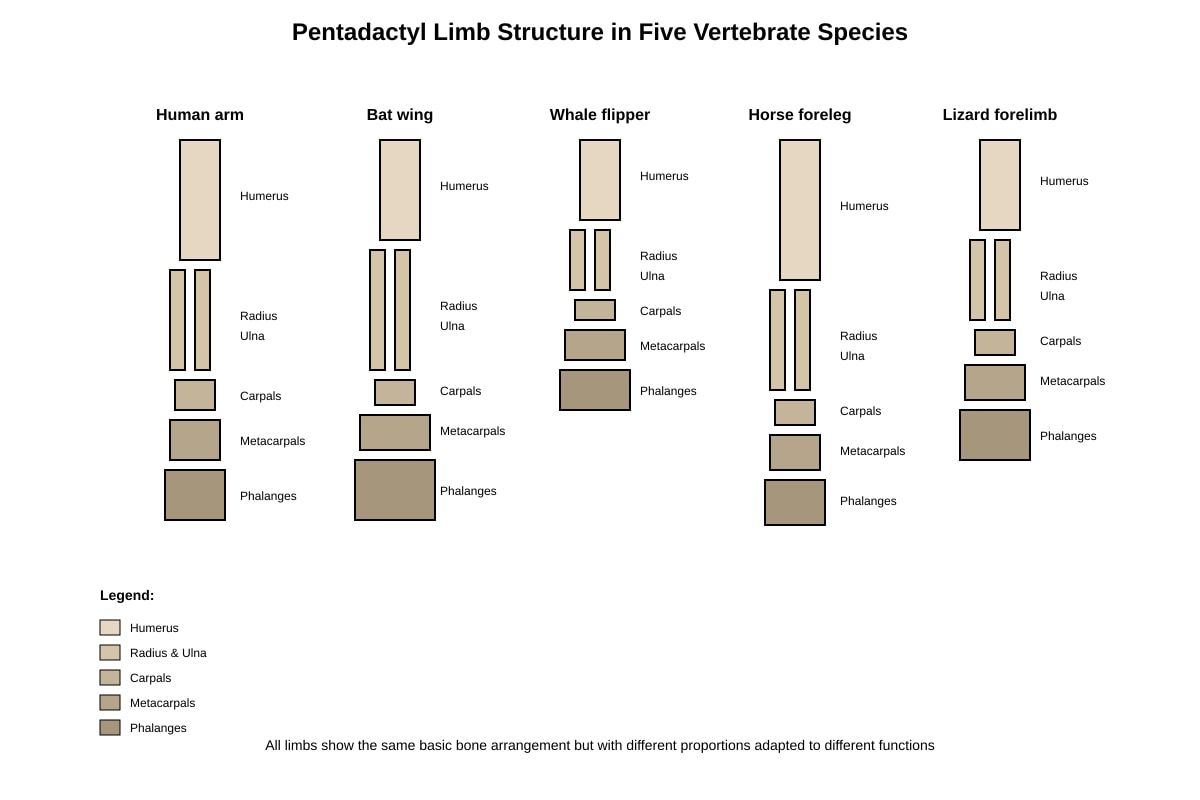
Answer: Homologous structures are structures in different species that have the same basic anatomical plan (same bone arrangement / same embryonic origin) but may perform different functions. They arise from a common ancestor.
Marking: 1 mark for "same basic structure / same bone arrangement"; 1 mark for "common ancestor" or "different functions."
(b) [2 marks]
Answer:
- Homologous structures indicate that the species sharing them evolved from a common ancestor that had the same basic limb structure.
- The fact that the same bone arrangement is found in species with very different lifestyles (flying, swimming, running, grasping) suggests that the structure was modified over time by natural selection to suit different functions, rather than being independently designed for each function.
- This supports the theory of evolution by common descent.
Marking: 1 mark for linking homologous structures to common ancestry; 1 mark for explaining that modification for different functions supports evolution.
(c) [2 marks]
Answer:
- The ancestral vertebrate had a pentadactyl limb that was adapted for a particular function (e.g., walking or paddling).
- As populations of descendants colonised different environments (air, water, land), different selection pressures acted on the limb structure.
- In the lineage leading to bats, natural selection favoured modifications for flight (elongated finger bones supporting a wing membrane).
- In the lineage leading to whales, natural selection favoured modifications for swimming (flattened, shortened bones forming a flipper).
- In the lineage leading to horses, natural selection favoured modifications for running (elongated metacarpals, reduced number of digits).
- Over many generations, natural selection modified the same basic structure to suit different functions in different environments.
Marking: 1 mark for explaining that different environments imposed different selection pressures; 1 mark for explaining how natural selection modified the limb for different functions over time.
Teaching note: Homologous structures are strong evidence for evolution because they show that different species share a common body plan that has been modified for different functions. This contrasts with analogous structures (e.g., insect wing vs. bird wing), which have similar functions but different evolutionary origins (convergent evolution).
17. [4 marks]
(a) [3 marks]
Answer:
- Divergent evolution occurs when two or more species evolve from a common ancestor and become increasingly different over time, often as they adapt to different environments or niches. (Example: Darwin's finches evolving different beak shapes from a common ancestor.)
- Convergent evolution occurs when unrelated species (not sharing a recent common ancestor) independently evolve similar traits or structures as a result of adapting to similar environmental pressures or ecological niches. (Example: the streamlined body shape of sharks and dolphins.)
Marking: 1 mark for correct definition of divergent evolution; 1 mark for correct definition of convergent evolution; 1 mark for correctly identifying that divergent involves related species and convergent involves unrelated species.
(b) [1 mark]
Answer: Any one from:
- The streamlined body shape of sharks (fish) and dolphins (mammals) — both adapted for fast swimming.
- The wings of birds, bats, and insects — all used for flight but evolved independently.
- The camera-type eye in vertebrates and cephalopods (e.g., octopus) — similar structure, independent origin.
- Cacti (Americas) and euphorbias (Africa) — similar succulent, spiny adaptations to arid environments but unrelated.
Marking: 1 mark for any valid example.
Teaching note: The key distinction is evolutionary relationship. Divergent evolution starts with related species that become different; convergent evolution starts with unrelated species that become similar. Both are driven by natural selection, but the starting points differ.
18. [4 marks]
(a) [3 marks]
Answer:
- The two groups of plants are pollinated by different pollinators (bees vs. hummingbirds), which means pollen is not transferred between the two groups.
- This creates pollinator isolation (a form of behavioural/mechanical reproductive isolation), reducing or preventing gene flow between the two groups.
- Over time, natural selection favours flower traits that attract the specific pollinator of each group (e.g., bees prefer blue/UV flowers; hummingbirds prefer red, tubular flowers).
- Genetic differences accumulate between the two groups due to different selection pressures and lack of gene flow.
- Eventually, the two groups may become so genetically distinct that they can no longer interbreed, resulting in speciation.
Marking: 1 mark for identifying reduced gene flow due to different pollinators; 1 mark for explaining natural selection favouring different flower traits; 1 mark for explaining accumulation of genetic differences leading to speciation.
(b) [1 mark]
Answer: Pollinator isolation (or behavioural isolation / mechanical isolation — any valid pre-zygotic isolation mechanism related to pollination).
Marking: 1 mark for identifying a valid type of reproductive isolation related to pollination.
Teaching note: This is an example of sympatric speciation, where new species arise within the same geographic area. Pollinator-mediated isolation is a well-documented mechanism in plants and does not require a physical barrier.
Section C: Extended Response (Questions 19–20)
19. [6 marks]
Answer:
Fossil Record:
- Fossils are the preserved remains or traces of organisms from the past, found in sedimentary rock layers.
- The fossil record shows a progression from simple organisms in older (deeper) rock layers to more complex organisms in younger (shallower) layers, indicating that life has changed over time.
- Transitional fossils (e.g., Archaeopteryx, which has features of both reptiles and birds) show intermediate forms between major groups, demonstrating evolutionary links.
- However, the fossil record is incomplete because fossilisation requires specific conditions and many organisms (especially soft-bodied ones) do not fossilise.
Comparative Anatomy:
- Homologous structures (e.g., the pentadactyl limb in vertebrates) have the same basic bone arrangement in different species but serve different functions (e.g., human hand, bat wing, whale flipper, horse leg).
- This indicates that these species share a common ancestor and that the limb structure was modified by natural selection over time to suit different functions — evidence of divergent evolution.
- Vestigial structures (e.g., the human appendix, whale pelvic bones) are reduced structures that serve little or no function in the present organism but were functional in ancestors, providing evidence of evolutionary change.
DNA and Molecular Evidence:
- Species that are more closely related evolutionarily have more similar DNA and protein sequences because they diverged more recently from a common ancestor.
- For example, humans and chimpanzees share approximately 98–99% DNA sequence similarity, indicating a recent common ancestor.
- Molecular clocks (using the rate of mutation in DNA sequences) can estimate when species diverged, and these estimates are consistent with fossil and anatomical evidence.
- Shared pseudogenes (non-functional genes) and endogenous retroviruses in the same genomic locations in different species provide strong evidence of common ancestry.
Marking descriptors:
| Marks | Descriptor |
|---|---|
| 5–6 | Comprehensive answer covering all three types of evidence with clear explanations of how each supports evolution. Accurate biological terminology. Well-structured response. |
| 3–4 | Covers at least two types of evidence with reasonable explanation. Some biological terminology used. Response is mostly clear. |
| 1–2 | Limited coverage (one type of evidence) or superficial explanation. Little use of biological terminology. |
| 0 | No relevant content. |
20. [6 marks]
Answer:
Variation within a population:
- Within any population, individuals vary in their phenotypes (observable traits) due to genetic variation arising from mutations, sexual reproduction (crossing over, independent assortment, random fertilisation), and gene flow.
- This variation is the raw material for natural selection.
Selection pressure:
- The environment exerts selection pressures — factors that affect the survival and reproductive success of individuals (e.g., predation, competition for resources, climate, disease).
- Individuals with traits (phenotypes) that are better suited to the environment are more likely to survive and reproduce — they have higher fitness.
- These advantageous traits are often determined by specific alleles, so individuals with beneficial alleles pass them on to more offspring.
- Over generations, the frequency of advantageous alleles increases in the population, while the frequency of disadvantageous alleles decreases.
Reproductive isolation:
- If populations of the same species become separated (e.g., by a geographic barrier, or by occupying different niches within the same area), gene flow between them is reduced or eliminated.
- Each population may experience different selection pressures, causing them to diverge genetically.
- Reproductive isolation mechanisms (pre-zygotic: temporal, behavioural, mechanical, gametic; post-zygotic: hybrid inviability, infertility) prevent interbreeding even if the populations come back into contact.
Accumulation of genetic differences over time:
- Over many generations, the separated populations accumulate genetic differences through natural selection, genetic drift, and mutation.
- Eventually, the genetic differences become so great that the populations can no longer interbreed to produce fertile offspring — they have become separate species.
- This process is called speciation, and it is the mechanism by which natural selection leads to the formation of new species.
Marking descriptors:
| Marks | Descriptor |
|---|---|
| 5–6 | Comprehensive answer covering all four required points with clear, logical explanation of how natural selection leads to speciation. Accurate biological terminology. Well-structured response showing understanding of the process. |
| 3–4 | Covers at least three of the four required points with reasonable explanation. Some biological terminology used. Response shows understanding of the overall process. |
| 1–2 | Limited coverage (one or two points) or superficial explanation. Little use of biological terminology. Response lacks coherence. |
| 0 | No relevant content. |
END OF ANSWER KEY