From Real Exams Quiz
A Level H1 Biology Evolution Diversity Quiz
Free A Level H1 Biology Evolution Diversity quiz, HY3 Exam version, with questions, answers, and A Level-style practice for Singapore students.
These static practice materials are generated from the site's syllabus and paper-generation workflow, with source and model context shown so students and parents can evaluate the material before use.
Questions
A-Level Biology H1 Quiz - Evolution Diversity
Name: ___________________________
Class: ___________________________
Date: ___________________________
Score: _______ / 40
Duration: 60 minutes
Total Marks: 40
Topic: Evolution & Diversity (Core Idea 4)
Instructions:
- Answer all 20 questions.
- Section A: Multiple-choice (1 mark each).
- Section B: Structured short answers (2 marks each).
- Section C: Data-based and extended response (3–4 marks each).
- Write your answers in the spaces provided.
Section A: Multiple Choice (Questions 1–5)
1. Which of the following best describes the biological species concept?
A. Species are groups that occupy the same niche
B. Species are groups of actually or potentially interbreeding natural populations that are reproductively isolated from other such groups
C. Species are classified by morphological similarity only
D. Species are defined by their geographic range
____ (1 mark)
2. A population of beetles shows variation in shell colour. After a volcanic eruption darkens the soil, dark beetles survive better. This is an example of:
A. Genetic drift
B. Directional selection
C. Stabilising selection
D. Disruptive selection
____ (1 mark)
3. The presence of homologous structures in different species suggests:
A. Convergent evolution
B. Common ancestry
C. Analogous function
D. Random mutation only
____ (1 mark)
4. Which condition is NOT required for the Hardy–Weinberg principle to hold? (Note: H1 syllabus does not assess calculation but recognises concept)
A. No mutation
B. Random mating
C. Small population size
D. No selection
____ (1 mark)
5. Antibiotic resistance in bacteria spreads mainly through:
A. Use of vaccines
B. Natural selection acting on pre-existing variation
C. Lamarckian inheritance
D. Cloning by humans
____ (1 mark)
Section B: Structured Short Answers (Questions 6–10)
6. State two sources of genetic variation in a population.
__________________________________________________________________ (2 marks)
7. Explain why convergent evolution can produce analogous structures.
__________________________________________________________________ (2 marks)
8. Name one piece of evidence for evolution other than the fossil record.
__________________________________________________________________ (2 marks)
9. Define "reproductive isolation" in one sentence.
__________________________________________________________________ (2 marks)
10. Give one reason why a species might become extinct due to environmental change.
__________________________________________________________________ (2 marks)
Section C: Data-Based and Extended Response (Questions 11–20)
11. A study measured beak depth (mm) in a finch population before and after a drought.
| Year | Mean beak depth (mm) | Sample size |
|---|---|---|
| 2015 | 9.1 | 120 |
| 2018 | 10.4 | 98 |
(a) Calculate the percentage increase in mean beak depth. (2 marks)
(b) Suggest why the drought led to this change. (2 marks)
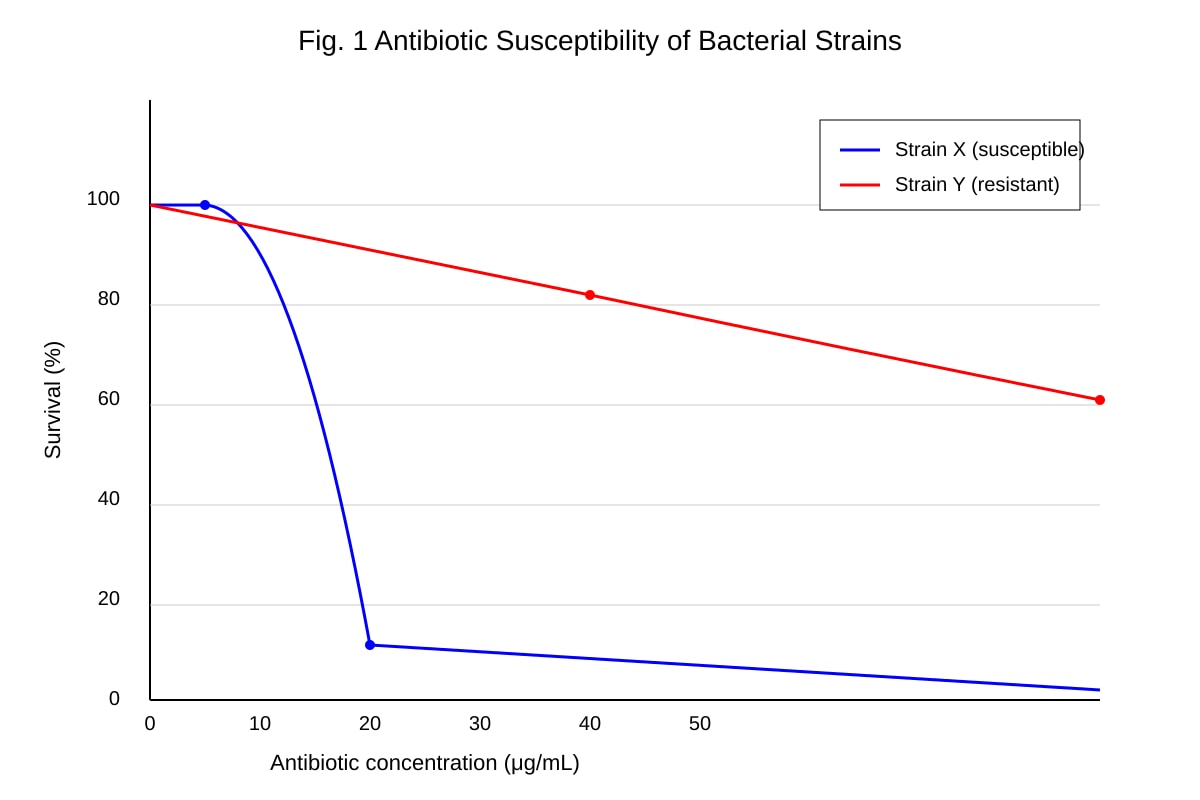
12. With reference to Fig. 1, describe how the antibiotic susceptibility graph shows selection.
Image pending generation: graph for Q12.
__________________________________________________________________ (3 marks)
13. Explain the difference between homologous and analogous structures with one example each. (3 marks)
14. The table shows amino acid differences in a protein between species.
| Species pair | Differing amino acids |
|---|---|
| A–B | 3 |
| A–C | 12 |
| B–C | 14 |
(a) Which two species are most closely related? (1 mark)
(b) Explain how this data can be used as evidence for evolution. (2 marks)
15. Describe how fossil records support the theory of evolution. (3 marks)
16. A population of moths has light and dark forms. A predator eats more light moths on dark tree bark.
(a) State the type of selection. (1 mark)
(b) Explain the likely change in allele frequency over 10 generations. (2 marks)
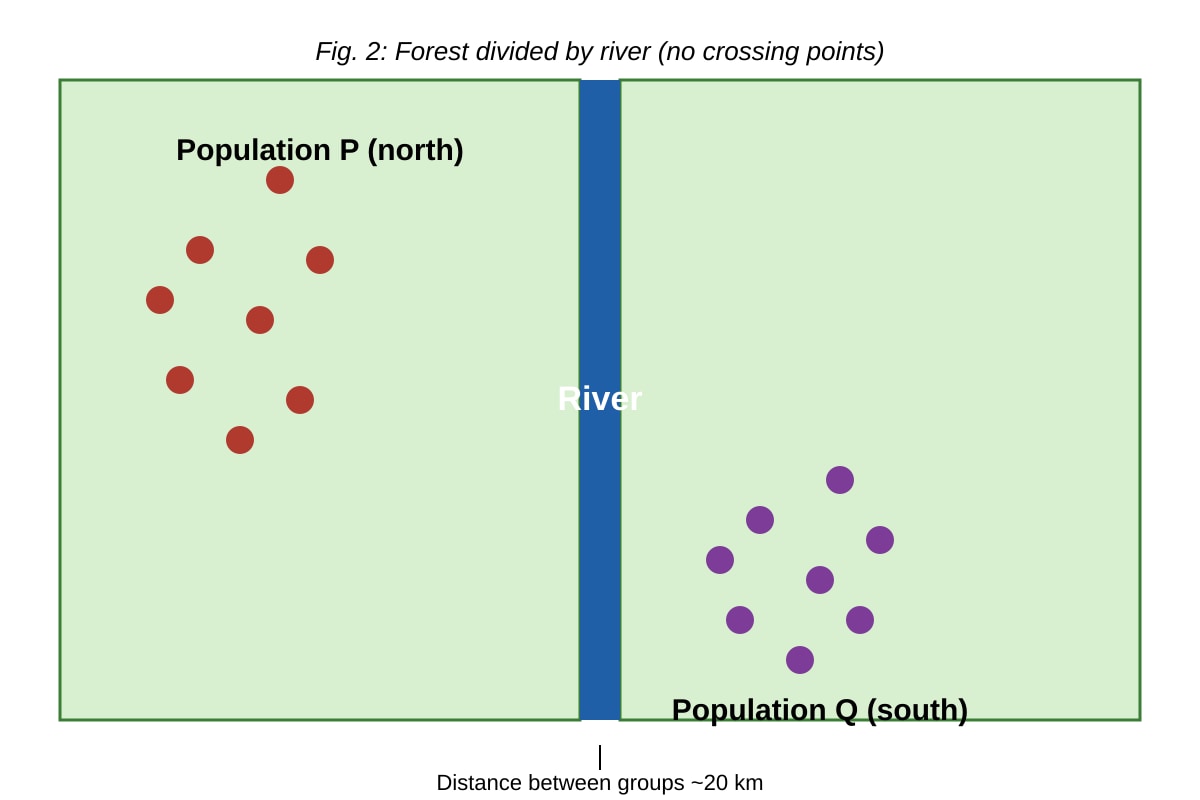
17. With reference to Fig. 2, identify the isolated populations and explain how allopatric speciation may occur.
Image pending generation: map for Q17.
__________________________________________________________________ (3 marks)
18. Explain how mutation and selection interact to produce adaptation. (3 marks)
19. Give two reasons why the biological species concept is difficult to apply to bacteria. (2 marks)
20. An island has 4 bird species with similar songs but different beak shapes.
(a) Suggest a likely evolutionary explanation. (2 marks)
(b) State one method to test your explanation using DNA. (1 mark)
Answers
A-Level Biology H1 Quiz - Evolution Diversity: Answer Key
Total Marks: 40
Topic: Evolution & Diversity
Section A: Multiple Choice
1. B (1 mark)
Teaching note: The biological species concept (Mayr) defines species as groups of actually or potentially interbreeding natural populations reproductively isolated from others. A is niche concept; C is morphological; D is geographic.
2. B (1 mark)
Teaching note: Directional selection favours one extreme phenotype (dark) after environmental change (dark soil). Genetic drift is random; stabilising favours intermediate; disruptive favours both extremes.
3. B (1 mark)
Teaching note: Homologous structures (e.g., forelimbs of vertebrates) indicate common ancestry despite different functions. Convergent evolution gives analogous structures.
4. C (1 mark)
Teaching note: Hardy–Weinberg requires large population (no drift). Small population violates condition. H1 does not calculate but should know assumptions: no mutation, random mating, no migration, large population, no selection.
5. B (1 mark)
Teaching note: Resistance arises from variation; antibiotics select survivors that reproduce. Not vaccine use or Lamarckian.
Section B: Structured Short Answers
6. (2 marks)
- Mutation (1)
- Sexual reproduction / recombination / meiosis (1)
Teaching: Variation sources include random mutation and allele shuffling during reproduction.
7. (2 marks)
Convergent evolution: unrelated species face similar environmental pressures (1) and independently evolve similar traits for same function (1). Example not needed but analogous wings of bird/insect.
8. (2 marks)
Any one: comparative anatomy / homologous structures / molecular biology (DNA/protein similarity) / biogeography / direct observation (e.g., antibiotic resistance). (2 for naming + brief)
9. (2 marks)
Reproductive isolation = members of different populations cannot interbreed to produce fertile offspring (2). Or barrier to gene flow.
10. (2 marks)
One reason: habitat loss / temperature shift beyond tolerance / new predator / food source removed (2 with explanation).
Section C: Data-Based and Extended Response
11. (4 marks total)
(a) % increase = (10.4 – 9.1) / 9.1 × 100 = 1.3 / 9.1 × 100 ≈ 14.3% (2 marks: 1 for method, 1 for answer)
(b) Drought reduced small seeds; birds with deeper beaks accessed remaining food, survived, reproduced → directional selection (2 marks).
12. (3 marks)
Strain Y survives at high antibiotic concentration while X dies (1); antibiotic acts as selective agent (1); resistant alleles increase in population (1). Ref to graph needed.
13. (3 marks)
Homologous: same origin, different function (e.g., human arm / whale flipper) (1.5). Analogous: different origin, same function (e.g., insect wing / bird wing) (1.5).
14. (3 marks)
(a) A–B (1).
(b) Fewer differences = closer relation (1); molecular similarity supports common ancestry (1).
15. (3 marks)
Fossils show chronological sequence (1); transitional forms (1); extinct intermediates link groups (1). E.g., Archaeopteryx.
16. (3 marks)
(a) Directional (1).
(b) Dark allele frequency increases (1); light allele decreases due to predation (1).
17. (3 marks)
River separates P and Q (1); no gene flow (1); independent mutation/selection → reproductive isolation (1).
18. (3 marks)
Mutation creates variation (1); selection favours beneficial alleles (1); repeated over generations → adaptation (1).
19. (2 marks)
Bacteria reproduce asexually (1); species concept based on interbreeding not applicable / horizontal gene transfer (1).
20. (3 marks)
(a) Adaptive radiation from common ancestor (1); different beaks for different food (1).
(b) Compare DNA sequences / phylogenetic tree (1).
Free quiz and exam paper access
Enter your details to view this paper
Your access is remembered on this device.