From Real Exams Quiz
A Level H1 Biology Ecology Quiz
Free A Level H1 Biology Ecology quiz, DeepSeek Exam version, with questions, answers, and A Level-style practice for Singapore students.
These static practice materials are generated from the site's syllabus and paper-generation workflow, with source and model context shown so students and parents can evaluate the material before use.
Questions
Free quiz and exam paper access
Enter your details to view this paper
Your access is remembered on this device.
Answers
A-Level Biology H1 Quiz - Ecology – Answer Key
Total marks: 40
Section A
1. Definition: The role and position an organism has in its environment, including its interactions with other organisms and its use of resources. [1]
Example: (any valid, e.g.) A barn owl occupies the niche of a nocturnal predator of small mammals. [1]
(Accept other suitable definitions and examples.)
2. (a) Any two abiotic factors: temperature, light intensity, water availability, pH, salinity, wind, etc. [1 mark each, 2 total]
(b) Explanation linking the chosen factor to population limits. Example: Low temperature can slow enzyme activity in poikilotherms, reducing metabolic rate and reproductive success, thus limiting population growth. [2]
(Award 1 mark for stating the limiting mechanism, 1 mark for linking it to population size.)
3. Energy passes through the ecosystem from producers to consumers and is eventually lost as heat; energy cannot be recycled back to the sun or producers. [1] Therefore, the flow is always one-way from the sun/producers upwards. [1]
(Accept: energy enters as sunlight, is transferred along food chains, and is ultimately dissipated as heat.)
4. Biomass [1]
5. Gas: carbon dioxide (or methane, water vapour). [1 for name] Effect: it traps heat/infrared radiation in the atmosphere, leading to warming. [1 for correct effect]
(If only name given, no mark for effect; total 1 mark.)
Section B
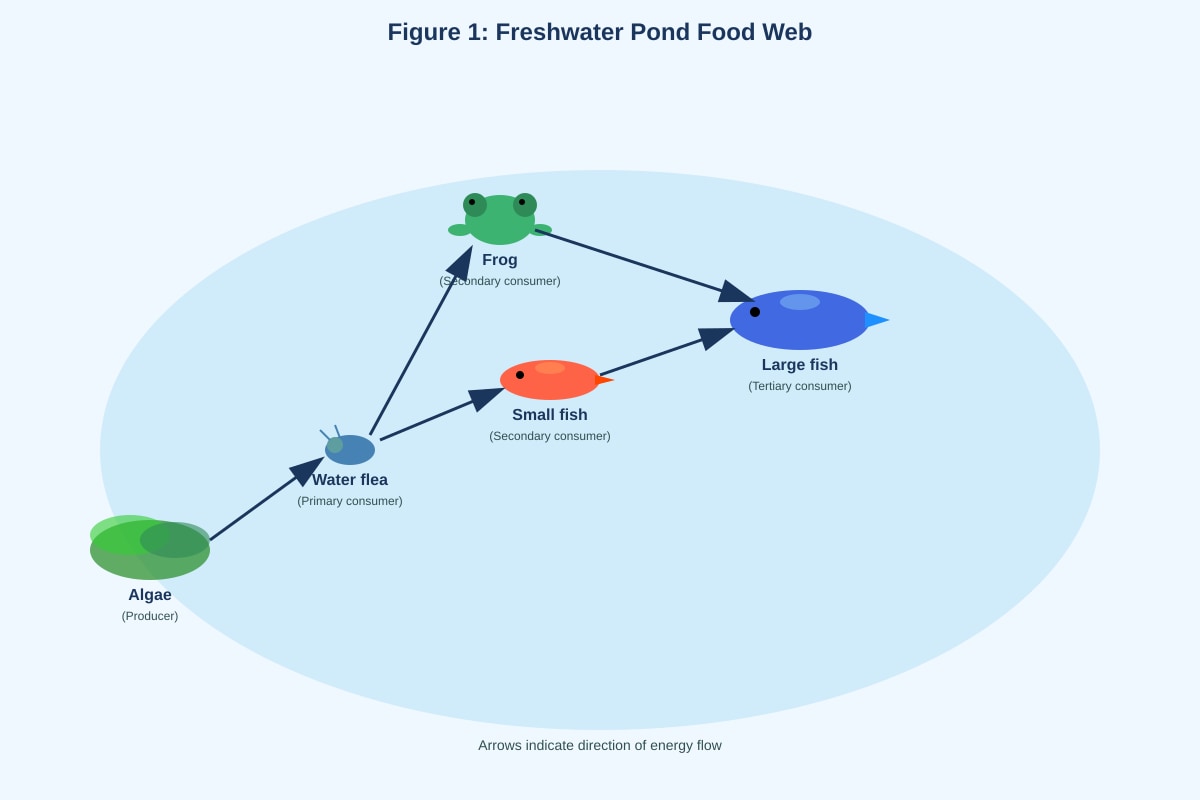
6. (a) Algae [1]
(b) Water flea (or any primary consumer from food web) [1]
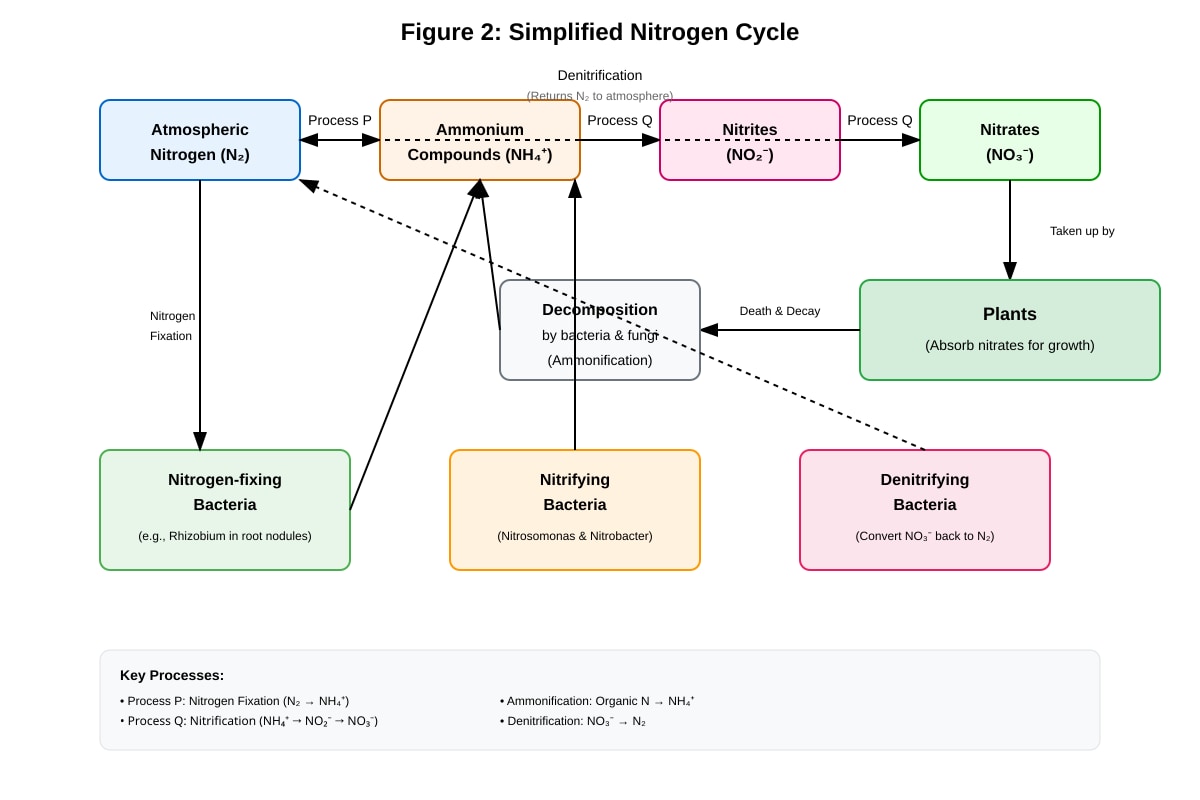
7. (a) P: Nitrogen fixation [1]
Q: Nitrification [1]
(b) Nitrogen fixation is the conversion of atmospheric nitrogen (N₂) into ammonium compounds (NH₄⁺) by nitrogen-fixing bacteria (e.g., Rhizobium) or by lightning. [1 for any correct description]
(c) Nitrifying bacteria oxidise ammonium compounds to nitrites and then to nitrates, making nitrogen available to plants. [1]
8. Any two of the following (1 mark each):
- Deforestation reduces the number of trees, which absorb CO₂ for photosynthesis, leading to higher atmospheric CO₂.
- Burning of forests releases stored carbon as CO₂.
- Decomposition of dead plant material releases CO₂ back to the atmosphere.
- Destruction of forest soils releases carbon from organic matter.
(Accept other valid points.)
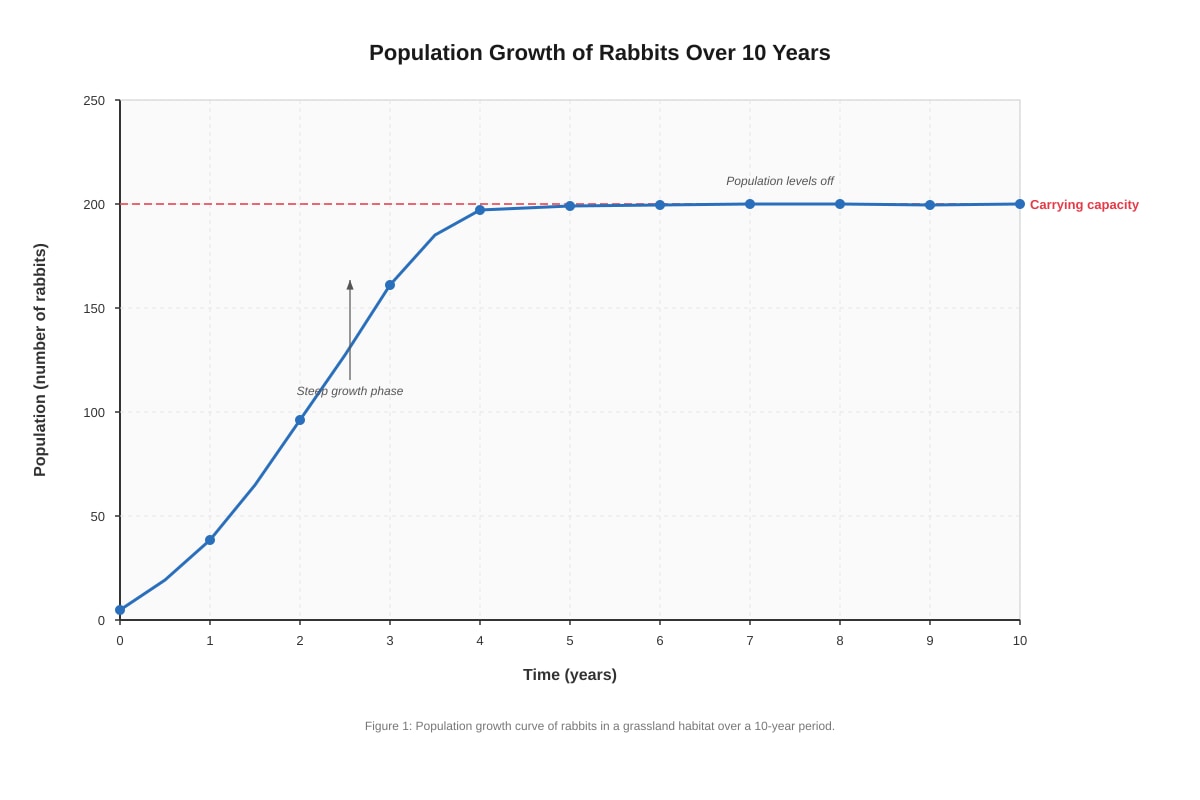
9. Carrying capacity [1]
10. Any one advantage, e.g.: Biological control agents are specific to the pest and do not harm other organisms; pests do not develop resistance as quickly; it does not leave chemical residues. [1]
Section C
11. (a) 200 individuals (or as indicated on graph) [1]
(b) Any two limiting factors: food shortage, predation, disease, competition, limited space/ nesting sites, etc. [2]
12. (a) The CO₂ concentration has steadily increased over the years 1960–2020. [1] The rate of increase appears to be accelerating/ greater in recent decades. [1]
(Accept: overall upward trend with specific data reference.)
(b) Any valid reason: increased burning of fossil fuels, deforestation reducing CO₂ uptake, industrial processes, increased vehicle emissions, etc. [1 for reason, 1 for explanation linking to CO₂ release.]
13. Biodiversity is the variety of living organisms in an ecosystem, including genetic diversity, species diversity, and ecosystem diversity. [1]
14. Any valid method: Simpson’s diversity index, quadrat sampling with species identification, transect line sampling, mark–release–recapture (for animals), etc. [1]
15. Any benefit: provides resources (food, medicine), ecosystem services (pollination, water purification), cultural/aesthetic value, stability of ecosystems, etc. [1]
Section D
16. Discuss impacts; 4 marks. Award for:
- Increased sea temperature causes coral bleaching (loss of symbiotic zooxanthellae), leading to coral death and reef degradation.
- Ocean acidification (due to more CO₂ dissolving) reduces calcification, weakening coral skeletons.
- Rising sea levels may alter light availability for photosynthesis.
- Changes in storm intensity can physically damage reefs.
- Loss of coral reefs reduces biodiversity, fish habitats, and coastal protection.
(Award 1 mark for each distinct, well-explained impact up to 4.)
17. Greenhouse gases (e.g., CO₂, methane) absorb and re-emit infrared radiation emitted by the Earth’s surface. [1] This traps heat in the atmosphere, reducing heat loss to space. [1] The enhanced greenhouse effect (due to increased gas concentrations from human activities) leads to greater warming, i.e., global warming. [1]
18. A trophic level is the position an organism occupies in a food chain, determined by its feeding relationship. [1]
19. Energy is lost at each trophic level (e.g., through respiration, heat, undigested material), so only a small percentage (about 10%) is transferred to the next level. [1] After a few transfers, insufficient energy remains to support another level, limiting the length to about 4–5.
20. Any realistic action: reduce energy use, use public transport, recycle, adopt a plant-based diet, reduce meat consumption, use energy-efficient appliances, plant trees, etc. [1]
(Total: 40 marks)