From Real Exams Quiz
A Level H1 Biology Cells Biomolecules Quiz
Free A Level H1 Biology Cells Biomolecules quiz, HY3 Exam version, with questions, answers, and A Level-style practice for Singapore students.
These static practice materials are generated from the site's syllabus and paper-generation workflow, with source and model context shown so students and parents can evaluate the material before use.
Questions
Free quiz and exam paper access
Enter your details to view this paper
Your access is remembered on this device.
Answers
A-Level Biology H1 Quiz - Cells Biomolecules: Answer Key
Total Marks: 40
Topic: Cells & Biomolecules (Core Idea 1)
Section A Answers (1–10)
1. [1 mark]
Answer: Any one of: cells are the smallest unit of life; all cells come from pre-existing cells; living organisms are composed of cells.
Teaching note: Cell theory is a foundational concept. Mark awarded for one correct statement. Common mistake: confusing with "cells can arise spontaneously" (false).
2. [2 marks]
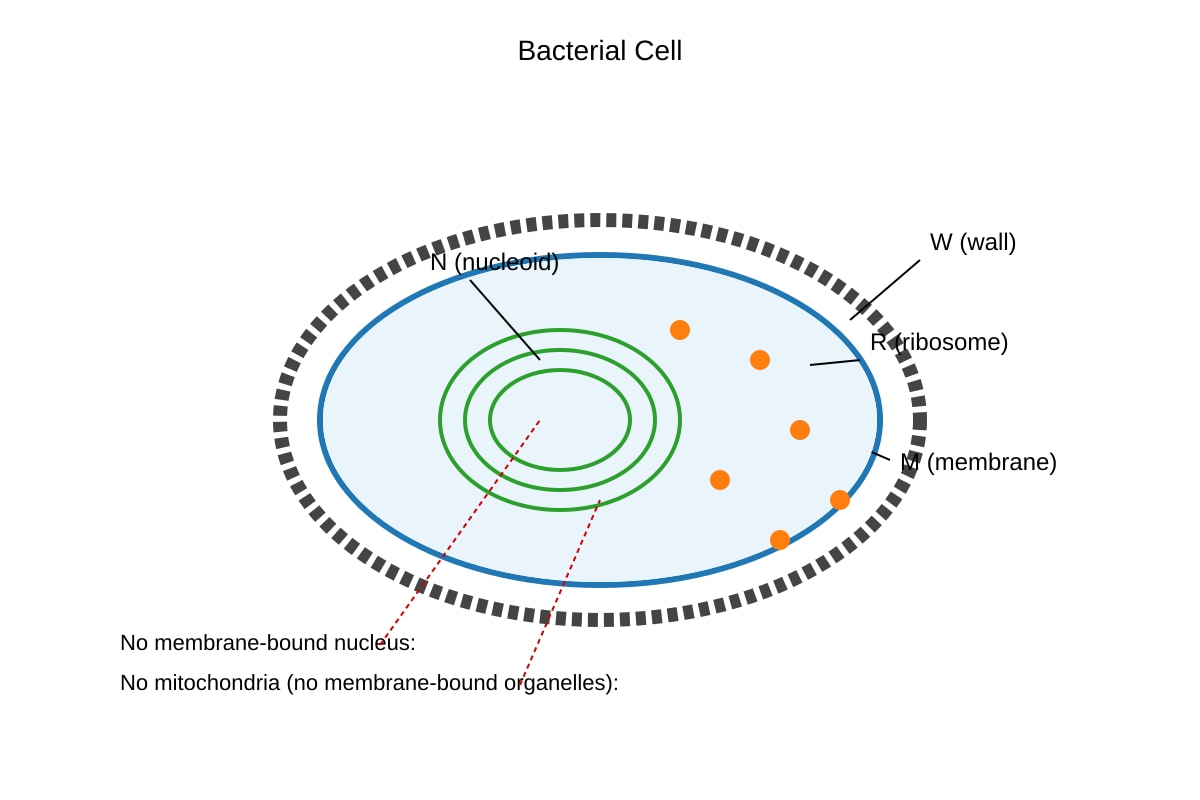
Answer: Organelle: bacterial cell (or prokaryote) has no membrane-bound nucleus; difference: lacks membrane-bound organelles such as mitochondria / has peptidoglycan wall (vs cellulose in plant).
Mark breakdown: 1 for naming bacterium/prokaryote context, 1 for structural difference.
Note: Syllabus specifies bacterial cell has circular DNA, 70S ribosomes, peptidoglycan wall, no membrane-bound organelles.
3. [2 marks]
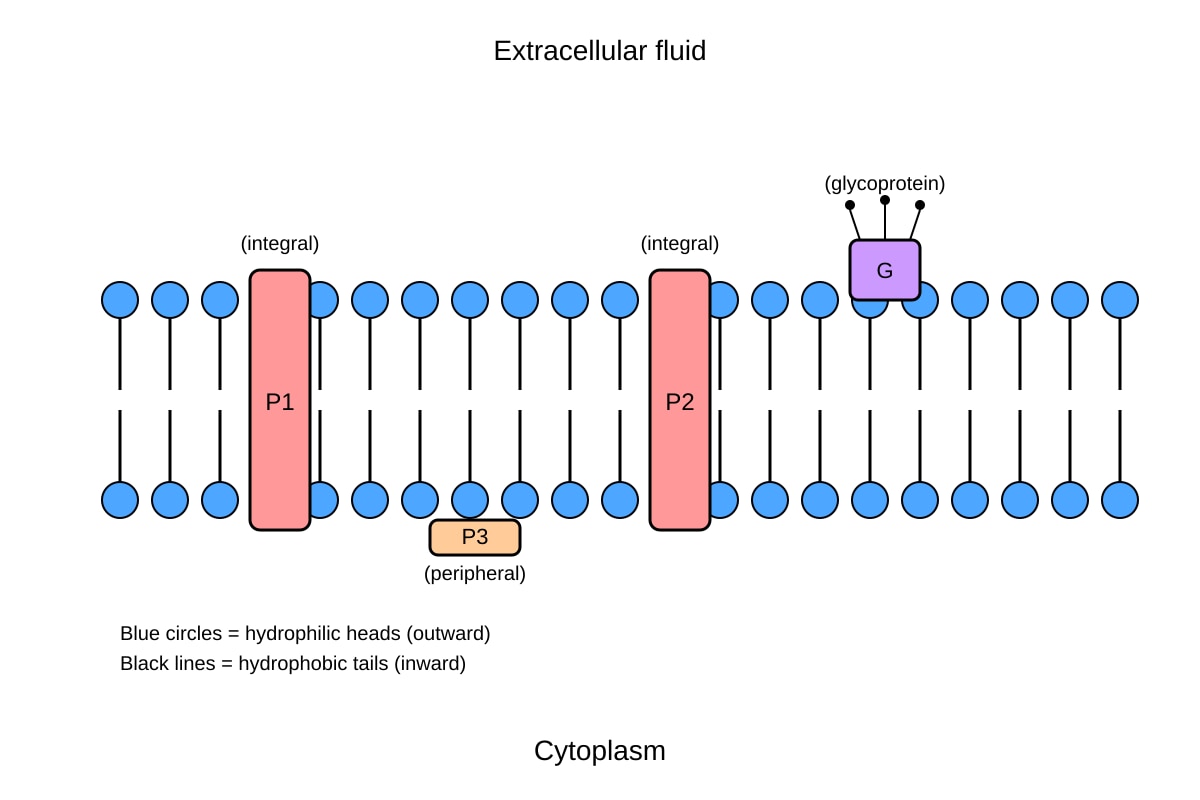
Answer: Phospholipids form a bilayer; hydrophilic heads face outward to aqueous environment, hydrophobic tails face inward away from water.
Mark breakdown: 1 for bilayer, 1 for orientation of heads/tails.
Teaching: This arrangement creates a selective barrier.
4. [2 marks]
Answer: Glycosidic bond; enzyme class: carbohydrase (or glycosidase / amylase).
Mark breakdown: 1 bond name, 1 enzyme class.
Note: α-glucose polymers (starch) linked by α-1,4 glycosidic bonds.
5. [1 mark]
Answer: Cholesterol provides stability / reduces fluidity at high temp and prevents crystallisation at low temp.
Teaching: It fits between phospholipid tails.
6. [2 marks]
Answer: Osmosis; passive transport (or simple diffusion of water).
Mark breakdown: 1 term, 1 type.
Note: Water moves out to region of higher solute concentration (lower water potential).
7. [2 marks]
Answer: Glucose moves down its concentration gradient via a carrier protein; no ATP needed because no energy input required for passive movement.
Mark breakdown: 1 gradient/carrier, 1 no ATP.
Teaching: Facilitated diffusion is passive.
8. [2 marks]
Answer: Tertiary (and quaternary); other bond: hydrogen / ionic / hydrophobic interaction.
Mark breakdown: 1 level, 1 bond type.
Note: Disulfide bonds stabilise tertiary structure.
9. [1 mark]
Answer: Totipotent.
Teaching: Zygotic stem cells can form all cell types including extra-embryonic.
10. [2 marks]
Answer: S phase; thymine is incorporated into DNA during replication.
Mark breakdown: 1 phase, 1 reason.
Teaching: Radioactive thymine labels new DNA strands.
Section B Answers (11–15)
11. [3 marks]
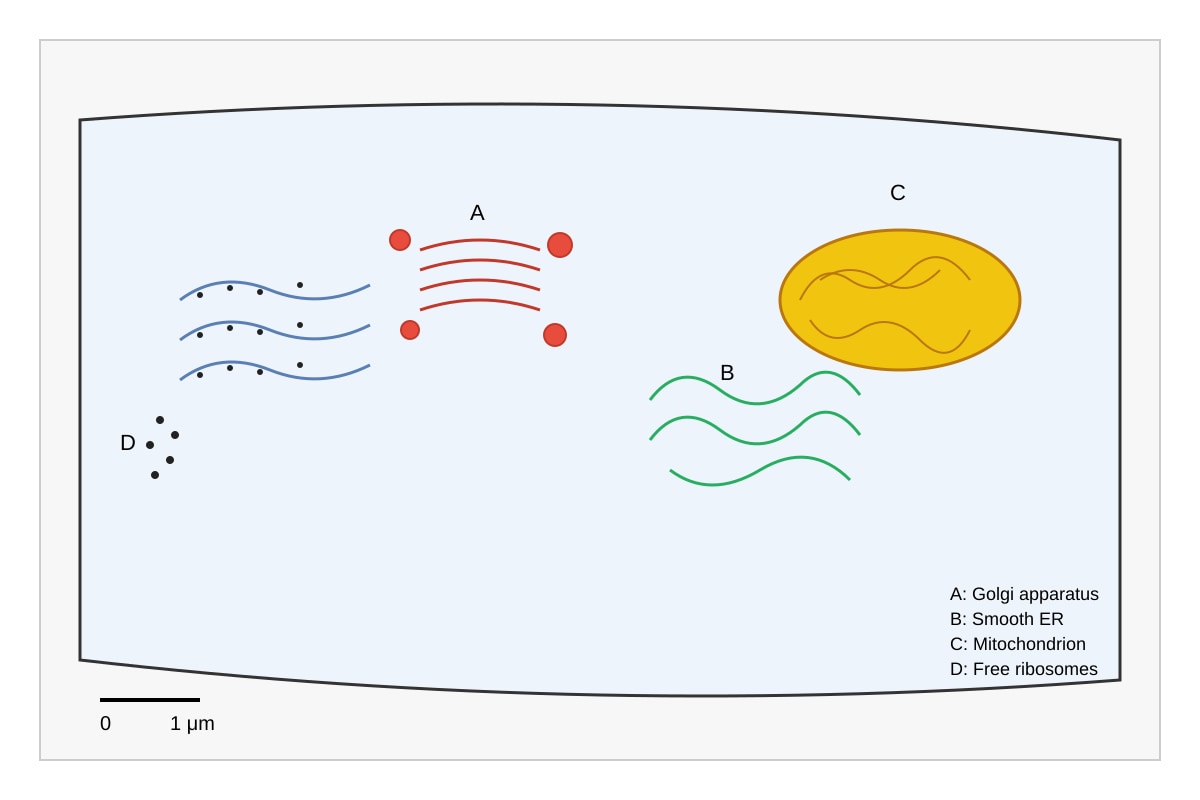
(a) A: Golgi body (or Golgi apparatus); C: mitochondrion (with cristae). [2]
(b) B (smooth ER): lipid synthesis / detoxification. [1]
Teaching: Smooth ER lacks ribosomes; identified by tubular network.
12. [3 marks]
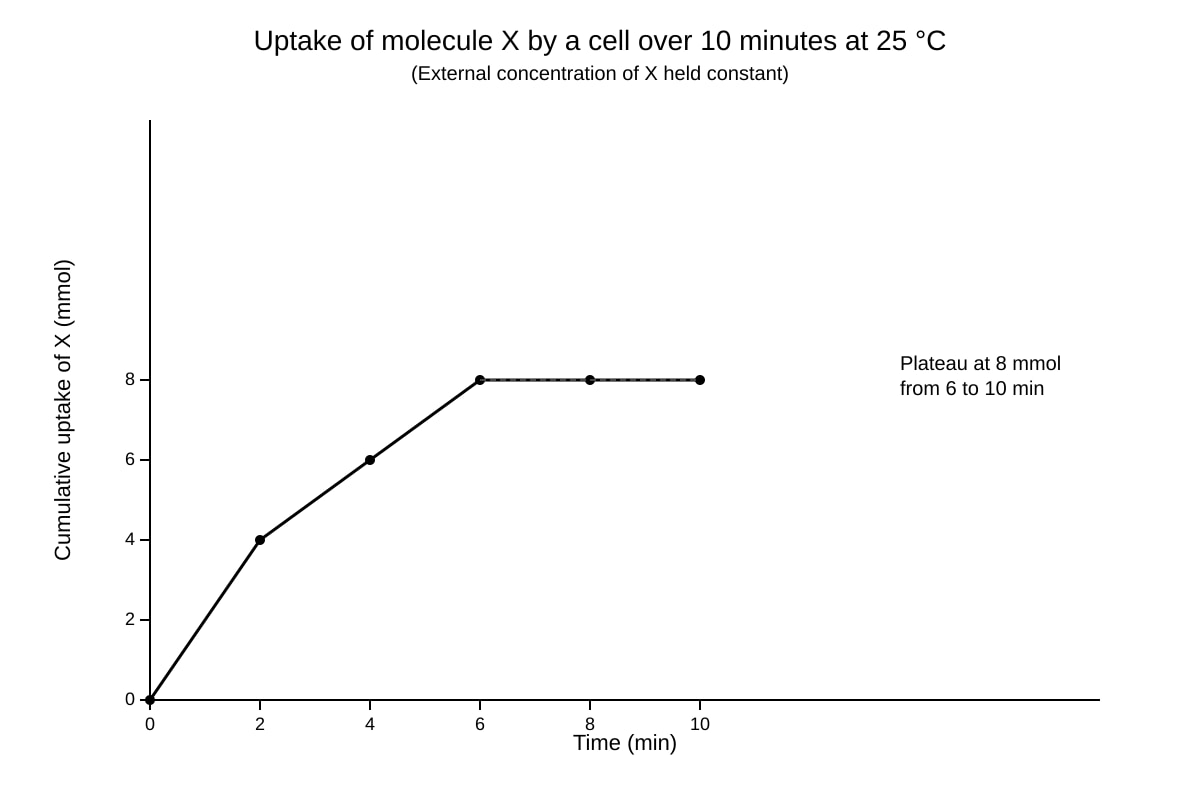
Answer: Uptake plateaus because carriers saturate (all transporter proteins occupied) OR internal concentration equals external (equilibrium). [2] External X constant but finite number of carriers / gradient reduced. [1]
Mark breakdown: 2 for saturation/equilibrium, 1 for constant external not sufficient.
Teaching: Shows facilitated diffusion, not simple diffusion.
13. [2 marks]
Answer: G (glycoprotein): cell recognition / receptor; Integral protein: channel / carrier / pump. [1+1]
Teaching: Glycoproteins have carbohydrate chains external.
14. [3 marks]
(a) 40 °C [1]
(b) At 60 °C enzyme denatured: tertiary structure disrupted, active site lost. [2]
Mark breakdown: 1 opt, 2 explanation.
Teaching: Beyond optimum, H-bonds/ionic bonds break.
15. [2 marks]
Answer: Any two: circular DNA (no nucleus); 70S ribosomes; peptidoglycan wall; no mitochondria. [1 each]
Teaching: Diagram must show nucleoid not enclosed.
Section C Answers (16–20)
16. [4 marks]
Answer: Cellulose is polymer of β-glucose with β-1,4 glycosidic bonds [1]; straight chains form H-bonds with adjacent chains → microfibrils [1]; provides tensile strength [1]; rigid wall supports plant cells against turgor [1].
Teaching: Contrast with starch (α, coiled, storage).
17. [3 marks]
Answer: Pyruvate enters mitochondrial matrix directly and is decarboxylated in Krebs cycle → CO₂ [1+1]; glucose requires glycolysis in cytoplasm first (not in mitochondrion) so isolated mitochondria cannot metabolise it [1].
Mark breakdown: 2 pyruvate reason, 1 glucose location.
18. [4 marks]
Answer: Enzyme active site initially not complementary [1]; substrate binding induces conformational change improving fit [1]; stresses substrate bonds / lowers Ea [1]; enzyme–substrate complex forms, product released [1].
Teaching: Induced-fit vs lock-and-key.
19. [3 marks]
Answer: Multipotent blood stem cells [1]; can differentiate into limited range of blood cell types (RBC, WBC, platelets) [1]; self-renew to maintain population [1].
Teaching: Multipotent < pluripotent < totipotent.
20. [4 marks]
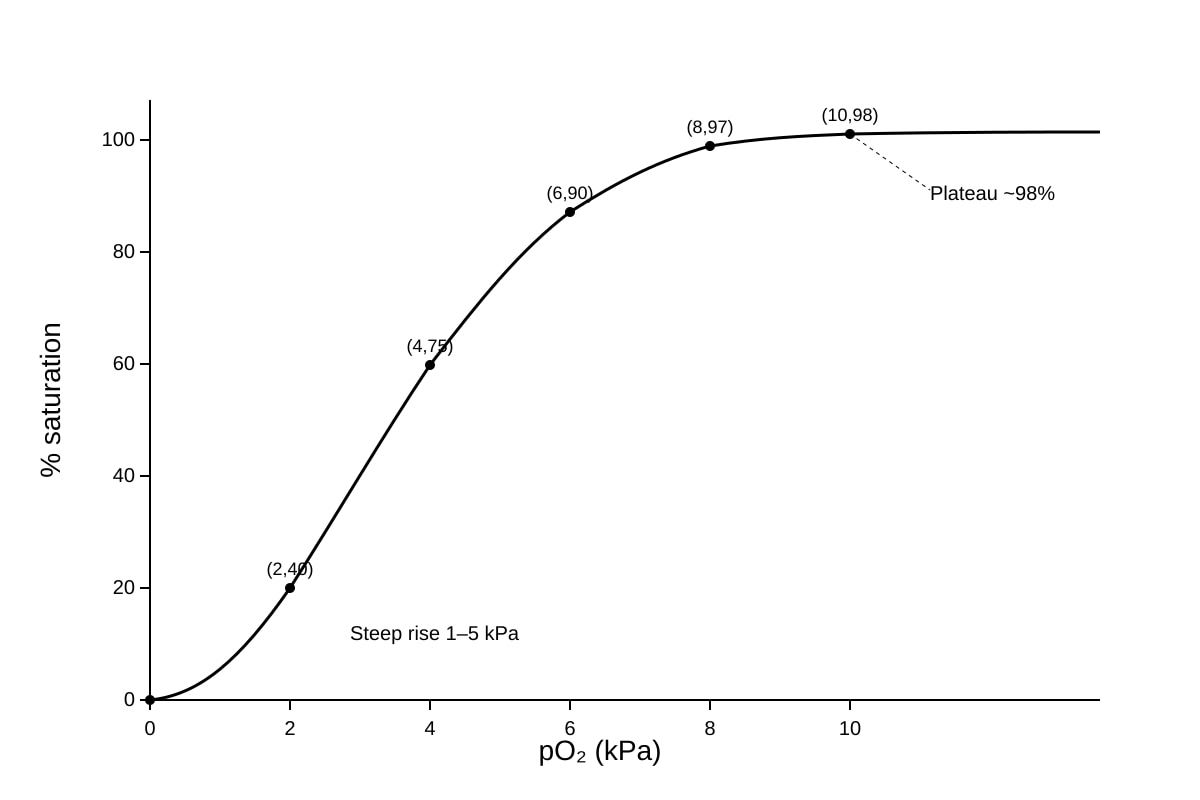
Answer: Haemoglobin has 4 subunits (quaternary) [1]; cooperative binding: binding of O₂ to one subunit increases affinity of others [1]; graph sigmoid shows steep load at lung pO₂ [1]; plateau at tissue ensures release only at low pO₂ [1].
Teaching: Quaternary structure enables allostery.