AI Generated Exam Paper
A Level H1 Biology Practice Paper 4
Free A Level H1 Biology Practice Paper 4, Qwen3.6 AI version, with questions, answers, and A Level-style practice for Singapore students.
These static practice materials are generated from the site's syllabus and paper-generation workflow, with source and model context shown so students and parents can evaluate the material before use.
Questions
Free quiz and exam paper access
Enter your details to view this paper
Your access is remembered on this device.
Answers
TuitionGoWhere Practice Paper - Biology H1 A-Level
Answer Key and Marking Scheme
Subject: Biology H1
Paper: Practice Paper (Version 4 of 5)
Topic Focus: Cells & Biomolecules
Section A: Structured Questions
1. (a) A: Hydrophilic head (phosphate group) [1]; B: Hydrophobic tail (fatty acid) [1]. (b) Heads are polar/hydrophilic and attract water [1]; Tails are non-polar/hydrophobic and repel water [1]; Therefore, heads face outward towards aqueous environment and tails face inward [1]. (Max 2) (c) Any two: Regulates membrane fluidity [1]; Stabilizes the membrane at high temperatures [1]; Prevents packing of phospholipids at low temperatures [1]; Reduces permeability to small water-soluble molecules [1].
2. (a) Increased kinetic energy of enzyme and substrate molecules [1]; More frequent collisions between enzyme and substrate [1]; More enzyme-substrate complexes formed [1]. (Max 2) (b) High temperature breaks hydrogen/ionic bonds holding the tertiary structure [1]; Active site changes shape/denatures [1]; Substrate no longer fits the active site [1]. (Max 2) (c) pH 3 is acidic/away from optimum pH [1]; Changes the charge of R-groups/ionic bonds in the enzyme [1]; Alters the shape of the active site/denatures enzyme [1]. (Max 2)
3. (a) C: Outer membrane [1]; D: Cristae (inner membrane) [1]. (b) Reduced NAD (NADH) [1]; Reduced FAD (FADH₂) [1]. (c) Increases surface area [1]; For attachment of electron transport chain proteins/ATP synthase [1]; Allows for more ATP production [1]. (Max 2)
4. (a) Water molecules are polar/dipolar [1]; Form hydrogen bonds with polar/charged solutes [1]; Surrounding solute molecules keeps them in solution [1]. (Max 2) (b) Water can absorb/lose large amounts of heat energy with little change in temperature [1]; Helps maintain stable internal body temperature/homeostasis [1]; Prevents overheating of cells [1]. (Max 2)
5. (a) E: Glycerol [1]; F: Fatty acids [1]. (b) High energy content per gram (more than carbohydrates) [1]; Insoluble in water (does not affect water potential/osmosis) [1]; Compact storage [1]. (Max 2) (c) Emulsion test [1]; Add ethanol and shake, then add water [1]; White cloudy emulsion indicates lipids [1]. (Max 2)
6. (a) Any two: Active transport requires energy (ATP) / Facilitated diffusion does not [1]; Active transport moves against concentration gradient / Facilitated diffusion moves down concentration gradient [1]; Active transport uses carrier proteins only / Facilitated diffusion uses channel or carrier proteins [1]. (b) Concentration of mineral ions is higher in root hair cells than in soil [1]; Ions must move against concentration gradient [1]; Requires active transport to accumulate ions [1]. (Max 2)
7. (a) The sequence of amino acids in the polypeptide chain [1]. (b) The sequence of amino acids (primary structure) determines the position of R-groups [1]; R-groups interact via hydrogen bonds, ionic bonds, disulfide bridges, and hydrophobic interactions [1]; These interactions cause the polypeptide to fold into a specific 3D shape (tertiary structure) [1].
8. (a) Metaphase [1]. (b) Chromosomes align at the equator/center of the cell [1]; Spindle fibers attach to the centromeres of chromosomes [1]. (c) Produces genetically identical cells [1]; Essential for growth, repair, and asexual reproduction [1].
9. (a) Any two: DNA is double-stranded / RNA is single-stranded [1]; DNA contains thymine / RNA contains uracil [1]; DNA contains deoxyribose sugar / RNA contains ribose sugar [1]. (b) Carries genetic code from DNA in nucleus to ribosomes in cytoplasm [1]; Template for translation/protein synthesis [1].
10. (a) The minimum amount of energy required for a reaction to occur [1]. (b) Enzyme binds to substrate to form enzyme-substrate complex [1]; Strains bonds in substrate or holds substrates in correct orientation [1]; Lowers the energy barrier for the reaction to proceed [1]. (Max 2)
Section B: Data Interpretation and Application
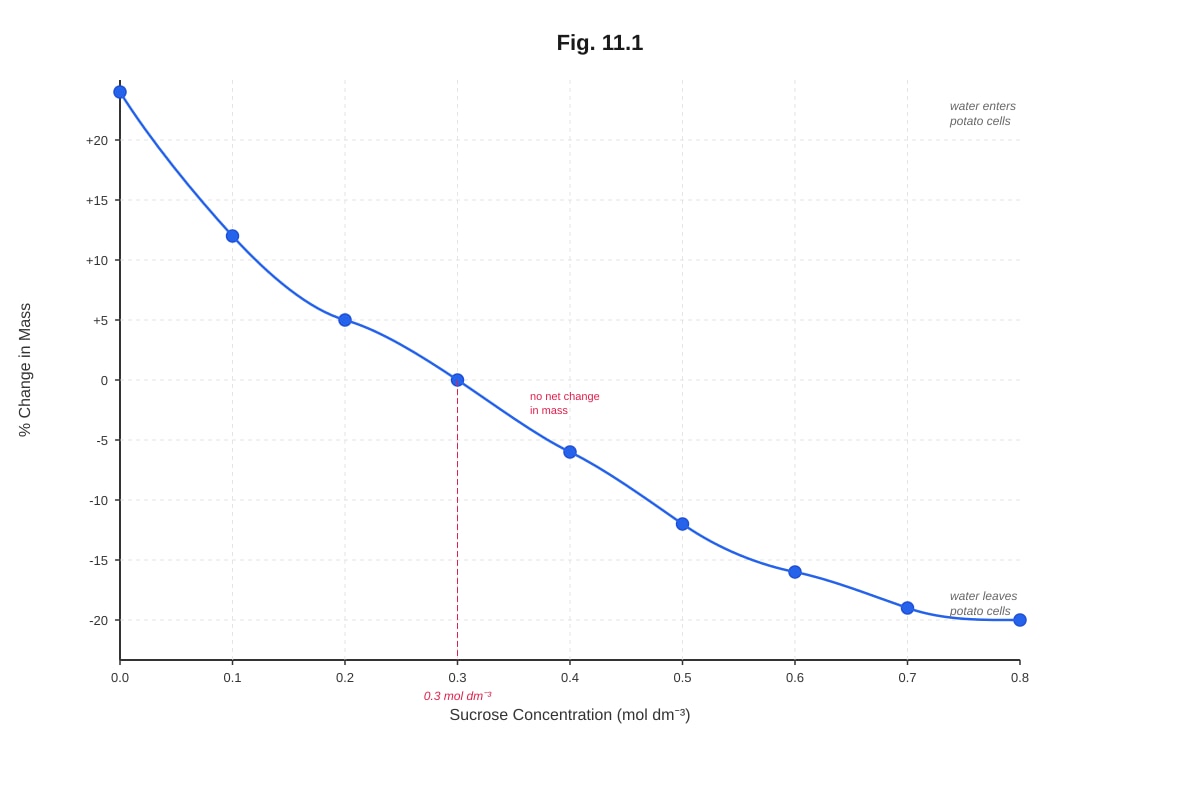
11. (a) 0.3 mol dm⁻³ [1]; This is the isotonic point where there is no net movement of water/no change in mass [1]. (b) Water potential of 0.1 mol dm⁻³ solution is higher (less negative) than potato cells [1]; Water enters cells by osmosis [1]; Through partially permeable membrane [1]; Down water potential gradient [1]. (Max 3) (c) Mass would decrease further/plasmolysis occurs [1]; Water potential of solution is much lower than cells [1]; Water leaves cells by osmosis [1]. (Max 2)
12. (a) Globular shape is compact/soluble in blood [1]; Contains heme group with iron to bind oxygen [1]; Quaternary structure (4 subunits) allows for cooperative binding [1]. (Max 3) (b) Change in amino acid changes primary structure [1]; Alters R-group interactions/tertiary structure [1]; Hemoglobin becomes insoluble/forms fibers/distorts red blood cell shape [1]; Reduced oxygen carrying capacity [1]. (Max 3)
13. (a) Phospholipids and proteins can move laterally within the layer [1]; Due to weak hydrophobic interactions between tails [1]. (b) Proteins are embedded in the bilayer like tiles in a mosaic [1]; Different types of proteins (channel, carrier, receptor) are scattered throughout [1]. (c) Small, non-polar/lipid-soluble substances (e.g., O₂, CO₂) can pass through the phospholipid bilayer by simple diffusion [1]; Large, polar, or charged substances (e.g., ions, glucose) cannot pass through the hydrophobic core [1]; Require channel/carrier proteins to facilitate movement [1].
14. (a) Percentage of Adenine equals percentage of Thymine [1]. (b) A pairs with T via hydrogen bonds in double helix [1]; Therefore, amount of A must equal amount of T [1]. (c) Cannot be determined / Not applicable [1]; In single-stranded DNA, base pairing rules (Chargaff's rules) do not apply [1]; OR if assuming double-stranded logic was mistakenly applied: 30% (but correct answer is that it's unpredictable without more data). Accept: "Cannot be calculated because it is single-stranded and bases do not pair." [2]
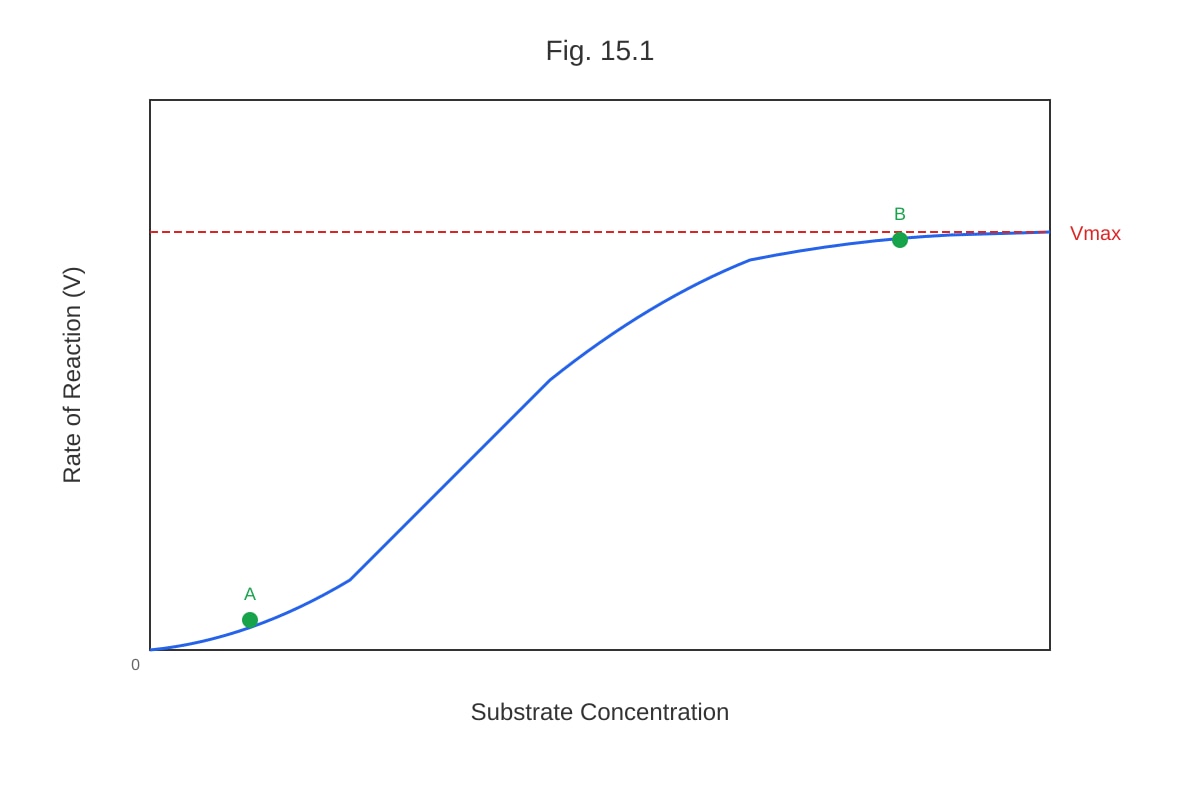
15. (a) At low substrate concentration, active sites are empty/available [1]; Increasing substrate concentration increases frequency of collisions/ES complex formation [1]; Rate increases proportionally [1]. (b) Sketch: Curve rises more slowly initially but reaches same Vmax [1]; Explanation: Inhibitor competes with substrate for active site [1]; At high substrate concentration, substrate outcompetes inhibitor [1]; Vmax is unchanged [1]. (Max 3)
Section C: Extended Response
16. Marking Guidance:
- Solvent: Polar nature allows dissolution of ions/polar molecules for metabolic reactions/transport [1].
- High Specific Heat Capacity: Buffers temperature changes, maintaining stable environment for enzymes [1].
- High Latent Heat of Vaporization: Cooling effect via sweating/transpiration [1].
- Cohesion/Adhesion: Transpiration stream in plants/column of water in xylem [1].
- Metabolite: Reactant in hydrolysis/photosynthesis [1].
- Incompressibility: Hydrostatic skeleton/turgor pressure in plants [1]. (1 mark per valid point explained, up to 6 marks.)
17. Marking Guidance:
- Starch (Amylose/Amylopectin): Alpha-glucose, helical/branched, compact storage in plants, insoluble [1].
- Glycogen: Alpha-glucose, highly branched, compact storage in animals/fungi, insoluble, rapid hydrolysis [1].
- Cellulose: Beta-glucose, straight chains, hydrogen bonds between chains form microfibrils, structural support in plant cell walls, high tensile strength [1].
- Comparison: Starch/Glycogen for storage vs Cellulose for structure [1]; Alpha vs Beta linkages [1]; Solubility/branching differences [1]. (1 mark per valid comparison/contrast, up to 6 marks.)
18. Marking Guidance:
- Phospholipid Bilayer: Hydrophobic core prevents passage of water-soluble/charged substances [1]; Allows passage of small non-polar molecules [1].
- Proteins: Channel proteins allow facilitated diffusion of ions/polar molecules [1]; Carrier proteins allow active transport/facilitated diffusion [1]; Specificity of proteins controls what enters/leaves [1].
- Cholesterol: Regulates fluidity and permeability [1].
- Glycoproteins/Glycolipids: Cell recognition/signaling [1].
- Selective Permeability: Membrane controls internal environment/homeostasis [1]. (1 mark per valid point explained, up to 6 marks.)
19. Marking Guidance:
- Glycolysis: Cytoplasm [1]; Glucose to Pyruvate [1]; Net gain 2 ATP, Reduced NAD [1].
- Link Reaction: Mitochondrial Matrix [1]; Pyruvate to Acetyl-CoA [1]; CO₂ released, Reduced NAD formed [1].
- Krebs Cycle: Mitochondrial Matrix [1]; Acetyl-CoA enters cycle [1]; CO₂ released, Reduced NAD/FAD, ATP formed [1].
- Oxidative Phosphorylation: Inner Mitochondrial Membrane/Cristae [1]; Electron Transport Chain pumps protons [1]; Chemiosmosis/ATP Synthase produces ATP [1]; Oxygen is final electron acceptor forming water [1]. (1 mark per valid point, up to 6 marks.)
20. Marking Guidance:
- Catalysis: Lower activation energy, speed up metabolic reactions [1].
- Specificity: Active site shape matches substrate [1].
- Metabolic Pathways: Series of enzyme-catalyzed reactions [1]; Product of one is substrate for next [1].
- Regulation (Inhibition): Competitive/Non-competitive inhibitors [1]; End-product inhibition (negative feedback) [1]; Prevents waste of resources [1].
- Regulation (Environmental): pH/Temperature affects enzyme activity [1].
- Compartmentalization: Enzymes in specific organelles (e.g., lysosomes) [1]. (1 mark per valid point explained, up to 6 marks.)