AI Generated Exam Paper
A Level H1 Biology Practice Paper 2
Free A Level H1 Biology Practice Paper 2, HY3 AI version, with questions, answers, and A Level-style practice for Singapore students.
These static practice materials are generated from the site's syllabus and paper-generation workflow, with source and model context shown so students and parents can evaluate the material before use.
Questions

Free quiz and exam paper access
Enter your details to view this paper
Your access is remembered on this device.
Answers
TuitionGoWhere Practice Paper - Biology H1 A-Level (Version 2) — Answer Key
Total Marks: 60
Section A: 22 marks
Section B: 23 marks
Section C: 15 marks
Section A Answers (22 marks)
1. [3 marks]
- Cells are the smallest unit of life. (1)
- All living organisms are composed of cells. (1)
- All cells come from pre-existing cells. (1)
Teaching note: Cell theory is foundational; do not omit any of the three tenets.
2. [2 marks]
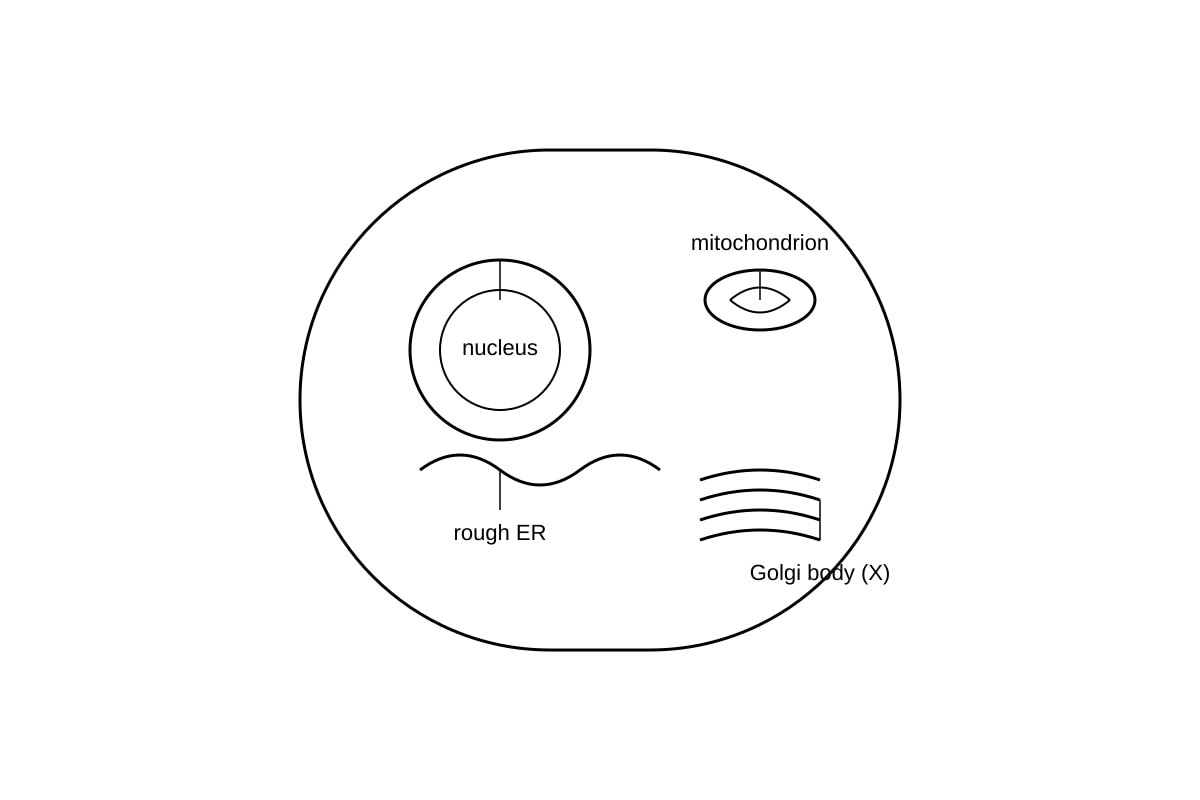
- Golgi body (or Golgi apparatus). (1)
- Modifies, sorts, and packages proteins/lipids for secretion or delivery in liver cells. (1)
Based on Q2-fig1: X is the stack of flattened sacs = Golgi.
3. [2 marks]
- Phospholipids form a bilayer. (1)
- Hydrophilic heads face outward to aqueous environments; hydrophobic tails face inward away from water. (1)
4. [2 marks]
- α-glucose has the hydroxyl group on C1 below the ring (trans to CH₂OH at C6). (1)
- β-glucose has the hydroxyl group on C1 above the ring (cis to CH₂OH). (1)
This difference affects polymer linkage (α=starch/glycogen, β=cellulose).
5. [2 marks]
- Peptide bond. (1)
- Condensation (dehydration) reaction. (1)
6. [2 marks]
Any two: circular DNA (1), 70S ribosomes (1), peptidoglycan cell wall (1). (max 2)
7. [2 marks]
Any two of: proteins (1), glycoproteins (1), glycolipids (1), cholesterol (1). (max 2)
8. [2 marks]
(i) Osmosis – passive. (1)
(ii) Endocytosis – active. (1)
9. [3 marks]
- Primary: sequence of amino acids in polypeptide chain. (1)
- Secondary: α-helix or β-pleated sheet from H-bonds between backbone. (1)
- Tertiary: 3D folding from side-chain interactions (hydrophobic, ionic, disulfide). (1)
10. [2 marks]
- Pluripotency. (2) (Embryonic stem cells are pluripotent.)
Section B Answers (23 marks)
11. [4 marks]
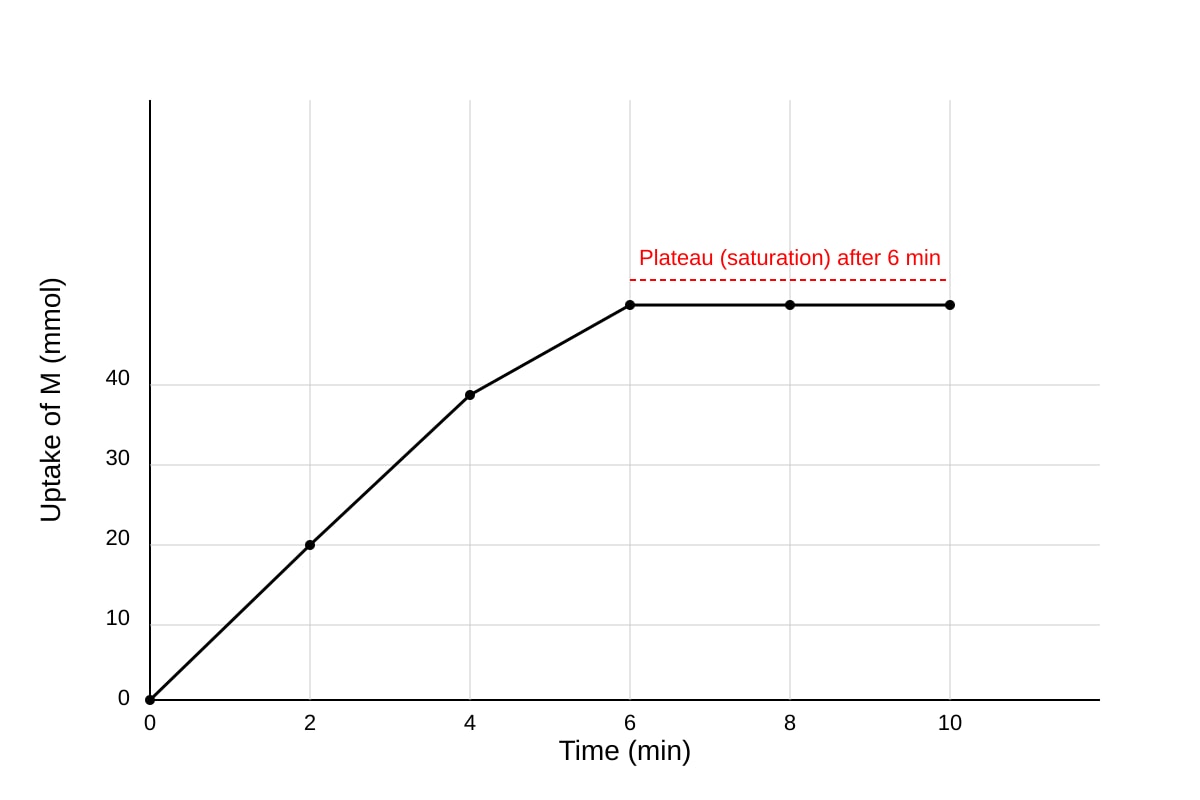
(a) [2] Plateau indicates saturation of transport proteins / carriers; all available proteins are occupied at max rate. (2)
(b) [2] Facilitated diffusion or active transport (1); justified by saturation kinetics suggesting protein-mediated transport (1).
12. [2 marks]
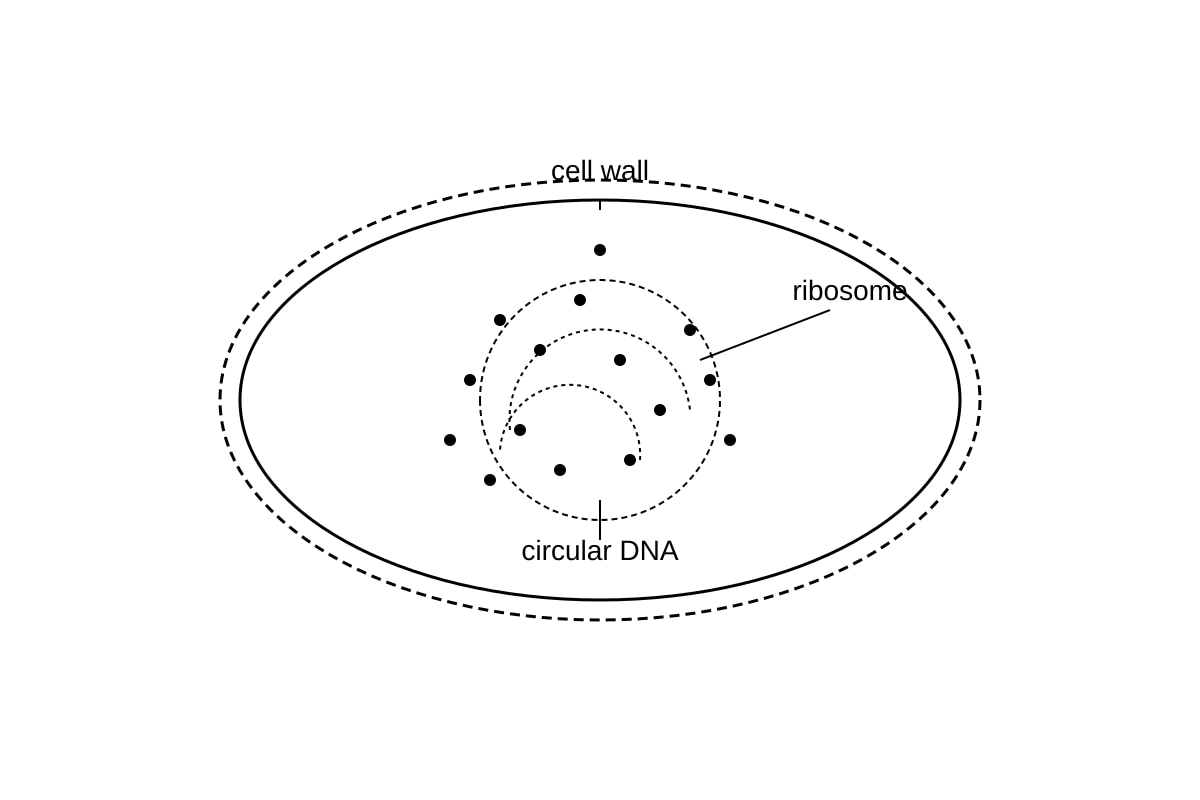
- Circular DNA (not linear in nucleus). (1)
- Lack of membrane-bound nucleus / presence of 70S ribosomes. (1)
From Q12-fig1: no nucleus visible.
13. [4 marks]
(a) [2] Mean = (12 + 25 + 38 + 30) / 4 = 105 / 4 = 26.25 μmol/min.
(b) [2] At 60 °C enzyme denatures; tertiary structure breaks (H-bonds/ionic bonds break), active site lost. (2)
14. [4 marks]
(a) [1] Ester bond.
(b) [3] Triglycerides have high energy per gram due to many C-H bonds in fatty acids (1); insoluble in water so do not affect osmosis (1); anhydrous storage efficient (1).
15. [3 marks]
- Quaternary: 4 polypeptide subunits (2 α, 2 β). (1)
- Allows cooperative binding: O₂ binding to one subunit increases affinity of others. (1)
- Enables efficient loading/unloading in lungs/tissues. (1)
16. [2 marks]
- Hypertonic solution. (1)
- Water moves out of cell by osmosis. (1)
17. [2 marks]
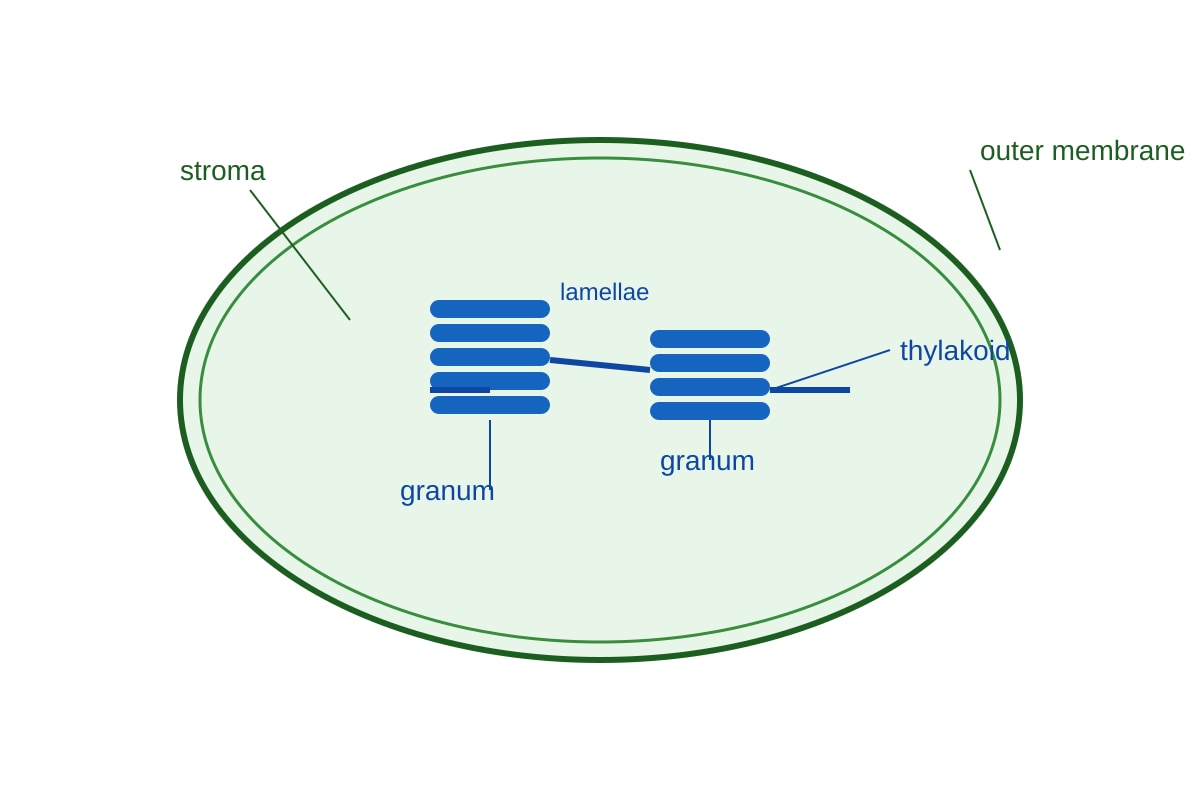
- Granum (stack of thylakoids). (1)
- Site of light-dependent reactions / contains chlorophyll. (1)
Section C Answers (15 marks)
18. [5 marks]
- β-glucose monomers linked by β-1,4-glycosidic bonds. (1)
- Straight, unbranched chains. (1)
- Chains cross-linked by H-bonds forming microfibrils. (1)
- Provides tensile strength. (1)
- Rigid support for cell wall, resists turgor pressure. (1)
19. [5 marks]
- Lock-and-key: active site rigid, substrate fits exactly. (2)
- Induced-fit: active site changes shape on substrate binding. (2)
- Both lower activation energy and show specificity. (1)
20. [5 marks]
- Zygotic: totipotent (can form all cell types + extra-embryonic). (2)
- Embryonic: pluripotent (all body cell types). (2)
- Blood: multipotent (limited to blood lineages). (1)