From Real Exams Exam Paper
A Level H1 Biology Practice Paper 5
Free A Level H1 Biology Practice Paper 5, LongCat Exam version, with questions, answers, and A Level-style practice for Singapore students.
These static practice materials are generated from the site's syllabus and paper-generation workflow, with source and model context shown so students and parents can evaluate the material before use.
Questions

Free quiz and exam paper access
Enter your details to view this paper
Your access is remembered on this device.
Answers
TuitionGoWhere Practice Paper - Biology H1 A-Level
Answer Key — Version 5 of 5
Section A: Structured Questions
Question 1 (4 marks)
(a) [2 marks]
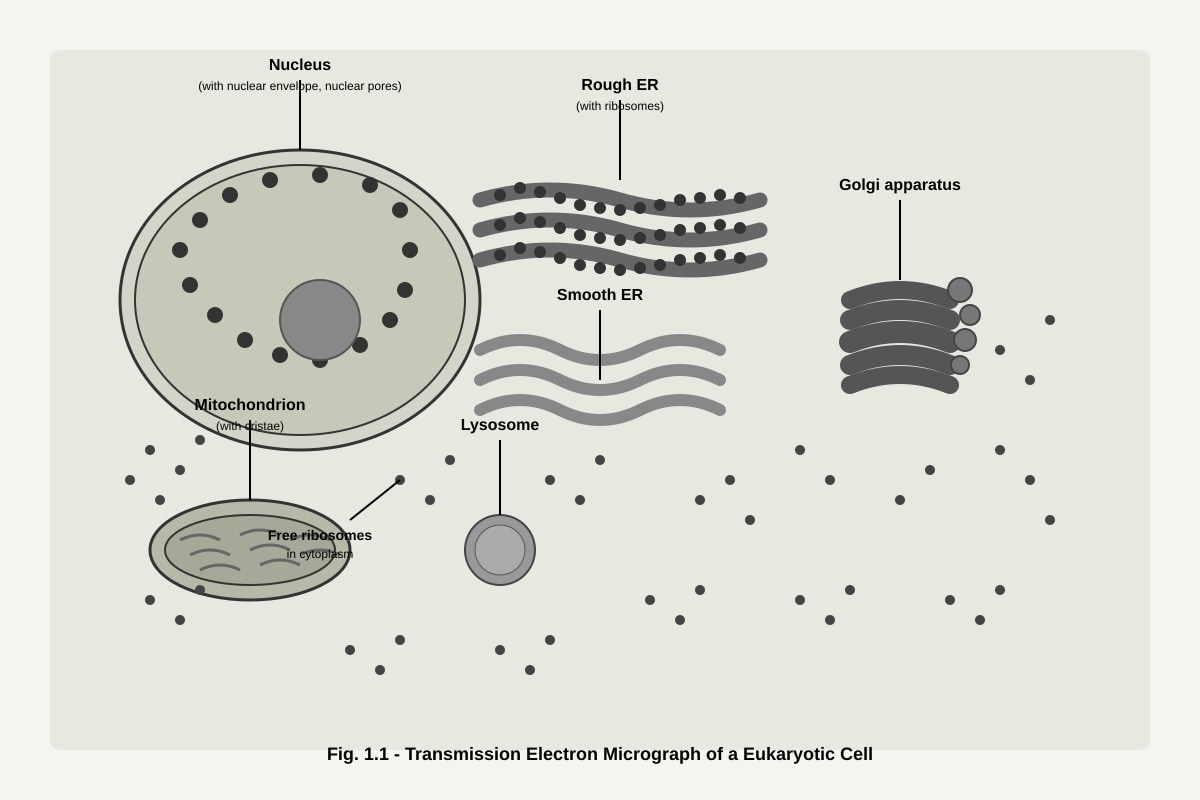
- Organelle X (Golgi apparatus / Golgi body): 1 mark
- Function: Modifies, sorts, and packages proteins (for secretion / transport to other organelles / to the cell surface); OR formation of lysosomes; OR addition of carbohydrate groups to proteins (glycosylation). Any valid function: 1 mark
Teaching note: The Golgi apparatus receives proteins from the rough ER via transport vesicles. It modifies proteins (e.g., by adding sugar chains), sorts them, and packages them into vesicles for transport to their final destinations. It is also involved in the formation of lysosomes.
(b) [2 marks]
- The mitochondrion has a double membrane; the inner membrane is highly folded into cristae, which increases the surface area for the attachment of enzymes involved in aerobic respiration / the electron transport chain (1 mark).
- The matrix contains enzymes for the Krebs cycle / contains DNA and ribosomes for synthesising some of its own proteins (1 mark).
Teaching note: The cristae (folds of the inner mitochondrial membrane) provide a large surface area for the electron transport chain and ATP synthase, which are embedded in the inner membrane. This structural adaptation maximises ATP production through oxidative phosphorylation.
Question 2 (5 marks)
(a) [2 marks]
- As temperature increases from 10 °C to 70 °C, the mean absorbance of the solution increases (1 mark).
- The increase is gradual between 10 °C and 40 °C, but becomes much more rapid between 40 °C and 60 °C (1 mark).
Award marks for: Describing the general trend (increase) and noting the change in rate of increase (slow then rapid / exponential-like increase above 40 °C).
(b) [3 marks]
- At 60 °C and 70 °C, the high temperature denatures the proteins in the cell membrane (1 mark).
- This disrupts / damages the cell membrane, making it more permeable (1 mark).
- As a result, more betalain pigment (the red pigment in beetroot cells) leaks out of the cells into the surrounding solution, causing the higher absorbance readings (1 mark).
Teaching note: The phospholipid bilayer itself becomes more fluid at higher temperatures, but the primary cause of increased permeability at temperatures above ~50 °C is the denaturation of membrane proteins and the disruption of membrane integrity. Betalain, stored in the cell vacuole, must pass through both the tonoplast (vacuolar membrane) and the cell membrane to escape the cell.
Question 3 (4 marks)
(a) [3 marks]
- The phosphate head of a phospholipid is hydrophilic (polar) and is attracted to water (1 mark).
- The fatty acid tails are hydrophobic (non-polar) and are repelled by water (1 mark).
- In an aqueous environment, phospholipids spontaneously arrange themselves into a bilayer so that the hydrophilic heads face the water on both sides and the hydrophobic tails are shielded from water in the interior (1 mark).
Teaching note: This spontaneous arrangement is driven by the hydrophobic effect — the tendency of non-polar molecules to aggregate in water to minimise disruption of the hydrogen bonding network of water. The bilayer is the most thermodynamically stable arrangement for phospholipids in water.
(b) [1 mark]
Any one of the following:
- The membrane is flexible / fluid (can change shape).
- Proteins can move laterally within the membrane.
- The membrane can self-seal if punctured.
- The membrane allows cell division (the membrane can pinch in two).
Teaching note: The fluid mosaic model describes the membrane as a fluid structure in which phospholipids and proteins can move laterally. This fluidity is essential for processes such as cell signalling, endocytosis, exocytosis, and cell division.
Question 4 (5 marks)
(a) [3 marks]
- A DNA nucleotide consists of three components: a phosphate group, a deoxyribose sugar (pentose sugar), and a nitrogenous base (adenine, thymine, guanine, or cytosine) (1 mark for naming all three components).
- The phosphate group is covalently bonded to the 5' carbon of the deoxyribose sugar (1 mark).
- The nitrogenous base is covalently bonded to the 1' carbon of the deoxyribose sugar (1 mark).
Award: 1 mark for all three components named; 1 mark for correct bonding of phosphate to sugar; 1 mark for correct bonding of base to sugar.
(b) [2 marks]
- DNA has a double-stranded structure with complementary base pairing (A–T and G–C), which allows accurate replication / ensures genetic information is faithfully copied during cell division (1 mark).
- The sequence of bases along the DNA strand encodes genetic information / can vary enormously, allowing vast amounts of information to be stored (1 mark).
Additional acceptable points: The sugar-phosphate backbone provides structural stability; hydrogen bonds between base pairs allow the strands to be separated for replication and transcription; the double helix protects the bases from chemical damage.
Question 5 (6 marks)
(a) [1 mark]
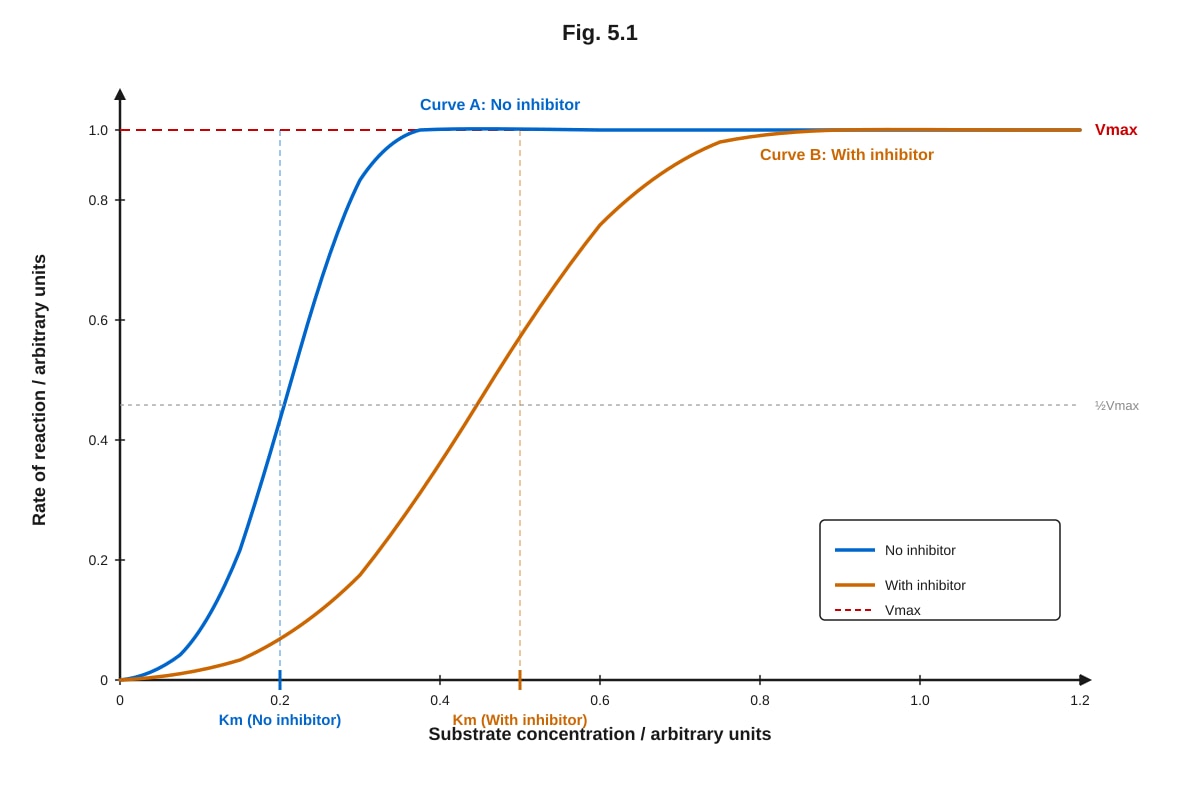
- At low substrate concentrations, the rate of reaction is lower in the presence of the inhibitor compared to without the inhibitor.
(b) [2 marks]
- At very high substrate concentrations, the substrate molecules are in such excess that they outcompete the inhibitor for binding to the active site of the enzyme (1 mark).
- Therefore, all active sites become occupied by substrate, and the reaction reaches the same as without the inhibitor (1 mark).
Teaching note: This is characteristic of competitive inhibition. The inhibitor binds reversibly to the active site, competing directly with the substrate. When substrate concentration is sufficiently high, the substrate effectively displaces the inhibitor.
(c) [3 marks]
- The type of inhibition is competitive inhibition (1 mark).
- The inhibitor binds to the active site of the enzyme (1 mark).
- It has a similar shape to the substrate and competes with the substrate for the active site, but the remains unchanged because increasing substrate concentration can overcome the inhibition (1 mark).
Award: 1 mark for identifying competitive inhibition; 1 mark for explaining binding to active site; 1 mark for explaining same (or that it can be overcome by increasing substrate concentration).
Question 6 (6 marks)
(a) [2 marks]
- Initial rate = gradient of the tangent to the curve at time = 0 (or can be approximated from the first 10 seconds).
- From Table 6.1, at pH 7: volume of O₂ at 10 s = 8.4 cm³.
- Initial rate ≈ cm³ s⁻¹ (1 mark for correct calculation, 1 mark for correct value with unit).
Accept: Any value between 0.7 and 0.9 cm³ s⁻¹ if the student draws a tangent. If using the first 10 seconds: 0.84 cm³ s⁻¹.
(b) [3 marks]
- At pH 3 and pH 11, the enzyme catalase is denatured (or its active site is altered) because these pH values are far from the optimum pH of catalase (approximately pH 7) (1 mark).
- The tertiary structure of the enzyme is disrupted / the shape of the active site changes, so substrate (hydrogen peroxide) can no longer bind effectively (1 mark).
- Therefore, fewer enzyme-substrate complexes are formed per unit time, resulting in a lower rate of reaction and less oxygen produced (1 mark).
Teaching note: Extreme pH disrupts hydrogen bonds and ionic bonds that maintain the tertiary structure of the enzyme. This changes the shape of the active site, reducing the enzyme's ability to catalyse the reaction. At very extreme pH, the enzyme is irreversibly denatured.
(c) [1 mark]
Any one of the following:
- Temperature
- Volume of hydrogen peroxide solution
- Concentration of hydrogen peroxide solution
- Mass / size of catalase / amount of enzyme
Section B: Free Response Questions
Question 7 (10 marks)
Marking scheme — award 1 mark for each valid point, up to 10 marks:
- Transcription occurs in the nucleus of the eukaryotic cell.
- The enzyme RNA polymerase binds to the promoter region of a gene on the DNA template strand.
- RNA polymerase synthesises a complementary strand of messenger RNA (mRNA) using the DNA template strand (following base-pairing rules: A–U, T–A, G–C, C–G).
- The pre-mRNA undergoes processing: a 5' cap and poly-A tail are added, and introns are removed (splicing) to produce mature mRNA.
- The mature mRNA exits the nucleus through a nuclear pore and enters the cytoplasm.
- In the cytoplasm, the mRNA binds to a ribosome (either free in the cytoplasm or on the rough ER).
- Transfer RNA (tRNA) molecules carry specific amino acids to the ribosome. Each tRNA has an anticodon that is complementary to a codon on the mRNA.
- The ribosome moves along the mRNA, reading each codon, and tRNA molecules bring the corresponding amino acids in the correct sequence.
- Peptide bonds form between adjacent amino acids, catalysed by enzymes in the ribosome (peptidyl transferase activity of rRNA).
- The polypeptide chain grows until a stop codon is reached, at which point the ribosome releases the completed polypeptide.
Award marks for: Correct sequence of events, correct location of each process, correct roles of mRNA, tRNA, and ribosomes, mention of transcription and translation, mention of processing (splicing), and correct terminology.
Question 8 (10 marks)
(a) [3 marks — 1 mark each]
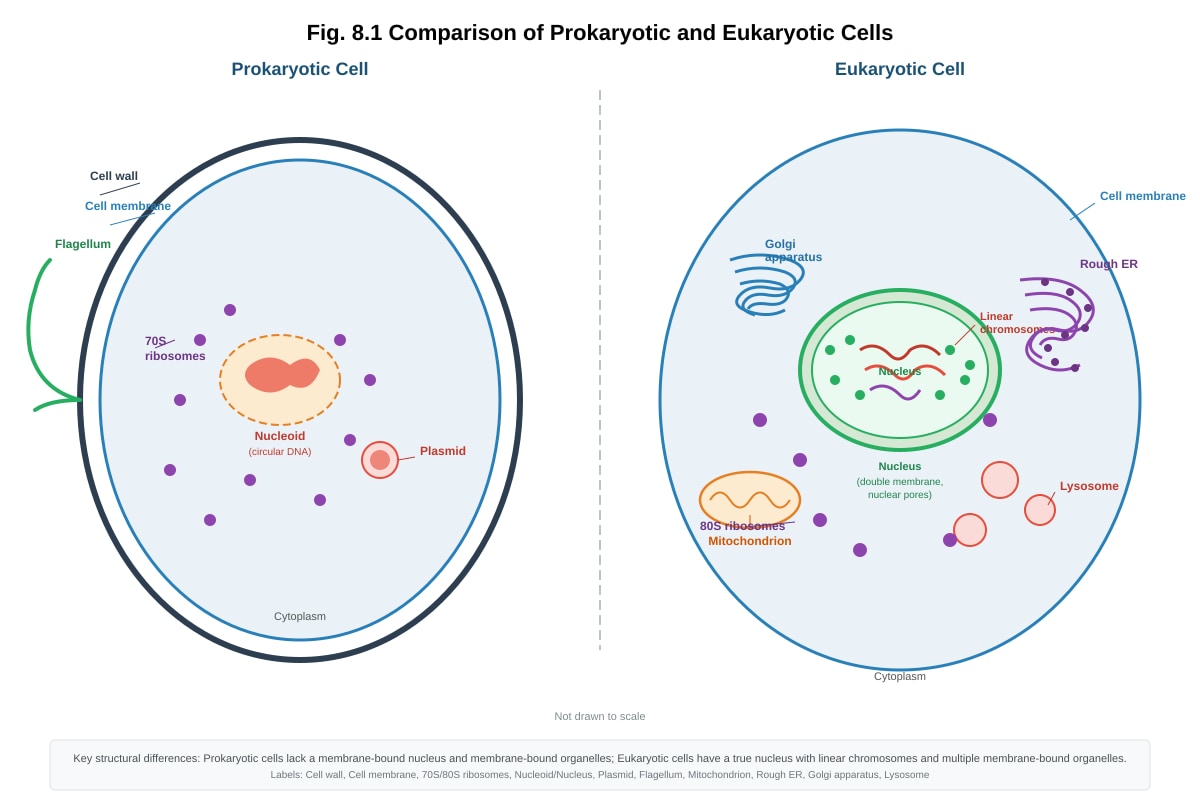
- Prokaryotic cells have no nucleus / no membrane-bound nucleus (DNA is in a nucleoid region), whereas eukaryotic cells have a true nucleus enclosed by a double nuclear membrane.
- Prokaryotic cells have 70S ribosomes, whereas eukaryotic cells have 80S ribosomes.
- Prokaryotic cells have no membrane-bound organelles (e.g., no mitochondria, no ER, no Golgi apparatus), whereas eukaryotic cells have membrane-bound organelles.
Also accept: Prokaryotic cells have a single circular chromosome; eukaryotic cells have multiple linear chromosomes. Prokaryotic cells may have a cell wall made of peptidoglycan; eukaryotic plant cells have a cell wall made of cellulose.
(b) [4 marks]
- In prokaryotic cells, transcription and translation occur simultaneously in the cytoplasm because there is no nuclear membrane to separate them. As soon as mRNA is being transcribed, ribosomes can attach to it and begin translation (1 mark).
- In eukaryotic cells, transcription occurs in the nucleus and the pre-mRNA must be processed (splicing to remove introns, addition of 5' cap and poly-A tail) before the mature mRNA is exported to the cytoplasm through nuclear pores (1 mark).
- In eukaryotes, translation occurs in the cytoplasm (on free ribosomes or on the rough ER), separated in time and space from transcription (1 mark).
- Prokaryotic mRNA does not require processing (no introns), so protein synthesis is faster / more direct in prokaryotes (1 mark).
Teaching note: The absence of a nuclear envelope in prokaryotes allows coupled transcription-translation, which is a key difference from eukaryotes. In eukaryotes, mRNA processing adds a regulatory step and allows for alternative splicing, increasing proteome diversity.
(c) [3 marks]
- Bacterial (prokaryotic) cells have 70S ribosomes, which are the target of tetracycline (1 mark).
- Human (eukaryotic) cells have 80S ribosomes, which are structurally different from 70S ribosomes (1 mark).
- Tetracycline binds specifically to the 70S ribosome and blocks the attachment of tRNA to the ribosome, preventing protein synthesis in bacteria, but it does not bind to 80S ribosomes, so human cell protein synthesis is unaffected (1 mark).
Teaching note: This is an example of selective toxicity — exploiting structural differences between prokaryotic and eukaryotic cells to target pathogens without harming the host. Mitochondria do have 70S-like ribosomes, but tetracycline does not effectively reach them at therapeutic concentrations.
Question 9 (10 marks)
(a) [3 marks]
- Hydrogen bonds form between water molecules (between the δ⁺ hydrogen of one molecule and the δ⁻ oxygen of another) (1 mark).
- When heat is supplied, much of the energy is used to break the hydrogen bonds between water molecules rather than increasing the kinetic energy (temperature) of the molecules (1 mark).
- Therefore, water can absorb a relatively large amount of heat energy before its temperature rises significantly — this is a high specific heat capacity (1 mark).
Teaching note: Water's high specific heat capacity () is biologically important because it buffers organisms and aquatic environments against rapid temperature changes, maintaining stable conditions for enzyme activity and metabolic processes.
(b) [3 marks]
- Sodium chloride (NaCl) is an ionic compound consisting of Na⁺ and Cl⁻ ions held together by electrostatic forces (1 mark).
- Water molecules are polar: the oxygen atom carries a partial negative charge (δ⁻) and the hydrogen atoms carry partial positive charges (δ⁺) (1 mark).
- The δ⁻ oxygen atoms of water surround and attract Na⁺ ions, while the δ⁺ hydrogen atoms surround and attract Cl⁻ ions. This process is called hydration (or solvation), and it pulls the ions apart, dissolving the crystal (1 mark).
Teaching note: Water's polarity makes it an excellent solvent for ionic and polar substances. This is why water is described as the "universal solvent" in biological systems and is the medium in which virtually all biochemical reactions occur.
(c) [4 marks]
Cohesion (2 marks):
- Cohesion is the attraction between water molecules due to hydrogen bonding (1 mark).
- In the xylem, cohesion creates a continuous column of water from the roots to the leaves. When water evaporates from the leaves (transpiration), it pulls the water column upward, enabling water transport against gravity (1 mark).
Adhesion (2 marks):
- Adhesion is the attraction between water molecules and other surfaces, such as the cell walls of xylem vessels (1 mark).
- Adhesion helps to support the water column by preventing it from pulling away from the vessel walls, and it also helps water to move up narrow tubes through capillary action (1 mark).
Teaching note: The combination of cohesion, adhesion, and transpiration pull (the cohesion-tension theory) explains how water can be transported to the tops of tall trees. Cohesion keeps the water column intact, while adhesion prevents the column from breaking away from the xylem walls.
Summary of Marks
| Question | Marks |
|---|---|
| Q1 | 4 |
| Q2 | 5 |
| Q3 | 4 |
| Q4 | 5 |
| Q5 | 6 |
| Q6 | 6 |
| Section A Total | 30 |
| Q7 | 10 |
| Q8 | 10 |
| Q9 | 10 |
| Section B Total | 30 |
| Grand Total | 60 |