From Real Exams Exam Paper
A Level H1 Biology Practice Paper 3
Free A Level H1 Biology Practice Paper 3, HY3 Exam version, with questions, answers, and A Level-style practice for Singapore students.
These static practice materials are generated from the site's syllabus and paper-generation workflow, with source and model context shown so students and parents can evaluate the material before use.
Questions
Free quiz and exam paper access
Enter your details to view this paper
Your access is remembered on this device.
Answers
TuitionGoWhere Practice Paper - Biology H1 A-Level (Version 3) Answer Key
Total Marks: 60
Section A: Structured Questions
1. [3]
- All living organisms are composed of cells. [1]
- The cell is the smallest unit of life. [1]
- All cells arise from pre-existing cells. [1]
Teaching note: Cell theory is foundational; do not include "cells contain DNA" as a theory statement.
2. [2]
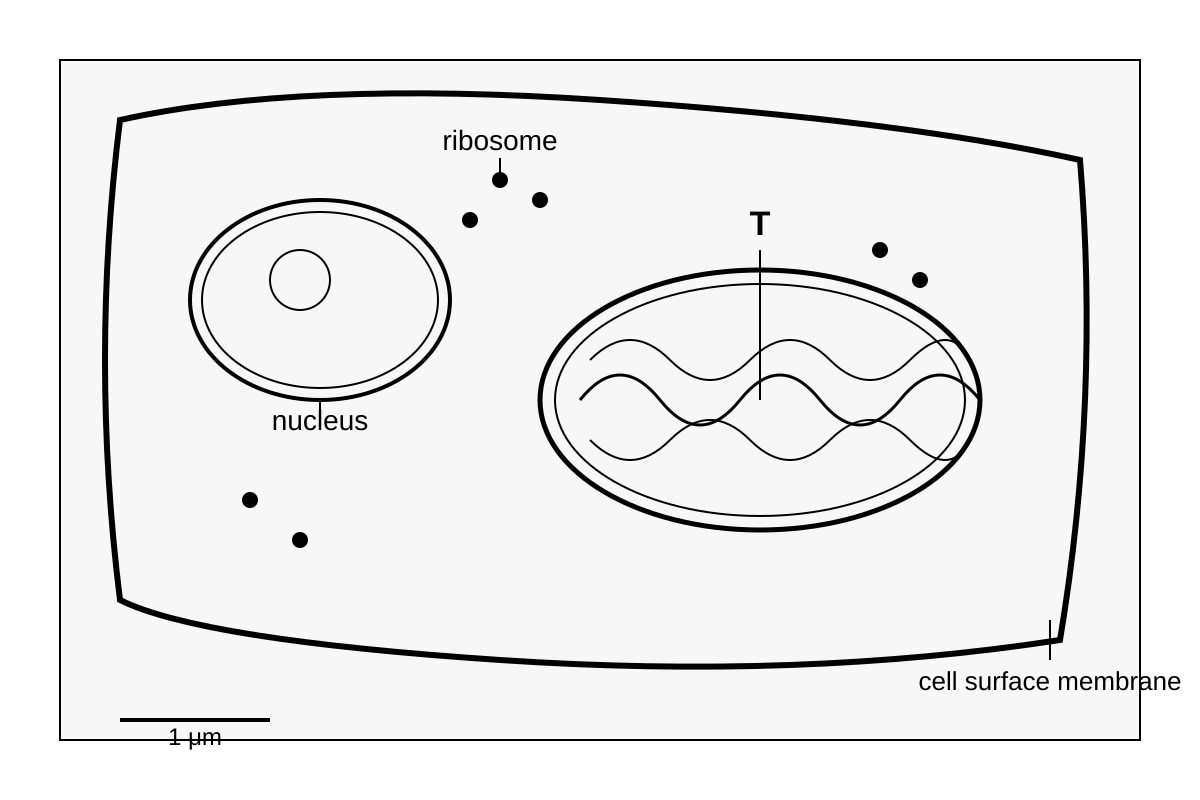
- Organelle T: mitochondrion (or mitochondria). [1]
- Function: site of aerobic respiration / ATP production. [1]
From image: T shows double membrane with cristae → mitochondrion.
3. [2]
- Phospholipids form a bilayer. [1]
- Hydrophilic heads face outward to aqueous environments; hydrophobic tails face inward away from water. [1]
Marking: Both points needed for full marks.
4. [2]
- α-glucose has the OH group on carbon 1 below the ring (trans to CH₂OH). [1]
- β-glucose has the OH group on carbon 1 above the ring (cis to CH₂OH). [1]
Teaching note: This difference affects polymer structure (starch vs cellulose).
5. [3]
- One glycerol + three fatty acids. [1]
- Ester bonds form between carboxyl group of fatty acid and hydroxyl of glycerol. [1]
- Condensation reaction releases 3 water molecules. [1]
6. [3]
- Made of β-glucose linked by glycosidic bonds in straight chains. [1]
- Chains are unbranched and run parallel. [1]
- Hydrogen bonds between chains form microfibrils giving tensile strength. [1]
7. [1]
- Facilitated diffusion.
8. [2]
- Proteins are embedded or span the bilayer (integral/peripheral). [1]
- They act as channels, carriers, receptors, or enzymes. [1]
9. [2]
- Sequence of amino acids in polypeptide chain. [1]
- Maintained by peptide bonds. [1]
10. [2]
- Heat breaks hydrogen/ionic/disulfide bonds stabilising tertiary structure. [1]
- Enzyme denatures; active site loses shape and function. [1]
11. [2]
- Active site has fixed shape complementary to substrate. [1]
- Only substrate with matching shape fits → specificity. [1]
12. [2]
- Multipotency: can differentiate into limited range of cell types of a tissue. [1]
- Example: blood stem cells (haematopoietic stem cells). [1]
13. [2]
- Peptidoglycan cell wall (not cellulose). [1]
- Lacks membrane-bound organelles / has circular DNA. [1]
14. [2]
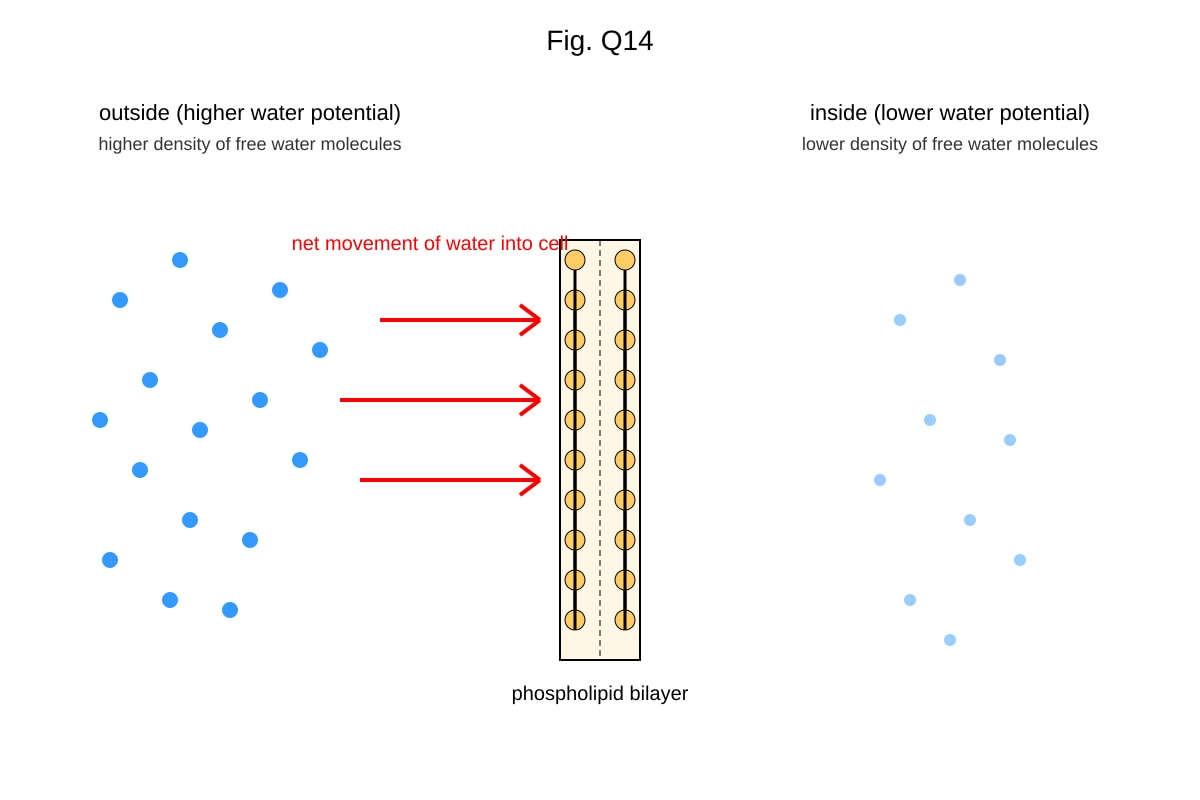
- Higher water potential outside than inside. [1]
- Net movement of water into cell through membrane by osmosis. [1]
15. [3]
- Active transport moves against concentration gradient. [1]
- Requires carrier protein and ATP hydrolysis. [1]
- Facilitated diffusion is down gradient via channel/carrier, no ATP. [1]
Section B: Data-based and Diagram Interpretation
16. [6]
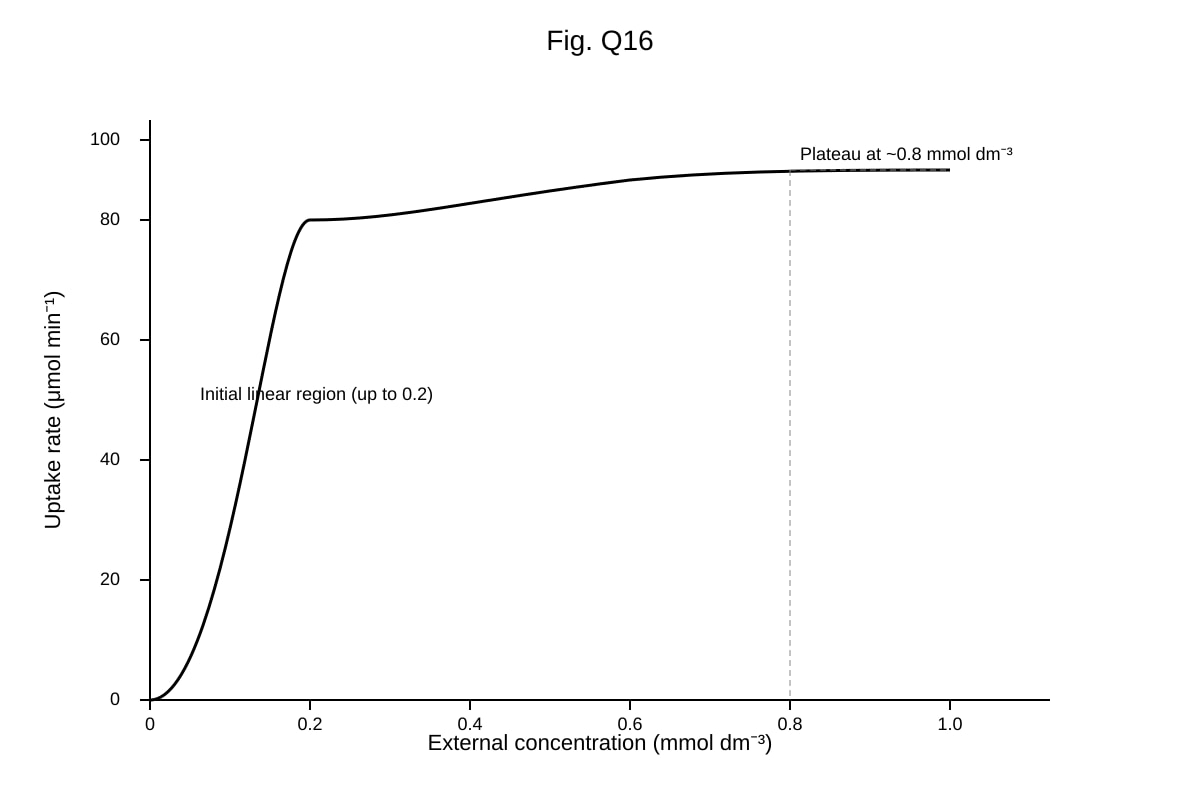
(a) [1] Facilitated diffusion (or carrier-mediated transport).
(b) [3] Rate increases with concentration as more carriers occupied. [1] Plateaus as all carriers saturated. [1] Shows finite number of membrane proteins. [1]
(c) [2] No change (if truly facilitated diffusion) OR if active component, rate drops to zero. [2] Accept: no effect because facilitated diffusion does not use ATP.
17. [4]
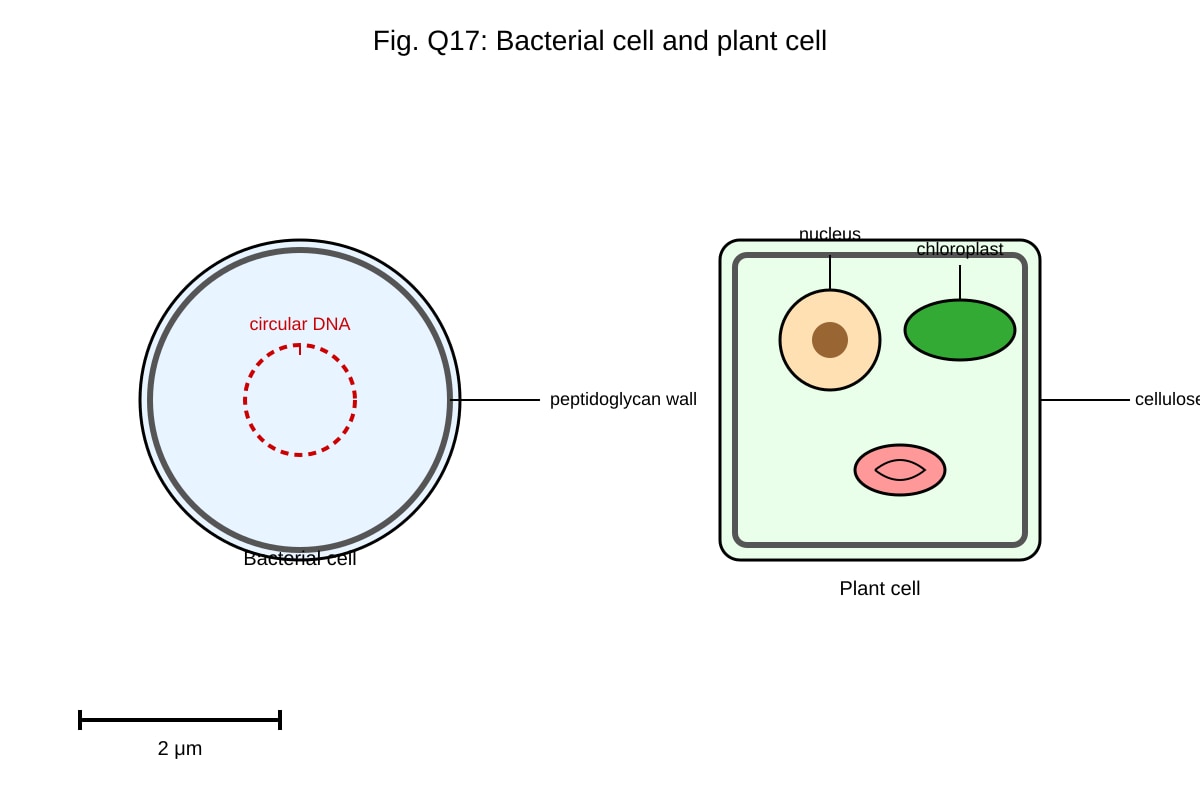
(a) [1] Nucleus / chloroplast / mitochondria (any one).
(b) [1] Peptidoglycan.
(c) [2] No membrane-bound nucleus. [1] DNA free as circular chromosome. [1]
18. [5]
(a) [1] pH 7.
(b) [2] High pH disrupts H/ionic bonds in enzyme. [1] Active site denatured, rate falls. [1]
(c) [2] Decrease = (45 − 10)/45 × 100 = 77.8 %. [2]
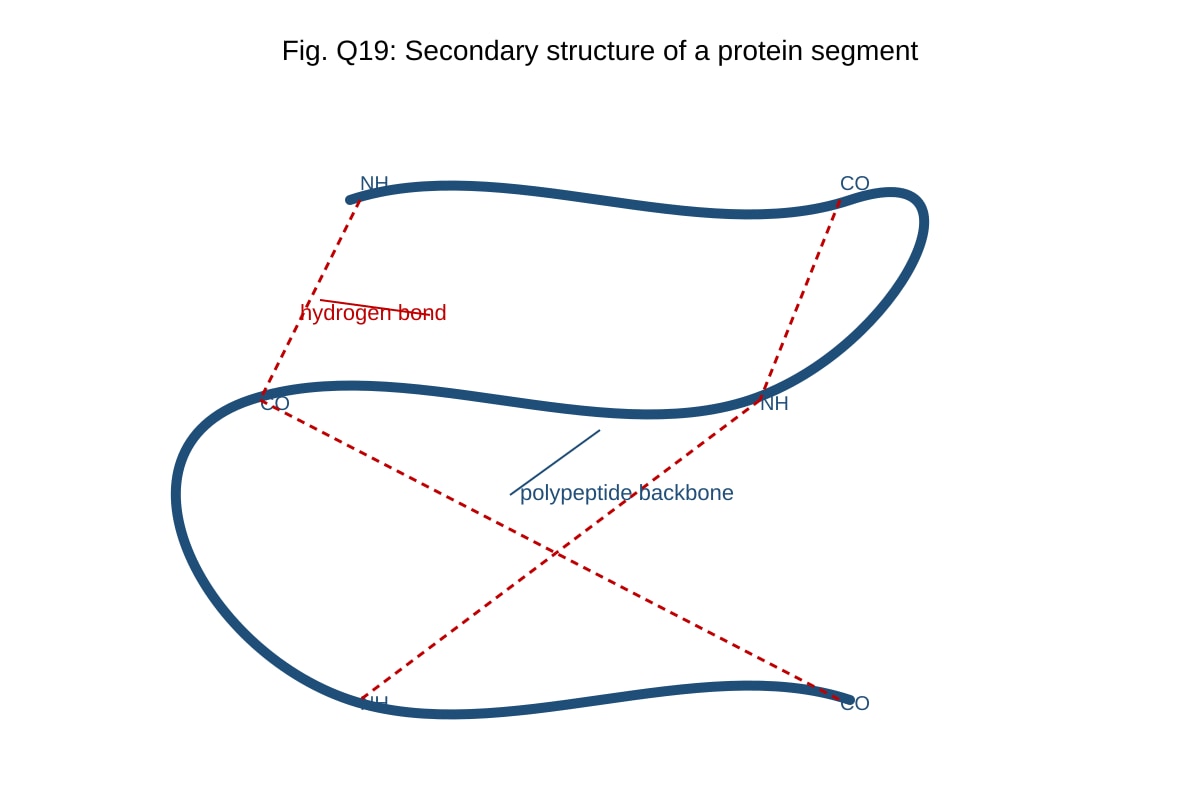
19. [4]
(a) [1] α-helix.
(b) [1] Hydrogen bond.
(c) [2] Between CO of one amino acid and NH of another in backbone. [1] Forms within same chain. [1]
20. [4]
(a) [3] Pyruvate enters mitochondrial matrix directly → Krebs cycle → CO₂ released. [1] Glucose needs glycolysis in cytoplasm first. [1] Isolated mitochondria lack cytosolic enzymes. [1]
(b) [1] Krebs cycle (citric acid cycle).
Section C: Extended Response
21. [6]
- Totipotency: can form all cell types including extra-embryonic. [1]
- Pluripotency: can form all tissue types of body. [1]
- Multipotency: limited to tissue-specific types. [1]
- Embryonic stem cells: differentiate to build all tissues during development. [1]
- Blood stem cells: replace worn-out RBCs, WBCs, platelets. [1]
- Clear linking of term to function. [1]
22. [6]
- Fluid mosaic: phospholipid bilayer with proteins floating. [1]
- Hydrophobic core blocks polar/charged substances. [1]
- Channel/carrier proteins allow facilitated diffusion/active transport. [1]
- Cholesterol modulates fluidity. [1]
- Glycoproteins/glycolipids for recognition. [1]
- Selectively permeable controls entry/exit. [1]
End of Answer Key